Treating Residual Stroke Symptoms at Home
Stroke is a common and serious condition. Although immediate mortality is high, thanks to modern life-saving interventions there are now more survivors. However, survivors often face residual symptoms such as paralysis, speech problems, and difficulties with self-care. Very few are lucky enough to escape without any loss of function. Effective rehabilitation after stroke is essential. You must understand that recovery is a slow process — it can take years to "reclaim" a lost function. In our country the rehabilitation system is far from ideal, so you will mostly depend on yourself and your family. The biggest problems are lack of information and losing your motivation early and giving up continuous practice.
A stroke can change your quality of life forever in a matter of minutes. Some of your physical abilities may even be permanently lost. To avoid this, you must receive the correct treatment and therapy as soon as possible, and once the life‑threat has passed (sometimes as early as the day after the stroke) you must begin rehabilitation.
Medical treatment of stroke
Time is critical in stroke treatment. The sooner you reach a well-equipped emergency center, the better your chance of recovery. Brain cells are very sensitive to lack of oxygen, so the longer the circulation problem or clot persists, the worse the damage becomes.
Medical therapy for stroke consists of life‑saving interventions and usually stabilizes your condition within a few days and you are discharged — even though your arm or leg may not move, you may not be able to speak, you cannot drink a glass of water unaided, and you certainly cannot care for yourself. The situation may seem hopeless.
The direct role of the doctors ends here. From that point you are basically on your own.
The doctors will prescribe some medications. Typically anticoagulants, antihypertensives, and drugs to control blood sugar and cholesterol.
They will also recommend physiotherapy, electrotherapies, speech therapy, etc. But these are not in‑hospital competencies.
This is the task of rehabilitation.
Treating stroke at home
The real work of eliminating the consequences of a stroke usually begins when you are sent home from the hospital. The immediate life‑threat has been addressed, you may have received a few electrotherapy treatments and the physiotherapist may have visited and done some exercises with you.
To understand the extent of the problem: in a stroke a certain area of your brain is destroyed and the functions that area controlled are lost. The consequences depend on which brain region was damaged. You may be unable to move certain muscles or limbs, have language or speech difficulties, or lose control of your bowel or bladder.
The phenomenon of neuroplasticity gives hope for recovery. Another area of the brain can take over the functions of the damaged area. This does not happen "by itself" — it is achieved only through persistent effort and practice: relearning functions.
Rehabilitation professionals help in this process, but the lion’s share of the work falls on you and the family members who assist you.
Stroke rehabilitation is a lengthy process. Improvements can require at least 6–8 months, but more often years of effort. Consider, for example, the case of the actor János Kulka. He admirably informed the public about his difficulties and reported that even years of effort only restored the ability for self‑care. He could not return to the stage or his original work.
Some opinions suggest the brain needs roughly 10,000 repetitions to relearn a movement. That means you must practise a tremendous amount; without that there is no chance of meaningful improvement. Continuous practice is therefore the foundation.
Stroke rehabilitation
Stroke affects tens of thousands of people every year, just in Hungary. The number of rehabilitation beds is only a few hundred and rehabilitation takes months. From this you can immediately calculate that the national rehabilitation system does not provide nearly enough capacity for stroke care — or for many other conditions. There is far less capacity available than needed.
Therefore you must prepare to carry out rehabilitation yourself, at home.
When you return home after a stroke, your general practitioner (GP) is responsible for organizing rehabilitation. The GP coordinates the cooperation of the physiotherapist, physical therapist and other specialists.
The physiotherapist will visit your home and teach you exercises appropriate to your condition. Then you may not see them for weeks, but you must repeat those exercises yourself. They will return and show additional exercises. You must practice not when they are present, but when they have gone! Day after day, increasingly more. Without stopping. If you don't do it, you lose your chance for improvement. No practice — no recovery.
The situation is similar with physical therapy. The specialist can help with 5–10 electrotherapy or other treatments, but these are only a beginning. You should acquire a physical therapy device designed for home use and use it under the therapist’s guidance. Not for 5 days, but possibly for years.
Other specialists, such as speech therapists, play a similar role. They provide information and tasks, but they cannot practice for you.
Consequences of stroke
Residual symptoms depend on which areas of your brain were affected, and their severity depends on how long the bleeding/circulatory disturbance lasted and how severe it was. Consequences can include physical disability or cognitive impairment (damage to perception, attention, memory, calculation, speech and language use, or higher‑order thinking tasks such as learning, decision‑making, planning, problem solving, self‑awareness, etc.).
These changes can develop within minutes and if you survive the first hours they can determine the rest of your life.
Loss of motor ability
If the stroke affects the brain’s motor area, paralysis may result. If it was in the left hemisphere, the muscles on the right side of the body may be paralyzed; if in the right hemisphere, the left side may be affected. Paralysis can be mild, but in severe cases hemiparesis or even hemiplegia (complete one‑sided paralysis) may occur. You may be unable to move muscles of the face, arm or leg. This is because an area of your brain was destroyed during the stroke and can no longer send movement commands to your muscles. Your movement becomes weak, uncertain, poorly coordinated or impossible.
If a muscle does not receive impulses from the brain and does not contract regularly, it quickly loses strength and muscle mass — this is called atrophy. If, having lost motivation, you make no attempt to move the muscles and you do not apply any muscle stimulation, within roughly one and a half to two years the muscles can degenerate into connective tissue “gel”. From there there is no return. Therefore it is very important not to lose motivation and to make continuous efforts, and to use a muscle stimulation device!
After returning home following a stroke, acquire the necessary devices and continue your rehabilitation at home. Continuous practice and functional stimulation result in another area of your brain "relearning" and taking over the lost function.
Ergometers for regaining motor ability
Arm‑ and leg‑driven bicycle ergometers are excellent options for patients recovering from stroke. They can be used to train both the upper and lower limbs.
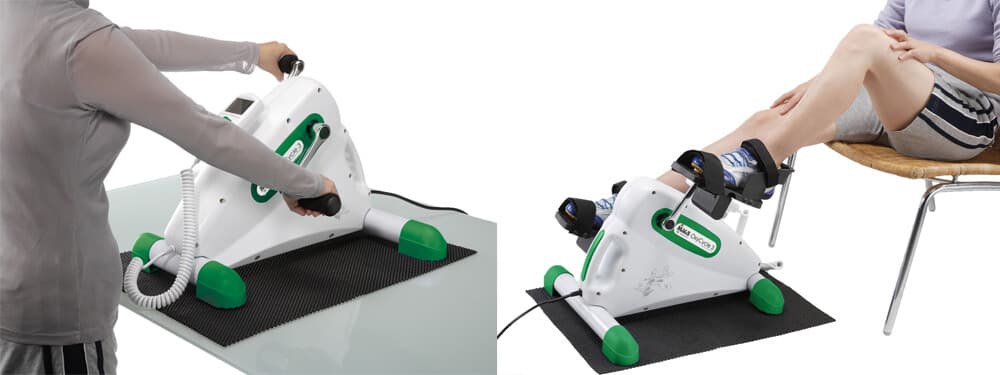
Research has shown that using an arm ergometer or a leg bicycle is beneficial for post‑stroke recovery. They help strengthen the arms and legs and improve cardiovascular health. The ergometer’s resistance is set by the movement therapist according to the patient’s current condition. Proper resistance ensures the effort required is appropriate for the patient.
The purpose of using an arm ergometer is to strengthen arms and legs so the stroke patient can better perform tasks such as eating, dressing and walking.
There are active and passive ergometers. An active ergometer does not rotate "by itself" — it is always driven by the user’s physical strength. With a passive ergometer an "automatic" mode can be set. The ergometer then "pulls" the limb along, assisting the movement — it can even move a completely immobile, paralyzed limb. This assistance is needed when a patient has not yet regained motor ability after the stroke.
Ergometer in stroke rehabilitation
Stroke is one of the leading causes of long‑term disability in adults. One of the most common consequences of stroke is hemiparesis — paralysis affecting muscles on one side of the body. Often the patient cannot walk without help and depends on others. Even activities such as eating, bathing and dressing require assistance. Problems with walking, muscle weakness, spasticity, poor motor control and coordination, balance disturbance and loss of sensation can cause great difficulty for stroke patients. It is recommended that the patient begin specialized physiotherapy as soon as possible after the stroke to retrain the body for proper movement, improve blood flow and maintain muscle strength. Since recovery from stroke can take months or even years, a home ergometer is an important tool in stroke rehabilitation… read more by clicking here!
Coordination disorder
To perform a movement (for example raising a glass to your mouth or standing up from a chair) multiple muscle groups must work together in a coordinated way, and the muscles must contract in a specific sequence for the desired movement to occur.
One of the most important tasks of rehabilitation is to have the patient practise the key activities necessary for self‑care until they can be applied effectively.
Functional muscle stimulators help in this! Studies show the chance of recovery is 15–20 times greater if you use a stimulator in stroke rehabilitation than if you try without one.
So‑called biofeedback devices (for example SineBravo) help you perform the correct movement. They even indicate when an impulse reaches a muscle whose contraction is not yet visible to the eye. Such a device motivates you: yes, the impulse reaches the muscle, but it is still weak. You must repeat the exercise until it becomes stronger — over time the movement itself will occur.
There are more advanced ETS devices as well, for example the DuoBravo. These detect the muscle’s electrical activity and assist the muscle with stimulation. This can significantly accelerate and improve the effectiveness of rehabilitation.
Today one of the most modern devices used in stroke treatment is the Stiwell Med 4. With its extremely precise adjustable stimulation it enables the relearning of lost muscle coordination. Unfortunately this excellent, special device costs roughly the same as a new Suzuki.
Swallowing disorder (dysphagia)
One consequence may be malnutrition. Because of aspiration, saliva, liquids or food can enter the airways, increasing the risk of pneumonia.
The newest solution in swallowing disorder treatment is provided by the Ami Life and Ami Pro stimulators. In Hungary only the Károlyi Hospital in Újpest currently has a single Ami Pro device; other institutions have not yet adopted this new therapeutic option.
Sensory disturbances
Sensory disturbances are also common in the affected area. Regular electrostimulation can improve these problems as well.
Incontinence
If the brain area responsible for bladder and bowel closure is damaged, it can cause inability to hold urine or stool — in other words, incontinence. Pelvic floor muscles can be treated and strengthened with electrotherapy; their function can be improved. Passive muscle stimulation can be suitable for this, but using biofeedback or even better an ETS device to "retrain" the pelvic floor muscles is more effective.
Pain
Pain can have many causes. Circulatory disturbances due to immobility and changes in posture can lead to pain. Central nervous system injuries can cause neuropathic pain — bizarre and unpleasant sensations. TENS or MENS (microcurrent) acting directly on sensory nerve endings can relieve pain, while muscle stimulation affects pain perception by improving local blood circulation.
Painful shoulder (partial dislocation of the shoulder joint)
After a stroke it is common for the muscles that stabilize the shoulder joint to weaken because of lack of movement, and the upper arm bone can be literally pulled out of the shoulder joint by its own weight. This causes extremely severe pain. Strengthening the shoulder muscles with muscle stimulation can eliminate this symptom.
Increasing muscle stiffness
After stroke, muscle stiffness — known as spasticity — is a serious problem that hinders movement and makes practice difficult. Increased muscle tone is caused by disruption or loss of coordination between the brain and the spinal cord. The arm and hand may become fixed in a flexed position and the hand is hard to open (grasping is difficult); elbow extension is slow and painful. The knee may remain bent while the foot tends toward plantar flexion, complicating walking practice. Normal movement is often impossible and painful.
Devices suitable for reducing muscle stiffness include models such as the Elite, Elite 150 and the Premium 400 (and others listed at the link above).
Muscle tone can be reduced with muscle stimulation at the appropriate frequency. Biofeedback is also an excellent aid. You can use it to learn how to relax your muscles.
Cognitive disorders
Attention, memory, concentration, motivation, executive function (planning, initiative, problem solving), spatial vision, etc., can improve with regular use of electrotherapy and biofeedback. The data provided by the devices and the assisted muscle movements improve motivation and determination — which is crucial, because you must repeat exercises thousands of times to restore a lost function.
Balance disorder
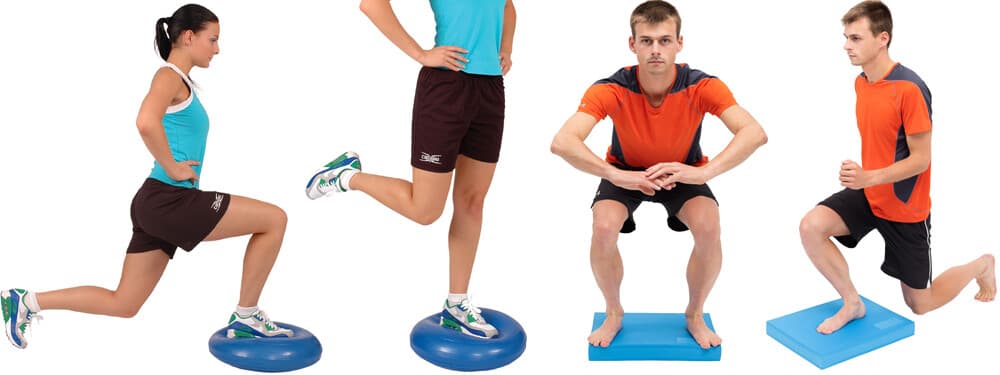
To reduce the risk of falls, special balance training is recommended. This should be started with the help of a physiotherapist. Then you can repeat the learned exercises many times. During exercises a muscle stimulator can also be used simultaneously. Stimulation makes balance training more effective.
Balance training is developed under the guidance of a movement therapist. Balance training tools such as a Balance Pad or Balance trainer can assist.
Other problems
Language disorder (aphasia) can take many forms: comprehension difficulties, word‑finding problems, reading and writing issues, or even complete loss of speech.
Speech problems may appear in voice production, volume, articulation and coordination of speech‑breathing.
Visual disturbances may include double vision, blurred vision, or unilateral loss of visual field (hemianopia). These problems can sometimes resolve on their own after a few months; otherwise glasses or other corrective solutions may be needed.
Among mood disorders, depression is the most problematic. If you lose motivation you just sit or lie around. With assistance you may perform exercises, but you do nothing on your own. As I have mentioned several times, only continuous practice gives hope. Therefore treating depression is very important. However, most antidepressants cause side effects. The Alpha‑Stim AID electrotherapy device may be a solution, offering an alternative equivalent to pharmacotherapy (currently not available in our country, but obtainable abroad).
So you may face a multitude of problems after a stroke. Never forget: with practice and the use of modern devices there is hope for regaining functions! The brain’s capabilities are "limitless." You can teach another area of the brain to take over a lost function. This is a slow process and can take years. But it is worth it!
Click here to purchase the devices mentioned in the article.