
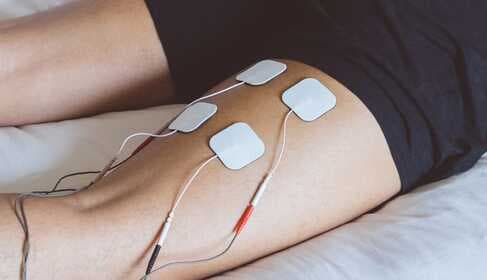

 Why and how do we lose muscle strength?
In this article I summarize how and why muscle atrophy occurs, the timeframes in which muscle loss begins, and how EMS fits into a comprehensive rehabilitation program. The mechanism of EMS stimulation as a method is covered in theoretical basics of muscle stimulation, and its sports applications are discussed in the EMS for athletes article.
 Key point
With prolonged lack of activity, noticeable reductions in muscle mass and strength can occur in as little as 2–3 weeks. Among muscle fiber types, the fast fibers (IIa, IIb/IIx) are lost fastest because their maintenance requires high force production. EMS partially bypasses Henneman's voluntary recruitment order, so with high-frequency (50–80 Hz) programs IIb fibers can be preserved. The 2025 Li meta-analysis (PMID 39811154) found that post-ACL NMES significantly improves quadriceps strength recovery, particularly when introduced early (≤1 week). The 2022 Labanca review (PMID 35256573) showed similar benefits after knee arthroplasty. Core components of full rehabilitation are: movement + physiotherapy + nutrition + EMS.
What causes decreased muscle strength?
Muscle is a use-sensitive tissue: a significant reduction in load triggers a range of catabolic (breakdown) processes within cells. The 2022 Liu et al. animal study (PMID 35484550) showed that immobilization activates autophagy within two weeks — a cell-level "self-cleaning" that leads to muscle fiber thinning. The most common causes are:
Orthopedic surgeries (knee arthroplasty, ACL reconstruction, hip surgery, ankle surgery) typically involve 2–6 weeks of partial or full movement restriction. The 2025 Kaneguchi & Ozawa systematic review (PMID 40685995) reports that muscle atrophy begins even before ACL reconstruction and worsens postoperatively — which is why early introduction of EMS is important.
One to two weeks in an intensive care unit can cause up to 15–30% muscle mass loss (ICU-acquired weakness, ICU-AW). The 2023 Nakanishi meta-analysis (PMID 37232695, 18 RCTs) found that preventive NMES can reduce the incidence of ICU-AW and help preserve muscle strength in critically ill patients. The 2022 Addinsall study (PMID 35502572) also elucidated a cellular mechanism: ES-activated AMPK signaling reduces muscle protein breakdown in critical illness myopathy.
After age 50 there is an average annual muscle mass loss of about 1–2%; after 65 losses exceeding 3% per year can occur. Part of the process is denervation of fast-twitch (IIb) fibers, which are then reinnervated by slower motor neurons — this contributes to age-related slowing of muscle. Regular exercise combined with EMS can significantly slow this process.
For athletes, a 2–3 week training break already leads to noticeable performance decline. This happens because the highly trained muscle "senses" the reduced load and breaks down tissue deemed unnecessary (catabolic reflex). Fast fibers (IIa, IIb) are lost fastest because they require high force to maintain. For a detailed explanation of the Henneman principle see: theoretical basics of muscle stimulation.
Chronic pain (e.g., low back pain, arthritis), persistent weakness, and neurological diseases (stroke, multiple sclerosis) all reduce daily activity and therefore the maintenance load on muscles. In these cases EMS can be particularly valuable when active movement is not possible.
 How does EMS help restore muscle strength?
In traditional exercise, because of Henneman's size principle, small slow (type I) fibers are activated first, and larger fibers are recruited only at higher force outputs (approximately >50% MVC for IIa, >75% MVC for IIb). In rehab settings the patient often cannot produce such high forces — due to pain, a cast, or limited range of motion. This is where EMS helps: by selecting parameters you can target which fiber types are activated even if the patient can only produce weak voluntary contractions.
At the cellular level EMS acts through multiple mechanisms:
- Maintaining muscle metabolism: stimulation activates AMPK signaling, which reduces protein breakdown (down-regulation of atrogin-1, MuRF1), as demonstrated at the cellular level in the Addinsall 2022 study (PMID 35502572).
- Inhibition of autophagy: the 2022 Liu et al. study (PMID 35484550) showed that low-frequency stimulation reduces autophagy in immobilized muscle — mTOR and LC3B-II markers normalized.
- Maintaining microcirculation: repeated contractions move blood and lymph flow, aiding waste removal and nutrient delivery.
- Neuromuscular "rewiring": after surgery or prolonged inactivity movement patterns deteriorate; repetitive EMS helps rebuild neuromuscular pathways.
Notable clinical evidence includes:
| Study | Findings | Indication |
|---|---|---|
| Li 2025 (PMID 39811154) 11 RCTs, n=202 |
NMES significantly improves quadriceps strength compared with conventional physiotherapy — earlier (≤1 week) introduction produced greater improvement | Post-ACL surgery rehab |
| Kaneguchi 2025 (PMID 40685995) Narrative review |
NMES is a key intervention for muscle atrophy after ACL reconstruction; effective when combined with eccentric training and blood flow restriction | ACL surgery |
| Labanca 2022 (PMID 35256573) Systematic review |
NMES is effective for quadriceps strength recovery after TKA, especially in the early postoperative period | Total knee arthroplasty (TKA) |
| Nakanishi 2023 (PMID 37232695) Meta-analysis of 18 RCTs |
NMES reduces the incidence of ICU-acquired weakness in critically ill patients | Intensive care, ICU-AW |
| Liu 2022 (PMID 35484550) Animal experiment |
Low-frequency ES inhibits autophagy and reduces muscle mass loss in immobilization | Mechanism of disuse atrophy |
 EMS protocols in rehabilitation
Rehab EMS protocols depend on the phase and the goal. General guidelines:
| Rehab phase | Frequency (Hz) | Pulse (μs) | Session / weekly frequency | Goal |
|---|---|---|---|---|
| Post-op 0–2 weeks (immobilization) | 1–20 Hz | 200–300 μs | 15–20 minutes / 1–2× daily | Slow atrophy, support microcirculation |
| Strength rebuilding 2–8 weeks | 30–50 Hz | 250–350 μs | 20–25 minutes / 4–5× weekly | General strength (type I + IIa fibers) |
| Functional recovery 6–12 weeks | 50–80 Hz | 300–400 μs | 15–25 minutes / 3–4× weekly | Rebuild IIb fibers, explosiveness |
| Maintenance (after 3+ months) | variable (20–60 Hz) | 250–350 μs | 20 minutes / 2–3× weekly | Long-term muscle mass preservation |
The exact protocol must always be personalized by the treating physician or physiotherapist! In the early postoperative stage (especially after orthopedic surgery) it is forbidden to use EMS parameters that could cause joint stress or tension around the surgical wound. Details: muscle stimulation after surgery.
EMS SHOULD NOT be used alone – a comprehensive recovery approach
Restoring muscle strength is a multimodal process: meaningful results come from combining methods rather than a single intervention. The 2025 Kaneguchi review (PMID 40685995) emphasizes that NMES alone delivers only partial benefit — it must be combined with movement therapy, eccentric training, and nutrition.
- Exercise and physiotherapy: muscle is use-sensitive — without voluntary movement recovery slows. It is worth following a plan created by a physiotherapist.
- Nutrition: muscle building requires protein (about 1.2–1.6 g/kg body weight), adequate calories and vitamin D. Both plant (beans, lentils, peas, tofu) and animal proteins are good — the key is sufficient amount.
- Rest and sleep: muscle building happens during rest, not during training. Aim for 7–9 hours of sleep per night.
- EMS as a supplement: especially valuable when active movement is limited (postoperative casting, pain, critical illness, old age).
- Physical therapy: ultrasound, magnet therapy, low-level laser, cold/heat — all support regeneration. The Suwankanit 2024 study (PMID 38668425) found NMES combined with therapeutic ultrasound particularly effective.
An example rehab protocol: quadriceps strengthening with EMS — a detailed description of post-knee surgery quadriceps rehabilitation.
 Which EMS device is suitable for rehabilitation?
In rehab the main considerations are ease of use, safe built-in programs, reliable electrode contact, and fine control of intensity. Some indicative choices:
| Device | Positioning | Ideal for |
|---|---|---|
| Rehalito | Rehab-focused entry-level | Home rehab, easy handling, basic functions |
| Myolito | EMS entry (HOME) | General strengthening, easy to start |
| Globus Elite 150 | Mid-range (HOME/REHAB) | Regular rehab + sport, multiple protocols |
| Globus Genesy 600 | PRO multifunctional | Complex rehab, with physiotherapist support |
| TensCare UniPro | 4-in-1 (TENS+EMS+MENS+IF) | For those seeking a combination of pain relief + strength restoration |
The full rehab-focused EMS portfolio: muscle strength recovery category. In special situations (central paresis, stroke, denervated muscle) other devices may be indicated: see DuoBravo N (ETS stimulator) and PeroBravo.
 When NOT to use EMS for rehab?
EMS is generally well tolerated, but in some situations home use is not recommended or requires specialist supervision. The full list: electrotherapy contraindications.
- Implanted electronic devices (pacemaker, ICD) – details: article on implants
- During the bleeding phase of an acute muscle, tendon or ligament injury (a 3–4 day waiting period is recommended)
- Fresh surgical wound in the treatment area – always start only with treating physician permission
- Acute deep vein thrombosis, recent vascular inflammation
- Active or unknown tumor in the treated region
- Epilepsy – specialist consultation required
- Acute fever, infectious condition
- Dermatitis, open wounds in the treatment area
- Pregnancy (lower abdominal, lumbar region)
- The anterior triangle of the neck (carotid line) – electrode prohibition
 Summary – what to take away?
- With prolonged inactivity, measurable muscle mass and strength loss can appear within 2–3 weeks; fast fibers (IIa, IIb) are lost first.
- At the cellular level immobilization triggers autophagy and AMPK signaling changes (Liu 2022, Addinsall 2022).
- EMS partially overrides the Henneman principle: at high frequency IIb fibers can be targeted — even if the patient cannot produce 75% MVC.
- Strong clinical evidence: ACL surgery (Li 2025, Kaneguchi 2025), TKA (Labanca 2022), ICU (Nakanishi 2023) — all show improved quadriceps strength recovery.
- Rehab protocol phases: 1–20 Hz for immobilization, 30–50 Hz for general strength, 50–80 Hz for functional recovery, maintenance 20–60 Hz.
- EMS does NOT work alone: exercise, physiotherapy, nutrition, rest and, when needed, physical therapy are also required.
Entry-level rehab pick: Rehalito – designed specifically for rehab, easy to use. Mid-range: Myolito or Globus Elite 150. PRO multifunctional: Globus Genesy 600. For stroke rehab with ETS function: DuoBravo N.
Frequently Asked Questions
Always based on the decision of the treating physician or physiotherapist. The 2025 Li meta-analysis (PMID 39811154) found that early (≤1 week) NMES introduction in ACL rehab produced greater quadriceps strength improvement than delayed. For some orthopedic surgeries (e.g., fracture fixation) the patient may begin muscle-maintaining stimulation after a 3–4 day "bleeding" window, but always avoiding the surgical wound and, if present, metal implants.
No. The 2025 Kaneguchi review (PMID 40685995) stresses that NMES is one tool in ACL rehab but does not replace active movement therapy, eccentric training or proprioceptive (balance) exercises. EMS is most valuable when the patient has limited access to active movement (early postoperative stage, pain, ICU). Combined approaches consistently produce better results in clinical trials.
In rehab settings improvement (strength and size) can be noticeable after 2–4 weeks of regular use. Full strength recovery depends on surgery type — after ACL reconstruction full rehab may take 6–9 months, and strength deficits can persist up to a year (Kaneguchi 2025). Consistency is critical: muscle is use-sensitive, so 3–5 sessions per week is the minimum for meaningful adaptation.
Yes. NMES is well-documented to help preserve muscle mass in age-related sarcopenia, especially in mobility-limited older patients. The treatment protocol should be designed by a geriatrician, physiotherapist or sports physician. EMS does not replace movement — but for those with limited walking ability it is a valuable adjunct.
EMS can be useful in post-stroke rehab, but in cases of central paresis devices with ETS function (EMG-Triggered Stimulation) such as DuoBravo N are specifically recommended. These trigger stimulation in response to the patient's own voluntary EMG attempts, supporting neuroplasticity and relearning of motor patterns. Device selection and protocol should always be supervised by a neurologist or rehabilitation physician.
The protocol depends on the rehab phase. Early postoperative (immobilization): 1–2× daily for 15–20 minutes at low frequency. Strength rebuilding: 4–5× weekly for 20–25 minutes at medium frequency. Functional recovery: 3–4× weekly for 15–25 minutes at high frequency. A muscle group needs 24–48 hours to recover between repeated intense stimulations.
Related articles
- EMS "overview" – electrical muscle stimulation
- NMES in rehab and sport
- Muscle wasting (atrophy) – disease-based spoke
- Muscle stimulation after surgery
- Theoretical basics of muscle stimulation – Henneman principle
- EMS for sport – performance and recovery
- Quadriceps strengthening with EMS
- Interview with sports physiotherapist Gréta Hepp
- Muscle strength recovery category
- Electrotherapy contraindications
 Scientific sources (2020+)
- Li Z, Jin L, Chen Z, Shang Z, Geng Y, Tian S, Dong J. Effects of Neuromuscular Electrical Stimulation on Quadriceps Femoris Muscle Strength and Knee Joint Function in Patients After ACL Surgery: A Systematic Review and Meta-analysis of Randomized Controlled Trials. Orthop J Sports Med. 2025 Jan 13;13(1):23259671241275071. DOI: 10.1177/23259671241275071 · PMID: 39811154
- Kaneguchi A, Ozawa J. Muscle atrophy following anterior cruciate ligament reconstruction: A narrative review. Histol Histopathol. 2025;41(2):183-193. DOI: 10.14670/HH-18-963 · PMID: 40685995
- Nakanishi N, Yoshihiro S, Kawamura Y, et al. Effect of Neuromuscular Electrical Stimulation in Patients With Critical Illness: An Updated Systematic Review and Meta-Analysis of Randomized Controlled Trials. Crit Care Med. 2023 Oct;51(10):1386-1396. DOI: 10.1097/CCM.0000000000005941 · PMID: 37232695
- Liu AY, Zhang QB, Zhu HL, Xiong YW, Wang F, Huang PP, Xu QY, Zhong HZ, Wang H, Zhou Y. Low-frequency electrical stimulation alleviates immobilization-evoked disuse muscle atrophy by repressing autophagy in skeletal muscle of rabbits. BMC Musculoskelet Disord. 2022 Apr 28;23(1):398. DOI: 10.1186/s12891-022-05350-5 · PMID: 35484550
- Labanca L, Bonsanto F, Raffa D, Orlandi Magli A, Benedetti MG. Does adding neuromuscular electrical stimulation to rehabilitation following total knee arthroplasty lead to a better quadriceps muscle strength recovery? A systematic review. Int J Rehabil Res. 2022;45(2):118-125. DOI: 10.1097/MRR.0000000000000525 · PMID: 35256573
This article provides general information and does not replace specialist, physiotherapist or treating physician consultation. Personalization of a rehabilitation EMS program must be performed by the treating physician or physiotherapist. For postoperative, acute injury or chronic disease contexts, home EMS use should be discussed in advance. EMS devices are CE/MDR-certified medical devices — use according to the user manual is recommended.

