
Practical Use of a Muscle Stimulation Device
The treatment performed with a muscle stimulation device is electrical muscle stimulation (EMS = electrical muscle stimulation). It is a method suitable for treating voluntarily controlled, so-called striated (skeletal) muscles and does not affect the viscera (intestines, internal organs). You can apply it to any muscle that lies close to the body surface and to which you can deliver an electrical impulse directly. For deeper-layer muscles it is therefore less applicable. In this article I explain the general rules of application so that you can successfully use it on almost any muscle of your body.
The electrical impulses generated by the device reach the so-called motor point of the muscle through the electrodes. The motor point is where the motor nerve reaches the muscle.
The electrical impulse triggers a series of contractions in the muscle. You will perceive this as twitching, and this produces the effect — relaxation of the muscle, improved blood circulation, increased strength — depending on the settings of the treatment program.
Watch my short video about the simple use of a muscle stimulator or scroll down for detailed information.
Preparations for stimulation
For the treatment you will need a device suitable for muscle stimulation (EMS). (Many people mistakenly think that a TENS device is also good for muscle treatment — they are wrong!)
At the end of this chapter you will find some suggestions for muscle stimulation devices.
How many channels you need depends on the size of the muscle you want to treat. The larger the treatment area, the more channels are required. If only one side of your neck hurts, a 1 channel device is sufficient. If you need to treat both thigh muscles, you will need 4 channels.
Each channel requires one stimulating cable and 2 self-adhesive electrodes. On the limbs you can use rubber electrodes with fastening straps instead of adhesive tens pads. So if you want 4-channel treatment, you need 4 cables and 8 electrodes. Prepare these!
You can connect the cable to the device; the other end (which splits and terminates in pin-like metal connectors or snaps) is where you attach the electrodes.
Stimulation cables may be different colors. It does not matter which color cable you plug into which socket on the device. The colors only help you easily identify the two ends of the cable.
The current flows between the two ends of the cable with the same color and this will create the muscle contraction. It follows that both electrodes must be on the same muscle (this also determines that larger — longer — muscles can be treated with muscle stimulation).
Applying the electrodes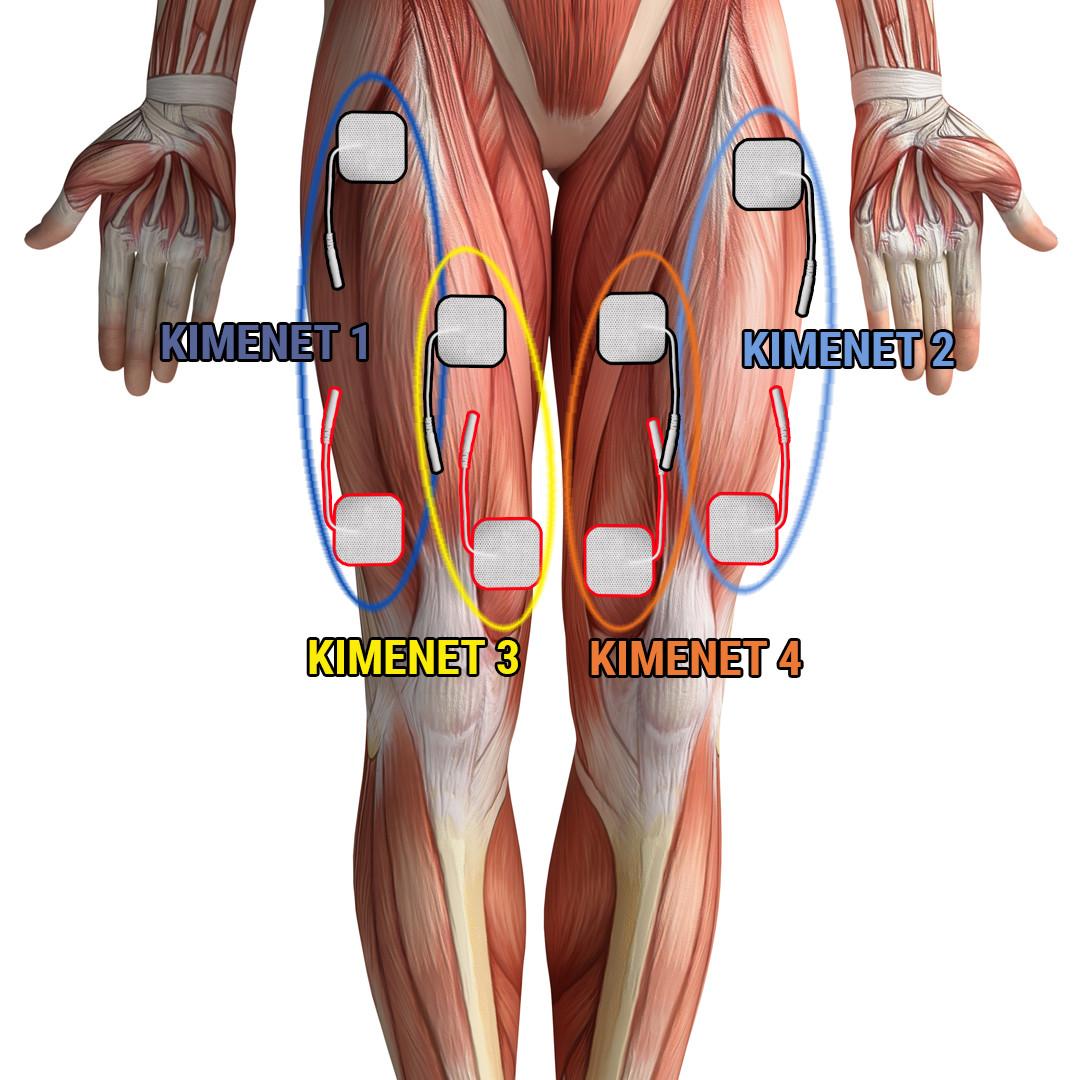
Once you have prepared, connected the device, cables and electrodes, the next step is to stick the electrodes onto the muscle to be treated. It is best if you have previously washed your skin with lukewarm soapy water and dried it. The greasier, dirtier or sweatier your skin, the shorter the lifespan of the electrode's adhesive.
Electrode placement is important for effective muscle stimulation. When you first try a muscle stimulator you may feel uncertain. But do not be afraid — even incorrectly placed electrodes cannot cause injury, at worst they simply won't activate your muscles.
The electrodes should be placed so that the electrical impulse reaches the neuromuscular junction, which then transmits the contraction signal to the muscle. For this you should consider:
- Both electrodes must be completely on the same muscle or muscle group;
- They should align with the direction of the muscle fibers (not across them);
- One electrode should be placed close to the muscle origin;
- The other electrode should be placed in the middle of the muscle mass (because motor end plates are densest there).
- The electrode placed higher up should preferably be twice the size of the more distal electrode.
Modern muscle stimulators use rectangular, symmetric waveforms. Therefore there is no point in worrying about which electrode is positive and which is negative. In the two phases of the waveform the direction of the current reverses. Thus at times one electrode is positive and at times the other is.
Electrode placement diagrams in books often mark positive and negative poles. That is because some medical therapeutic applications use asymmetric waveforms that rely on electrode polarity. For muscle stimulation, however, there is no difference.
Regarding polarity marking there is another "convention" that labels the active electrode as positive and the inactive one as negative. These can indicate relative sizes of the electrodes. It is useful if the positive (active) electrode is smaller so the current can be concentrated and reach deeper into the muscle structure.
Some muscle groups (for example the biceps, triceps and forearm muscles) are stimulated with electrodes of identical size for ease of use. However, if there is space, the passive electrode should be twice the size of the active one. For example on the thigh, the active electrode near the knee could be 5×5 cm, while the passive electrode in the middle of the thigh 5×9 or 5×10 cm.
The most important basic rule concerning placement is that both electrodes connected to the same stimulating cable must be located on the same muscle. If you want to treat your forearm flexor, both electrodes must be on that muscle. (There is no situation where you place one electrode on your ear and the other on your toe and all your muscles "exercise"!)
Beyond the point where the muscle continues into tendon there are no nerve endings. Tense the muscle you want to treat and palpate it! Determine how far it remains "soft" and where it becomes tendon. Place the electrodes only on the muscle.
High-quality devices include diagrams showing electrode placement. If you follow these, you cannot go far wrong. But feel free to experiment! Move one electrode a few millimeters right-left, up-down and observe the effect. You will soon discover the most effective point.
An imaginary line connecting the electrode pair should follow the direction of the muscle fibers. This is usually parallel to the muscle's pull direction. If you place the electrodes across the fibers, the muscle will twitch and you may feel cramp-like pain. This is because the current leaving the electrodes forms a closed circuit on the muscle and may hit several nerves at once.
Follow the direction of the muscle fibers! If the circuit is correctly closed, the electrical current meets less resistance. This is important to maintain a strong contraction and also improves your comfort.
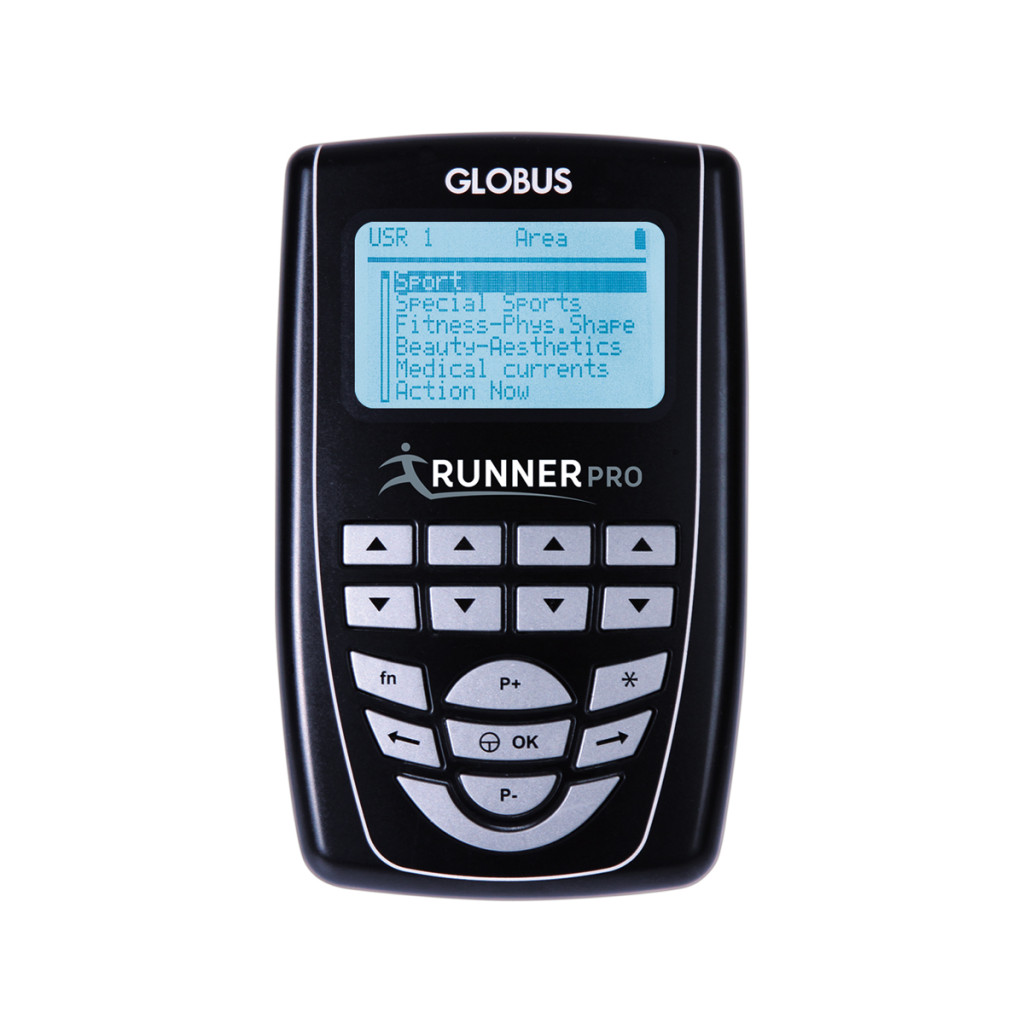
Runner Pro EMS device – muscle stimulation for sport and rehabilitation
A professional EMS device for runners and athletes. 30 pre-programmed treatments for muscle strengthening, regeneration and pain relief. Ideal for post-injury rehabilitation and performance enhancement.
Selecting the treatment program
Many people think that every muscle stimulator produces the same effect. They are wrong!
The effect of muscle stimulation is mainly determined by
- the quality of the device (the more precise the device produces the impulse, the less painful the treatment and the better its effect on the muscles)
- the treatment program settings (primarily the frequency, pulse duration and the current intensity values).
So you must choose the treatment program according to your goal!
If your muscles are stiff, run "relaxation, stiffness-relief" or "circulation-improving" programs. Avoid all "strengthening" programs because these will increase stiffness.
If your muscle strength has diminished, for example due to prolonged illness, injury or surgery, you first need to regain "endurance strength." The "stiffness relief", "muscle mass increase" or "maximum strength" programs are not suitable for this. Those can be used later, once your baseline strength has been restored.
If you have never used a muscle stimulator before, choose a stiffness-relief or circulation-enhancing program for the first trials. These produce gentle twitches and help you understand how stimulation works. If you start immediately with a maximal strength program, it can be painful, frightening, and you may get serious muscle soreness after only a few minutes of treatment.
How to regain lost muscle strength in 12 weeks
Treatment program plan for 12 weeks
This is a general, gradually progressive program for regaining lost muscle strength. It can be applied to any muscle group. Pay attention to proper electrode placement.
Week 1
A = Stiffness relief
B = Endurance strength
Week 1
A = Stiffness relief
B = Endurance strength
A = Stiffness relief
B = Endurance strength
| Week 1 | Mon | Tue | Wed | Thu | Fri | Sat | Sun |
| A | X | X | X | X | X | X | X |
| B | X | X | X | X |
Weeks 2–3
C = Stiffness relief
D = Endurance strength
E = Max. force exertion
C = Stiffness relief
D = Endurance strength
E = Max. force exertion
| Weeks 2 – 3 | Mon | Tue | Wed | Thu | Fri | Sat | Sun |
| C | X | X | X | X | |||
| D | X | X | X | X | X | X | X |
| E | X | X |
Weeks 4 – 12
F = Endurance strength
G = Max. force exertion
F = Endurance strength
G = Max. force exertion
| Weeks 4 – 12 | Mon | Tue | Wed | Thu | Fri | Sat | Sun |
| F | X | X | X | X | X | X | X |
| G | X | X | X |
Mon=Monday, Tue=Tuesday, Wed=Wednesday, Thu=Thursday, Fri=Friday, Sat=Saturday, Sun=Sunday
Setting the intensity
When you start the treatment program you will initially feel nothing. To have an effect you must increase the current intensity.
On your device look for + and – buttons. Each channel has its own. The + button increases the current strength and the – decreases it.
Everyone feels the current differently and reacts differently. You will feel different even on different days. That is why the device always starts from zero. You must find the correct value yourself.
If you increase the intensity step by step you will gradually feel fine twitches in your muscles. These weak contractions have no effect yet, so you need to increase the intensity further.
The higher the intensity, the stronger the contraction you will experience and the stronger the effect will be.
Beyond a certain (individual) value the treatment becomes painful. Then reduce a few mA! The higher the current strength, the more uncomfortable the treatment can be. Pain is caused by the voltage passing through the skin.
For muscle-relaxing, stiffness-relief and circulation-enhancing treatments the intensity should be moderate. You should feel definite contractions, but these should not be uncomfortable or painful!
For muscle-strengthening treatments stimulate at the upper level of your comfort zone. Try to find the current strength you can no longer tolerate and then reduce it by a few milliamps (with the – button).
Using too low a current strength in muscle stimulation is a mistake! If you do not feel definite contractions, the treatment has no effect.
After the treatment
When the treatment time is over the program finishes and the impulses stop.
Turn off the device and carefully remove the electrodes from your skin one after the other — do not pull them off by the cable — and immediately put them back onto the plastic backing.
Tip: If you store the electrodes in the refrigerator (not the freezer!) the adhesive life will be prolonged.
How much time is needed?
Muscle strengthening results from stimulation, but not directly from electricity — it is the many muscle contractions it triggers that produce the effect!
Your body — similar to gym training — senses that you regularly put the muscles to work. Your body reacts to the load. If it senses that greater muscle strength is needed, it signals the hormonal system to increase the amount of muscle-building hormones. Under their influence the muscle cells begin to be "built": slowly more and stronger muscle fibers develop.
This does not happen in one day. You should not expect anything from a single treatment (nor from the usual 10 sessions in a clinic).
Muscle stimulation treatment produces results only with a minimum of 8–12 weeks of daily treatments. 1–2 sessions per week have no meaningful effect.
Progression is important! In the first week you must accustom your muscles to stimulation; from the second week you receive increasingly frequent and stronger treatments, and after the basics are established you move into the real strengthening phase.
By the end of the third to fourth week you will feel that the treated muscles are firmer, but they are not yet "finished".
Do not stop after three months either, because without regular contractions the muscles will lose strength again.
From this point you can switch to conventional exercise/training. This way you can maintain your muscle condition and use stimulation only as a supplement for improving regeneration and circulation.

