
 What is sinusitis?
Sinusitis is inflammation of the mucous membrane of the paranasal sinuses – also called sinuses. The paranasal sinuses are air-filled cavities in the skull bones that connect to the nasal cavity. There are four pairs of these cavities: the frontal sinuses (above the eyebrows), the maxillary sinuses (behind the cheekbones), the ethmoid air cells (between the eyes) and the sphenoid sinus (behind the nose, deeper).
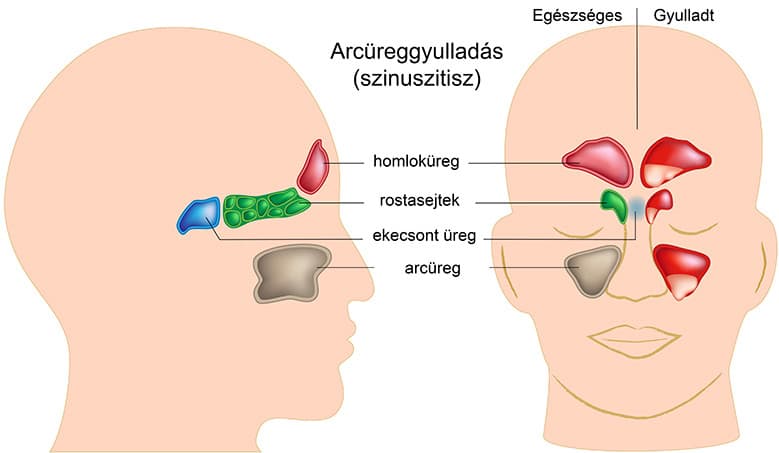
Normally these cavities are filled with air and lined with a thin mucous membrane that produces mucus. This mucus drains continuously through an opening (ostium) between the sinus and the nasal cavity and helps clear invading pathogens and debris.
Problems start when these openings become blocked. Then mucus cannot drain, accumulates in the cavities, and creates an ideal environment for bacteria. The mucosa swells and becomes inflamed – and the characteristic symptoms appear.
 Key point
Sinusitis can be simply described: think of it like a drain. If the drain is clear, water flows away. But if it gets clogged, water pools, becomes foul and bacteria multiply. The same thing happens in the paranasal sinuses in sinusitis.
Types of sinusitis
Sinusitis has several forms, and the type influences the treatment.
Acute sinusitis usually develops after a cold or influenza and lasts less than 4 weeks. Symptoms appear suddenly and with appropriate treatment they usually resolve within a few days to weeks. Most cases are viral in origin, but a secondary bacterial infection can occur.
Subacute sinusitis lasts 4–12 weeks. It represents a transition between the acute and chronic forms.
Chronic sinusitis (chronic rhinosinusitis, CRS) is inflammation that persists for more than 12 weeks. This is a more serious problem that can significantly reduce quality of life. The chronic form can occur with nasal polyps (CRSwNP) or without nasal polyps (CRSsNP).
Recurrent (recurrent) acute sinusitis means four or more acute episodes per year with symptom-free intervals between episodes.
Symptoms of sinusitis
The symptoms of sinusitis are characteristic, although their severity varies between individuals.
Nasal congestion and discharge are the most common complaints. The nose is blocked, breathing is difficult, and thick, often yellowish-green discharge is present. Mucus can drip backward into the throat (postnasal drip), causing coughing and throat irritation.
Facial pain and pressure are typical: a pressing, squeezing pain corresponding to the affected sinus. With maxillary sinus inflammation the pain is felt above the cheeks and around the teeth, with frontal sinusitis around the forehead and eyebrows, and with ethmoid involvement between the eyes and at the nasal root.
Headache often accompanies sinusitis and typically worsens when leaning forward.
Reduced or lost sense of smell is also common, especially in chronic cases.
General symptoms – fatigue, malaise, low-grade fever – can also occur, particularly in acute cases.
 How is sinusitis treated?
Treatment of sinusitis depends on the type and severity.
In acute, viral cases symptomatic treatment is primary: nasal drops (decongestants), painkillers, antipyretics, and – the topic of this article – nasal irrigation with saline.
If bacterial superinfection is suspected (symptoms lasting more than 10 days, high fever, severe symptoms), a physician may prescribe antibiotics.
Treatment of chronic sinusitis is more complex: inhaled nasal steroids, regular nasal irrigation, and in severe cases surgical intervention (FESS – functional endoscopic sinus surgery) may be required.
This is where salt therapy comes in as an effective complementary method – useful in both acute and chronic cases.
The salt therapy in sinusitis primarily means nasal irrigation with saline. It is one of the oldest and simplest methods for cleaning the paranasal sinuses – used for millennia in Ayurvedic medicine.
Osmotic dilution of secretions
Hypertonic (stronger) saline has an osmotic effect: it draws water from the swollen mucosa, thereby reducing swelling and diluting thick secretions. This facilitates drainage from the sinuses. In addition, nasal irrigation physically washes out thick mucus, allergens, pathogens and inflammatory mediators from the nasal cavity and paranasal sinuses.
Anti-inflammatory effect
Research indicates that hypertonic saline can directly reduce inflammatory processes in the mucosa. Alongside mechanical cleansing, the osmotic effect helps remove inflammatory mediators.
Improvement of mucociliary clearance
The nasal cavity is lined with tiny cilia that move mucus outward in wave-like motions. Saline stimulates their function, improving the natural self-cleaning mechanism. This effect is important in preventing recurrent infections.
 What does the scientific research say?
Nasal irrigation with saline is one of the best-researched complementary methods in the treatment of sinusitis. I summarize the main results below.
2020 meta-analysis – Hypertonic vs. isotonic saline
The meta-analysis by Liu et al. pooled 7 randomized trials comparing hypertonic vs. isotonic saline in chronic rhinosinusitis. The results were convincing: hypertonic saline was significantly more effective than isotonic saline in reducing nasal discharge (SMD = 1.52), relieving nasal congestion (SMD = 1.52), reducing headache (SMD = 0.82), and improving overall symptoms (SMD = 1.63). Mucociliary clearance time also improved significantly in the hypertonic group.5
2016 Cochrane systematic review
The systematic review evaluated the effectiveness of nasal irrigation in chronic rhinosinusitis. The authors concluded that saline irrigation is "well tolerated" and that the benefits "appear to outweigh the harms for most patients." The review recommended saline irrigation "as an adjunctive treatment for symptoms of chronic rhinosinusitis."6
2022 systematic review – Optimal methods
Kanjanawasee et al. analyzed 69 trials on the optimal nasal saline treatment methods for various sinonasal diseases. The researchers found that larger-volume irrigation (≥60 ml) is more effective in adults, while lower volumes (5–59 ml) are sufficient in children. The study highlighted that nasal irrigation is effective in allergic rhinitis as well as acute and chronic rhinosinusitis.7
2003 Russian study – Halotherapy in acute sinusitis
Lopatin et al. specifically examined the effect of halotherapy in acute purulent sinusitis. The researchers treated 45 patients with halotherapy and found that "halotherapy proved effective in treating acute purulent maxillary sinusitis without puncture." This is noteworthy because sinus puncture was previously the standard treatment for these cases.8
Effect of salt therapy on sinusitis symptoms
In practice, patients with sinusitis report the following effects from regular salt therapy.
Relief of nasal congestion is one of the most commonly mentioned changes. Saline irrigation washes out thick mucus, reduces mucosal swelling and makes nasal breathing easier. Many report immediate relief and easier breathing after irrigation.
Reduction of pressure headache and facial pain is also common. When mucus drains from the sinuses, pressure sensations decrease. The meta-analysis found that hypertonic saline significantly reduced headache (SMD = 0.82).
Decrease in the amount and viscosity of discharge is characteristic as well. Initially, after the first irrigations more mucus may come out – this is normal and indicates that accumulated secretions are being flushed. After a few days the amount and thickness of discharge decrease.
Improvement in smell is an important consideration in chronic cases. If the nasal cavities are cleared and inflammation decreases, olfactory receptor cells function better.
 Different salt therapy methods in sinusitis
Several salt therapy methods can be used for sinusitis.
| Method | Description | Effectiveness |
|---|---|---|
| Nasal irrigation | Passing a larger volume (60–240 ml) of saline through the nasal cavity and sinuses. Devices: neti pot, nasal rinse bottle, electric nasal irrigator. | High – best-researched method |
| Nasal spray | Delivers smaller amounts of saline into the nasal cavity. More practical for daily use. | Moderate – less effective than irrigation |
| Halotherapy | Delivers salt particles into the air, which reach the airways. Salt room or salt cave. | High for acute purulent sinusitis |
| Home salt therapy devices | Produce salt aerosol (e.g., SaltDome). Ideal for nighttime use. | Moderate–high – as a complementary method |
Technique of nasal irrigation
If you want to try nasal irrigation, here is the correct technique.
Step one: Preparing the saline. Use distilled, sterile, or boiled (then cooled) water – never use tap water directly! Pathogens in tap water can cause serious infections. Saline concentration: for isotonic solution use 9 g salt (about 1 heaped teaspoon) per 1 liter of water; for hypertonic solution use 20–30 g salt per 1 liter of water. You can also use ready-made irrigation solutions available at pharmacies.
Step two: Correct temperature. The solution should be lukewarm, body-temperature (about 37°C). Water that is too cold or too hot can be uncomfortable.
Step three: Proper posture. Lean forward over the sink and tilt your head slightly to one side. Place the tip of the irrigation device into one nostril and gently pour the solution in. The fluid will flow through the nasal cavity and out the other nostril (or mouth).
Step four: Repetition. Rinse both nostrils, then blow your nose gently – but not too hard, as this can create pressure waves in the sinuses.
 My tip
Start with isotonic solution, and if you tolerate it well, switch to hypertonic. Perform irrigation 1–2 times daily, preferably morning and evening.
 Home salt therapy with the SaltDome device
In addition to nasal irrigation, home salt therapy devices can help relieve sinusitis symptoms.
The SaltDome ultrasonic salt therapy device emits salt particles of 2–5 microns into the air. According to Semmelweis University, particles between 0.5–5 microns reach the upper and lower airways – including the paranasal sinuses.
The device is best placed in the bedroom and set for nighttime use. While you sleep, the device continuously produces salty air that passes through the nasal cavity and, with inhalation, into the sinuses.
Important note
A home device does not replace nasal irrigation, it complements it! The best results are achieved by combining the two: irrigation washes out mucus and the salt therapy device maintains the beneficial effect.
The role of salt therapy in the treatment of sinusitis
Let me emphasize: salt therapy is a complementary treatment for sinusitis. It does not replace physician-prescribed medications, especially antibiotics in bacterial infection.
The 2016 Cochrane review also highlights that nasal irrigation "can be used as an adjunctive treatment." The keyword is: adjunct.
Think of sinusitis treatment as a triangle. One side is drug therapy (nasal drops, painkillers, antibiotics when needed). The second side is physical measures (nasal irrigation, salt therapy). The third side is lifestyle factors (humidity, fluid intake, rest). All three sides are important – if one is missing the structure becomes unstable.
Salt therapy can be particularly useful for those who suffer frequent recurrent sinusitis, have chronic rhinosinusitis, want to reduce medication use (under medical supervision), or seek natural preventive methods.
 Before you start treatment
Nasal irrigation and salt therapy are generally safe, but there are some important considerations.
- Using tap water directly for nasal irrigation – The amoeba Naegleria fowleri present in tap water can cause severe, even fatal, brain infection. Use distilled, sterile, or at least boiled (then cooled) water.
- Nasal polyp or severe deviated septum – Consult your doctor before starting nasal irrigation. These conditions can affect the effectiveness and safety of irrigation.
- Active nosebleed – Do not perform nasal irrigation. Wait until bleeding has completely stopped.
- Fresh facial/skull fracture – Nasal irrigation may be risky.
After surgery (FESS)
After surgery (e.g., after FESS) your doctor will tell you when and how to begin nasal irrigation. Irrigation is an important part of postoperative rehabilitation – a 2024 meta-analysis confirmed its effectiveness. If symptoms do not improve within 7–10 days or worsen, consult a physician. Salt therapy does not replace medical care.
 Possible side effects
Side effects of nasal irrigation and salt therapy are generally mild and temporary.
Nasal irritation and a burning sensation may occur, especially with hypertonic solution or on the first uses. If this is bothersome, reduce the concentration or switch to isotonic solution.
Nosebleeds are rare but can occur, especially in dry winter conditions or if the mucosa is already irritated.
Tinnitus or a feeling of ear fullness may occur if fluid enters the Eustachian tube. This can be avoided by not blowing your nose too hard after irrigation and by not irrigating with a completely blocked nose.
The 2020 meta-analysis found that hypertonic saline is associated with "mild side effects."
Practical tips for sinusitis
If you have sinusitis and start salt therapy, here are some practical tips.
Combine methods
Nasal irrigation + home salt therapy device + humidification together are more effective than any single measure alone.
Regularity is key. Perform nasal irrigation 1–2 times daily, and not only when you have symptoms. For prevention continue during symptom-free periods as well.
Pay attention to humidity. Dry air irritates the nasal mucosa and thickens secretions. Use a humidifier in the bedroom in winter.
Drink enough fluids. Proper hydration thins secretions and helps their clearance.
Avoid irritants. Cigarette smoke, strong perfumes, and chlorinated pools all irritate the nasal mucosa and worsen sinusitis.
Use steam inhalation. Hot steam (e.g., steam bath, leaning over a bowl of hot water) helps thin secretions and relieve congestion. Combined with salt therapy it can be even more effective.
Frequently Asked Questions
Start with isotonic solution (9 g salt / 1 liter water). If well tolerated and you have chronic sinusitis, switch to hypertonic solution (20–30 g salt / 1 liter water). Meta-analysis shows hypertonic is more effective.
For acute sinusitis 2–3 times daily. For chronic cases or prevention 1–2 times daily. Regularity is more important than a single intensive irrigation.
Yes, but use lower volumes (5–60 ml) and gentler pressure in children. For small children nasal sprays or drops may be more practical.
NO! The amoeba Naegleria fowleri in tap water can cause severe infection. Use distilled, sterile, or at least boiled (then cooled) water.
If symptoms do not improve within 7–10 days, if high fever develops, severe headache or facial swelling occurs, or vision disturbance or double vision appears. These may indicate serious complications.
Yes. The 2003 Russian study confirmed halotherapy's effectiveness in acute purulent sinusitis. A salt room can complement but not replace nasal irrigation.
 Detailed guides by condition
If you're interested in a specific disease or condition, read our detailed guides, where we present salt therapy options supported by scientific research:


Sources
- Harvey RJ, et al. (2007). Nasal saline irrigations for the symptoms of chronic rhinosinusitis. Cochrane Database of Systematic Reviews, (3):CD006394. PubMed: 17636843
- Elkins MR, Bye PTP. (2011). Mechanisms and applications of hypertonic saline. Journal of the Royal Society of Medicine, 104(S2):S2-5.
- Talbot AR, et al. (1997). Mucociliary clearance and buffered hypertonic saline solution. Laryngoscope, 107(4):500-503.
- Rabago D, et al. (2002). Efficacy of daily hypertonic saline nasal irrigation among patients with sinusitis: a randomized controlled trial. Journal of Family Practice, 51(12):1049-55.
- Liu L, et al. (2020). Efficacy of nasal irrigation with hypertonic saline on chronic rhinosinusitis: systematic review and meta-analysis. Brazilian Journal of Otorhinolaryngology, 86(5):639-646. PubMed: 32534983
- Chong LY, et al. (2016). Saline irrigation for chronic rhinosinusitis. Cochrane Database of Systematic Reviews, 4(4):CD011995. PubMed: 27115216
- Kanjanawasee D, et al. (2022). Optimal Device and Regimen of Nasal Saline Treatment for Sinonasal Diseases: Systematic Review. American Journal of Rhinology & Allergy, 36(3):368-379. PMC: 9201324
- Lopatin AS, et al. (2003). Halotherapy in combined non-puncture therapy of patients with acute purulent maxillary sinusitis. Vestnik Otorinolaringologii, (4):42-44. PubMed: 13677023
- Khan MA, et al. (2015). The role of non-medicamental technologies in the rehabilitation of the children presenting with acute rhinosinusitis. Voprosy Kurortologii, Fizioterapii i Lechebnoi Fizicheskoi Kultury, 92(4):36-40. PubMed: 26595967
- Szabó K, et al. (2021). Salt Therapy as a Complementary Method for the Treatment of Respiratory Tract Diseases. Alternative Therapies in Health and Medicine. PubMed: 34726628
- Semmelweis University, Department of Otorhinolaryngology and Head-Neck Surgery. Effects of salt therapy. semmelweis.hu
- Atik B, et al. (2024). Evaluating the efficacy of nasal irrigation in postoperative functional endoscopic sinus surgery patients: a systematic review and meta-analysis. European Archives of Oto-Rhino-Laryngology. PubMed: 38492009
The information in this article is for guidance only. Salt therapy is intended as a complement to medical treatment for sinusitis, not a replacement. If symptoms do not improve within 7–10 days, worsen, or if high fever, severe headache, facial swelling or visual disturbance occur, seek medical attention immediately. Never use tap water directly for nasal irrigation – use only distilled, sterile or boiled (then cooled) water.