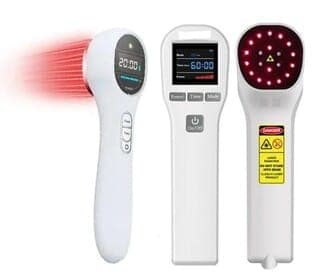

 Why am I writing about soft laser scams?
As a doctor and medical technology retailer, I see the other side of the market every day: “miracle lasers” advertised on social media, containing LEDs that emit only a few milliwatts, impressive “total power” figures, and disappointed buyers who treat themselves for months with a device that is physically incapable of delivering an effective dose. They then draw the conclusion: “soft lasers don’t work”.
Yet the situation is exactly the opposite: soft laser therapy (photobiomodulation), when used with the right wavelength and dose, is a research-supported method – in most cases, the reason for ineffectiveness is not the technology but the wrong device or incorrect dosing.2, 3 I wrote this article to help you identify the two most common scams BEFORE buying – an LED lamp falsely presented as a laser and the “shower laser” total-power trick – and to show you how to check any device using six questions.
 Key idea
Ask for three figures for every device: the exact wavelength (in nanometres), the power per diode (in milliwatts) and the available dose (in J/cm²). Anyone who gives you “total power”, “laser technology” or ranges instead either doesn’t understand their own product or doesn’t want you to understand it. Either is reason enough to move on.
 The language of laser therapy: three figures that determine everything
The wavelength of light determines how deeply it penetrates the tissues. The red range (630–660 nm) reaches 1–2 cm deep – it is suitable for skin problems, mucous membranes and superficial wounds. Near-infrared light (780–860 nm, typically 808–830 nm) reaches 2–4 cm deep – this is needed for joints, tendons and muscles. That is why it matters whether the device states an EXACT wavelength (e.g. 808 nm) or merely says “red light”: effective therapy requires a known wavelength suited to the target tissue. I have described the detailed background in the soft laser therapy guide.
Power (mW) determines how long it takes to deliver the required amount of energy. Let’s calculate it: if you want to deliver 5 joules of energy to one treatment point, a 500 mW laser takes 10 seconds, while a 200 mW laser takes 25 seconds. With a 5 mW LED, the same dose takes more than 16 minutes, and with a 1 mW LED, 83 minutes – PER POINT. For the 6–8 treatment points of a knee joint, treatment with a weak LED lamp would take several hours a day – which is why there is no effect even when the light theoretically has the right wavelength. The question is not whether it emits light – but whether it can deliver the dose in a reasonable time.
The true unit of therapy is not the watt but the energy delivered per unit area: joules per square centimetre (J/cm²). The recommendations of the international laser therapy society (WALT) prescribe a few joules per point – less for superficial targets and more for deep tissue. And this is where the twist comes in, described in research as a bell-shaped curve: too little dose is ineffective, the right dose supports cell function, but too much inhibits it.2 In other words, neither a low-power LED lamp nor the attitude of “the longer I apply it, the better” leads to the desired result – a predictable, known dose does. A review of studies on tendon problems confirmed exactly this: favourable results were achieved where the recommended doses were used.3
 Scam 1: an LED lamp sold as a “laser”
The advertisement says “laser”, but inside the box there are LEDs producing only a few milliwatts. These are physically different:
| LED | Diode laser | |
|---|---|---|
| Light beam | Divergent, non-coherent | Parallel (collimated), coherent |
| Wavelength | ~20–30 nm wide band | Single, precisely defined value (±1–2 nm) |
| Typical power | 1–5 mW per diode | 200–500 mW per diode |
| Penetration | Superficial layers | Up to 2–4 cm, depending on wavelength |
| Dose | Difficult or impossible to calculate | Can be calculated and timed precisely |
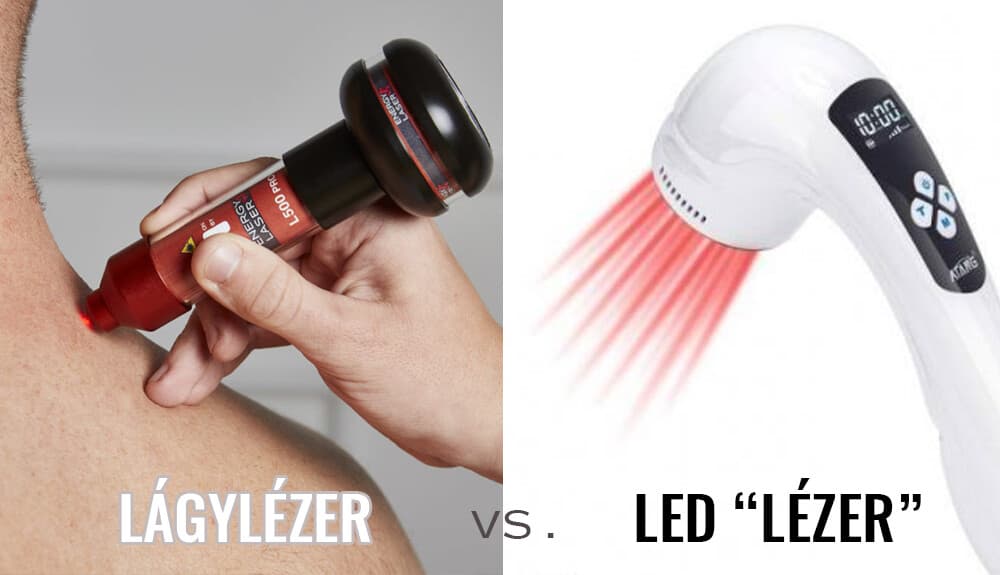
For the sake of fairness, let’s also state the scientific position: red and infrared LED light does have a photobiomodulation effect – according to researchers, the effect depends primarily on the delivered dose, not on the coherence of the light, and LED devices have their own advantages (large treatment area, safety and low price).1 So the scam is NOT that someone sells an LED device – it is selling a lamp with a few milliwatts as a “laser” at a laser price, with claims for deep-tissue indications (joint, spine, tendon) that the LED light cannot even reach, and dose promises that could only be fulfilled with several hours of daily use. An LED lamp is not a laser – and anyone calling it one is already misleading you on the label.
Scam 2: the “shower laser” and the total-power trick
The other classic is the multi-diode “showerhead” device with an impressive total-power figure: “12×5 mW red + 3×150 mW infrared = 510 mW total power!” The maths is correct, but the physics is not. A given point on your tissue does not receive the “total power”; it receives the light from the ONE diode positioned directly above it. In the example device, this is either a 5 mW red diode (effectively decorative lighting) or, at best, a 150 mW infrared diode. The 510 mW figure on the box serves marketing purposes only.
The recipe is tried and tested: an anonymous eastern device costing a few tens of thousands of forints gets a new brand name, a “professional” website and a few made-up expert endorsements – and is then advertised at an astronomical “special offer” price, typically as suitable for everything from back pain to diabetes. The protection is simple: ask for the power and wavelength of each diode. If all you get in reply is the total power, you know everything you need to know.
 Before buying: the six-question checklist
| Question | Good answer | Warning sign |
|---|---|---|
| 1. Does it have CE/MDR medical device certification? | Certification for the specific model, available for inspection | “Of course, it’s CE-marked” – but no paperwork (the CE mark alone may indicate only electronic conformity) |
| 2. How many diodes, and how many mW per diode? | Precise data, e.g. “1×400 mW” | Only “total power” |
| 3. What is the exact wavelength? | Specific value, e.g. 808 nm | Range, “red light” or a mixture |
| 4. Can the dose (J/cm²) be calculated? | Known spot size + power + recommended treatment time | No dose data, only suggested minutes |
| 5. Who is the manufacturer, and is local service available? | Identifiable manufacturer, accessible service and spare parts | An anonymous device sold under several names in several online shops |
| 6. What is it claimed to be for? | Specific indications, treatment protocols and realistic expectations | “Good for everything” – from wrinkles to chronic diseases |
 My advice
Reverse the order in which you buy. Don’t start by looking for a device. First clarify your complaint and the treatment depth it requires: superficial problem (skin, mucous membrane) → the red range is sufficient; joint, tendon or spine → infrared light around 800 nm and at least a few hundred mW are needed. Then all you need to do is use the checklist above to verify whether the device you are considering can really deliver this. And before you buy anything, read the contraindications too – even a good device is not suitable for everyone.
Devices that pass the checklist
I mention only devices with an identifiable manufacturer, medical device certification and documented technical specifications. Here are three typical examples for different needs:
B-Cure Laser Classic
A Class 1, 808 nm, pulsed device with a large treatment surface – a safe introduction to laser therapy that does not require protective eyewear, for superficial and medium-depth targets.
Personal-Laser L400
A 400 mW, 808 nm, Class 3B diode laser – suitable for deep-tissue targets (joint, tendon and spine), with short, point-based treatments. Power and dose are precisely documented.
Energy-Laser L500 Pro
A 500 mW, 808 nm professional home-use device with built-in programmes – a sensible choice if you want to treat several body areas regularly and are looking for the shortest treatment time.
You can find the full range – with technical data and comparisons – in the soft laser device category; for guidance on how to use them for different complaints, see the soft laser home-use guide.
 When should you NOT use a soft laser?
- Exposure of the eyes to light – laser light must never be directed into the eyes; Class 3B devices require protective eyewear
- Cancer or a suspected tumour – treatment only with the approval of the treating doctor
- Pregnancy – treatment of the abdominal and lower-back area should be avoided; all other treatment only after medical consultation
- Direct treatment of the thyroid – the area over the gland must be avoided
- Taking medicines that cause photosensitivity – consult your doctor first
 The full list
I have collected the detailed safety information and all contraindications in a separate article: soft laser contraindications and safety information. Read it before buying – and if a complaint has not been medically clarified, always see a doctor first, then start home treatment.
Frequently asked questions
Not necessarily – just use it for the right purpose. Red and infrared LED light also has a biological effect described in research, mainly on superficial targets: skin problems, supporting wound healing and treating larger areas.1 What it is not suitable for: deep-tissue targets (joint, tendon and spine) and any indication requiring a calculated dose. If you bought it for that purpose, unfortunately you were sold a device that is not suitable for your complaint.
Less than we used to think – according to researchers, the main determinants are the dose delivered to the tissue and the wavelength, not the coherence of the light.1 The real practical advantage of a laser lies elsewhere: its high, precisely known power and parallel beam make it possible to deliver a deep-tissue dose predictably within seconds or minutes. With a low-power LED, the problem is not the lack of coherence – it is that the dose cannot be delivered in a reasonable time.
It is a safety classification, not a quality ranking. A Class 1 device (e.g. B-Cure) is designed to be safe for the eyes when used as intended – it is safe at home without protective eyewear. A Class 3B device (typically 200–500 mW devices) is stronger and intended for deep-tissue treatment – in return, eye protection and responsible use are mandatory. The choice depends on the purpose: superficial treatment and safety → Class 1; deep tissue and a short treatment time → Class 3B, with the rules followed.
Because it does not exist from the perspective of the treated point. A given point on your tissue is always illuminated by the one diode positioned above it – the other diodes’ light falls elsewhere. A “510 mW total power” showerhead therefore delivers, at each point, no more than the power of its strongest diode. The only figures that make your treatment genuinely predictable are the power per diode and its corresponding wavelength.
Ask for the declaration of conformity or certificate and check what it covers. The CE mark alone may indicate only electronic conformity (like on a hairdryer) – a medical device becomes one through certification under the MDR (EU Regulation 2017/745), with a specific model designation and intended purpose. A serious distributor will show this without hesitation; if someone avoids the request, the CE mark is probably just a sticker.
 What does the research say?
“So does LED work too, or only lasers?”
According to a review of the field, the effects of photobiomodulation depend mainly on wavelength and delivered dose – non-coherent light sources (LEDs) also have a real effect and their own advantages: large treatment area, safety and low price.1 The practical difference lies in power: deep-tissue doses require laser diodes in the hundreds-of-milliwatts range – a low-power LED lamp could deliver the same dose only over several hours. So the deception is not LED technology but the false label and impossible promise.
“How do we know that the effect depends on the dose?”
An analysis of 25 controlled studies on tendon problems found exactly this: half of the studies produced favourable results and half did not – and the dividing line was dosing. Where doses based on the international (WALT) recommendations were used, favourable results were consistently achieved: measurably greater grip strength in tennis elbow and less pain in Achilles tendon problems.3 The same technology – it works with the right dose and not with the wrong one.
“If I use a higher dose, will it work faster?”
Exactly the opposite. According to research, the dose-response curve of phototherapy is bell-shaped (the Arndt–Schulz rule): a low dose stimulates cellular energy production and repair functions, the effect peaks as the dose increases, then reverses – too much energy inhibits the process.2 That is why “stronger = better” is not a valid argument, and why you need to follow the recommended treatment time for every device – here, more literally produces less.
 Summary – Quick overview
Read more
Scientific sources
- Heiskanen V, Hamblin MR (2018). Photobiomodulation: lasers vs. light emitting diodes?. Photochemical & Photobiological Sciences, 17(8), 1003–1017. DOI: 10.1039/c8pp90049c
- Huang YY, Chen ACH, Carroll JD, Hamblin MR (2009). Biphasic dose response in low level light therapy. Dose-Response, 7(4), 358–383. DOI: 10.2203/dose-response.09-027.Hamblin
- Tumilty S, Munn J, McDonough S, Hurley DA, Basford JR, Baxter GD (2010). Low level laser treatment of tendinopathy: a systematic review with meta-analysis. Photomedicine and Laser Surgery, 28(1), 3–16. DOI: 10.1089/pho.2008.2470