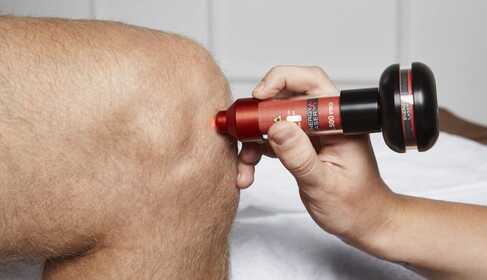

 Soft laser therapy: how does it work, and what determines its effect?
Soft laser therapy – scientifically known as photobiomodulation (PBM) – uses low-energy red or infrared laser light. It does not cut or burn, but supports cell function. The method has Hungarian roots: in the 1960s, Professor Endre Mester was the first to observe at Semmelweis University that low-dose laser light accelerates wound healing. His experiments helped photobiomodulation develop into a research field that now includes thousands of scientific publications.2
This article is the “soft laser handbook”: it shows what happens inside cells, and above all, WHAT DETERMINES the effect. Laser therapy is not a matter of belief, but of physics: the wavelength, power and dose determine whether the light reaches the target tissue and transfers enough energy to it. If you understand these three parameters, you can choose a device well and treat effectively.
 Key point
With laser therapy, the main question is not “does it work?”, but “are you using it with the right parameters?” Research has confirmed a biphasic dose–response relationship: too little energy has no effect, the optimal range produces a biological response, while an excessive dose may weaken it.4 The same applies to wavelength: light with an unsuitable wavelength does not even reach the deep target tissue.3 Much of the conflicting results seen in studies can be traced precisely to this – the wrong dose and protocol.
 What happens in the tissues?
The main absorber of red and near-infrared light in the cell is an enzyme in the mitochondrial respiratory chain (cytochrome c oxidase). When this molecule absorbs light energy, the cell’s energy production (ATP synthesis) increases, signalling processes begin and the production of growth factors rises. In this way, the cells of “depleted”, damaged or inflamed tissue gain functional reserves.2
The tissue-level effects documented include improved microcirculation, reduced prolonged inflammation, support for collagen production and tissue rebuilding, and an increased threshold of pain-sensing nerve endings – which is why pain decreases.12 It is important to be realistic: laser light affects LOCAL tissue processes. It does not treat systemic causes of disease, such as metabolic disease.
Tissues are most permeable to light in the wavelength range of 600-1100 nm. The literature calls this the “optical or biological window”.3 Within this range, the wavelength determines the penetration depth: 660 nm red light reaches roughly 1-2 cm (skin, mucous membranes and superficial tissues), 808 nm infrared light reaches 3-4 cm (muscles, tendons and small to medium-sized joints), while the 980-1064 nm range reaches deeper than 4-5 cm (hip, spine and deep muscle layers).
In practice, this means that a red-light device is suitable for a superficial target (wound, herpes, acne), while infrared light is suitable for deeper targets (joint, spine). The reverse does not work: no matter how powerful the red lamp is, it will never reach the hip joint.
One of the most important research findings in photobiomodulation is the biphasic dose–response curve: the biological response is strongest within an optimal energy range. Below it there is no meaningful effect, while well above it the effect decreases and may even turn into inhibition.4 This is why “more is better” is not true, and why it is not enough to “shine light on” a painful area occasionally.
We measure the dose in J/cm², and the optimum varies by target area: 1-4 J/cm² for superficial wounds, 4-10 J/cm² for joint and muscle complaints, and 8-12 J/cm² for deep tissues are the usual ranges. A good device calculates this for you in its table or programme. Your task is consistency: in research, results always came from a COURSE of treatment (daily or several times weekly, over several weeks), not from a single session.15
 The three parameters that determine the effect
| Parameter | What does it mean? | Practical guidance |
|---|---|---|
| Wavelength (nm) | The “colour” of the light – this determines the penetration depth3 | 660 nm (red): skin, mucous membranes, 1-2 cm 808 nm (infrared): muscles, joints, 3-4 cm 980-1064 nm: deep tissues, 4-5+ cm |
| Power (mW) | Energy delivered per second – this determines the treatment TIME | home-use devices: 50-500 mW professional devices: 500-12 000 mW; higher power does not necessarily mean a “stronger effect”, but a shorter treatment time for the same dose |
| Dose (J/cm²) | The total energy delivered to the target tissue – this determines the biological response4 | superficial wound: 1-4 J/cm² joint, muscle: 4-10 J/cm² deep tissue: 8-12 J/cm²; as a course, daily or several times weekly |
Treatment technique can be of two types:
with point treatment, you place the device head on a specific point (pain point, joint space or acupuncture point) for the calculated time. This is the method for deeper targets;
with scanning treatment, you move the device slowly and evenly over a larger area. This is the method for wounds, skin areas and muscle groups. The two techniques can be combined: treat the points first, then scan the area.
 Laser classes: safety and power
Lasers are divided into safety classes. For home use, Class 1 and Class 3B are relevant:
| Class | Characteristics | Examples |
|---|---|---|
| Class 1 | The safest category: the light is spread over a larger area at lower intensity, so protective eyewear is not required. Practical for family use, including around children | B-Cure Laser family |
| Class 3B | More concentrated beam and a higher dose per point in a shorter time. Protective eyewear is mandatory during treatment, and the beam must never be directed towards the eyes | Personal-Laser and Energy-Laser families |
| Class 4 | High-power professional category. It requires a trained operator and is intended for clinical and veterinary settings | PhysioLaser, LaserVet families |
One common misunderstanding needs clearing up: the class is a SAFETY classification, not a quality ranking.
A Class 1 device is not “weaker” in its therapeutic effect. It delivers the same dose, simply spread over a larger area and over a longer time.
The real question when choosing is the depth of the target and your comfort. And one warning: many LED lamps marketed as “lasers” are sold on the market even though they do not produce coherent laser light. I wrote a separate article about the difference and the scams.
 My advice
Before buying a device, ask yourself three questions: WHAT is your target (superficial or deep – this determines the wavelength), HOW MUCH time do you have each day for treatment (this determines the required power), and WHO will use it (family, an elderly parent – this supports choosing Class 1). The most common mistake is not choosing the wrong device, but having the wrong expectation: laser therapy is a course of treatment. Anyone judging it after two weeks of daily treatment is judging too soon, while anyone expecting a miracle from one session a week is using the wrong dose.45
Proven devices from two different power classes
B-Cure Laser SPORT Pro (Class 1)
Large 4.5 cm² treatment surface, usable without protective eyewear. Suitable for every member of the family and for comfortable treatment of larger areas. Treatment of 4.5cm2 takes 5 minutes.
Personal-Laser L400 (Class 3B)
808 nm infrared, 400 mW. For point treatment of deeper targets (joints, spine and muscles), with a short treatment time per point. Treatment of 5cm2 takes 1 minute. Worth considering where a large area or several joints need to be treated.
The full range – filterable by class and power – is available in the soft laser devices category. The home-use guide can help you choose a device suited to your complaint.
 When should you NOT use it?
- Cancer in the treatment area – the laser must not be used over a known or suspected lesion
- Pregnancy – the abdomen and lower back must not be treated
- Thyroid area – direct treatment of the front of the neck should be avoided
- Acute infection with fever – seek medical care first; the laser may only be used afterwards as a supplement
- Site of a recent steroid injection – wait several weeks before treating the area after a cortisone injection
- Photosensitivity or photosensitising medicines – consult your doctor or pharmacist before starting
 The full list is in a separate article
The list above highlights the most important restrictions. You can find the complete, detailed and explained list (eye protection, epilepsy, treatment of children, tattoos and more) in the article on soft laser contraindications. Read it before treatment. Five minutes is worth your safety.
Frequently asked questions
It depends on the complaint, but the rule of thumb is that the first signs (less pain and easier movement) usually appear after 10-14 days of daily or several-times-weekly treatment. A 4-6-week course is needed for the full effect. Acute complaints (a recent injury, herpes or an aphtha) respond more quickly, sometimes within days, while chronic complaints that have been present for years respond more slowly. The consistent message from research is that regular treatment produces the result15. It is worth keeping a diary or taking a weekly photograph, because daily impressions do not show gradual improvement.
Treatment is painless. At most, you may feel slight, pleasant warmth in the treated area. According to research, soft laser therapy is one of the safest physiotherapy methods: studies have not reported any meaningful side effects.15 Two rules must be followed: never direct the beam into the eyes (protective eyewear is mandatory for Class 3B), and take the contraindications seriously. Occasionally, the complaint may temporarily feel more pronounced the day after treatment. This is usually a sign of increased circulation and disappears within 1-2 days.
Generally, yes. Laser therapy does not interact with medicines in the same way that two medicines can interact with each other. Pay attention to two exceptions: medicines that cause photosensitivity (some antibiotics, anti-inflammatory medicines and dermatological products – ask your pharmacist), and the site of a recent cortisone injection, which must not be treated with a laser for several weeks. In fact, several studies found that painkiller doses could be reduced during a course of laser treatment. Always decide this together with your doctor and never change your medicines on your own.
It is not the same. A genuine laser produces a coherent, single-wavelength, parallel beam of light. This allows accurate dose calculation and deeper penetration. LED light is diffuse and has a broad spectrum. It has documented effects in superficial applications (skin and wounds), but laser is the established tool for deep tissues. Unfortunately, many LED products are sold as “lasers” with unrealistic claims. The article on laser-buying scams explains how to recognise them.
The target and your circumstances decide. Class 1 (B-Cure family) is suitable for family use, older users or people who are less comfortable with technology, larger areas, and situations where protective eyewear is not desired. Class 3B (Personal-Laser, Energy-Laser) is suitable for deeper targets (hip and spine), point treatment and shorter treatment times. Both classes work according to the same principle, and the dose rule4 applies to both. The complaint table in the home-use guide can help you choose the right device.
 What does the research say? Answers to readers’ questions
“Is this really science, or just a fashionable wellness tool?”12
Photobiomodulation is now a field documented by thousands of publications in major medical databases. A 2025 umbrella review – a meta-analysis of meta-analyses and the highest level of evidence – found significant pain reduction and functional improvement for several indications, while also showing where better-quality research is still needed.1 The cellular mechanism (mitochondrial light absorption, ATP production and signalling) has also been studied in detail.2 For a balanced view, it is important to note that the strength of evidence differs between indications. This is why we prepared a separate evidence map showing what research says about each complaint.
“I tried it and felt nothing. Why?”34
The most common reasons are not found in the method itself, but in the parameters. The first suspect is wavelength: treating a deep joint with a red-light device is physically impossible because the light does not reach the target.3 The second is dose: because of the biphasic dose–response curve, a treatment that is too short has no effect, while an overdose given on a “just to be safe” basis may also worsen the result.4 The third is time: research results were achieved after courses lasting several weeks. A few trial sessions are not meaningful. If there is still no change after a proper protocol, that is useful information: another method or medical review may be needed.
“Can a home-use device do what a clinic device does?”56
Research has examined this question. A systematic review of home-use photobiomodulation devices found that treatment performed at home several times a week produced favourable and safe results for most of the indications studied. The authors noted that home treatment makes it possible to achieve the TREATMENT FREQUENCY that clinic visits rarely allow.5 Research in athletes supports the same conclusion: regular treatment scheduled around training produced measurable additional recovery.6 A clinic device delivers a higher dose in an individual session. The strength of a home-use device is that it can be repeated every day. The two do not exclude each other; they complement each other.
Summary
What is this article? The “user manual” for soft laser therapy: how light acts in cells, what wavelength, power and dose mean, what the laser classes are, and how to choose a device based on these factors, together with the safety rules.
Who is it for? People who are just getting to know laser therapy and are looking for reliable foundations, as well as people who already have a device but want to use it more precisely.
Main message: The effect of laser therapy depends on physics. Wavelength determines whether the light reaches the target tissue, while dose determines whether a biological response begins. Because of the biphasic dose rule, neither too little nor too much works. If you understand the parameters and treat as a course, you will obtain the results measured in research.
Next step: Check the home-use guide to see what research says about your complaint, review the contraindications, and choose a device with a wavelength suited to the depth of the target.
Read more
Scientific sources
- Son Y, Paton CM. (2025). The efficacy of photobiomodulation therapy: an umbrella review of systematic reviews and meta-analyses. Systematic Reviews. DOI: 10.1186/s13643-025-02902-3
- Glass GE. (2021). Photobiomodulation: the clinical applications of low-level light therapy. Aesthetic Surgery Journal. DOI: 10.1093/asj/sjab025
- Zein R, Selting W, Hamblin MR. (2018). Review of light parameters and photobiomodulation efficacy: dive into complexity. Journal of Biomedical Optics. DOI: 10.1117/1.JBO.23.12.120901
- Huang YY, Chen ACH, Carroll JD, Hamblin MR. (2009). Biphasic dose response in low level light therapy. Dose-Response. DOI: 10.2203/dose-response.09-027.Hamblin
- Gavish L, Houreld NN. (2019). Therapeutic efficacy of home-use photobiomodulation devices: a systematic literature review. Photobiomodulation, Photomedicine, and Laser Surgery. DOI: 10.1089/photob.2018.4512
- Lawrence J, Sorra K. (2024). Photobiomodulation in sports medicine. Journal of Functional Morphology and Kinesiology. DOI: 10.3390/jfmk9040181