What complaints can it be used as an adjunct treatment for?
For muscle, tendon or ligament complaints, photobiomodulation can be part of complementary rehabilitation. The Sport Pro is lightweight, portable and easy to use alongside training programs.
For fresh injuries, fractures, complete tears and other urgent conditions must first be excluded. The soft laser does not replace diagnosis, offloading or gradual return to load.
Tennis elbow, Achilles tendon overload, rotator cuff tendinopathies and other insertional pains often recur when load and recovery are not balanced.
The Sport Pro can be used for regular adjunct treatment of the affected tendon segment and surrounding soft tissues. Optimal results require offloading, progressive strengthening and an appropriate exercise program.
Soft laser treatment is often used as a complementary therapy for joint overload, wear and pain in the soft tissues around the joint.
The device does not restore worn cartilage and does not replace strengthening or physiotherapy. The goal is adjunct pain relief and functional improvement as part of a therapy plan tailored to the complaint's cause.
After surgery, pain, swelling, restricted motion and loss of muscle strength can all hinder recovery. Photobiomodulation can be a complementary tool in rehabilitation.
Start treatment only according to the wound and surgical site status and with approval from the treating physician or physiotherapist. The soft laser does not replace wound checks or gradual mobilization therapy.
Plantar fascia overload is common in runners, jumping sports and prolonged standing. The pain on first steps in the morning can be a typical symptom.
The soft laser does not remove a bony heel spur. The aim of treatment is adjunct relief of pain and irritation in surrounding soft tissues, alongside load modification and foot arch rehabilitation.
Low back and neck pain can be due to muscle and joint overload, disc-related changes, nerve involvement and other causes. Persistent or radiating pain requires initial investigation.
With an appropriate diagnosis, the Sport Pro can be used as an adjunct treatment for paraspinal muscles and other painful soft tissue areas.
Is the B-Cure Laser Sport Pro right for you?
It can be a good choice if
you exercise regularly and seek a portable device as adjunct treatment for recurrent muscle, tendon or joint complaints.
Particularly practical if
you value simple use without goggles and want shorter treatment times than the B-Cure Classic.
Useful during rehabilitation,
if you use the device regularly alongside physiotherapy and progressive loading.
Not for you if
you need ultra-fast, few-seconds point treatments. For that, a higher-power point laser is more suitable.
Also not ideal if
you want to treat a very large surface at once. Large joints and extensive muscle areas may require multiple treatment positions.
Frequently asked questions
The Sport Pro is a pulsed laser. The 250 mW value is the maximum pulse peak power, not the continuous average power. The device delivers 5 Joules per minute, so this figure better reflects the real treatment speed.
Not with intended use. The device is Class 1. Nevertheless, do not intentionally direct the light-emitting aperture into the eye or look into it from close range.
Manufacturer materials list a typical treatment time of 4.5 minutes per treatment area. Exact time depends on the problem, treatment location and application protocol.
Individual response varies. Acute and chronic complaints progress at different rates. Persistent problems may require regular treatment over several weeks. If symptoms worsen, new symptoms appear or there is no meaningful improvement, seek medical review.
Photobiomodulation has been studied in athletes in relation to training, but optimal timing depends on the goal and load. In cases of injury or pain, treatment does not replace load modification and is not intended to mask symptoms that prevent safe return.
Both devices are 808 nm, pulsed, Class 1 soft lasers. The Sport Pro delivers 5 Joules per minute while the Classic operates at roughly 4.2 Joules/min. The Sport Pro's advantage is primarily shorter treatment time and a kit tailored for sporty, frequent use.
Not necessarily. Photobiomodulation is dose-dependent, so both too little and too much energy can be unfavorable. Choose treatment time and frequency based on manufacturer and condition-specific guidance, not by feeling.
 What does photobiomodulation mean?
During soft laser treatment, tissues are exposed to light of a specific wavelength and dose. This process is called photobiomodulation (PBM).
Light interacts with cellular light-absorbing molecules and can influence several biological processes. Research has investigated effects on cellular energy metabolism, local inflammatory signaling and regenerative processes.
The B-Cure Laser Sport Pro operates in pulsed mode. The 250 mW figure refers to peak pulse power, while the device delivers 5 Joules per minute. Therefore, when selecting treatment time consider the actual energy delivered and follow the manufacturer's guidance.
Pulse mode alone does not prove greater penetration depth or superior effect. Therapeutic outcome depends on wavelength, dose, treatment area, duration and the underlying condition together.
Which B-Cure model suits you?
B-Cure Laser Classic
– suitable if you want a simple, more affordable home device and don't mind a somewhat longer treatment time.
B-Cure Laser Sport Pro
– more practical if you train regularly, use the device often and value higher per-minute energy output and shorter treatments.
How to use it in four simple steps
1
Choose the treatment area and time
Based on the treatment guide for the specific complaint, determine device placement and required treatment time. The timer adjusts in 30-second increments.
2
Place directly on the skin
Treat on clean, dry skin. Clothing, dressings and other coverings reduce the amount of light reaching the skin.
3
Hold steadily until the end of treatment
Place the applicator head on the marked area and keep it still. The timer signals the end of treatment with an audible alert.
4
Repeat according to the treatment plan
The required frequency and course length depend on the complaint. Do not automatically apply longer or more frequent treatments for every problem. Follow the manufacturer's and condition-specific guidance.
What’s in the package?
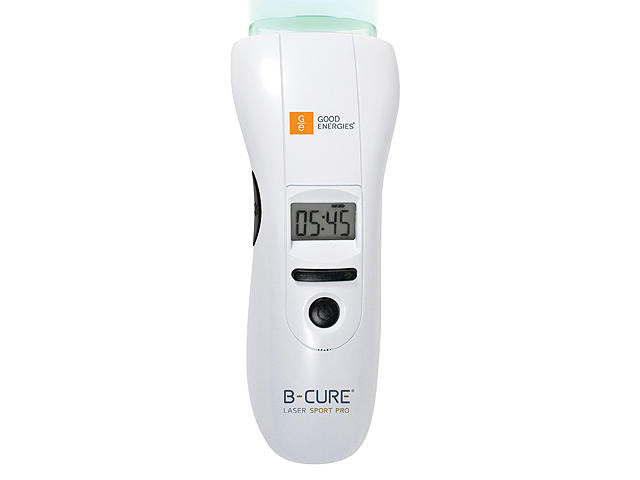
The Sport Pro kit is assembled for portable, active use.
- 1 pc B-Cure Laser Sport Pro device
- 1 pc charger
- 3 pcs rechargeable batteries
- 1 pc user manual
- 1 pc illustrated treatment booklet
- 1 pc carrying case
- Sold separately: adjustable stand
The booklet demonstrates device placement and key application steps for common complaints. Always choose treatment time and frequency based on the specific problem and the user manual.
The package contains three rechargeable batteries. Charge with the supplied charger (maximum 300 mA) following the user manual.
Technical specifications
| Wavelength | 808 nm, infrared |
| Maximum pulse power | 250 mW |
| Energy output | 5 Joules per minute |
| Energy density | 1.1 J/min/cm² |
| Pulse duration | 17 µs |
| Operating mode | Pulsed, PW |
| Typical treatment time | 4.5 minutes per treatment area, according to manufacturer protocol |
| Laser class | Class 1 |
| Charging current | Maximum 300 mA |
| Batteries | 3 rechargeable batteries |
| Medical designation | CE-marked medical device |
| Manufacturer | Good Energies Ltd., Israel |
 When NOT to use the device?
- Do not intentionally direct the light-emitting aperture into the eye.
- Do not apply to the abdomen or pelvic area during pregnancy.
- Do not use directly over malignant tumor areas without the express permission of the treating physician.
- Do not treat the thyroid area directly.
- Do not use over actively bleeding areas.
- If you have epilepsy or photosensitivity, consult a physician before use.
- For unknown, worsening or feverish complaints, seek medical examination first.
Always read the user manual and do not start random treatments if diagnosis is uncertain. Detailed contraindications and safety information →
 Important information
The B-Cure Laser Sport Pro is intended as a complementary treatment. It does not replace medical examination, diagnosis, physician-prescribed therapy, physiotherapy or appropriate rehabilitation.
A reduction in pain does not automatically prove the injured tissue is load-bearing. When returning to sport, function, strength and gradual load tolerance assessment are more important than temporarily masking symptoms.
Product description is for information only and is not personalized medical advice. Cited research examines general applications of photobiomodulation; individual results may vary.
Scientific background
Photobiomodulation has been studied in multiple musculoskeletal conditions. Publications discuss the method's general therapeutic possibilities and are not device-specific evidence for every listed application of the B-Cure Laser Sport Pro.
-
Stausholm MB et al.
(2019):
Efficacy of low-level laser therapy on pain and disability in knee osteoarthritis: systematic review and meta-analysis of randomised placebo-controlled trials.
BMJ Open
, 9(10):e031142.
PubMed
Meta-analysis of randomized trials in knee osteoarthritis. -
Clijsen R et al.
(2017):
Effects of low-level laser therapy on pain in patients with musculoskeletal disorders: a systematic review and meta-analysis.
European Journal of Physical and Rehabilitation Medicine
, 53(4):603–610.
PubMed
Systematic review of soft laser therapy for musculoskeletal pain. -
Glazov G et al.
(2016):
Low-level laser therapy for chronic non-specific low back pain: a meta-analysis of randomised controlled trials.
Acupuncture in Medicine
.
PubMed
Meta-analysis of randomized trials in chronic non-specific low back pain. -
Naterstad IF et al.
(2022):
Efficacy of low-level laser therapy in patients with lower extremity tendinopathy or plantar fasciitis: systematic review and meta-analysis of randomised controlled trials.
BMJ Open
, 12(9):e059479.
PubMed
Summary of studies on lower extremity tendinopathies and plantar fasciitis. -
Chow RT, Barnsley L
(2005):
Systematic review of the literature of low-level laser therapy in the management of neck pain.
Lasers in Surgery and Medicine
.
PubMed
Systematic review of soft laser therapy for neck pain.
Treatment guides and further information
-
 Soft laser therapy – comprehensive guide to home application →
-
 Soft laser treatment for sports injuries →
-
 Soft laser for knee pain and knee osteoarthritis →
-
 Soft laser for herniated disc and low back pain →
-
 Soft laser for tendinitis →
-
 Contraindications and safety information for soft laser therapy →
-
 Soft laser devices – all models →
Are you looking for a simple, goggles-free soft laser for active use?
The main advantages of the B-Cure Laser Sport Pro are portability and faster per-minute energy output than the Classic: 808 nm pulsed laser, 5 Joule/min energy output and Class 1 design.