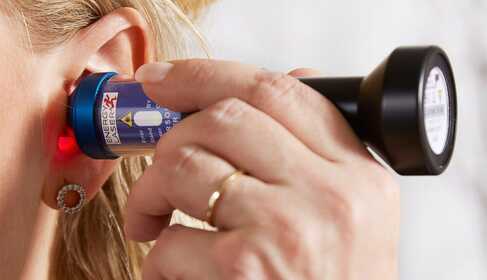

 What is tinnitus?
The most important point to clarify right at the start is this: tinnitus is not a disease in its own right, but a symptom. It is a signal that can have many causes — from a blocked ear canal to noise damage or a circulatory disorder. That is why there is no single “tinnitus medicine”: treatment always depends on the cause and the nature of the complaint. This article takes you through the causes, types and treatment options available today — including a detailed home soft-laser treatment protocol.
 Key point
The first step in treating tinnitus is never a device or a tablet, but an ENT examination: the cause must be clarified and underlying conditions requiring treatment must be ruled out. After that, there is still plenty that can be done — chronic tinnitus rarely disappears completely, but its disruptive effect can be meaningfully reduced in most people by combining methods intelligently.
What can cause tinnitus?
Click on the option that fits your situation — but the exact cause must always be established by a specialist examination.
This is the most common background cause. The sensory hair cells in the inner ear work less effectively because of noise, age or other damage — and the brain compensates for the missing sound input by effectively “turning up the volume”. We hear this as buzzing or ringing. Typical triggers include noisy workplaces, concerts and headphones at high volume. Age-related hearing loss (presbyacusis) often causes high-pitched ringing.
These are among the easiest causes to treat: an earwax blockage, inflammation of the ear canal or middle ear, fluid in the middle ear, Eustachian tube dysfunction or an eardrum problem. Otosclerosis (fixation of the stapes) and Ménière’s disease also belong here. Ménière’s disease causes attacks of dizziness, a feeling of ear fullness and fluctuating hearing. Treating the underlying condition can also help the tinnitus — which is why an examination is needed.
Disrupted circulation in the tiny blood vessels of the inner ear — due to atherosclerosis, high blood pressure or diabetes — is also a common background factor. Pulsatile tinnitus is a separate group: if the sound pulses in time with your heartbeat, it usually has a real blood-flow cause in the vessels of the head or neck (narrowing, turbulent flow or a venous abnormality), so this form always warrants imaging.
Few people know that signals from the temporomandibular joint (TMD), the chewing muscles and the cervical spine can also affect how the auditory system works — this is somatosensory tinnitus. A clue is that the ringing changes when you clench your teeth, chew, turn your head or move your jaw. In such cases, a bite splint, physiotherapy and relaxing the neck and shoulder region may also improve the tinnitus.6
Some medicines — high-dose salicylates, certain anti-inflammatory drugs, aminoglycoside antibiotics, some diuretics, chemotherapy medicines and quinine derivatives — can cause tinnitus and hearing loss when taken in high doses or for a long time. Important: never stop a medicine on your own for this reason — discuss with your doctor whether there is an alternative.
Less commonly, a neurological condition is behind the tinnitus: migraine, multiple sclerosis or stroke — and the rare but important-to-exclude tumour of the auditory nerve (vestibular schwannoma), which typically causes one-sided ringing and hearing loss. This is why specialists take one-sided, asymmetric symptoms seriously.
Stress is rarely the only cause, but it is almost always an aggravating factor — and a vicious cycle can start here: the ringing causes stress and sleep problems, while stress and lack of sleep make the ringing seem louder. One aim of treatment is precisely to break this cycle — which is why the sound-based and behavioural methods described below are so important.
Types of tinnitus — what does the nature of the sound tell you?
The nature, side and duration of the sound reveal a great deal about the possible cause. Here is how to interpret it:
| Feature | What do you experience? | What might it indicate? |
|---|---|---|
| Non-pulsatile (continuous) | Whistling, ringing, humming, hissing | The most common form — hearing loss, noise damage, ear disease or medication effect |
| Pulsatile | A whooshing or beating sound pulsing with the heartbeat | Vascular flow disorder — always warrants examination |
| Changes with movement | The ringing changes when clenching your teeth, chewing or turning your head | Somatosensory origin — jaw (TMD), cervical spine or muscle tension |
| Acute (days to weeks) | Recent, for example whistling after a concert | Often temporary — but if accompanied by hearing loss, urgent examination is needed |
| Chronic (3+ months) | Persistent ringing | “It will go away” is no longer a strategy — a treatment plan is needed |
| One-sided | Only in one ear | An important warning sign, especially with hearing loss or dizziness |
 When should you seek urgent medical attention?
If tinnitus appears suddenly together with one-sided hearing loss, urgent specialist care is needed within 24 hours — the window for treating sudden sensorineural hearing loss is short. Pulsatile ringing, and tinnitus accompanied by dizziness or balance problems, discharge from the ear or facial paralysis, are also urgent warning signs. Do not wait for the next available routine appointment.
What treatment options are available?
I will be honest: there is currently no “switch it off” cure for chronic tinnitus. What we do have are several methods supported by evidence of varying strength which, when combined, meaningfully reduce the disruptive effect of the ringing in most people. This is how the options compare:
| Method | What does it do? | Evidence |
|---|---|---|
| Cognitive behavioural therapy (CBT) | It does not remove the sound, but changes how you respond to it — reducing distress and anxiety | Strong |
| Sound therapy, white noise | Uses an external sound to push the ringing into the background; inexpensive and immediately available | Moderate to strong |
| Hearing aid | Dual effect: improves hearing and the amplified environmental sound masks the internal noise | Moderate to strong (when hearing loss is also present) |
| Tinnitus Retraining Therapy (TRT) | Counselling plus quiet background noise: the brain learns to ignore the sound; a 12–24-month programme | Moderate |
| Soft laser (photobiomodulation) | Supports inner-ear circulation and cellular metabolism using light | Limited to mixed: promising in the short term, but durability is uncertain |
| Ginkgo biloba, B12, magnesium | Supports circulation and nerve function; useful when there is a deficiency | Weak to moderate |
Research suggests that combining methods brings the greatest benefit: behavioural therapy, sound therapy and — when hearing loss is present — a hearing aid together form the package supported by the strongest evidence.2 Home methods (soft laser, white noise and stress management) may complement this.
 Soft laser for tinnitus: how might it work?
Low-intensity laser light penetrates the tissues and may support cellular energy production (ATP production) and microcirculation, while reducing local inflammatory processes. In tinnitus, the aim is to improve the blood supply and metabolism of the inner ear — the cochlea and its sensory cells. The method has been studied since the 1990s, mainly at centres in Austria, Germany and Denmark.
Clinical experience suggests that soft laser shows the most promising results in tinnitus of circulatory origin — where impaired blood supply to the inner ear is involved. It has also been studied in noise-induced and age-related forms, with favourable partial results.5 It is not suitable for everyone, however: before treatment begins, an ENT specialist must rule out underlying conditions requiring treatment — for example, an auditory-nerve tumour or otosclerosis.
An important lesson from the studies is that some of the improvement achieved after short treatment courses fades within 3–6 months.3 The explanation is straightforward: if the light supports microcirculation, the original circulatory state may return after treatment stops. For this reason, soft laser for tinnitus should be considered not as a one-off course, but as regular maintenance — similar to exercise therapy. An important limitation, however, is that controlled studies have not yet tested long-term maintenance use — what we know about this comes from clinical observation.
 How to carry out home soft-laser treatment
Once you have been examined and your doctor has found no contraindication, home treatment consists of two phases. Treat both ears — even if only one is ringing!
Phase 1: points around the ear
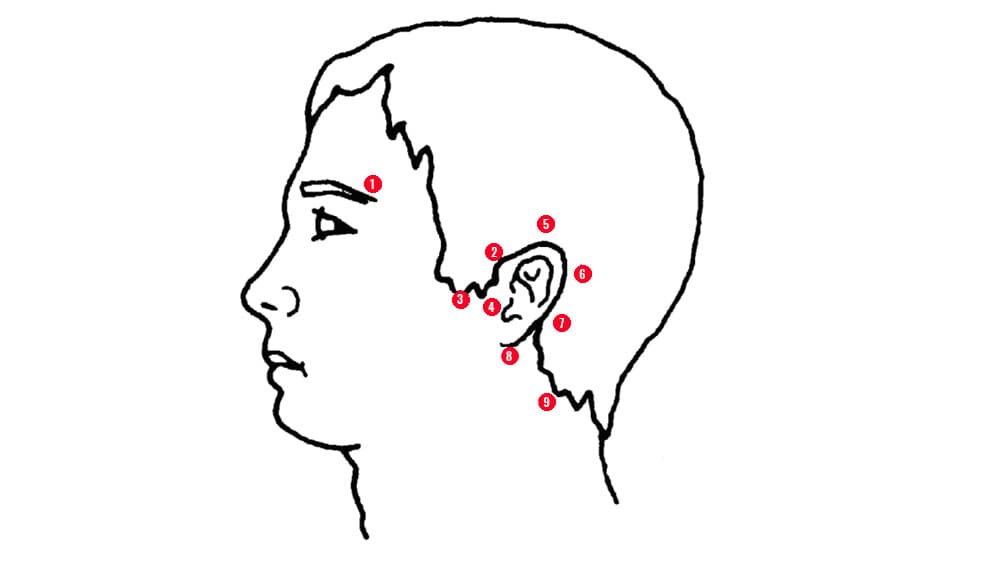
First, treat the acupuncture points around the ear: hold the treatment head perpendicular to the skin and deliver 4 Joules of energy to each point (with the Personal Laser L400, this takes 10 seconds; the device gives an audible signal every 10 seconds, making it easy to count). The location of the points is shown in the illustration below:
Phase 2: illuminating the ear canal
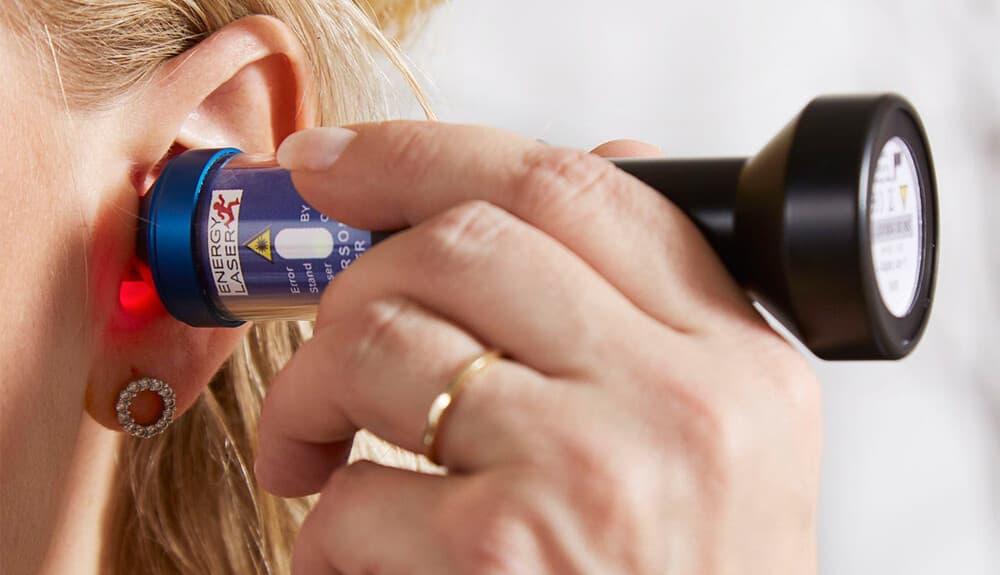
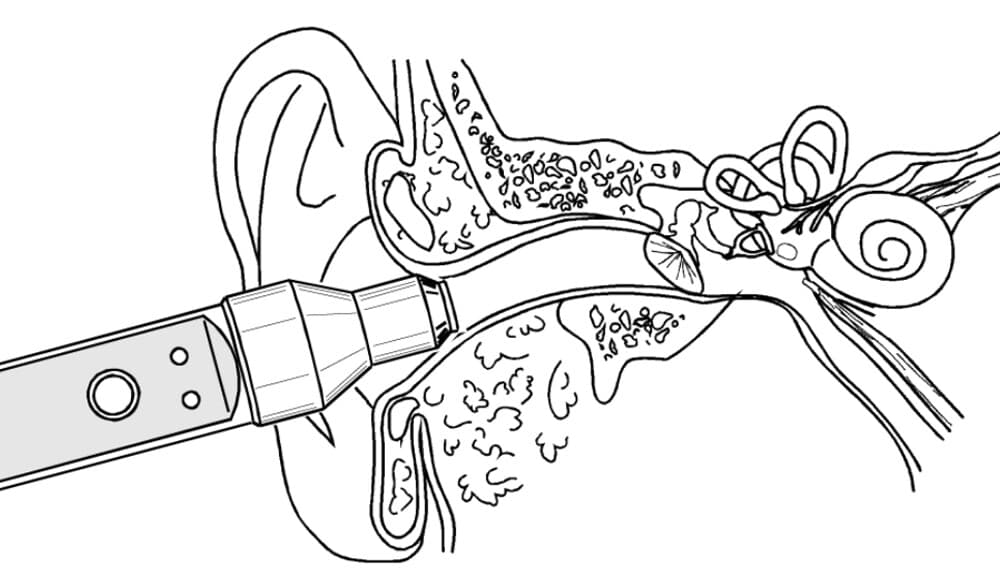
The aim is to reach the inner ear through the ear canal. Preparation: clean the ear canal (earwax absorbs light), remove the focusing attachment if fitted, and wear the protective goggles supplied with the device. Direct the light into the ear canal and move the device slowly and continuously: tilt it by a few degrees and make small circles with the tip so that the energy is distributed evenly. Starting dose: 20 Joules (about 50 seconds), which may gradually be increased to 30–40 Joules if there is no reaction (with the L400 this takes about 1.5–2 minutes, and with the L500 Pro about 1–1.5 minutes). During treatment, you may notice slight warmth and a crackling or “ship’s horn” sound — these are harmless accompanying effects.
Frequency and realistic expectations
The recommended frequency is 2–3 sessions per week. If the method works for you, the first signs usually appear after 5–10 treatments, with most changes around 15–20 treatments — but individual variation is considerable. If you notice improvement, 1–2 maintenance sessions per week are recommended. And the honest part: it does not work for everyone, and complete disappearance is rare — the realistic aim is quieter ringing and less disruption. If a neck-related factor also plays a role (the ringing changes with head movement), add treatment of the bone behind the ear (mastoid) with 4–8 Joules and relaxation of the neck and shoulder region.
 My advice: keep a tinnitus diary
Rate the loudness and disruptive effect of the ringing from 1 to 10 each day, and record your treatments as well. After four to six weeks, the diary will show what daily impressions can hide: whether the treatment is helping you. If there is no change after 15–20 treatments, do not force it — direct your energy towards sound therapy and stress management; they work through a different route.
What else can you do at home?
Do not sit in silence. Complete silence is tinnitus’s strongest ally — this is when the brain tunes in to the internal sound. Quiet background noise (radio, fan, white-noise app or nature sounds) throughout the day, and especially when falling asleep, can help a great deal. Always use white noise quietly — just loud enough to push the ringing into the background.
Break the stress cycle. Thirty minutes of exercise each day, a breathing exercise (inhale for 4 seconds — hold for 7 — exhale for 8), an evening screen break and a regular bedtime: these are not “wellness tips”, but ways of breaking the tinnitus–stress vicious cycle. Many people associate afternoon caffeine and alcohol with worsening symptoms — it is worth trying to cut them out.
Food supplements — in moderation. Vitamin B12 deficiency is more common in people with tinnitus, so supplementation is sensible when there is a deficiency. Ginkgo biloba (200 mg of standardised extract daily) may support circulation — results are mixed. Magnesium (200–400 mg daily) has been studied for protection against noise damage. None is a miracle cure; if a deficiency is suspected, ask for a blood test.
Protect what you have. Wear earplugs in noisy environments, keep headphone volume to a maximum of 60% and use active noise cancellation in a noisy workplace — preventing further noise damage is especially important when tinnitus is already present.
Suitable devices for ear-canal treatment
Laser treatment for tinnitus requires a device that can deliver sufficient energy into the ear canal. I recommend two CE-marked medical devices suitable for home use — the protocol can be carried out with either device as described above.
Personal Laser L400
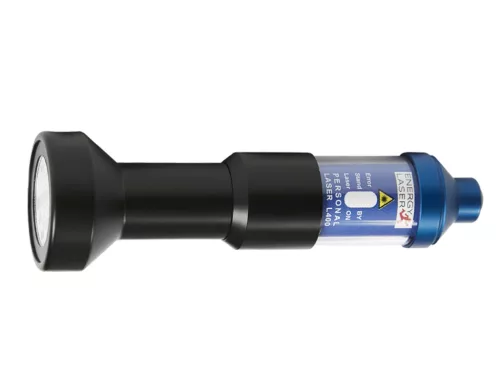 A 400 mW soft laser with an 808 nm wavelength. Its design is well suited to treating the points around the ear and the ear canal. It delivers the 40-Joule ear-canal dose in about 100 seconds. It can also be used for other home applications of soft laser treatment (joints, wounds and skin problems).
Energy-Laser L500 Pro
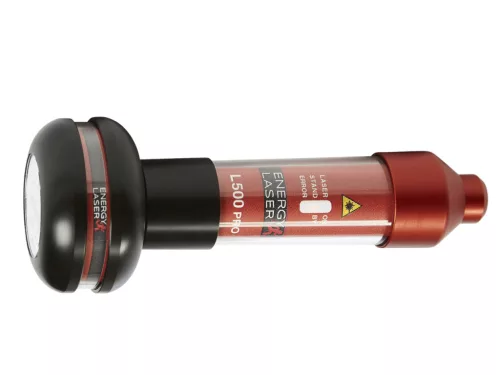 An 808 nm device with 500 mW power — thanks to its higher output, the same energy dose can be delivered in less time (40 Joules in about 80 seconds). A good choice if, alongside ear treatment, you also want to treat larger body areas and joints regularly.
 Before you start treatment
Only begin home treatment once an ENT specialist has clarified the cause of the tinnitus and ruled out underlying conditions requiring treatment:
- Uninvestigated tinnitus – do not treat without a diagnosis: a condition requiring treatment may be behind the symptom.
- Auditory-nerve tumour (vestibular schwannoma, acoustic neuroma) – excluding this is a prerequisite for treatment, especially with one-sided symptoms.
- Otosclerosis and other ear disease requiring treatment – specialist treatment of the underlying condition comes first.
- Cancer in the head and neck region – avoid laser treatment in the affected area.
- Pregnancy – home laser treatment only after medical consultation.
 Important information
Never direct the laser light into the eyes, and wear the protective goggles supplied with the device during ear-canal treatment. I have written about the general contraindications of soft laser treatment in a separate article: Contraindications to soft-laser therapy →
 What does the research say?
“What helps most with chronic tinnitus?”
According to a recent, comprehensive review of current treatment options, the approach supported by the strongest evidence is a combination: cognitive behavioural therapy (which reduces the emotional burden caused by the ringing), sound therapy and — when hearing loss is also present — a hearing aid together.2 None of these “switches off” the sound; instead, they help the brain pay less and less attention to it, giving everyday life room again. This is currently the realistic gold standard in tinnitus treatment.
“Does soft laser help with tinnitus?”
This question has now been examined by an unusually large number of studies — a 2023 comprehensive analysis summarised data from 28 studies involving nearly 1,500 participants. The result is mixed: in the short term, ringing measurably improved in some people treated with laser, and the method proved better than placebo — but the durability of the effect has not been established, and the studies used such different settings that the optimal protocol is still unclear. Noise-induced tinnitus has also produced favourable partial results.5 In summary: it is a safe complementary method worth trying — with realistic expectations, repeated in courses, and not treated as a miracle cure.
“Can my neck and jaw really cause ringing in my ear?”
Yes — and this is one of the most treatable forms. According to a recent review summarising the effects of treating temporomandibular disorders (TMD), a bite splint and physiotherapy can also improve ear-related accompanying symptoms, including tinnitus.6 If your ringing changes when you clench your teeth, chew or turn your head, it is worth pursuing this route with the help of a dentist specialising in gnathology and a physiotherapist — because here the cause can be treated, not just the symptom.
Frequently asked questions
Acute, recent tinnitus — such as whistling after a loud concert — often disappears on its own within days or weeks. A chronic form that has lasted longer than 3 months rarely disappears completely by itself — but its disruptive effect can be significantly reduced in most people using the methods described. Taking action is a better strategy than simply waiting.
Environmental noise fades at night, and in the silence the brain “turns up” the internal sound — while evening tiredness and stress also worsen perception. This is why quiet background sound in the evening (white noise or nature sounds beside the bed) works well: it does not suppress the ringing, but takes the stage away from it.
Not at an appropriate volume. The rule is that it should be only loud enough to push the ringing into the background — never louder. The aim is not to “drown out” the ringing, but to create a neutral sound carpet in which the ringing gets lost.
The first step is always an ENT specialist: a hearing test (audiometry), followed by further investigations if needed. Imaging may be appropriate for pulsatile ringing. If the tinnitus is causing severe emotional distress, involving a psychologist is not a sign of weakness, but the gateway to CBT — the treatment element supported by the strongest evidence.
It may be worth considering once you have been examined, no underlying condition requiring treatment has been found, and especially if a circulatory factor is likely to be involved. The method is safe and combines well with other treatments — but start with realistic expectations: the aim is to reduce the ringing, not eliminate it completely, and regular treatment will probably be needed to maintain the effect. The tinnitus diary will show after 15–20 treatments whether it is worth continuing.
 Summary – Quick overview
Sources
- Saeed S, Khan QU. (2021). The pathological mechanisms and treatments of tinnitus. Discoveries. DOI: 10.15190/d.2021.16
- Park KW, Kullar P, Malhotra C, Stankovic KM. (2023). Current and emerging therapies for chronic subjective tinnitus. Journal of Clinical Medicine. DOI: 10.3390/jcm12206555
- Nikookam Y, Zia N, Lotfallah A, et al. (2023). The effect of photobiomodulation on tinnitus: a systematic review. The Journal of Laryngology & Otology. DOI: 10.1017/S0022215123002165
- Abdali HM, et al. (2025). Low-level laser therapy and photobiomodulation for tinnitus. Cureus. DOI: 10.7759/cureus.96234
- Mollasadeghi A, Mirmohammadi SJ, Mehrparvar AH, et al. (2013). Efficacy of low-level laser therapy in the management of tinnitus due to noise-induced hearing loss: a double-blind randomized clinical trial. The Scientific World Journal. DOI: 10.1155/2013/596076
- Ferrillo M, et al. (2024). Efficacy of rehabilitative therapies on otologic symptoms in patients with temporomandibular disorders. Journal of Oral Rehabilitation. DOI: 10.1111/joor.13716