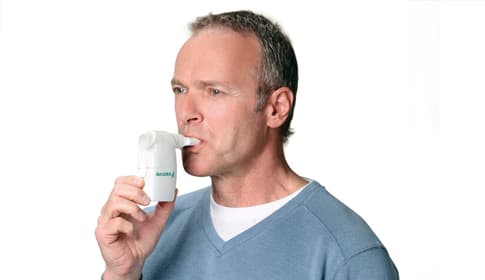

 What is oscillating OPEP therapy?
OPEP – Oscillating Positive Expiratory Pressure – is a breathing therapy method that combines two mechanisms at once: it applies positive pressure during exhalation while generating oscillation (vibration) in the airways. This combination can mobilize mucus that neither coughing nor conventional breathing therapies can reach.
 Key point
The essence of OPEP therapy is that the vibration during exhalation physically breaks up the mucus layer adherent to the airway walls – it does not only treat symptoms but targets the causative mechanism.
 How does it work?
The OPEP mechanism is based on three mutually reinforcing processes. It’s useful to understand each separately because they also explain why this method is more effective than simple coughing.
When you exhale through the device, the valve creates resistance – this produces positive pressure in the airways during exhalation. This is especially important in COPD, where airway walls lose elasticity and collapse by the end of exhalation. The positive pressure keeps the airways open, preventing air from becoming trapped behind an obstruction.
In simpler terms: it’s like inflating your tube-like bronchi from the inside so they don’t collapse.
What differentiates OPEP from PEP devices is that the valve produces an oscillating, not continuous, resistance. This creates rapid pressure changes – vibrations – in the airways that physically disrupt the internal structure of the mucus layer.
Thick airway mucus is a viscoelastic fluid: an internal network holds it together. The oscillation frequency "tears" this network apart, reduces mucus viscosity and makes it movable – similar to how a well-shaken ketchup pours more easily from the bottle.
Accumulated mucus blocks small airways and stops ventilation in the regions beyond the blockage. These areas not only reduce breathing efficiency but become foci for recurrent infections. OPEP therapy creates collateral airflow through pressure waves: air reaches the blocked areas via alternative pathways and pushes the mucus out from within.
This is an effect that conventional coughing cannot reproduce – because coughing works only by rapidly expelling air, it does not push air behind an obstruction.
Watch it in action
Why can’t the lung clear mucus on its own?
In a healthy lung, the cilia that line the airways continuously transport secretions toward the larger bronchi, from where they can be coughed up. This process, called mucociliary clearance, normally runs automatically – you don’t notice it and you don’t have to do anything consciously.
In chronic airway diseases, however, this system fails at multiple points at once:
| What goes wrong? | Consequence |
|---|---|
| Mucus production accelerates (infections, inflammation) | The cilia cannot keep up with the increased volume |
| Mucus viscosity increases (dehydration, inflammatory proteins) | The cilia cannot move the dense, sticky layer |
| Small airways collapse at end-exhalation (COPD) | Air and mucus become trapped and ventilation stops |
| Cilia are damaged (recurrent infections, smoking) | Mucociliary clearance is chronically weakened |
From this spiral, conventional coughing can only partially rescue you – it clears the larger bronchi but cannot reach the thick mucus stagnating in the smaller airways. OPEP therapy specifically targets that component.
Dr. Zátrok’s explanation
People often ask me: “But I cough properly, so why doesn’t it clear?” The answer is that coughing can only remove secretions where it can get behind them. Air does not reach mucus-blocked bronchi, so the cough wave cannot sweep mucus out of them. The AerobikA OPEP uses positive expiratory pressure to push air into the blocked area, and the vibration mobilizes the mucus – then coughing can be effective.
PEP and OPEP – what’s the difference?
Not every airway-clearing device is an OPEP device. It’s worth understanding the difference because it affects which method is appropriate for whom.
| Method | How does it work? | Particularly useful for |
|---|---|---|
| Conventional coughing | Rapid exhalation wave, no positive pressure | Larger airways – where secretions have already reached |
| PEP (positive expiratory pressure) | Continuous resistance on exhalation, no vibration | Opening small airways, reducing air trapping |
| OPEP (oscillating PEP) | Oscillating resistance = positive pressure + vibration together | Thick, viscous mucus; both small and upper airways |
| HFCWO (chest wall vibration) | External oscillating vest – a clinical device | Severe cystic fibrosis, institutional treatment |
OPEP therefore combines the advantages of PEP and mechanical vibration in a single device that can be used at home – making it suitable for long-term, self-administered airway clearance.
 In which airway conditions can OPEP therapy help?
The OPEP method can be a useful adjunct in any situation where accumulating airway secretions obstruct breathing or reduce quality of life.
In COPD the airway walls lose elasticity and collapse at the end of exhalation – this is the so-called air-trapping effect. Accumulated secretions stagnate in these collapsed regions and become sources of recurrent exacerbations. OPEP therapy keeps the airways open with positive pressure and the vibration loosens stagnant mucus. Research shows that regular use can improve lung function, exercise tolerance and symptom burden.1,2
In cystic fibrosis, disease-related changes produce extremely thick, highly viscous mucus that cilia cannot mobilize. Daily airway clearance – with an OPEP device or other methods – is a cornerstone of disease management. Use of OPEP devices in cystic fibrosis is common from early adulthood and is recommended as part of a treatment protocol agreed with the treating physician.3
After the acute phase of pneumonia – including COVID-19 pneumonia – recovery can be accompanied by weeks of increased secretion production and residual cough. In this phase, an OPEP device can help remove residual secretions and restore the lungs’ natural self-cleaning. Important: use only after the acute, febrile phase has resolved and with medical approval.
In bronchiectasis, dilated and deformed bronchi allow secretions to stagnate and become sources of recurrent bacterial infections. Regular introduction of OPEP treatment as an adjunct airway clearance method can help maintain lung hygiene. In recurrent bronchitis, preventive daily OPEP between exacerbations is recommended.3
 Airway cleaning devices – category →
 What do the studies show?
OPEP therapy – and specifically the AerobikA device – has been analyzed in numerous clinical studies over the past decade. Below I summarize the most important findings.
Sahardin et al., 2023 – Frontiers in Medicine1
In a 24-week prospective study of 53 COPD patients, twice-daily (2×10 minutes) use of the AerobikA OPEP showed significant improvement in small airway resistance (impulse oscillometry, R5 and R5-R20 parameters), lung function (FEV1, FEF), exercise tolerance (6-minute walk distance) and symptom burden (CAT score) – improvements appeared by 12 weeks and continued to increase up to 24 weeks.
Gupta et al., 2022 – Lung India2
In a randomized controlled trial of 50 stable COPD patients, the group using AerobikA OPEP for 3 months achieved significantly greater improvements in FEV1, FVC, 6-minute walk distance and CAT score than the control group receiving only pharmacological treatment.
Coppolo et al., 2021 – Pulmonary Therapy3
A comprehensive narrative review analyzing non-pharmaceutical airway clearance techniques – including OPEP devices – in the context of COPD and cystic fibrosis. The authors conclude that OPEP devices are particularly effective for highly viscous secretions and strongly recommend regular, protocol-based use.
 Important note about the evidence
The study results are encouraging, but it is important to know: OPEP therapy is an adjunct method, not a standalone cure. The results refer to regular use alongside medical treatment. Individual experiences may vary – how much improvement someone feels depends on disease severity, adherence to use and other factors.
 Before you start – when is OPEP treatment not recommended?
OPEP therapy is generally well tolerated, but there are situations when its use is not recommended or should be performed only with medical approval.
- Active pneumonia in the febrile, acute phase – treatment may begin after the acute phase has resolved
- Untreated pneumothorax – positive pressure can worsen the condition
- Severe heart failure or treated cardiac arrhythmia – increased expiratory pressure may place strain on the heart
- Presence of hemoptysis (coughing up blood) – vibration may increase bleeding
- Early phase after chest surgery – use only with permission from the treating physician
Adjunct treatment – always consult a doctor
OPEP therapy is an adjunct to medical treatment, not a replacement. For respiratory disease, always consult your treating physician before starting the device – especially if you take medications or have other chronic conditions.
Practical tips for effective use
Start with the lowest resistance
The biggest mistake I see is people starting immediately on the highest setting. The result: increased breathlessness after a few minutes and they stop. Start at the minimum and only increase the setting if you can complete the full 10-minute session without worsening breathlessness.
Make exhalation slower than inhalation
This is one of the most important techniques: the speed and duration of exhalation determine how intense the vibration is. With slower, longer exhalation the valve vibrates for a longer time and the vibration reaches deeper. Try to imagine inflating a balloon – a steady, sustained, slow airflow.
Cough purposefully after use
OPEP treatment loosens mucus – but it doesn’t bring it into the mouth. After a 10-minute device session, help remove the mobilized secretions with 2–3 forceful coughs. This is the point where OPEP and coughing truly work together.
Regular, consistent use – that’s the key
OPEP therapy is not a one-time intervention. Clinical studies are based on regular treatments performed 1–3 times daily. If you use it only symptomatically and occasionally, the effect will also be occasional. In stable COPD, daily use during symptom-free periods is recommended for prevention.
Frequently asked questions
PEP devices apply continuous expiratory resistance – they keep the airways open but do not generate vibration. OPEP devices, on the other hand, work with oscillating resistance that creates oscillation – vibration – in the airways. This vibration physically disrupts the internal structure of the mucus layer and makes clearance more effective, especially for thick, viscous secretions.
Clinical studies show measurable changes in lung function and symptom burden scores after 12 weeks of regular use. Individual experiences vary – some notice easier coughing within a few weeks, while for others the change is more gradual. The key is consistency: OPEP therapy works only with regular use.
In asthma the primary problem is bronchospasm, not mucus accumulation – although in some more severe cases mucus problems may coexist. OPEP is not a first-line method in asthma, and its use should always be discussed with a pulmonologist. It may be considered as an adjunct in phlegmy, productive asthma, but this must be evaluated individually.
Yes – and the order matters. The generally recommended protocol is: perform the OPEP treatment first (it clears the airways), then use the inhaler. Medication reaches deeper into cleared airways, so the effectiveness of a bronchodilator or corticosteroid may improve. Narrative reviews support this inhaler-after-OPEP sequence.3
 Summary – quick overview
Sources
- Sahardin SN, Jailaini MFM, et al. (2023). Impact of Aerobika oscillating positive expiratory pressure in improving small airway resistance, lung function, symptoms and exercise capacity in chronic obstructive pulmonary disease. Frontiers in Medicine, 10, 1202380. PubMed: 37332765
- Gupta A, Sodhi MK, Jaggi S, et al. (2022). Therapeutic efficacy of oscillating positive expiratory pressure therapy in stable chronic obstructive pulmonary disease. Lung India, 39(5), 449–454. PubMed: 36629206
- Coppolo DP, Schloss J, Suggett JA, Mitchell JP. (2021). Non-Pharmaceutical Techniques for Obstructive Airway Clearance Focusing on the Role of Oscillating Positive Expiratory Pressure (OPEP): A Narrative Review. Pulmonary Therapy, 8(1), 1–41. PubMed: 34860355