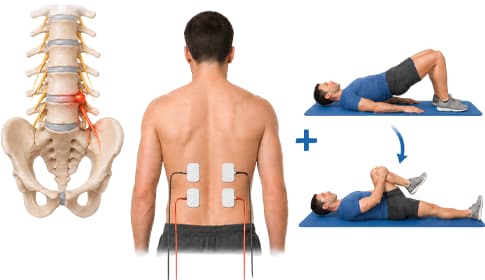

 If you have a herniated disc, use EMS alongside exercise
You spend all day hunched over a computer, then jolt around in traffic, and can barely wait to collapse into your armchair and watch your favourite series. Your physical activity is close to zero – yet you wonder what is causing your back to start hurting. The more you rest, the more it hurts. The more it hurts, the less you move. The whole thing comes down to one vicious circle: weakening of the muscles that support the spine, especially the deep (paraspinal) stabilising muscles. These are almost impossible to reach without deliberate exercise – but with intact nerve supply, an electrical muscle stimulator (EMS) can “prime” them, in other words, pre-activate them.
 Key point
The key to disc herniation rehabilitation is reactivating the deep spinal stabilising muscles (multifidus, transversus abdominis). Exercise barely reaches them during the painful phase – EMS, however, directly triggers muscle contraction, regardless of how much “willpower” is behind it. Exercise + EMS together provide measurably more than either method alone.
Why does a herniated disc hurt, and why does it not go away on its own?
A herniated disc develops when the flexible inner core of the disc between the vertebrae breaks through the outer fibrous ring under intermittent or sustained strain. The protruding material may press on the nerves – this causes the classic radiating pain (sciatica, sciatic nerve pain), numbness or muscle weakness in the leg.
Many patients are surprised to learn that the pain does not originate solely from the disc abnormality, but from the loss of protective strength in the surrounding muscles. The deep muscles around the painful area – mainly the multifidus and transversus abdominis – become poorly activated, shorten and tighten because of pain inhibition. This causes relative muscle weakness: someone may look fit from the outside, while their deep stabilising muscles have become compromised.
 Even manual workers report back pain
Manual workers and bricklayers often come to me because of back pain. Their spinal-supporting muscles are incomparably stronger than those of office workers. However, continuously lifting heavy objects – especially with poor posture – can still cause “relative muscle weakness”: their deep stabilising muscles cannot keep pace with the large superficial muscles.
 How can EMS help with spinal rehabilitation?
Electrical treatment can have three different roles in disc herniation rehabilitation. Each serves a different purpose and requires different settings.
EMS – reactivating the deep stabilising muscles
EMS (Electrical Muscle Stimulation) stimulates the motor nerve fibres of the muscle and thus triggers muscle contraction – even when pain makes it almost impossible for you to move voluntarily. With paraspinal electrode placement, the current reaches not only the superficial muscles but, according to studies, also significantly activates the deep stabilisers (multifidus, transversus abdominis, internal oblique).1
This “neurological priming” effect is particularly important after the acute phase of a herniation, when the deep muscles have already “forgotten” how to activate because of the pain. Stimulation wakes them up – and exercise becomes much more effective from that point.
TENS – pain relief so that exercise is possible
TENS (Transcutaneous Electrical Nerve Stimulation) stimulates sensory nerve fibres and therefore blocks pain signals travelling to the brain (the “gate control theory”). It can reduce radiating sciatic-type pain and sharp lower-back pain.
In a study of 100 people with disc herniation and sciatica, electrical stimulation reduced pain more effectively than conventional traction treatment (on several pain scales).5 It is important that TENS has no effect on muscle strength or function4 – so use TENS before exercise to reduce pain, but TENS alone is not enough for lasting improvement.
EMS + exercise – the demonstrably more favourable combination
The best results are achieved when you combine the two methods. In studies, coordinated, simultaneous use of NMES stimulation and voluntary movement produced measurably better deep-muscle activation and greater muscle thickening than exercise or stimulation alone.3
According to a comprehensive 2023 analysis, EMS (and especially the EMS + exercise combination) is more effective than passive and active controls for trunk-muscle endurance and strength in chronic low back pain.6 The logic is simple: EMS “starts” the muscle, while exercise teaches you how to use it in everyday movement.
Why is physiotherapy alone not always enough?
Exercise is the foundation of disc herniation rehabilitation – but for the following reasons it is often slow or insufficient on its own. That is why it is worth supplementing it with EMS:
| Problem | Why is it difficult? | Contribution of EMS |
|---|---|---|
| Too short, too infrequent | One or two physiotherapy sessions a week are not enough to develop muscle strength. | Daily 20-30-minute stimulation at home multiplies the muscle workload. |
| Pain prevents exercise | Because of the pain, you do not dare to strain your muscles – you “protect” them without realising it. | EMS still triggers contraction, but does not create joint movement, so it does not provoke pain. |
| The deep muscles do not activate | The multifidus and transversus abdominis are difficult to activate voluntarily – exercise mainly reaches the superficial muscles. | Paraspinal electrode placement directly activates the deep stabilising muscles.1 |
| Lack of motivation and persistence | It is difficult to maintain motivation for several hours of exercise every week for months. | The home device is convenient – you can use it while watching television or as part of your evening routine. |
 EMS does not replace exercise in the long term!
EMS “starts” the deep muscles – but only voluntary exercise teaches everyday movements such as walking, climbing stairs and lifting. The ideal balance is to use EMS more actively and more often during the first weeks; once exercise has been gradually incorporated, stimulation takes on a supplementary role.
For which spinal problems is EMS worth using?
This is the most typical indication. It is worth starting after the acute painful phase has passed, in the “subacute” or “chronic” stage. The combined EMS + exercise approach generally brings noticeable improvement in pain, range of motion and function after 8-12 weeks. A randomised clinical trial found that stimulation combined with movement produced better results in patients with sciatic LDH over 8 weeks.4
Read the complete guide to treating a herniated disc at home →
With degenerative disc changes, the disc loses its flexibility. Surgery is considered only as a last resort – until then, targeted muscle stabilisation (of the paraspinal and core muscles) can slow the process. EMS helps ensure that the superficial muscles are not the only ones compensating.
Radiating leg pain makes exercise difficult. Here, TENS can provide pain relief so that you can perform the exercises, while EMS works on the stabilising muscles. Clinical studies confirm that electrical stimulation is better than passive traction controls for relieving sciatica pain.5
After disc surgery, the muscles supporting the spine can deteriorate disproportionately quickly because of restricted movement. McKenzie extension exercises and supplementary NMES treatment reduce pain scores and functional disability scores.8 After surgery, always ask your treating doctor for approval and start at a gentle intensity.
After hospital or physiotherapy treatment, muscle strength can decline within a few weeks if strengthening exercises are stopped. Home EMS, alongside exercise, may help maintain the strengthening phase for months.
 Home EMS devices for spinal rehabilitation
For spinal rehabilitation, you need a 4-channel device that can stimulate the back and abdominal muscles at the same time. One clinical study specifically found this arrangement to be the most effective for activating the deep stabilising muscles.2
 My advice on choosing a programme
Three programme groups are useful for spinal rehabilitation: Warm-up / Relieving stiffness (5-10 minutes, low frequency) before exercise; Strengthening / Muscle tone (20-30 minutes, 30-50 Hz) for the deep muscles; Active recovery / Massage (10-15 minutes, 1-8 Hz) after exercise. For the detailed 12-week protocol, see the 4-channel back-muscle strengthening programme plan →
 Before starting home EMS treatment
In the following situations, using a lower-back stimulator is contraindicated or requires consultation with a specialist:
- Acute inflammatory phase with severe radiating pain – let the pain subside first, and only then use stimulation.
- Implanted pacemaker, ICD, spinal cord stimulator or other active implant – the current may interfere with the device.
- Pregnancy – abdominal and lower-back electrode placement is not recommended.
- Cancer in the treatment area – avoid the affected region.
- Recently operated area – wait for wound healing (at least 2-3 weeks), and start only with medical approval.
- Skin disease, injury or loss of sensation in the treatment area – the skin must be intact and sensation must be present.
- Epilepsy or another condition involving seizures – stimulation may act as a trigger.
- Deep vein thrombosis or active vascular occlusion – the current may worsen the condition.
- Acute fever or infectious illness – wait until you have recovered.
- Severe cardiovascular disease – if you have an arrhythmia or heart failure, seek cardiological approval.
Consult your treating doctor
A herniated disc is a complex condition. Home EMS treatment does not replace medical diagnosis and treatment protocols – at the beginning, always ask your doctor, physiotherapist or physical therapy specialist for approval. For the complete list of contraindications, read our article on contraindications to electrical treatment.
 What does science say about using EMS for spinal rehabilitation?
Clinical studies clearly support the role of EMS in disc herniation rehabilitation. Here are some relevant findings:
“Does EMS really reach the deep muscles that exercise does not?”
Yes. In an ultrasound imaging study, NMES applied to the paraspinal region significantly activated the deep stabilising muscles – the multifidus, transversus abdominis and internal oblique – which are often “unreachable” with voluntary exercise.1
“What is the ideal electrode arrangement for strengthening the spine?”
Simultaneous abdominal + back (4-channel) placement proved more favourable for activating the deep muscles than back-only or abdominal-only placement. According to the study, the combined protocol produced significantly greater muscle thickening both in the multifidus and in the abdominal stabilisers.2
“What difference does adding EMS to exercise make?”
In a 2021 clinical study, adding NMES to motor control exercises (compared with pseudo-stimulation) produced measurably greater multifidus activation in people with recurrent low back pain. The stimulation acts as “neurological priming”: it wakes the muscle up so that exercise can use it effectively.3
“Is TENS alone enough, or is motor control exercise necessary?”
A 2019 study in patients with disc herniation and radiculopathy found that after 8 weeks, motor control exercise produced significantly better results than TENS alone on both pain and function scales, and transversus abdominis activation was also better.4
“What do comprehensive analyses show?”
According to a large systematic review and meta-analysis from 2023, NMES (and especially the EMS + exercise combination) is more favourable than passive and active controls for trunk-muscle endurance and strength in chronic low back pain. Research clearly supports the combined approach.6
“Can this also help a young person, including an athlete?”
Yes. In a 2023 clinical study of 128 active-duty military adults with subacute low back pain, NMES strengthening therapy improved physical performance (sit-up, push-up) and trunk strength more than standard care, with a dose-response relationship.7
The key point in brief
The scientific evidence is consistent: EMS effectively reaches the deep stabilising muscles that exercise barely reaches. Combined EMS + exercise produces measurably greater muscle activation, thickening and functional improvement than exercise alone. A significant effect appears after 8-12 weeks of regular use.
How should you incorporate EMS into rehabilitation?
Basic principles of EMS treatment for disc herniation
- Acute phase (weeks 1-2): if you have severe radiating pain, the first goal is to reduce it. Use a TENS programme (80-150 Hz, gentle tingling) at low intensity for 20 minutes. Do not stimulate the lower back if there is severe acute inflammation!
- Subacute phase (weeks 3-6): muscle priming begins. Use a Warm-up or “Relieving stiffness” programme (5-10 minutes), followed by a “Strengthening / Muscle tone” programme (20-30 minutes, 30-50 Hz) on the paraspinal and abdominal areas.
- Chronic phase (weeks 7-12 and beyond): exercise becomes primary, with EMS used as a supplement 3-4 times a week. Keep progressing the intensity.
- Electrode placement: place the electrodes 2-3 cm to the side of the vertebrae (along the paraspinal muscle band), one below the other. With a 4-channel device, stimulate the transversus abdominis at the same time.2
- Intensity: above the sensory threshold, gradually increasing until visible contraction. Always remain below the pain threshold!
- Duration: 1 (occasionally 2) treatment per day, 20-30 minutes. 4-6 sessions per week.
- Timing around exercise: EMS “Warm-up” → 30-60-minute break → exercise; or use an “Active recovery” programme after exercise.
Maintenance – preserving the result
- After week 12, exercise should remain the foundation (3-4 sessions per week), with EMS as a supplement once or twice a week.
- Ergonomics (chair adjustment, monitor height and lifting technique) are just as important – without them, even strengthened muscles quickly become overloaded.
- NSAID painkillers (Algoflex, Ibuprofen, Nurofen, etc.) provide symptomatic relief but can cause side effects in the long term – they do not replace strengthening the muscles. The exercise + EMS approach acts at the source of the problem.
Frequently asked questions
Start after the acute phase of severe radiating pain – generally after 2-3 weeks, when the pain is already tolerable. During the first 1-2 weeks, rest and gentle pain relief are the priority. Always ask your treating doctor for approval before starting.
The first noticeable changes (less stiffness, better back support and a less easily fatigued lower back) appear after 2-3 weeks of regular EMS + exercise. Measurable muscle thickening and functional improvement stabilise after 8-12 weeks.3, 6
No. EMS “starts” the deep muscles, while exercise teaches you how to use them in everyday movements. Together they provide more than either one alone. Exercise is the long-term solution; EMS helps support faster recovery.
During the strengthening phase (months 1-3), use it 4-6 times a week for 20-30 minutes per day. During the maintenance phase (from month 3), once or twice a week is enough if you also exercise regularly.
After disc surgery (discectomy), gentle EMS can generally begin after 2-3 weeks with the surgeon’s approval, once wound healing and scar formation are progressing normally. The combination of McKenzie extension exercises and NMES can support recovery favourably.8
With a 4-channel device, you can stimulate the paraspinal muscles of the back (2 channels) and the abdominal stabilisers (transversus abdominis – 2 channels) at the same time. Clinical studies indicate that this simultaneous combined arrangement is the most effective for activating the deep muscles.2 With a 2-channel device, you can only do the same in separate stages, which takes twice as long and produces less synchronised muscle activation.
 Summary – Quick overview
Sources
- Baek SO, Ahn SH, Jones R, Cho HK, et al. (2014). Activations of deep lumbar stabilizing muscles by transcutaneous neuromuscular electrical stimulation of lumbar paraspinal regions. Annals of Rehabilitation Medicine 38(4):506-513. PubMed: 25229029
- Kim SY, Kim JH, Jung GS, Baek SO. (2016). The effects of transcutaneous neuromuscular electrical stimulation on the activation of deep lumbar stabilizing muscles of patients with lumbar degenerative kyphosis. Journal of Physical Therapy Science 28(2):399-406. PubMed: 27064323
- Songjaroen S, Sungnak P, Piriyaprasarth P, Wang HK. (2021). Combined neuromuscular electrical stimulation with motor control exercise can improve lumbar multifidus activation in individuals with recurrent low back pain. Scientific Reports 11(1):14815. PubMed: 34285318
- França FJR, Callegari B, Ramos LAV, Burke TN. (2019). Motor Control Training Compared With Transcutaneous Electrical Nerve Stimulation in Patients With Disc Herniation With Associated Radiculopathy: A Randomized Controlled Trial. American Journal of Physical Medicine & Rehabilitation 98(3):207-214. PubMed: 30247159
- Wang L, Fan W, Yu C, Lang M, Sun G. (2018). Clinical effects of electrical stimulation therapy on lumbar disc herniation-induced sciatica and its influence on peripheral ROS level. Journal of Musculoskeletal & Neuronal Interactions 18(3):393-398. PubMed: 30179218
- Wolfe D, Rosenstein B, Fortin M. (2023). The Effect of Transcutaneous Electrotherapy on Lumbar Range of Motion and Paraspinal Muscle Characteristics in Chronic Low Back Pain Patients: A Systematic Review and Meta-Analysis. Journal of Clinical Medicine 12(14):4680. PubMed: 37510796
- Talbot LA, Webb L, Ramirez VJ, Morrell C, et al. (2023). Neuromuscular electrical stimulation for the management of subacute low back pain: a randomized controlled trial in active-duty military personnel. Military Medicine 188(1-2):12-19. PubMed: 34510214
- Abdi A, Bagheri SR, Shekarbeigi Z, Usefvand S, Alimohammadi E. (2022). The effects of McKenzie-based exercises on outcomes in patients with lumbar disc herniation following discectomy: a randomized clinical trial. Neurological Research 45(1):28-40. PubMed: 36039973