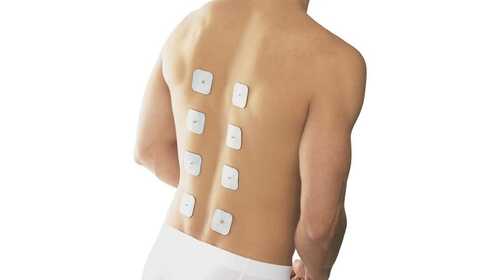

 Why is it worth strengthening your back muscles with a stimulator?
If your back often hurts, your lower back struggles with prolonged sitting, or you are looking for a way to avoid a recurring slipped disc, strengthening your back muscles is the most important long-term investment you can make. In this guide, you will find a 3-month plan you can do at home to strengthen the muscles supporting your spine in 30–40 minutes a day.
I have already explained why this approach is effective (see the article on weakness of the muscles supporting the spine). Here I will focus on the practical treatment steps: what type of device you need, where to place the electrodes and how to increase the intensity so that you progress without pain.
 Key point
Weakness of the back muscles – especially the deep spinal stabilisers, including the multifidus – is one of the main structural causes of chronic low back pain. Neuromuscular electrical stimulation (NMES), alongside exercise, can reactivate and thicken these muscles, helping to reduce pain and improve function.
 Why are the back muscles important? – Anatomy and function for non-specialists
Our back is not held by a single “back muscle”, but by a layered muscle system. The larger, visible muscles on the surface, such as the trapezius and latissimus dorsi, work on the shoulder girdle and arm movements. The true “supporting column” of the spine, however, is the deeper paravertebral muscle system, which we rarely feel even though it works during every movement.
Three layers of muscles work together along your back. Each has a different role:
- Superficial layer (trapezius, latissimus dorsi): carries out larger movements – raising the arms, pulling the shoulders back and pulling. In exercise programmes, these are what we call the “back muscles”.
- Middle layer (rhomboids, serratus posterior muscles): keeps the shoulder blades in position and supports upper-body stability and the mechanics of breathing.
- Deep layer (paravertebral muscle group, including the multifidus): runs between the vertebrae in segments only a few centimetres long. It keeps the vertebrae stable relative to one another during every bend, twist and step. Studies show that this layer is thinner in people with a slipped disc or long-term low back pain – and it is also the layer that is barely activated without targeted exercise.3
The three layers do not work separately. During every step, while sitting and when lifting, they work together to keep your spine balanced – you only notice them when one becomes weak or goes into spasm.
- Stable spine: strong deep back muscles hold the vertebrae against the small but frequent twisting and shearing forces that occur during bending, lifting and sudden movements. This is the most visible pain-preventing effect.
- Less low back pain: research suggests that strengthening the multifidus with exercise or stimulation measurably reduces pain and improves everyday movement function.1, 5
- Correct posture: rounded shoulders caused by desk work, an overactive upper trapezius and a flattened thoracic curve are all signs of disturbed muscle balance. Endurance strengthening helps correct this.
- Less strain on the shoulders: without strong middle back muscles, the shoulder blades slide loosely over the chest. This adds extra strain to every shoulder movement. Strengthening them can also reduce shoulder pain.
- Freer breathing: the back muscles also indirectly support proper expansion of the chest. This is why many desk workers feel that they “cannot get enough air” – their lungs are not small; their chest simply does not expand properly.
- Independence in later life: age-related muscle loss (sarcopenia) particularly affects the paraspinal muscles. Stooped posture and the risk of falling are largely related to this. Starting strengthening in time can slow the process.
- Better sports performance: every hit, throw and twist passes through trunk rotation. A strong core is the key to transferring force – in elite young football players, a 10-week programme produced up to a 34% increase in trunk flexor strength.7
- Chronic low back pain: research suggests that the multifidus is selectively thinner and contains more fat in people with low back pain than in healthy people. This is not merely a consequence; it is an active part of the pain mechanism.3
- Increased slipped-disc risk: if the deep muscles do not stabilise the spine, the discs bear disproportionately greater loads. This may lead to faster disc degeneration and a slipped disc.
- Poor posture: a rounded thoracic curve, forward head posture and a flattened lumbar curve all result from disturbed muscle balance.
- Neck and shoulder pain: when the middle back muscles do not support the shoulder blade, the upper trapezius has to work too hard. This can become a source of head and neck pain.
- Feeling unable to breathe properly: because the chest does not expand, desk workers often find themselves sighing.
- Early falls in later life: the forward-tilted trunk caused by weak paraspinal muscles is one of the main fall-risk factors over the age of 65.
When is it worth starting back muscle strengthening?
Home back-muscle training with 4 channels may be useful in any of the following situations. Look through them and see which one applies to you:
Sitting for 6–10 hours a day, in the office, in the car or in front of a computer, directly contributes to weakness and stiffness in the paraspinal muscle group. The “Stiffness relief / Trunk” and “Endurance strength / Back muscles” programmes address both problems: stimulation relaxes stiff muscle fibres while gradually strengthening the supporting muscles. The feeling of painful heaviness in the afternoon and evening usually decreases after 2–3 weeks.
In chronic non-specific low back pain, the multifidus is selectively thinner than in healthy people.3 In a recent clinical study, patients who received stimulation alongside lumbar stabilisation exercises showed measurably greater multifidus thickening and pain reduction than those who exercised alone.1 This is why a combined strategy (exercise + stimulation) is important, rather than stimulation on its own.
If an MRI scan or your symptoms show a disc problem, strengthening the back muscles is key to avoiding surgery or speeding recovery after surgery. With a stable spine, the discs are exposed to less strain. In this situation, always ask your doctor and/or physiotherapist to approve stimulation, and start the programme after the painful phase has passed.
Age-related wasting of the paravertebral muscles (sarcopenia) can progress quickly – above the age of 65, a clear loss of strength and muscle mass may occur from month to month and year to year. The 12-week programme is gentle, can be done sitting or lying down, and has also been shown to thicken muscles in older people. Strong paraspinal muscles can indirectly reduce the risk of falling.
In every rotational sport – golf, tennis, football, rowing, running and cycling – the trunk is the engine that transfers force. In a 10-week study of elite young football players, home 4-channel stimulation as part of a combined programme produced a 34% increase in trunk muscle strength.7
After spinal or hip surgery, or a long hospital stay, the back muscles lose strength quickly. Exercise may still be difficult to start, whereas NMES can “switch on” the muscles without active movement. After surgery, always start with your doctor’s approval and use a gentle intensity of 18–28 mA.
 What does science say about back muscle stimulation?
Home NMES for back muscle strengthening is not new to research. Here are a few relevant findings in brief, so that you know what to expect:
“If I also exercise, what more can muscle stimulation do?”
A 2025 clinical study in patients with chronic low back pain found that adding back muscle stimulation to lumbar stabilisation exercises, in 15 sessions, produced measurably greater multifidus thickening and a greater reduction in pain than exercise alone. The patients also found their daily activities easier.1
“Why does stimulation not work for everyone?”
An earlier study with a similar design did not find the same additional benefit compared with exercise.2 This shows that stimulation is not a miracle cure, but an adjunct to exercise. The two work most effectively together, which is why a gradual combined strategy is important rather than stimulation on its own.
“Why do so many people have low back pain if the disc is fine?”
According to a professional review, multifidus shrinkage and fatty change are characteristic findings in chronic low back pain. This is not simply a consequence of pain, but part of the cause-and-effect chain: a weak deep muscle is less able to stabilise the vertebrae, so the discs receive less protection.3
“I do not have much time. Could 20 minutes a week be enough?”
In a larger study of 110 people with non-specific chronic low back pain, a whole-body EMS protocol of 1 × 20 minutes per week produced a 22% reduction in pain, while trunk extensor and flexor strength also increased – similarly to the results of 45 minutes of conventional exercise per week.8 This means that stimulation may be worth considering when time efficiency matters.
 The key point in brief
Muscle stimulation does not replace exercise, but it is an effective adjunct. Exercise and stimulation together provide more than either one alone. Pain reduction and muscle thickening generally begin after 2–6 weeks; achieving a lasting result requires 12 weeks of regular training.
Ten principles you need to understand before starting
- Exercise always comes first. Muscle strengthening is most effective through physical exercise; stimulation is an adjunct or a substitute when exercise is not yet possible.
- If your condition is severe – if pain prevents exercise or you are too weak to manage the exercises, muscle stimulation is often the only way to improve muscle condition.
- If you can move independently, the stimulator complements exercise. It can shorten recovery because the muscles receive stimulation in two ways.
- Physiotherapy is the key to regaining strength, followed by increasing amounts of movement. A physiotherapist, movement therapist or medical fitness trainer can teach you the exercises suited to you.
- Strengthening muscles does not happen in one day. After a single treatment, expect only muscle soreness. Meaningful change comes after 2–3 weeks of regular training.
- Progress gradually. In the first week, the muscles need to get used to the contractions (18–28 mA); from the second week, the intensity may increase (24–36 mA), followed by the strengthening phase at the upper limit of your comfort zone, without pain.
- You will feel the first meaningful change after 2–3 weeks. You will feel stronger and your muscles will support you better. This is not the finished result.
- From the second month, you can also do more demanding exercises alongside stimulation.
- From the third month, exercise becomes the priority and stimulation becomes the adjunct.
- You must maintain the result! Without exercise and stimulation, the strength you have gained decreases within a few weeks. Regular movement is the long-term solution.
 Devices for back muscle strengthening
For 4-channel back muscle stimulation, you need a device with at least 4 independent channels, meaning that 8 electrodes can be placed at the same time, and with “Back muscles” and “Trunk” programmes. If you only have a 2-channel device, treatment takes at least twice as long: first the upper section and then the lumbar section separately.
I recommend the following 4-channel devices for back muscle strengthening:
MyoBravo
An entry-level 4-channel TENS + EMS device. The programmes are numbered; the detailed back muscle protocol is provided in the user manual.
Genesy 300 Pro
A classic 4-channel NMES + TENS + MCR device with a Hungarian menu. It also contains sports programmes and is a particularly suitable home option for back muscle strengthening.
Premium 400
A mid-range 4-channel Globus device with a built-in Sport programme group and more fitness and microcurrent programmes than the Genesy 300 Pro.
 My advice on choosing
If you are still unsure which device suits your life, read the guide to choosing a TENS-EMS device, or contact us through the online shop.
Preparation and electrode positions
What will you need?
- Your device, 4 cables and 8 self-adhesive electrodes (TENS pads).
- I recommend 5×5 cm square electrodes. The size may differ by a few millimetres. ValueTrode, ValueTrode X, UltraStim and PALS electrodes are all suitable for back muscle strengthening.
- The split ends of the cables finish in pin-like metal connectors. Attach the electrodes to these.
- Plug the other ends of the cables into the device, into the channel outputs.
- The different cable colours are only for identification. It does not matter which colour you connect to which output. Electrodes of the same colour belong together.
Applying the electrodes
- Peel the self-adhesive electrodes off the plastic sheet and apply them to the skin.
- Before treatment, wash the skin with lukewarm soapy water and dry it.
- Oily, sweaty or dusty skin reduces the effectiveness of the electrode adhesive and shortens its life.
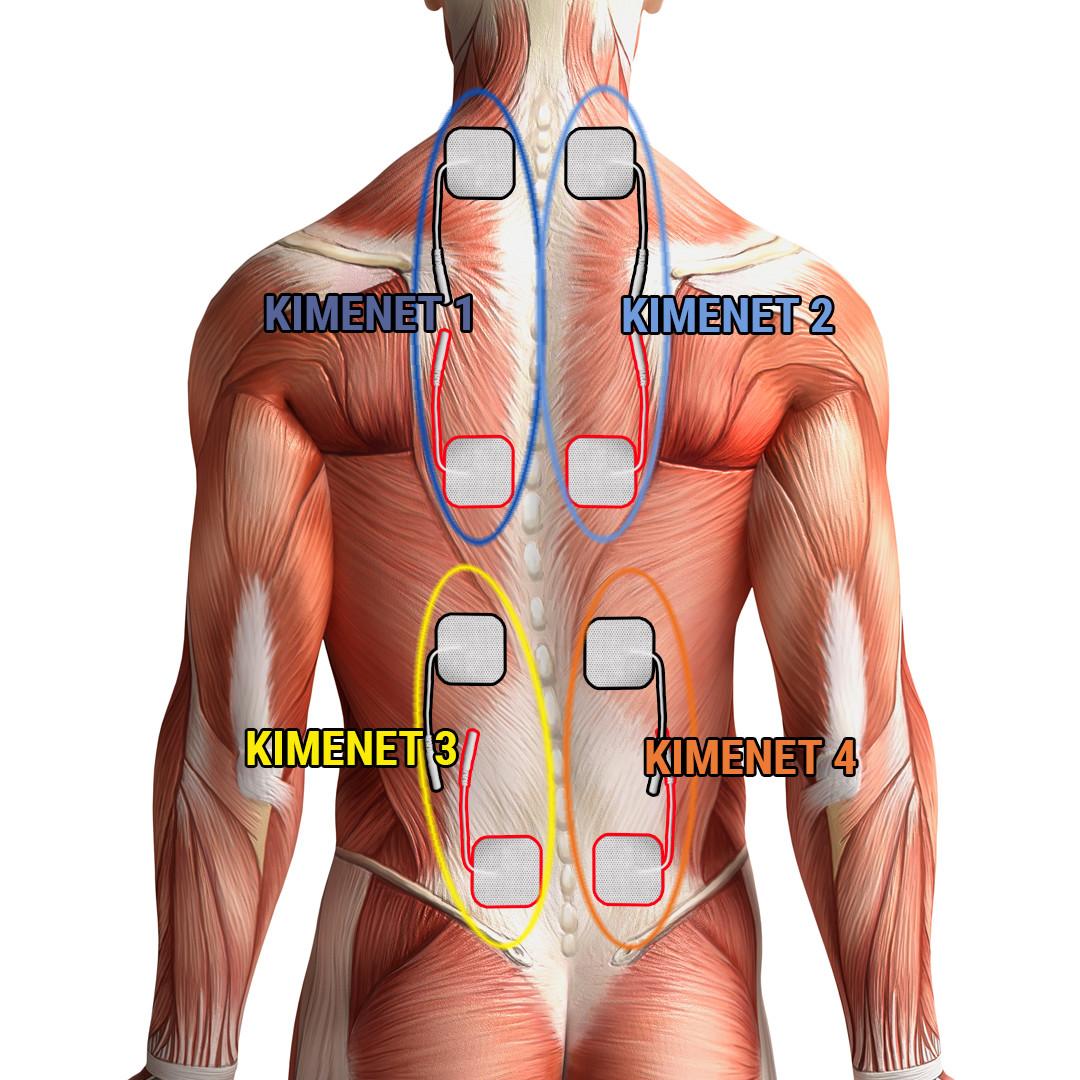
- Place the electrodes 3–4 cm to the side of the vertebrae. Ask a family member to help you.
- Apply the two electrodes connected to Output 1 one below the other, as shown in the illustration – one on the neck and the other between the shoulder blades.
- Apply the Output 2, 3 and 4 electrodes in order, as shown in the illustration.
- Never connect the electrode pairs diagonally!
The 12-week back muscle strengthening plan
Once the electrodes are in place, switch on the device and select the programme from the menu. On the Premium 400, Cycling Pro, Runner Pro, Triathlon Pro, Soccer Pro and The Champion devices, you will find the treatment programmes under Programme list / Sport.
Week 1 – Familiarisation (18–28 mA range)
| Programme | Mon | Tue | Wed | Thu | Fri | Sat | Sun |
|---|---|---|---|---|---|---|---|
| Stiffness relief / Trunk (20 minutes) | X | X | X | X | X | X | X |
| Endurance strength / Back muscles (25 minutes) | X | X | X | X |
Weeks 2–3 – Adaptation and increasing intensity (24–36 mA)
| Programme | Mon | Tue | Wed | Thu | Fri | Sat | Sun |
|---|---|---|---|---|---|---|---|
| Stiffness relief / Trunk (20 minutes) | X | X | X | X | |||
| Endurance strength / Back muscles (25 minutes) | X | X | X | X | X | X | X |
| Max. strength / Back muscles (20 minutes) | X | X |
Weeks 4–12 – Strengthening phase (upper limit of your comfort zone)
| Programme | Mon | Tue | Wed | Thu | Fri | Sat | Sun |
|---|---|---|---|---|---|---|---|
| Endurance strength / Back muscles (25 minutes) | X | X | X | X | X | X | X |
| Max. strength / Back muscles (20 minutes) | X | X | X |
Differences between some devices
Genesy 300 Pro: the “Stiffness relief” programme is not listed separately on this device. Use the Sport / Warm-up programme instead.
MyoBravo: instead of programme names, you need to select programme numbers. The details are in the user manual; the following mapping will help:
- Stiffness relief = Programme 23
- Endurance strength, week 1 = Programme 02
- Endurance strength, from week 2 = Programme 03
- Max. strength, weeks 1–3 = Programme 08
- Max. strength, from week 3 = Programme 09
Practical advice during treatment
Setting the intensity correctly
- When you start the programme, you do not feel anything yet. Treatment has not started at this point.
- You must set the current intensity yourself. Everyone feels the current differently, and even your own sensitivity may vary from day to day. The device therefore never sets a value automatically.
- Increase the intensity slowly. Each button press raises the value by 1 mA.
- You will soon feel twitches in the muscle. If they are still weak, increase the intensity further.
- The higher the intensity, the stronger the contraction and the stronger the effect.
- Above a personal upper limit, treatment becomes painful. Then reduce the intensity by a few mA. The contraction should be firm but not painful.
- Work at the upper level of your comfort zone. Usually, 18–40 mA is suitable.
- With a 5×5 cm electrode, the intensity must not exceed 50 mA.
- If the intensity is too low, there is no contraction and no effect.
Finishing treatment
- When the treatment time ends, the programme finishes automatically.
- Switch off the device.
- Remove the electrodes one by one, carefully and NOT by pulling the cable, then immediately put them back on the plastic sheet.
My advice for extending electrode life
Many users report that storing the electrodes in a normal refrigerator, on the original plastic sheet and in sealed packaging, may extend the life of the adhesive.
 Before starting treatment
Back muscle stimulation is contraindicated or requires specialist medical advice in the following situations:
- Implanted pacemaker, ICD or another active implant – the current may interfere with its operation.
- Pregnancy – back muscle stimulation is not recommended at any stage of pregnancy.
- Epilepsy or another condition involving seizures – stimulation may act as a trigger.
- Acute illness with fever or inflammation – wait until you have recovered.
- Skin inflammation, eczema or wounds at the electrode site – the skin must be intact.
- Active malignant tumour in the treatment area – avoid the affected region.
- Deep vein thrombosis or active vascular occlusion – the current may make the condition worse.
- Painful acute phase of a slipped disc – wait for the pain to ease before starting stimulation.
- Recently operated area – wait for wound healing and start only with medical approval.
- Severe cardiovascular disease – if you have an arrhythmia or heart failure, obtain cardiology approval.
Important information
If any of the situations listed above applies to you, ask your doctor before starting the programme. For the complete list of contraindications, read our article on contraindications to electrical treatment.
Frequently asked questions
You will generally feel the first meaningful change after 2–3 weeks of regular treatment. Typical signs include “my back supports me better”, “it hurts less in the evening” and “my lower back does not feel so heavy in the afternoon”. Measurable muscle thickening starts after 6–8 weeks and stabilises after 12 weeks.1, 3
Not completely. Exercise always comes first. The stimulator complements exercise or temporarily replaces it when pain makes exercise impossible. The two methods work most effectively together. After week 12, exercise should be the foundation and stimulation the adjunct.
If you have a slipped disc, ask your doctor and/or physiotherapist to approve muscle stimulation before you start. Do not stimulate during the painful acute phase. Once the pain has eased, start gently at 18–28 mA. Strengthening the back muscles plays an important role in preventing recurrence of a slipped disc: a stable spine means less strain on the discs.
The back is anatomically a long muscle area, from the neck to the lower back. With a 4-channel device and 8 electrodes, you can work along the full length at the same time and finish in 30–40 minutes. With a 2-channel device, you first treat the upper section and then the lumbar section separately, which takes at least twice as long. A device costing 20–30 thousand requires even more time.
No. At the correct intensity, you feel a strong, firm contraction but no pain. If it becomes uncomfortable, reduce the intensity by a few mA. The upper level of your comfort zone is ideal: you feel the muscles working, but remain comfortable. This is not one fixed value; it may change from day to day.
Without exercise and muscle activity, the strength gained through the demanding programme decreases again within a few weeks. You must continue maintaining the muscles after week 12. At that stage, exercise should be the priority, 3–4 times a week, with stimulation continued once or twice a week to maintain muscle adaptation.
 Summary – Quick overview
Sources
- Vardar S, Yalcin G, Aksungur S, Yavuzdemir MA, et al. (2025). Effects of Neuromuscular Electrical Stimulation Adjunct to Lumbar Stabilization Exercises on Multifidus Muscle Thickness, Pain, Disability, and Psychosocial Status in Patients With Chronic Low Back Pain. American Journal of Physical Medicine & Rehabilitation 104(9):800-808. PubMed: 39938065
- Alrwaily M, Schneider M, Sowa G, Timko M, Whitney SL, Delitto A. (2018). Stabilization exercises combined with neuromuscular electrical stimulation for patients with chronic low back pain: a randomized controlled trial. Brazilian Journal of Physical Therapy 23(6):506-515. PubMed: 30482602
- Hodges PW, Danneels L. (2019). Changes in Structure and Function of the Back Muscles in Low Back Pain: Different Time Points, Observations, and Mechanisms. Journal of Orthopaedic & Sports Physical Therapy 49(6):464-476. PubMed: 31151377
- Johnson MI, Paley CA, Jones G, Mulvey MR, Wittkopf PG. (2022). Efficacy and safety of transcutaneous electrical nerve stimulation (TENS) for acute and chronic pain in adults: a systematic review and meta-analysis of 381 studies (the meta-TENS study). BMJ Open 12(2):e051073. PubMed: 35144946
- Rampazo EP, Rehder-Santos P, Catai AM, Liebano RE. (2023). Interferential current for chronic non-specific low back pain: systematic review and meta-analysis. Brazilian Journal of Physical Therapy 27(5):100549. PubMed: 37801776
- Frizziero A, Pellizzon G, Vittadini F, Bigliardi D, Costantino C. (2021). Efficacy of Core Stability in Non-Specific Chronic Low Back Pain. Journal of Functional Morphology and Kinesiology 6(2):37. PubMed: 33922389
- Ludwig O, Berger J, Schuh T, Backfisch M, Becker S, Fröhlich M. (2020). Can A Superimposed Whole-Body Electromyostimulation Intervention Enhance the Effects of a 10-Week Athletic Strength Training in Youth Elite Soccer Players?. Journal of Sports Science & Medicine 19(3):535-546. PubMed: 32874107
- Weissenfels A, Wirtz N, Dörmann U, Kleinöder H, et al. (2019). Comparison of Whole-Body Electromyostimulation versus Recognized Back-Strengthening Exercise Training on Chronic Nonspecific Low Back Pain: A Randomized Controlled Study. BioMed Research International 2019:5745409. PubMed: 31687394