
 High blood pressure (hypertension): the “silent” disease worth taking seriously
High blood pressure is one of the most common chronic diseases: in Hungary, it affects roughly one in every three adults, and a significant proportion of those affected do not even know they have it. Hypertension typically does not hurt, torment you or give any warning sign—it works silently for years or decades on the blood vessels, heart, kidneys and brain. That is why it is called the “silent killer”—but this dramatic name can easily mislead. The reality is much more encouraging: high blood pressure is one of the best understood, most accurately measurable and most successfully treatable diseases that people live with today.
In this article, I aim to give you the full picture: what the numbers mean and where the threshold lies, why hypertension develops and what untreated hypertension causes, how it can be confirmed reliably (clinic measurement, home measurement, 24-hour monitoring), and what you can do about it—from the measurable, quantifiable power of lifestyle changes to the real benefits of medication. The focus throughout will be on what major studies show most clearly: every millimetre of mercury reduction matters, and most of the tools for treatment are in your hands.
 Key point
The benefit of lowering blood pressure is not a matter of faith, but one of the most thoroughly measured relationships in medicine: according to an analysis combining data from more than 600,000 patients, every sustained 10 mmHg reduction in systolic pressure means one-fifth fewer cardiovascular events, 27% fewer strokes, 28% fewer cases of heart failure—and 13% lower mortality.1 It does not matter whether you achieve that 10 mmHg through exercise, reducing salt, losing weight or medication—the benefit follows.
 What do the numbers mean—and where is the threshold?
Blood pressure consists of two values: the systolic (upper) value is the pressure in the blood vessels when the heart contracts, while the diastolic (lower) value is the pressure measured while the heart relaxes during the cardiac cycle. Both matter, but above middle age, systolic pressure is the more sensitive indicator of cardiovascular risk.
| Category (clinic measurement) | Systolic (mmHg) | Diastolic (mmHg) |
|---|---|---|
| Optimal | < 120 | < 80 |
| Normal | 120–129 | 80–84 |
| High-normal | 130–139 | 85–89 |
| Grade 1 hypertension | 140–159 | 90–99 |
| Grade 2 hypertension | 160–179 | 100–109 |
| Grade 3 hypertension | ≥ 180 | ≥ 110 |
The clinic threshold for hypertension is therefore 140/90 mmHg—based on repeated, correctly performed measurements. It is important to know that the threshold for home measurement is lower because measurements are taken in calmer surroundings at home. At home, an average above 135/85 mmHg already counts as hypertension. The diagnosis never depends on a single measurement: blood pressure changes from minute to minute, so the decision is always based on the average of several measurements taken over several days.
White-coat hypertension and 24-hour monitoring (ABPM)
For many people, the value measured in the clinic is regularly higher than at home because the medical environment causes anxiety. This is white-coat hypertension: it is important to distinguish it from true hypertension because its management is different. The opposite also exists (masked hypertension: normal in the clinic, high at home). The established way to clarify these situations is ABPM (ambulatory blood pressure monitoring): a device secured to the arm measures for 24 hours, every 15–30 minutes during the day and every 30–60 minutes at night, including during sleep. This reveals the true daily average and whether blood pressure falls normally at night—the latter is an independent risk indicator. If your doctor recommends ABPM, it is worth accepting: in exchange for one uncomfortable day, it provides an accurate picture (and if your doctor does not recommend it, it may be worth asking for it!).
 Why does it develop—and what does untreated hypertension cause?
About 90–95% of cases are primary hypertension: there is no single cause behind it, but rather a combination of inherited susceptibility and lifestyle factors. The most important modifiable risk factors are excess weight (especially abdominal obesity), lack of exercise, high salt intake, regular alcohol consumption, smoking, prolonged stress and poor sleep (including sleep apnoea). Age and family history cannot be changed—but even with these factors, lifestyle determines when and how severe the disease arising from that susceptibility will be. In a smaller proportion of cases (secondary hypertension), an identifiable cause lies behind it—kidney disease, a hormonal disorder or certain medicines. In such cases, treating the cause is the key to solving the problem; doctors mainly consider this when high blood pressure starts at a young age or is difficult to control.
The damage caused by untreated high blood pressure comes from the fact that the vessel walls are exposed to more pressure than necessary for decades. The inner lining of the vessels becomes damaged, their walls thicken and become stiffer, and atherosclerosis accelerates—I described this process in detail in the article on arterial narrowing. The consequences appear in the most sensitive organs: in the brain, stroke and cognitive decline caused by slow, small-vessel damage; in the heart, left ventricular thickening, coronary artery disease and heart failure; in the kidneys, gradually worsening function; and in the retina, impaired vision. This list is not intended to frighten you, but to provide motivation: these complications can largely be prevented—exactly what studies measuring the benefits of treatment show.1
 How does it work—and what do you gain by lowering it?
Blood pressure is determined by two main factors: how much blood the heart pumps (cardiac output), and how much resistance that blood encounters in the small arteries (peripheral resistance). In hypertension, the latter typically increases: the walls of the small vessels thicken, their muscles remain more contracted, and the “tube” of the vessels becomes narrower. The heart therefore has to work against greater pressure, which puts further strain on the vessel walls. They become even stiffer, and the cycle closes.
The good news is that this cycle also works in the opposite direction: regular exercise makes blood vessels more flexible, reducing salt reduces the circulating fluid volume, and losing weight reduces the workload on the heart—while medicines intervene in a targeted way where regulation has gone wrong.
The body adapts to blood pressure that rises slowly over months or years: receptors in the vessel walls “reset” to the new level and regard the higher pressure as normal. That is why there is no headache, dizziness or other sign in everyday life—in contrast to popular belief, pain at the back of the head is not a reliable indicator of high blood pressure, and most people with hypertension feel nothing.
This leads to the most important practical rule of the disease: high blood pressure is not something you should feel; it is something you should measure. Above the age of forty—and earlier if there is a family history—it is worth measuring your blood pressure at least once a year even if you have no symptoms. A blood pressure measurement takes two minutes; undetected hypertension can cost years of life.
The most comprehensive analysis of the benefits of lowering blood pressure combined data from 123 large studies involving more than 600,000 participants. The result: every sustained 10 mmHg reduction in systolic pressure reduces the risk of major cardiovascular events by 20%, stroke by 27%, heart failure by 28% and overall mortality by 13%.1 The benefit applies almost regardless of the starting value and was demonstrated in every group studied, from people with diabetes to those with kidney disease.
This set of figures provides the framework for everything else in this article: the value of lifestyle changes and medicines can both be expressed in mmHg—and every method that sustainably lowers the value brings the benefits described above. The method is not the point; the value achieved and maintained is.
The power of lifestyle—in numbers
Lifestyle treatment is not “good advice alongside medication”, but an independent treatment with a measurable effect. In mild cases, it may be enough on its own; in more severe cases, it reduces the need for medication. Here are the most important elements and their effects measured in mmHg in research:
| Lifestyle element | What does the research show? | Practical dose |
|---|---|---|
| Regular aerobic exercise | In people with hypertension, an average of −8.3/−5.2 mmHg—an effect of medication magnitude2 | 150 minutes of moderate-intensity exercise per week (brisk walking, cycling, swimming), preferably spread across most days of the week |
| Isometric and resistance training | In the meta-analysis, isometric training (static-hold exercise) produced a −10.9 mmHg reduction in systolic pressure2; dynamic resistance training also measurably reduces the value | 2–3 sessions per week, alongside aerobic exercise—for high blood pressure, it is worth having a professional set up the exercise programme |
| Reducing salt | Moderate, sustained salt reduction in people with hypertension: −5.4/−2.8 mmHg; the greater the reduction, the greater the effect3 | Aim for less than 5 g of salt per day: most salt is hidden in processed foods (bread, cold meats, cheese and ready meals)—that is where you should look for it |
| Weight loss | As a rule of thumb, every kilogram lost brings about 1 mmHg—a 10 kg weight loss produces a change comparable to medication | Not a crash diet, but an eating pattern you can maintain long term—it works best together with exercise |
| Reducing alcohol | Regular alcohol consumption raises blood pressure; reducing it brings a reduction of several mmHg | The less, the better—the myth that “a daily glass of red wine protects you” is not supported by newer research |
| Stress management and sleep | Long-term stress and poor sleep (especially sleep apnoea) are recognised factors in raised blood pressure | Daily deliberate relaxation and regular sleep times; if there is loud snoring and daytime sleepiness, have your sleep assessed—I wrote a separate article about stress |
The elements in the table add up: exercise + reducing salt + losing a few kilos can realistically mean a reduction of 10–15 mmHg together—that is exactly the magnitude discussed in the benefit figures in the previous chapter.1 You can read more about the role and management of stress in the article on stress, and about tailored, supervised exercise for medical conditions in the medical fitness article.
 My advice
Do not try to tackle every front at once. Choose one thing—daily 30-minute brisk walking is the easiest to build into life for most people—and keep it up for 6–8 weeks while tracking your home measurements. When you see the reduction in your own measurement diary, that is worth more than any amount of persuasion from a doctor—and from there, the second step will come naturally. Lifestyle treatment is a course, not a campaign: the effect lasts exactly as long as you keep doing it.
 Medication—a partner, not an enemy
A common belief is that “blood pressure medication only treats the symptom, not the cause”, leading many people to conclude that taking it is pointless. The first part is partly true: medication does not reverse the cause—the lifestyle and inherited processes that have developed over decades. But the conclusion is wrong, because in hypertension the high pressure itself is the damaging factor: it is the pressure, not the “cause”, that harms the vessel walls, heart, kidneys and brain. Anyone who normalises their pressure sustainably stops the process of organ damage—that is what the analysis of data from 600,000 patients measured: every 10 mmHg reduction achieved with medication brought one-fifth fewer cardiovascular events and 13% lower mortality.1 This is not cosmetic treatment of a symptom, but one of the interventions that saves the most years of life in modern medicine.
The medicines used today (ACE inhibitors, ARBs, calcium-channel blockers, diuretics and beta-blockers) work at different points of action and typically provide the best balance between effect and side effects when given in combination at low doses.
Here are a few practical truths that prevent many misunderstandings:
- getting the treatment right is a process, not a one-off event—it is normal for the first medicine or dose not to be perfect, and for the doctor to fine-tune it based on your home measurement diary;
- most side effects can be resolved by changing medicines (for example, the dry cough caused by an ACE inhibitor typically disappears when it is replaced with an ARB)—so a bad experience is not an argument against treatment, but a topic for your next consultation; and
- medication does not make lifestyle changes unnecessary—the two add up, and successful lifestyle changes may allow the dose to be reduced, always by a medical decision.
 The most common mistake: stopping treatment without advice
“My readings were good, so I stopped the medicine”—this is the most common and most dangerous own goal in hypertension care.
The readings are usually good precisely because of the medicine; after stopping it, blood pressure rises again over days or weeks, often unnoticed.
If your readings have settled sustainably—for example after successful weight loss and an exercise programme—reducing the dose is a legitimate topic: raise it with your doctor and take the steps together, with more frequent home measurements.
Home blood pressure measurement—an important task for you
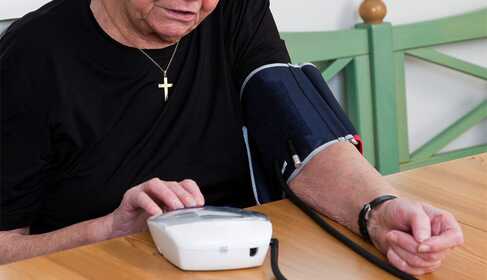
Hypertension care stands or falls on measurements: the doctor sees a few snapshots each year in the clinic, while at home you can record the “whole film”. According to an analysis combining individual patient data from 25 studies, home self-measurement on its own produces only minimal improvement (about 1 mmHg)—but when measurement is combined with an action plan (fine-tuning medication based on the measurement diary, feedback from the care team and target values), the difference grows to more than 6 mmHg.4 The lesson is: do not just measure—measure according to a plan, and take the diary with you to every medical appointment.
The basics of correct home measurement are as follows: measure while seated, after 5 minutes of rest, with your back supported and the cuff at heart level; do not drink coffee, smoke or exercise during the half-hour before measurement; measure in the morning (before taking medication) and in the evening, taking two measurements each time 1–2 minutes apart, and always record the result. I have collected the detailed rules—including the most common mistakes—in the article on the rules of blood pressure measurement, and I have explored the major question of choosing a device (wrist or upper arm?) in a separate article—in short: for most adults, a validated upper-arm device is the reliable choice.
 Warning signs—when should you NOT wait for your next appointment?
- A value above 180/120 mmHg with symptoms—if there is chest pain, shortness of breath, severe headache, visual disturbance, confusion, speech disturbance or limb weakness, call an ambulance immediately: this may be a hypertensive crisis
- A value above 180/120 mmHg without symptoms—sit down and calm yourself, then measure again after 15–30 minutes; if the value does not fall, seek medical help that same day
- Possible stroke symptoms at any blood pressure—drooping at the corner of the mouth, one-sided weakness or speech disturbance: call an ambulance immediately, every minute counts
- High blood pressure detected during pregnancy—hypertension during pregnancy (especially with headache, visual disturbance or oedema) requires urgent obstetric assessment
- High blood pressure beginning at a young age or worsening suddenly—a value appearing under the age of 30, or a value that was previously well controlled and then rises inexplicably, suggests a secondary cause: investigation is needed
A single high reading is not yet a crisis
Anyone can temporarily have a high reading after excitement, pain, a bad night or a missed dose of medication. A single spike without symptoms is no reason to panic—repeat the measurement, stay calm and record the result. The warning signs above are EXCEPTIONAL situations; the everyday rhythm of hypertension care is based on calm, regular measurement.
Frequently asked questions
This is the classic white-coat phenomenon, which is precisely why a diagnosis should not be based on a single clinic measurement. The question is decided by your home measurement diary (the average of correctly taken readings over several days) or 24-hour ABPM. If your home average is consistently below 135/85, you probably do not have hypertension requiring treatment despite the clinic spike—but white-coat hypertension is not entirely harmless either: those affected are more likely to develop genuine high blood pressure later, so annual checks are justified.
Measure both arms the first time, using the average of several readings—a small difference (under 10 mmHg) between the arms is normal. After that, always measure on the arm where you recorded the higher value, and note this in your diary. If the difference between the arms is consistently greater than 15–20 mmHg, tell your doctor because it may indicate arterial narrowing.
In mild, grade 1 hypertension without other risk factors, this is a realistic goal: exercise (−8.3 mmHg2), reducing salt (−5.4 mmHg3) and losing weight can together produce exactly the required magnitude of change—doctors often allow 3–6 months of “lifestyle grace period” without medication in this situation, with home monitoring. At higher values or with coexisting conditions (diabetes, kidney disease or a previous cardiovascular event), medication cannot be postponed—but lifestyle remains a full treatment partner and may reduce the amount of medication needed.
For most treated patients, the general target is below 140/90 mmHg, with a well-tolerated clinic value around 130/80—but your doctor will set the precise target according to your age, coexisting conditions and tolerance of treatment. At an older age, targets are more cautious and gradual; they are stricter with diabetes or kidney disease. The key is not decimal-point precision but consistency: a steady value maintained over the long term produces the benefits measured in research.1
Not only can you—the most effective elements of treatment include exercise.2 With treated and controlled hypertension, moderate-intensity aerobic exercise (walking, cycling, swimming) is specifically recommended, and resistance training also has a place in the programme. Two sensible rules: with untreated readings above 180/110, get the blood pressure controlled before exercising; and avoid or adapt exercises involving heavy exertion and straining (heavy weights while holding your breath), ideally with professional guidance. If you are uncertain, tailored, supervised exercise—medical fitness—is a safe way to begin.
What research says—in answer to readers’ questions
“Blood pressure medication only treats symptoms—it does not treat the cause. Why should I take it?”1
In hypertension, the “symptom” and the “damaging factor” are the same: the pressure itself. According to a meta-analysis published in The Lancet covering 123 studies and 613,815 patients, every 10 mmHg reduction in systolic pressure achieved through blood pressure treatment means 20% fewer major cardiovascular events, 27% fewer strokes, 28% fewer cases of heart failure and 13% lower overall mortality—in other words, treatment does not merely make the sensation look better; it reduces heart attacks, strokes and lost years of life.1 It is a separate question that it is also worth addressing the causes—lifestyle: the two approaches are not alternatives, but add up.
“How much can be achieved through lifestyle alone, without medication?”23
A great deal, in measurable terms. According to an exercise meta-analysis combining 93 studies, aerobic training reduces blood pressure in people with hypertension by an average of 8.3/5.2 mmHg, while isometric exercise reduces it by almost 11 mmHg2—an effect comparable to medication. According to the Cochrane analysis, moderate, sustained salt reduction brings a further 5.4/2.8 mmHg reduction in people with hypertension, in a dose-dependent manner.3 A combined lifestyle programme can therefore realistically reduce blood pressure by 10–15 mmHg—the condition for maintaining the effect is the same as with medication: continuous “dosing”, in other words persistence.
“Does home measurement really improve results, or does it only cause anxiety?”4
An analysis combining individual data from 10,487 patients in 25 studies provides a precise answer: self-measurement alone—without a plan or feedback—barely changes the values (about 1 mmHg). When measurement is combined with a care plan—with medication fine-tuned based on the diary, a target value and feedback—the additional reduction is already 6.1 mmHg.4 The monitor is therefore not a magic device but a dashboard: it becomes useful because you and your doctor make decisions based on its data. That is why it is worth keeping a diary and taking it to every appointment.
Summary
What is this article about? A complete guide to high blood pressure: what the numbers mean and where the threshold lies, why it develops and what untreated hypertension causes, how it can be confirmed reliably (home measurement, ABPM), and what you can do about it—from the power of lifestyle changes measured in mmHg to the real benefits of medication.
Who is it for? People who have only just begun to suspect high blood pressure—and people who have been treated for hypertension for years but want to understand and do more for their own numbers.
Main message: Hypertension is silent, but it is not unbeatable: every sustained 10 mmHg reduction means one-fifth fewer cardiovascular events and 13% lower mortality. Exercise, reducing salt and losing weight can together produce an effect comparable to medication, while medication is not cosmetic treatment of symptoms but one of the medical interventions that saves the most years of life—the two approaches add up.
Next step: Get a reliable upper-arm blood pressure monitor, measure correctly every morning and evening for one week, and see your doctor with the average—not a single reading. If you are already receiving treatment, keep a measurement diary, take it to your appointments and start your first lifestyle change this week.
Read more
- Blood pressure measurement rules—how to measure accurately at home
- Blood pressure monitor: wrist or upper arm?
- Stroke: a catastrophe affecting more than just the brain
- Arterial narrowing: how does it develop and how can it be treated?
- Stress: does it help or make you ill?
- Medical fitness: tailored exercise guidance for people with medical conditions
Scientific sources
- Ettehad D, Emdin CA, Kiran A, et al. (2016). Blood pressure lowering for prevention of cardiovascular disease and death: a systematic review and meta-analysis. The Lancet. DOI: 10.1016/S0140-6736(15)01225-8
- Cornelissen VA, Smart NA. (2013). Exercise training for blood pressure: a systematic review and meta-analysis. Journal of the American Heart Association. DOI: 10.1161/JAHA.112.004473
- He FJ, Li J, MacGregor GA. (2013). Effect of longer term modest salt reduction on blood pressure: Cochrane systematic review and meta-analysis of randomised trials. Cochrane Database of Systematic Reviews. DOI: 10.1002/14651858.CD004937.pub2
- Tucker KL, Sheppard JP, Stevens R, et al. (2017). Self-monitoring of blood pressure in hypertension: a systematic review and individual patient data meta-analysis. PLOS Medicine. DOI: 10.1371/journal.pmed.1002389