


 What is hyperhidrosis? What is iontophoresis?
Let’s start with the basic terms, because it’s important to understand exactly what we’re talking about.
Hyperhidrosis is a medical term of Greek origin meaning excessive sweating. “Hydro” refers to water, while “osis” indicates an abnormal condition. Hyperhidrosis is therefore a condition in which your body sweats far more than necessary – not because of heat or physical exertion, but because the sweat glands are overactive.
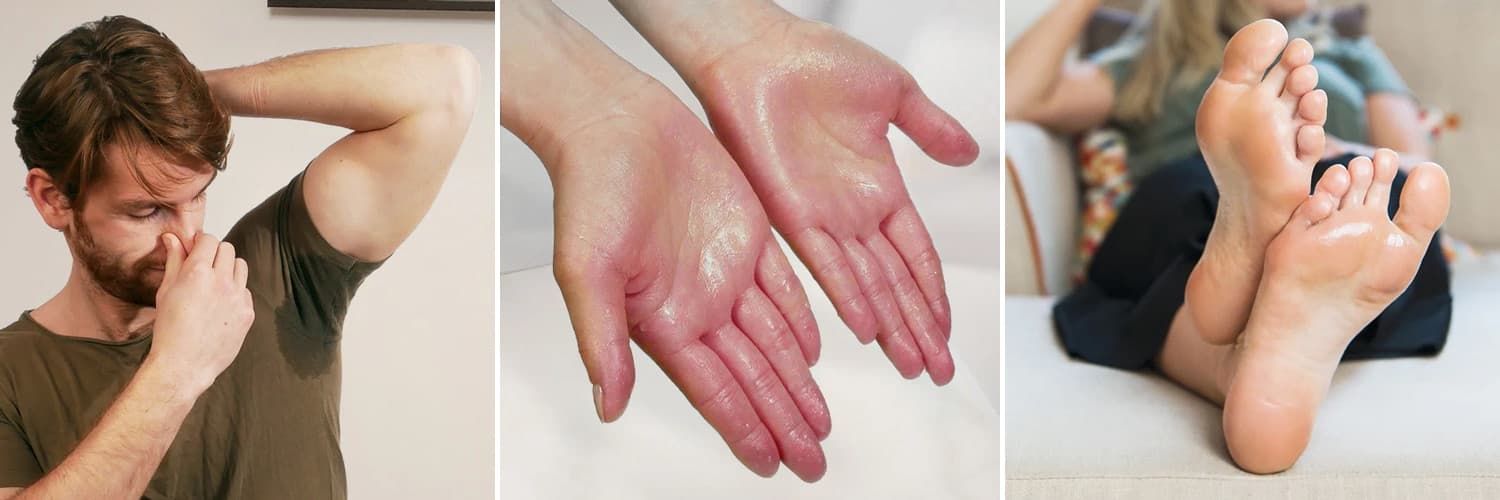
Think of it as a tap whose shut-off mechanism has broken. Your body’s “thermostat” is set incorrectly: it keeps cooling you even when there is no need. This is not a disease in the classic sense, but a functional disorder – the regulation of the sweat glands is not working properly.
Iontophoresis is also a word of Greek origin. It comes from “ion” (a charged particle) and “phoresis” (transfer or transport). Iontophoresis is therefore a procedure that uses an electric current to deliver charged particles into or through the skin.
Tap water iontophoresis is a method used specifically to treat hyperhidrosis. It uses ordinary tap water as the conductive medium. In international literature, you will find it under the name “tap water iontophoresis”.
Types of hyperhidrosis
Primary hyperhidrosis: This is the most common form, accounting for 90% of cases. It begins in childhood or adolescence and is typically genetic in origin. The symptoms are symmetrical – both palms, both soles or both armpits are affected. According to research, 30-65% of affected people have a family member with similar complaints. An important characteristic is that it does not occur at night during sleep – this helps distinguish it from the secondary form.
Secondary hyperhidrosis: This develops as a result of an underlying disease or as a side effect of medication. Possible causes include an overactive thyroid, diabetes, menopause, infections, malignant tumours or certain medicines. It can begin at any age, is often asymmetrical and may also occur at night. If your hyperhidrosis began suddenly in adulthood, see a doctor to rule out underlying causes.
 How does tap water iontophoresis work?
Iontophoresis has been used to treat hyperhidrosis since the 1940s, but the real breakthrough came in the past decade with the appearance of modern devices for home use. During treatment, a mild electric current is passed through the skin via tap water. But how does this reduce sweating?
How the treatment works
The exact mechanism of action is not yet fully understood. Several hypotheses exist, and all of them probably contribute to the result.
The first and most widely accepted theory is the temporary blockage of sweat gland ducts. Under the effect of the electric current, tiny particles – probably proteins and ions – are deposited in the outlet ducts of the sweat glands. This does not damage the glands. It only temporarily “plugs” them, like a blockage closing a pipe. The effect is reversible: if you stop treatment, the ducts gradually open again.
The second mechanism involves electrochemical changes. The current changes the pH balance in the sweat glands. Sweat production requires a specific chemical environment. If this is disrupted, gland activity slows down.
The third theory is a reduction in nerve excitability. The current raises the threshold at which the nerves activate the sweat glands. Put simply, the glands become less sensitive to the signals that trigger sweating.
 Key point
It is important to understand that the effect is not permanent. It usually lasts for a few weeks after the initial course. Regular maintenance treatments are therefore needed to maintain the result. But this is not a disadvantage. On the contrary, you can control the result, and there is no irreversible intervention. If you stop treatment for any reason, no permanent change occurs.
Pulsed current vs direct current – which should you choose?
Devices may use two types of current, and this is important both for treatment success and user comfort.
Direct current (DC – Direct Current): Earlier generations of iontophoresis devices used continuous direct current. In theory, this is the most effective method because the current acts continuously. In practice, however, it has significant limitations. Effective treatment can be uncomfortable, may cause skin irritation and can be painful, particularly in the armpits. As a result, many patients cannot reach the current strength needed for effectiveness – they simply cannot tolerate it. It is like having a very effective medicine that is so bitter you cannot swallow it. The IontoBravo device also provides DC current.
Pulsed current (PC – Pulsed Current): Modern devices such as DermaDry use pulsed current. The 10 kHz square-wave pulses do not activate the skin’s pain receptors as intensely, making treatment much more comfortable.
What does this mean in practice? **According to the DermaDry instructions, pulsed current is just as effective as direct current while reducing the risk of irritation and pain.**¹ In the 1993 clinical study by Reinauer and colleagues, patients treated with pulsed current reached a completely sweat-free state after an average of 11 treatments – an identical result to that of the continuous-current control group, while side effects were minimal.²
DermaDry technology: The device uses a fixed 90% duty cycle (90% active period, 10% pause) at a frequency of 10 kHz. This means that during a 20-minute treatment, you receive 18 minutes of actual therapeutic dose – close to the effectiveness of continuous current. The pulse ratio cannot be adjusted, but this is not a disadvantage: the manufacturer optimised this setting for the best balance between effectiveness and comfort.
Key point
In summary, the greatest advantage of pulsed current is that it is more comfortable. You can therefore tolerate a higher current strength, which results in more effective treatment. It is like coating a bitter medicine with a pleasant-tasting layer: the effect is the same, but it is much easier to take.
(Read more: why electrode polarity matters in electrotherapy.)
Comparing iontophoresis with other treatment methods
If you have hyperhidrosis, you can choose from several treatment options. Each has advantages and disadvantages. The ideal choice depends on your individual situation. Below, I compare the main methods in detail so that you can make an informed decision.
Antiperspirants
What do you need to know? Aluminium chloride antiperspirants temporarily block the openings of the sweat glands. They are first-line treatments – in other words, they are worth trying before turning to another method.
Effectiveness: In mild to moderate hyperhidrosis, an improvement of 30-50% can be expected. They are generally not sufficient in more severe cases.
Advantages: They are inexpensive and easy to obtain. No prescription is needed, although stronger prescription versions are also available. They are simple to use – just apply them like a deodorant.
Disadvantages: Their effect is limited and they are generally insufficient for severe hyperhidrosis. They cause skin irritation in many users, particularly products with a higher aluminium content. The effect wears off quickly – they need to be reapplied daily or every other day.
Who are they ideal for? People with a mild sweating problem who are looking for a quick, simple solution. This is the first step. If it does not work, it is worth moving on.
Botulinum toxin (Botox) injections
What do you need to know? Botox temporarily blocks the nerve signals that activate sweat production. The doctor injects it at several points in the problem area, such as the armpit, palm or sole.
Effectiveness: 85-95%, and the effect lasts for 4-12 months, depending on the individual.
Advantages: Excellent effectiveness and a rapid effect, which appears within a few days. No daily routine is needed – one treatment lasts for months.
Disadvantages: It is painful, particularly in the palms and soles, where there are many nerve endings. It is expensive – one treatment costs around HUF 80-150 thousand and must be repeated every 4-6 months. Over the long term, this means an expense of several million forints. The effect is not permanent and treatment must be repeated regularly. Temporary muscle weakness may rarely occur in the treated area.
Who is it ideal for? People for whom iontophoresis has not produced results, or who cannot or do not want to carry out home treatment regularly. It is particularly popular for underarm sweating because it is less painful there.
Medication (anticholinergic medicines)
What do you need to know? Anticholinergic medicines such as oxybutynin and glycopyrrolate block the neurotransmitter acetylcholine, which is also responsible for sweat production. They are taken as tablets.
Effectiveness: 60-80%, but this varies greatly from person to person. They work very well for some people and produce little benefit for others.
Advantages: They treat the whole body. If you sweat in several areas, such as the palms, soles, armpits and face, one tablet can treat all of them. They are easy to use – you simply take one each day.
Disadvantages: They may cause systemic side effects because they affect the whole body. The most common are dry mouth (very common, occurring in up to 80% of cases), blurred vision, constipation, palpitations and urinary retention. Older people and people with certain conditions, such as glaucoma or an enlarged prostate, must not take them. Long-term use may lead to reduced effectiveness, or tolerance.
Who are they ideal for? People with severe sweating in several areas of the body when iontophoresis is unsuitable, for example because regular treatment is not possible. They should be used in consultation with a doctor, after carefully weighing up the possible side effects.
Surgery (endoscopic thoracic sympathectomy – ETS)
What do you need to know? During the operation, the doctor cuts or closes the nerves, known as the sympathetic nerve chain, that control sweat production. This is a permanent procedure.
Effectiveness: More than 95% for sweaty palms, but variable in other areas.
Advantages: A lasting, often permanent solution. One procedure and it is “done”.
Disadvantages: It is irreversible. If problems arise, it cannot be undone.
The most significant and fairly common risk is compensatory sweating: increased sweating may develop in other areas of the body, such as the back, abdomen and thighs, and this can be more severe than the original problem. This occurs to some degree in 50-80% of operated patients. Surgical risks may also include infection, bleeding and nerve injury. Horner’s syndrome, involving eye symptoms, may develop rarely.
Who is it ideal for? Only as a last resort, when every other method has failed and hyperhidrosis seriously impairs quality of life. Young people should consider it particularly carefully because of its irreversible nature.
Tap water iontophoresis (DermaDry or IontoBravo)
What do you need to know? A mild electric current is passed through the skin via tap water, temporarily “plugging” the sweat gland ducts.
Effectiveness: 80-93%, based on research and user experience.
Advantages: Safe, with decades of clinical experience and minimal side effects. Cost-effective over the long term – after the initial investment, there are no significant further costs. It can be carried out at home, so you do not need to visit a doctor. It is non-invasive – there are no injections or incisions. It is reversible – if you stop, no permanent change occurs. It can also be used in children under parental supervision.
Disadvantages: Time-consuming – during the initial phase, a 15-20-minute treatment is needed each day, followed by 1-2 maintenance treatments per week. It requires consistency – if you stop, the sweating returns. It is not suitable for every body area; it cannot be used on the face, neck or scalp.
Who is it ideal for? People who are willing to commit to regular treatment and are looking for a safe, cost-effective long-term solution. It is recommended as the first choice after antiperspirants and before Botox or medication.
Children and iontophoresis
If your child has excessive sweating, you are not alone. Hyperhidrosis often begins during adolescence, a time that can be particularly difficult psychologically. The good news is that tap water iontophoresis can also be used safely in children.
A study of children aged 6-17 confirmed the safety and effectiveness of the method in this age group.⁷ A 2024 study also showed that children’s quality of life improves significantly after just 10 iontophoresis treatments.⁶ This is important because self-esteem and social relationships are strongly affected when young people feel they must be embarrassed by sweating.
Key point
My advice: Always start a child at a lower current strength and increase it gradually. The manufacturer recommends the DermaDry device from the age of 13. For children under 13, carry out treatment only under close parental supervision.
What to expect during treatment
Treatment protocol
Intensive phase (2-4 weeks): Treat daily or every other day until you achieve the desired dryness. Treatment takes 15-20 minutes per area. DermaDry automatically alternates the polarity, which reduces the likelihood of side effects.
Maintenance phase: 1-2 treatments per week are sufficient to maintain the result. In mild cases, once a week may be enough. You can adjust the frequency of maintenance treatments to your individual needs. If you feel that sweating is returning, carry out one or two extra treatments.
Most people achieve the maximum effect after 10-14 treatments. Be patient – you may not notice a visible change in the first few days.
Possible side effects
Iontophoresis is a safe treatment, but temporary reactions may occur:
Common temporary reactions: Mild tingling or stinging during treatment. This is normal and indicates that the current is passing through. Redness in the treated area, which usually disappears within minutes. Temporary dry skin – treatment reduces moisture, so moisturising is recommended.
Less common reactions: Small blisters if the current strength is too high – reduce it. Skin irritation along the waterline, where the water meets the air.
Key point
My advice: Apply petroleum jelly to the waterline and any small wounds before treatment. This helps prevent irritation.
 Before you start treatment
For safe use, it is important to know the contraindications. In addition to the rules specific to iontophoresis, you should also be familiar with the general contraindications of electrical treatment.
When should you NOT use it?
Do NOT use the device if you have an implanted pacemaker or defibrillator; are pregnant; have metal implants in the area to be treated, such as bone plates or screws; are being treated for a heart rhythm disorder; have a history of epileptic seizures; or have an open wound, infection or skin injury in the area to be treated. (Detailed explanation: electrical treatment and implants.)
Extra caution is needed
Ask for medical advice if you have diabetes, with reduced sensation in the limbs; peripheral neuropathy; or a skin condition, such as eczema or psoriasis, in the area to be treated.
Practical advice for home treatment
Water quality
Tap water quality varies from one area to another. Water that is too soft does not contain enough minerals to conduct the current, and the effect may be reduced. What can you do if your water is soft? Add one teaspoon of bicarbonate of soda to the water, or use mineral water. On medical advice, an anticholinergic additive such as glycopyrrolate may also be added to the water to increase the effect.
Treatment areas
Palms and soles: Simply place your hands or feet in the trays filled with water. Treatment time: 20 minutes, with automatic polarity reversal.
Armpits: These can be treated with special pads containing wet electrodes. The DermaDry device includes an underarm attachment. Treatment time: 15 minutes.
Home iontophoresis devices
If you have decided on iontophoresis, the next step is choosing the right device. The Medimarket range includes two iontophoresis devices designed for different needs. Below, I introduce both in detail and help you decide which one is right for you.
The full iontophoresis product category is available here.
DermaDry Total – specialised tap water iontophoresis
DermaDry Total is a CE-certified and FDA-authorised medical device designed specifically for tap water iontophoresis. The device uses pulsed current (PC) only, making treatment more comfortable.
Package contents: DermaDry control unit with mains adapter; 2 treatment trays for the palms and soles; underarm electrodes and sponge covers; silicone meshes to protect the electrodes; cables and instructions for use.
Technical data: Fixed 90% duty cycle, 10 kHz frequency; treatment time 15-20 minutes; maximum current: hand 15 mA, foot 25 mA, underarm 8 mA; automatic polarity reversal; safety current limitation.
Advantages: Specifically optimised for tap water iontophoresis; automatic polarity reversal; 5-year manufacturer’s warranty; FDA and Health Canada authorisation.
Who is it recommended for? People who want to use tap water iontophoresis only and value simple, automated operation.
IontoBravo – dual-function iontophoresis device
IontoBravo is a CE-certified, dual-purpose iontophoresis device. Unlike DermaDry, it is suitable not only for tap water iontophoresis but also for conventional medicated iontophoresis.
Dual use:
- Tap water iontophoresis: It can be used on the palms, soles and armpits, just like DermaDry.
- Conventional iontophoresis: Anti-inflammatory active substances such as Voltaren and Fastum gel can be delivered with electrodes into joints and muscles, bypassing the digestive system. This is a useful additional function for joint and tendon inflammation and sports injuries. A separate article covers acetic acid iontophoresis for treating heel spurs (plantar fasciitis).
Technical data: Both direct current (DC) and pulsed current (PC) modes; a wider range of settings; treatment time 15-20 minutes.
Package contents: IontoBravo control unit; treatment trays; electrodes and sponge covers; cables and instructions for use.
Advantages: Dual function, tap water and conventional iontophoresis; both DC and PC modes available; can also be used for musculoskeletal complaints.
Who is it recommended for? People who want to use the device for joint complaints as well as tap water iontophoresis, or who want to try both current types, DC and PC.
DermaDry vs IontoBravo – detailed comparison
| Feature | DermaDry Total | IontoBravo |
|---|---|---|
| Manufacturer | DermaDry Laboratories (Canada) | MTR+ (Germany) |
| CE certification | ✓ Yes | ✓ Yes |
| FDA authorisation | ✓ Yes | ✗ No |
| Tap water iontophoresis | ✓ Yes | ✓ Yes |
| Conventional iontophoresis | ✗ No | ✓ Yes (joint treatment) |
| Current type | PC only (pulsed) | Both DC and PC |
| Duty cycle | Fixed 90% | Adjustable |
| Automatic polarity reversal | ✓ Yes | ✗ Manual |
| Palm/sole treatment | ✓ Yes | ✓ Yes |
| Underarm treatment | ✓ Yes | ✓ Yes |
| Joint treatment | ✗ No | ✓ Yes |
| Treatment time | 15-20 minutes | 15-20 minutes |
| Maximum current (foot) | 25 mA | Wider range |
Which one should you choose?
Choose DermaDry if:
- You want to use tap water iontophoresis only, for the palms, soles or armpits
- FDA authorisation and a longer warranty are important to you
- You like simple, automated treatment
- You value the comfort of pulsed current
Choose IontoBravo if:
- You have joint complaints as well as a need for tap water iontophoresis
- You would also like to try direct-current treatment
- Versatility and a wider range of settings are important to you
- You do sport and would also like to support recovery after injuries
Both devices are suitable for tap water iontophoresis, and both are CE-certified medical devices. The choice mainly depends on whether you need the dual function.
Step by step: your first iontophoresis treatment
If you have just bought your device and do not know how to get started, here is a simple guide.
Step 1: Preparation. Fill the treatment trays with lukewarm tap water up to the marked level. The water should be comfortably warm – 20-40°C is ideal.
Step 2: Skin care. Check the area to be treated. If there is a small wound, peeling or a crack, apply petroleum jelly. This insulates the damaged area and prevents irritation.
Step 3: Settings. Start at a low current strength, 5-10 mA, and increase it gradually until you feel mild tingling. This is the optimal level. Do not set it too high – the tingling should not be uncomfortable.
Step 4: Treatment. Place your hands or feet in the trays and switch on the device. Sit comfortably and do not move your hands or feet during treatment. DermaDry automatically reverses the polarity.
Step 5: Finishing. After treatment, dry your hands or feet and apply moisturising cream. This helps prevent dryness.
Step 6: Regularity. During the first 2-4 weeks, treat every day or every other day. Once you achieve the desired dryness, switch to 1-2 maintenance treatments per week.
Watch the short videos showing how to carry out the treatments
 When should you see a doctor?
Although iontophoresis is a safe home treatment, there are situations when you should see a doctor:
If hyperhidrosis began suddenly in adulthood, as this may indicate a secondary cause; if you also sweat at night, as this may be a symptom of various diseases; if sweating is accompanied by fever, weight loss or another unusual symptom; if iontophoresis has not improved the situation after 4 weeks; or if you have a skin reaction that does not disappear within a few days.
 Summary – quick overview
What is this article about? A comprehensive guide to treating hyperhidrosis, or excessive sweating, with tap water iontophoresis. It presents the scientific background of the method, compares it with other treatment options and provides practical advice for home use.
Who is it for? Anyone dealing with sweaty palms, soles or armpits; parents whose child has hyperhidrosis; healthcare professionals who provide information to their patients; and anyone looking for an effective, drug-free solution.
Main message: Tap water iontophoresis is a scientifically supported, safe method that can be used at home. 80-93% of treated people report significant improvement. It does not replace medical care, but used alongside it, it may effectively reduce symptoms and improve quality of life.
Key terms and definitions:
| Term | Meaning | Note |
|---|---|---|
| Hyperhidrosis | Abnormally excessive sweating | Greek: hydro = water, osis = abnormal condition |
| Iontophoresis | Therapy using an electric current | Greek: ion = charged particle, phoresis = transport |
| Tap water iontophoresis | Hyperhidrosis treatment using tap water | English: tap water iontophoresis |
| DC (Direct Current) | Direct current | Older technology, less comfortable |
| PC (Pulsed Current) | Pulsed current | Modern technology, more comfortable |
| Primary hyperhidrosis | Primary, genetic in origin | 90% of cases |
| Secondary hyperhidrosis | Secondary, caused by an underlying disease | Medical assessment is needed |
Summary of the mechanism of action:
Iontophoresis works through three main mechanisms. First, blockage of the sweat gland ducts: the current causes tiny particles to settle in the outlet ducts, temporarily blocking them. Second, electrochemical changes: the pH balance in the glands changes, slowing sweat production. Third, a reduction in nerve excitability: the threshold at which the nerves activate the glands increases.
Detailed comparison of treatment methods:
| Method | Effectiveness | Cost (5 years) | Side effects | Pain | Home use | Reversible |
|---|---|---|---|---|---|---|
| Iontophoresis | 80-93% | ~HUF 150-200 thousand | Minimal | None | Yes | Yes |
| Antiperspirants | 30-50% | ~HUF 100-150 thousand | Mild irritation | None | Yes | Yes |
| Botox | 85-95% | ~HUF 2-4 million | Moderate | Yes | No | Partly |
| Medication | 60-80% | ~HUF 200-500 thousand | Systemic | None | Yes | Yes |
| Surgery (ETS) | 95%+ | ~HUF 500 thousand-1 million | Significant | Yes | No | No |
Applications and level of evidence:
| Treatment area | Level of evidence | Note |
|---|---|---|
| Palms (palmar) | Strong | Most frequently studied, 91% effectiveness |
| Soles (plantar) | Strong | Similar results to the palms |
| Armpits (axillary) | Moderate to strong | Effective with special electrodes |
| Children (6-17 years) | Moderate to strong | Safe; improvement in quality of life demonstrated |
Contraindications (when NOT to use it):
Iontophoresis is not recommended in people with an implanted pacemaker or defibrillator, during pregnancy, in the presence of metal implants in the area to be treated, during treatment for a heart rhythm disorder, with a history of epilepsy, or when there is an open wound or infection in the area to be treated.
Frequently asked questions
During the intensive phase, every day or every other day for 2-4 weeks. For maintenance, 1-2 treatments per week are sufficient.
Many people notice an improvement after just 1-2 weeks. The full effect usually requires 10-14 treatments.
It is not painful. You may feel mild tingling, which indicates that the current is passing through. If it is uncomfortable, reduce the current strength.
Yes. Research confirms its safety from the age of 6. The manufacturer recommends it from the age of 13; below that age, medical consultation is needed. Start under parental supervision and at a lower current strength.
The sweating gradually returns, usually within 1-4 weeks. This is why regular maintenance treatment is important.
Yes. Iontophoresis can be safely combined with antiperspirants and other treatments. Consult your doctor if you are taking medication.
For the palms and soles, 20 minutes with automatic polarity reversal. For the armpits, 15 minutes. The complete routine takes 20-40 minutes.
Yes. DermaDry is compact and portable. You can also take it on a plane in your hand luggage.
Direct current (DC) is continuous, while pulsed current (PC) acts in pulses. Pulsed current is more comfortable and just as effective.
Because you can tolerate a higher current strength without discomfort, making treatment more effective. With its 90% duty cycle, DermaDry achieves almost the same result as direct current.
If you want to use tap water iontophoresis only, DermaDry is the simpler and more automated choice, with a 5-year warranty. If you also have joint complaints, or would like to deliver active substances into muscles and joints, IontoBravo is the more versatile option, with dual functionality and both DC and PC current types.
Sources
- DermaDry Laboratories Inc. (2022). Instructions for use – Iontophoresis device. Section 13: Integrated safety functions.
- Reinauer S, et al. (1993). Iontophoresis with alternating current and direct current offset (AC/DC iontophoresis): a new approach for the treatment of hyperhidrosis. British Journal of Dermatology, 129(2):166-169. PubMed: 7654577
- International Hyperhidrosis Society. Iontophoresis for palmoplantar hyperhidrosis. sweathelp.org
- Kim WO, et al. (2017). Treatment of Palmar Hyperhidrosis with Tap Water Iontophoresis: A Randomized, Sham-Controlled, Single-Blind, and Parallel-Designed Clinical Trial. Annals of Dermatology, 29(6):728-734. PubMed: 29200761
- Hölzle E, et al. (1987). Long-term efficacy of home tap water iontophoresis for palmar hyperhidrosis. British Journal of Dermatology, 117(6):761-766. PubMed: 3653460
- Children (2024). Quality of life improvement in pediatric hyperhidrosis following iontophoresis treatment. DOI: 10.3390/children11101253. MDPI
- Dagash H, et al. (2017). Pediatric tap water iontophoresis safety and efficacy. Journal of Pediatric Surgery, 52(2):309-311. PubMed: 27912978
- Pariser DM, Ballard A. (2014). Iontophoresis for palmar and plantar hyperhidrosis. Dermatologic Clinics, 32(4):491-494. PubMed: 25152342
- Stolman LP. (1987). Treatment of excess sweating of the palms by iontophoresis. Archives of Dermatology, 123(7):893-896. PubMed: 3606167
- Siah TW, Hampton PJ. (2013). The effectiveness of tap water iontophoresis for palmoplantar hyperhidrosis using a Monday, Wednesday, and Friday treatment regime. Dermatology Online Journal, 19(3):2. PubMed: 23552011
 Scientific background – what does the research say?
It is important to understand what scientific studies show. Tap water iontophoresis is not a miracle cure, but decades of clinical experience and numerous studies support its effectiveness.
According to the International Hyperhidrosis Society, 91% of people with palmar and plantar sweating experience significant improvement with iontophoresis.³ This is a particularly high proportion among treatment methods.
The 2017 randomised, placebo-controlled study by Kim and colleagues is one of the strongest pieces of evidence for the effectiveness of the method.⁴ In the study, the group receiving active treatment showed 92.9% improvement, while the placebo group showed only 38.5%. This difference was statistically significant, meaning it was not due to chance.
The long-term study by Hölzle and colleagues in 1987 showed that home tap water iontophoresis produces an 81% reduction in sweating with continued use.⁵ This is important because it demonstrates that the treatment can remain effective not only in the short term but for years.
A 2024 paediatric study confirmed that children’s quality of life improves significantly after just 10 iontophoresis treatments.⁶ This is particularly important because hyperhidrosis often begins during adolescence, when young people are especially sensitive to social situations.

Final thoughts
Excessive sweating is not merely unpleasant. It can affect quality of life and limit social interaction. You avoid handshakes, worry that others will notice your sweat-soaked shirt, and feel that embarrassment has become a constant companion. But you do not have to live with this.
Tap water iontophoresis offers a safe, effective and cost-effective long-term solution. Numerous scientific studies support significant improvement for the vast majority of treated people. It is not a miracle cure – but it works.
If you have been putting off taking action, now is the time. Modern devices are simple to use at home. After 2-4 weeks of regular treatment, you may finally be free from clammy palms, sweat-soaked shirts and embarrassment. The decision is yours. If you decide to go ahead, we are here to help. The Medimarket team’s 30 years of experience is behind you.
The information in this article is for general information only. Iontophoresis is intended to complement medical treatment, not replace it. If you have complaints, consult your treating doctor. Information about the correct use of home therapy devices can be found in the product description and instructions for use.

