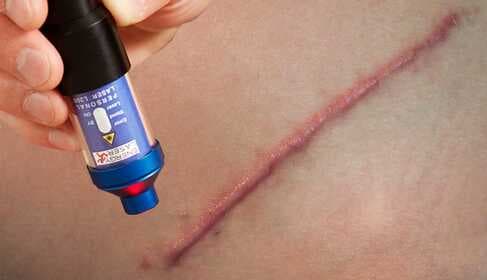

 Treating scars and keloids with soft laser – what can you achieve at home?
A scar is connective tissue "made" by the skin: this is how it closes an injury, a surgical wound or a deep spot. Most scars gradually fade nicely on their own – but not all of them: some become thicker, raised, itchy and tight, while others – keloids – grow beyond the original wound margins. The good news is that scar tissue is not a finished story. A scar actively "matures" and remodels for months, sometimes up to a year and a half – and light therapy has a well-documented role during this remodelling window: in a meta-analysis of clinical laser scar treatments, more than two-thirds of patients improved meaningfully1, and daily light treatment at home also produced measurable results in a study.2
This article will teach you to distinguish between scar types – because a normal scar, a hypertrophic scar and a keloid are different stories –, show you what you can do at home with light (for prevention and treatment), and honestly place the home method within the full range of options, from silicone sheeting to clinical treatments.
 Key point
The golden rule of scar treatment is timing: a scar is most malleable during the first months, so PREVENTIVE treatment brings the greatest benefit – regular light treatment of a fresh, already closed wound. In the pioneering study, patients treated one half of a freshly revised scar at home, daily, with infrared light for 30 days – and the treated side healed visibly better than the untreated control in every measurement.2 With a mature keloid, the goal is more modest: thinning, softening and fading – not disappearance.
 What type of scar do you have? This determines the plan
| Type | How can you recognise it? | What can you do? |
|---|---|---|
| Normal (mature) scar | Remains within the wound line, gradually fades, flattens and softens | Patience + skin care + sun protection; light treatment supports improvement during the months of maturation |
| Hypertrophic scar | Raised, red, hard and often itchy – but remains WITHIN the original wound margins; it may also improve on its own over 1–2 years | The most responsive target: light treatment + silicone sheeting, started early |
| Keloid | GROWS BEYOND the wound margins; thick, hard, reddish-purple, tight and itchy; does not improve on its own and tends to recur after excision | Combined strategy: home light to soften and fade it + dermatological treatments (injections, clinical laser) for persistent cases |
| Atrophic (depressed) scar | Sinks BELOW the skin surface – typically acne scars | A different field: there is tissue loss here, so clinical procedures (fractional laser, fillers) are the main route; red light may help fade fresh acne marks |
A tendency to keloids is partly inherited and is more common in darker skin types; favourite locations are the earlobe (ear piercing!), chest, shoulder and back. If you know that you are prone to them, every skin injury – piercing, tattoo or minor surgery – should be considered in advance, and preventive treatment is especially worthwhile.
 How does a scar mature – and where can light make a difference?
After the wound closes, intensive activity continues in the scar for months: connective-tissue cells (fibroblasts) initially produce collagen quickly and in a disorganised way – this makes a young scar red, hard and raised. This is followed by the long remodelling phase: the disorganised fibres gradually become an orderly structure following the lines of the skin, excess material breaks down and the blood vessels retract – the scar fades and softens. This process lasts 6–18 months.
Two major lessons for scar treatment follow from this: a scar can be actively shaped for many months – so it is never "too late" to start during the maturation period –, and a hypertrophic scar or keloid is essentially overactive collagen production: treatments aim to rebalance this process.
Red and infrared light acts precisely on the conductors of scar maturation: it moderates the signalling that drives excessive collagen production (researchers identified suppression of the TGF-beta pathway), improves microcirculation and supports the orderly remodelling of fibres. The most encouraging home-use data concerns prevention: patients who had undergone scar revision treated one half of the new scar at home, daily, with 805 nm infrared light for one month – the treated half healed visibly more favourably in every measurement (thickness, colour and surface), even up to a year later.2
The effect is more modest but real in established scars: in a randomised study, the appearance of laser-treated scars improved meaningfully, and the thickness of older scars also showed a downward trend.3 The realistic goal is therefore: better maturation for a fresh scar, and softening and fading for an older one.
The biggest numbers in scar treatment relate to clinical lasers: according to a meta-analysis covering 28 clinical studies and 919 patients, 71% of patients responded to laser treatment for scar prevention, 68% for hypertrophic scars and 72% for keloids – pulsed dye laser (585/595 nm) was the most effective, with treatment intervals of 5–6 weeks.1 The Cochrane review is more cautious – it calls for more consistent studies –, but it too found almost twice the chance of improvement with pulsed dye laser-treated scars compared with untreated scars.4
It is important to speak clearly: these are medical devices – home soft laser is not the same technology. Their roles are complementary: home light is a tool for daily, long-term support and prevention; a persistent, established keloid deserves combined dermatological treatment, in which clinical laser is one option.
 Home treatment protocol – for prevention and established scars
| Question | Fresh scar (prevention) | Established hypertrophic scar / keloid |
|---|---|---|
| When should you start? | When the wound is COMPLETELY closed and epithelialised – typically 2–3 weeks after surgery, with the treating doctor’s approval; do not treat an open wound | Any time – a scar still maturing (less than 1–1.5 years old) is more responsive, but an old scar may also respond3 |
| What light? | 660 nm (red) for superficial scars, 808 nm (infrared) for thicker, deeper scar tissue – the prevention study used 805 nm2 | |
| How? | Move point by point along the full length of the scar: hold the treatment head perpendicular, 0.5–1 cm from the skin; 5–8 J/cm² per point (10–25 seconds depending on the device), then move on by 1 cm; with a thick keloid, use twice the time per point | |
| How often and for how long? | Daily for 4–8 weeks – the study used daily treatment for 30 days2 | Daily or every other day; scar tissue is slow – plan a 3–5-month course and take monthly photographs |
Light is not the only player – scar treatment is most effective when combined with established partners: silicone sheeting or gel is a first-line home option for hypertrophic scars and keloids (silicone at night, light treatment during the day – they work well together); massaging the scar softens the tissue daily; and sun protection is essential: a scar that is still maturing may become permanently darker in the sun, so give it SPF 50 protection or cover it for six months to a year. With a persistent keloid, a dermatologist’s other options – steroid injection, pressure therapy and clinical laser – can be combined with the home programme.
What is a silicone sheet?
A thin, soft, self-adhesive medical silicone sheet that you apply to a fully closed wound and maturing scar, wearing it for at least 12 hours a day (typically overnight too) for 2–3 months. It does not work through an active ingredient: it creates a sealed, moisturising layer over the scar, so the skin sends fewer "emergency signals" that produce collagen – the scar remains flatter, softer and paler. It has been used since 1981 and is supported by research: studies suggest it reduced the chance of raised scar formation by more than half in people prone to scarring5, while a newer meta-analysis also ranked it among the most favourable methods for treating established scars.6 It is available without prescription from pharmacies (also as spreadable silicone gel); one sheet can be washed and reused for weeks.
 My advice
Scar treatment is a matter of patience – scar tissue thinks in months, not weeks. So link two things from the beginning: a monthly photograph (in the same light and from the same angle – the daily mirror shows nothing, the monthly sequence shows everything) and a realistic goal: with a fresh scar, "almost unnoticeable" is achievable; with an established keloid, aim for flatter, softer and paler. And if you are prone to keloids, the most valuable knowledge is prevention: tell your doctor about the tendency before every future operation, and start the light + silicone programme after the wound has closed – a keloid that never develops is the best result.
Which device is suitable for scar treatment?
Scars require precise, point-by-point treatment – this is what point lasers are designed for:
Personal-Laser L200
660 nm red point laser – for superficial, fresh scars and preventive courses; pocket-sized and easy to fit into your daily routine. The same device can also be used for acne, cold sores and small wounds.
Personal-Laser L400
808 nm, 400 mW infrared point laser – for thicker, deeper scar tissue and keloids: the longer wavelength penetrates deeper, while the higher power keeps the time per point short.
Energy-Laser L500 Pro
A 500 mW professional device with built-in programmes – for a long course lasting several months, device-controlled dosing is convenient and predictable.
You can find the full range in the soft laser category – before buying, also check the scam-avoidance checklist.
 When should you NOT treat a scar at home?
- Open, oozing or infected wound – light treatment may only begin on completely closed, epithelialised skin; an infected (red, hot or purulent) area requires medical care
- Scar after tumour removal – an oncology surgery scar may only be treated with the treating oncologist’s approval
- Suspicious skin lesion in the scar area – if the scar changes, grows, ulcerates or develops a coloured lump, have a dermatological examination first
- Taking medicines that cause photosensitivity – consult your doctor first
- Pregnancy – only after medical consultation
- Around the eyes – never direct laser light into the eye or at the eyelid
 When should you see a dermatologist?
If the keloid grows quickly, is very painful or ulcerates; if the scar restricts movement (tightens over a joint); or if it is very bothersome cosmetically and the home programme has not produced visible improvement after 4–5 months – dermatological combination treatments (injection, clinical laser and, if necessary, surgical correction plus aftercare) are the next step. You can find general light-therapy safety information in the soft laser contraindications article.
Frequently asked questions
Honestly: no – and be wary of anyone who promises this. The connective tissue of an established keloid does not dissolve; regular light treatment may achieve thinning, softening, fading of redness and a reduction in itching and tightness – which can make a real difference in everyday life. Combined dermatological treatments come closer to complete removal, but because of the tendency to recur, combination treatment and aftercare are also essential there. The best result is a keloid that never develops: the preventive programme.2
With realistic expectations, yes: in the randomised study, laser treatment meaningfully improved the appearance of scars, and a downward trend was seen specifically in the thickness of older scars.3 A mature scar responds more slowly than a fresh one – here, a consistent 4–5-month course and monthly photo sequence are the measure. If your scar is depressed (atrophic), that is a different field: clinical procedures are the main route.
Three steps: tell your surgeon about the tendency BEFORE surgery (the incision line and suture technique also matter); follow the wound-care instructions precisely while the wound heals; and after the wound has fully closed – with your doctor’s approval – start the preventive programme: daily light treatment for 4–8 weeks2 + silicone sheeting + sun protection. Prevention is more effective than any later treatment – according to clinical data, 71% of patients responded to laser scar prevention.1
Yes, in fact this is the ideal home combination because they work differently: silicone regulates the scar’s hydration and tension (which makes it flatten and soften), while light supports collagen remodelling and circulation. The practical routine is simple: use the light treatment on clean skin without silicone (after removing the sheet), then put the silicone back on after treatment – typically overnight. Scar massage can be the third element: a few minutes daily, after light treatment.
Earlobe keloids are the most common form and, unfortunately, among the most persistent – for an established pea- or bean-sized lump, home light may help with softening and fading, but meaningful reduction is typically a dermatological task (injection, excision plus mandatory aftercare, pressure earrings). Home light is particularly valuable for prevention after a new piercing or AFTER keloid removal – in this situation, combining daily treatment with pressure therapy may reduce the chance of recurrence. And if you know you are prone to keloids, it is worth avoiding another piercing.
 What does the research say – answers to readers’ questions
“How well proven is laser scar treatment in general?”
On the clinical side, quite well: according to a meta-analysis covering 28 clinical studies and 919 patients, 71% of patients responded to laser therapy for scar prevention, 68% for hypertrophic scars and 72% for keloids – scar thickness, redness and elasticity also improved measurably, with pulsed dye laser being the most effective.1 The authors call for further research on the keloid results – the stricter Cochrane analysis also found an almost twofold chance of improvement with pulsed dye laser compared with untreated scars, although with low certainty of evidence.4 The direction is therefore clear: clinical laser is an established scar-treatment option.
“Is there data specifically on light treatment AT HOME?”
There is, and it concerns the most important use – prevention: patients who had undergone scar revision because of a hypertrophic scar or keloid treated one half of the new scar themselves at home, daily, with 805 nm infrared LED light for 30 days; the other half remained untreated as a control. The treated side healed visibly more favourably in every measurement – scar scale, photographic assessment and instrument-based surface analysis –, without side effects, and the difference was still present one year later.2 It was a small study, but it tested the daily home self-treatment model precisely – with favourable results.
“What did they measure in existing scars?”
In a randomised study of established scars, after a five-week soft laser course, the appearance (macroscopic appearance) of scars in the treated group improved meaningfully, and a downward trend was seen in the thickness of older scars – however, the difference from the placebo group did not reach the statistical threshold for every measurement, so the authors use cautious wording.3 The lesson is the dose–time rule: five weeks is a short time for scar tissue – which is why we recommend a course lasting several months, monitored with photographs, where slow improvement becomes visible.
Summary
What is this article about? A complete guide to light treatment for scars and keloids: scar types and the scar maturation timetable, home protocols for prevention and treatment, the silicone–light–massage combination, and the dermatological treatment pathway – with research figures.
Who is it for? People recovering with a fresh surgical scar, those living with a hypertrophic scar or keloid – and anyone who knows they are prone to keloids and wants to make a more informed decision after the next skin injury.
Main message: A scar can be shaped for months – and early preventive treatment brings the greatest benefit: in the study, daily light treatment at home produced better healing in every measurement. With an established keloid, the realistic goal is softening and fading; persistent cases require combined dermatological treatment. The key words are: timing, combination and patience.
Next step: With a fresh scar, start the daily light + silicone + sun-protection programme after the wound has closed; with an established scar, plan a 3–5-month course with monthly photographs – and if the keloid grows or is very bothersome, ask for a dermatological consultation about combined treatment.
Read more
Scientific sources
- Jin R, Huang X, Li H, et al. (2013). Laser therapy for prevention and treatment of pathologic excessive scars. Plastic and Reconstructive Surgery. DOI: 10.1097/PRS.0b013e3182a97e43
- Barolet D, Boucher A. (2010). Prophylactic low-level light therapy for the treatment of hypertrophic scars and keloids: a case series. Lasers in Surgery and Medicine. DOI: 10.1002/lsm.20952
- Freitas CP, Melo C, Alexandrino AM, Noites A. (2013). Efficacy of low-level laser therapy on scar tissue. Journal of Cosmetic and Laser Therapy. DOI: 10.3109/14764172.2013.769272
- Leszczynski R, da Silva CA, Pinto ACPN, et al. (2022). Laser therapy for treating hypertrophic and keloid scars. Cochrane Database of Systematic Reviews. DOI: 10.1002/14651858.CD011642.pub2
- O'Brien L, Jones DJ. (2013). Silicone gel sheeting for preventing and treating hypertrophic and keloid scars. Cochrane Database of Systematic Reviews. DOI: 10.1002/14651858.CD003826.pub3
- Choi C, Mukovozov I, Jazdarehee A, et al. (2022). Management of hypertrophic scars in adults: a systematic review and meta-analysis. Australasian Journal of Dermatology. DOI: 10.1111/ajd.13790