

 Facial nerve palsy (Bell’s palsy): symptoms, causes and home treatment
You look in the mirror in the morning, and one half of your face no longer obeys you: your eyebrow does not rise, your eye does not close properly, and the corner of your mouth droops. Facial nerve palsy is frightening – the first thought is almost always stroke. That is why the most important sentence comes right at the start: if facial paralysis develops suddenly, seek medical attention immediately, because ruling out stroke and starting treatment as soon as possible are medical tasks.
In this article, I explain what happens to the nerve, what symptoms to expect, what the causes are and what the recovery prospects look like – and I present the three pillars of home treatment in detail: facial exercises, soft laser treatment and electrostimulation. One clarification is important here, because the two conditions are often confused: facial nerve palsy (a disorder of the VII cranial nerve, the MOTOR nerve of the face) is not the same as trigeminal neuralgia (the PAIN attacks of the V cranial nerve, the trigeminal nerve). If your complaint is not weakness but lightning-like facial pain, read the article on trigeminal neuralgia.
 Key point
The order of Bell’s palsy treatment is fixed: first comes urgent medical assessment and drug treatment started within 72 hours – this determines the most. After that comes the long recovery phase, where your daily work matters: according to randomised studies, facial exercises supplemented with laser treatment produced faster and more complete functional improvement than exercises alone3, while in prolonged cases, properly adjusted electrostimulation may provide an additional boost to recovery.5
 The symptoms – and distinguishing them from stroke
Bell’s palsy symptoms typically develop over several hours, or at most 1–2 days, almost always on ONE side of the face. The full picture is more extensive than many people realise, because the facial nerve does more than move the facial expression muscles:
On the affected side: the forehead cannot be wrinkled, the eyebrow does not rise; the eye does not close or closes incompletely (the eyeball visibly turns upwards – this is Bell’s phenomenon); the corner of the mouth droops, the smile is crooked; the face appears “flattened”, the nasolabial fold is smoothed out; liquid may leak out when drinking, and food may become trapped between the gum and cheek; speech, especially forming the “p”, “b” and “f” sounds, is more difficult. Associated symptoms may include: pain behind or around the ear (often preceding the paralysis by 1–2 days); sensitivity to sound on the affected side (the nerve also supplies a small muscle connected to the auditory bones); impaired taste in the front two-thirds of the tongue; and reduced tear and saliva production.
| Feature | Typical of Bell’s palsy | Suggestive of stroke – CALL AN AMBULANCE IMMEDIATELY! |
|---|---|---|
| Extent of facial paralysis | The entire side of the face is affected – including the forehead: the eyebrow does not rise | Forehead movement is preserved; only the lower half of the face is affected |
| Associated symptoms | Pain behind the ear, impaired taste and sensitivity to sound may occur | Weakness of a limb, speech disturbance, difficulty swallowing, double vision, dizziness, severe headache |
| What to do | Urgent medical assessment (GP, out-of-hours service, neurology) so drug treatment can start as soon as possible | Call an ambulance immediately – every minute counts |
 Causes, risk factors and recovery prospects
The facial nerve runs through a narrow bony canal in the area behind the ear. In Bell’s palsy, the nerve becomes inflamed and swollen – the most extensively studied triggering mechanism is reactivation of dormant viruses in the body, primarily from the herpesvirus family, but in many cases the cause ultimately remains unclear. The key point is mechanical: in the narrow canal, the swollen nerve compresses itself, which causes its function to fail.
It occurs more often in people with diabetes, during pregnancy (particularly in the final trimester), with high blood pressure, in a weakened immune state, and after an upper respiratory infection – and many people report having been chilled or exposed to a draught beforehand, although this has not been proven to be a cause. It is important to know that Bell’s palsy is not infectious and is not a “prelude” to stroke.
The outlook is generally good: the vast majority of patients recover partly or completely, and the chances improve further when drug treatment starts early, preferably within 72 hours. The usual timeline is: first improvement after 2–3 weeks, meaningful improvement over 2–3 months, and complete recovery possibly within 6–12 months. Recovery therefore requires patience: nerve regeneration is a process measured in millimetres per day. I have explained separately why nerve healing is so slow and what affects the chances of recovery: the consequences of nerve damage and the chances of recovery.
 How can light help a healing nerve?
An inflamed, swollen nerve suffers from two things: compression and lack of energy – regeneration of nerve cells is an extremely energy-intensive process. This is where red and infrared light come in: they stimulate cellular energy production, moderate inflammatory signalling around the nerve, and improve microcirculation, meaning the supply of oxygen and nutrients needed for healing.
The facial nerve is a favourable target for this: most of its course is superficial, directly beneath the skin, so light can reach it with a meaningful dose – unlike many deeply located nerves.
The strongest evidence concerns the combination of exercises and laser: in a randomised study, 46 patients with Bell’s palsy were divided so that half performed facial exercises alone, while the other half also received laser treatment (830 nm, at 8 points, three times a week for 6 weeks) – facial function in the laser group was measurably better as early as week 3, and the difference remained at week 6.3 Another double-blind study tested laser alongside massage and exercises: both low- and high-intensity laser significantly improved recovery compared with the exercise-only group.2
A study involving people with diabetes deserves special attention: among 30 patients with Bell’s palsy and poorly controlled diabetes, the large majority showed complete or partial recovery 3 months after 12 laser treatments – even without drug treatment, which matters because steroid treatment may be problematic in diabetes.4
A systematic review – 4 randomised studies involving 171 patients – found a mixed picture. Two studies showed a clear additional benefit in favour of laser, while two did not; the authors concluded that a 830 nm, 100 mW, 6-week protocol may be beneficial in recent (subacute) Bell’s palsy, but that more and larger studies are needed – none of the studies observed adverse effects.1
The practical translation is this: laser is a promising, low-risk adjunct – not a proven miracle treatment. The unsuccessful studies used shorter treatment periods or different parameters, so if you start treatment, follow the established protocol: weeks, not days, and alongside exercises.
Home rehabilitation – 1. facial exercises
This is the backbone of the programme, and it is the foundation to which other treatments are added in every study.3 In front of a mirror, 2–3 times a day for 10 minutes, slowly and with control – the aim is not effort but relearning precise, symmetrical movement:
Raise the eyebrows and wrinkle the forehead; close the eyes – first gently, then with mild effort; wrinkle the nose; smile broadly with the lips closed and then open; puff out the cheeks (hold air in the cheeks and move it from side to side); purse the lips and blow a kiss; and over-articulate the sounds “a”, “e”, “i”, “o” and “u”.
Useful technique: gently hold back the unaffected side with your hand so it does not take over the work – this gives the weak side’s muscles a stimulus. At first, the grimaces may barely move: that is normal. Rebuilding the nerve–muscle connection takes weeks, and daily repetition is the training itself.
2. Soft laser along the course of the nerve
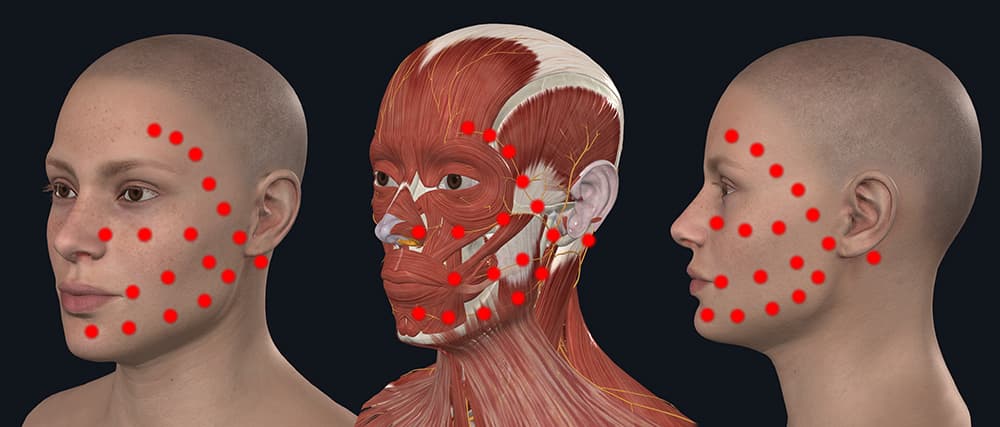
The treatment points start behind the ear, where the nerve exits the skull, and follow the branches of the nerve towards the face: behind the ear, in front of the ear, at the temple, above the cheekbone, on the cheek, beside the corner of the mouth and along the jawline.2 Dose: 4–8 J per point (the studies most often used a wavelength of 830 nm; 808 nm home devices operate in the same therapeutic window); calculate the treatment time from your device’s dose table. Frequency: at least 3 times a week, or even once daily, for at least 6 weeks.1 Important: around the eye, never direct the light towards the eye and wear protective goggles – do not treat the eyelid or eyeball.
3. Electrostimulation – a “gym” for weakened muscles
While the nerve regenerates, the muscles it supplies do little work – and unused muscle wastes away. Electrostimulation bridges this gap: carefully controlled electrical impulses delivered through electrodes placed on the skin make the facial muscles contract, keeping them “in training”, preserving their mass and blood supply until nerve control returns. According to a 2025 systematic review, electrotherapy applied early with suitable parameters, together with associated muscle retraining techniques, has a favourable effect on the quality of facial movement and quality of life in peripheral facial paralysis.5
When may it be considered? Primarily in prolonged, more severe cases – when there is still very little muscle activity after several weeks – and during the middle stage of recovery, as an adjunct to exercises. And here is an important rule: facial stimulation is not a “switch it on and go” activity. A physiotherapist or doctor should set the parameters – pulse width, frequency, intensity and treatment time – to suit your condition, because incorrectly chosen, excessive or poorly timed stimulation may contribute to abnormal associated movements (synkinesis). Once a professional has set the programme, you can safely continue it at home.
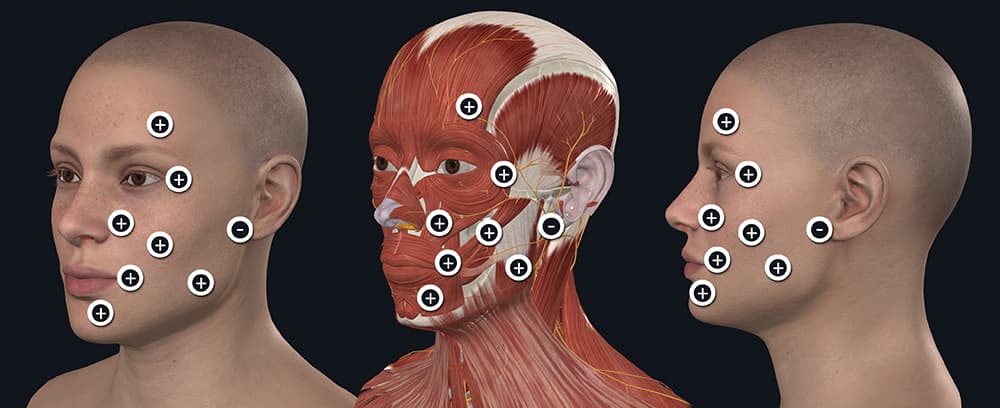
What should you look for when choosing a device? The face requires small electrodes, low intensity that can be adjusted gradually, and special programmes with long pulse durations for severely weakened muscles – few devices can do this. Examples suitable for this purpose include the PeroBravo (with programmes specifically designed to treat muscles affected by peripheral nerve damage) and the professional Globus Genesy 1500, which is also used by physiotherapists.
 My advice
Build the three treatments into one daily routine as follows: facial exercises in front of the mirror in the morning; laser treatment at the 8 points during the day or in the evening; and electrostimulation – if your condition warrants it and a professional has set it up – in a separate time slot, for example after the exercises, 3–5 times a week. Also track your progress: make a short video once a week using the same exercises – the nerve regenerates by around half to one millimetre a day, and weekly comparison shows improvement that daily mirror-watching hides. In the meantime, protect your eye: until the eyelid closes fully, artificial tears during the day and eye ointment plus taping at night are not a matter of comfort but of protecting the cornea.
Practical advice for everyday life
When eating and drinking, smaller bites, a straw for liquids, and rinsing the cheek–gum pocket after meals can help – food can become trapped unnoticed on the less sensitive side. Protective glasses shield the eye from wind and dust; when looking at a screen, make a conscious effort to blink more often, because reduced blinking alone dries the cornea. There is no need to fear cold or draughts, but during the treatment weeks it is sensible to protect the face with a scarf in freezing wind. And a word about the emotional side: the face accounts for half of our communication, and paralysis makes many people withdraw – remember that the great majority of cases recover well, and the people around you get used to the appearance sooner than you do. If anxiety becomes overwhelming, talking about it – even with a professional – is also part of recovery.
Recommended devices for the home programme
The laser pillar requires a point device that can be aimed accurately and delivers a known dose; the stimulation pillar requires a stimulator with finely adjustable settings and small-muscle programmes:
Personal-Laser L400
A 400 mW, 808 nm point laser – the 8 treatment points can be treated accurately in a short time. The simplest choice for the facial nerve protocol.
Energy-Laser L500 Pro
A 500 mW professional device with built-in programmes – the device controls the dosing, which is convenient and predictable for multi-point facial treatment lasting several weeks.
PeroBravo electrostimulator
With programmes specifically designed for facial and small-muscle stimulation and gradual intensity adjustment – a convenient tool for a home stimulation protocol set by a professional.
Globus Genesy 1500
A professional multi-programme stimulator also used by physiotherapists – a sensible choice if, alongside facial stimulation, you plan to treat other muscle groups over the long term.
You can find the laser range in the soft laser device category – before buying, also read the scam-avoidance checklist.
 When should you NOT start home laser treatment?
- Recent facial paralysis not yet assessed by a doctor – ALWAYS seek medical assessment first: ruling out stroke and starting drug treatment within the first 72 hours are the priorities
- Associated symptoms suggestive of stroke – limb weakness, speech disturbance, difficulty swallowing or double vision: call an ambulance immediately
- The eye and its immediate surroundings – never direct laser light into the eye or at the eyelid
- Cancer in the head and neck region – treatment only with the approval of the treating doctor
- Pregnancy – only after medical consultation
- Taking medicines that cause photosensitivity – discuss it with your doctor first
Separate exclusions for electrostimulation
- Pacemaker or implanted defibrillator – electrical impulses may interfere with the device: electrotherapy only with cardiological approval
- Epilepsy – electrical stimulation of the head and neck only with a neurologist’s approval
- The front and side of the neck – placing an electrode around the carotid artery is prohibited: it may trigger blood pressure and rhythm disturbances
- Metal implant in the treated area – if there is a maxillofacial metal plate or screw, consult a specialist first
- Damaged, inflamed or eczematous skin at the electrode site – the skin problem must be dealt with first
- Parameters not set by a professional – do not start facial stimulation by guesswork: incorrect settings may cause synkinesis
 When should you return to your doctor during treatment?
If the paralysis worsens despite drug treatment; if no improvement starts within 3–4 months; if your eye becomes red or painful, or your vision becomes blurred (this may indicate corneal damage); or if you notice abnormal associated movements (for example, your eye waters while eating). These do not necessarily indicate a serious problem, but they require specialist review. You can find the full list of laser safety information in the soft laser contraindications article.
Frequently asked questions
The typical course is: the first signs of improvement after 2–3 weeks, meaningful improvement over 2–3 months, and complete recovery may take 6–12 months – nerve regeneration is a slow biological process. The vast majority of patients recover well, especially when drug treatment has started on time. The earlier improvement begins, the better the outlook – but a slower start does not mean failure.
Start laser treatment and facial exercises early: after medical diagnosis and the start of drug treatment, typically during the first week – in the studies, laser treatment started in the recent, subacute phase and continued for 6 weeks.1 The timing of electrostimulation is more individual: it is primarily considered when recovery is prolonged or muscle activity remains very weak after several weeks – and it should always be set by a professional. Your treating doctor and physiotherapist should decide the exact order based on your condition.
Yes – in fact, there is a specific study involving people with diabetes: among 30 patients with diabetes and Bell’s palsy, the large majority showed complete or partial recovery after 12 laser treatments, without adverse effects.4 This matters because steroids can raise blood glucose in diabetes, so doctors may sometimes use them more cautiously – laser is a valuable glucose-neutral adjunct in this situation. Your treating doctor should decide about the treatment and medicines here too.
When properly adjusted, it is safe, and research suggests that electrotherapy applied early with suitable parameters has a favourable effect on the quality of facial movement.5 The risk lies in improper use: stimulation that is too strong, too frequent or uses unsuitable impulses may fatigue weak muscles and contribute to abnormal associated movements. The rule is therefore: leave the initial settings and training to a physiotherapist or doctor – continuing at home afterwards is routine.
Two different nerves, two different conditions. Facial nerve palsy is a disorder of the VII cranial nerve (the facial nerve): the facial MUSCLES become weak, with little pain. Trigeminal neuralgia is a condition affecting the V cranial nerve: brief, lightning-like PAIN attacks on one side of the face, without muscle weakness. Their treatments also differ – I wrote a separate article about trigeminal neuralgia and laser support.
 What the research says – answers to readers’ questions
“Does laser really add anything to facial exercises?”
The study that answers this question most precisely tested exactly that: 46 patients with Bell’s palsy were divided into two groups – everyone performed facial exercises, but half also received laser treatment (830 nm, at eight facial points, three times a week). After six weeks, both groups had improved, but facial function scores in the laser group were measurably better from week 3, and the advantage remained until the end of the study.3 Exercises are therefore the foundation – laser improved the speed and degree of recovery.
“Does it matter how powerful the laser is?”
A double-blind, placebo-controlled study compared low-intensity (LLLT) and high-intensity (HILT) laser in 48 patients, with both used alongside massage and exercises: both laser groups recovered significantly better than the exercise-only control group, while the advantage of high-intensity laser over low-intensity laser was moderate.2 The lesson is consistent with other indications: raw power is not the deciding factor, but correct dosing and persistent treatment over several weeks.
“Is there evidence for electrostimulation, or is it just traditional practice?”
There is, but it is conditional: a 2025 systematic review analysing 14 studies found that electrical stimulation and associated muscle retraining techniques have a favourable effect on the quality of facial movement, quality of life and reduction of abnormal associated movements when applied early with suitable parameters.5 The emphasis is on “suitable parameters” – which is why facial stimulation must be set up with a professional rather than by trial and error.
Summary
What is this article about? A complete guide to facial nerve palsy (Bell’s palsy): symptoms and distinguishing it from stroke, causes and recovery prospects, plus a detailed three-part home recovery programme – facial physiotherapy, soft laser along the course of the nerve, and professionaly adjusted electrostimulation.
Who is it for? People whose doctor has already diagnosed Bell’s palsy and who are looking for active, home-based support during the recovery phase lasting weeks or months – as well as relatives who want to understand what is happening.
Main message: The order is fixed: first urgent medical assessment and drug treatment – then home work begins. Studies suggest that facial exercises supplemented with laser treatment produced faster and more complete recovery than exercises alone; in prolonged cases, professionally adjusted electrostimulation provides additional support. The outlook is good – patience and a daily routine are the keys.
Next step: Discuss the programme with your treating doctor, then start your daily routine: facial exercises 2–3 times a day, laser at the 8 points at least 3 times a week for 6 weeks; in prolonged cases, stimulation set by a physiotherapist, with progress documented in a weekly video. And while the eyelid does not close: artificial tears during the day and eye protection at night.
Read more
- Soft laser for trigeminal neuralgia
- The consequences of nerve damage and the chances of recovery
- Peripheral neuropathy: causes and reducing pain
- Soft laser therapy guide: how it works, dosing and laser classes
- Soft laser therapy: what does the science say?
- Soft laser contraindications: when should you not use it?
Scientific sources
- Javaherian M, Attarbashi Moghaddam B, Bashardoust Tajali S, Dabbaghipour N. (2020). Efficacy of low-level laser therapy on management of Bell's palsy: a systematic review. Lasers in Medical Science. DOI: 10.1007/s10103-020-02996-2
- Alayat MS, Elsodany AM, El Fiky AA. (2014). Efficacy of high and low level laser therapy in the treatment of Bell's palsy: a randomized double blind placebo-controlled trial. Lasers in Medical Science. DOI: 10.1007/s10103-013-1352-z
- Ordahan B, Karahan AY. (2017). Role of low-level laser therapy added to facial expression exercises in patients with idiopathic facial (Bell's) palsy. Lasers in Medical Science. DOI: 10.1007/s10103-017-2195-9
- Aghamohamdi D, Fakhari S, Farhoudi M, Farzin H. (2020). The efficacy of low-level laser therapy in the treatment of Bell's palsy in diabetic patients. Journal of Lasers in Medical Sciences. DOI: 10.34172/jlms.2020.52
- Dominguez-Defez N, Lopez-Barreiro J, Hernandez-Lucas P, González-Castro A. (2025). Proprioceptive neuromuscular facilitation and/or electrical stimulation in patients with peripheral facial paralysis: a systematic review. Neurology International. DOI: 10.3390/neurolint17020017