
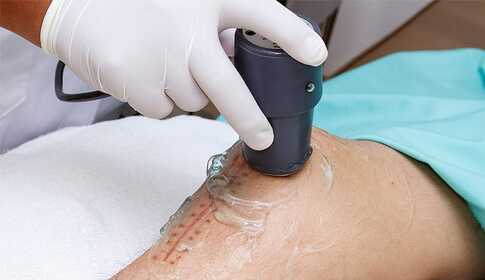
Ultrasound dosing – Guide to treatment settings
The effectiveness of an ultrasound treatment depends greatly on correct settings. Too low an intensity will not produce results, while too high can worsen your symptoms. In this article I'll show you how to choose the right parameters.
This article is a supplementary chapter to the Comprehensive Guide to Therapeutic Ultrasound Treatment.

The four basic setting parameters
For every ultrasound treatment you need to determine four things:
- Frequency – how deep the energy should penetrate
- Pulse ratio – whether it should be continuous or pulsed
- Intensity – how much energy the tissues receive
- Treatment time – how long the treatment should last
1. Choosing the frequency
Frequency determines how deep the ultrasound acts:
| Frequency | Penetration depth | Application |
|---|---|---|
| 1 MHz | 2–5 cm | Deep muscles, large joints (knee, hip, shoulder) |
| 3 MHz | 0.5–2 cm | Superficial tissues, tendons (wrist, ankle, elbow, face) |
Simple rule: If you can pinpoint the pain by touch near the skin surface, choose 3 MHz. If you feel it deeper in large muscle masses, choose 1 MHz.
2. Setting the pulse ratio
The pulse ratio indicates whether energy is delivered continuously or in bursts. The choice depends on the “age” of your complaint:
| Nature of complaint | Duration | Recommended pulse ratio |
|---|---|---|
| Acute | Recent, a few days old | 1:4 or 1:3 (20–25%) / on some devices the “L” (low) mode |
| Subacute | 1–2 weeks | 1:2 or 1:1 (33–50%) / on some devices the “M” (medium) mode |
| Chronic | Several weeks–months | 1:1 or continuous (50–100%) / on some devices the “H” (high) mode |
Why is this important? In fresh injuries tissues are more sensitive – pulsed mode produces less heat and is therefore gentler. Chronic complaints, however, require more energy to elicit change.
3. Determining intensity
Intensity (W/cm²) indicates the amount of energy. The correct value also depends on the condition of the complaint:
| Condition | Recommended intensity |
|---|---|
| Acute (fresh) | 0.1–0.3 W/cm² |
| Subacute (1–2 weeks) | 0.2–0.5 W/cm² |
| Chronic (old) | 0.3–0.8 W/cm² (or higher) |
Important: Always start at the lower value! If you do not feel a pleasant warmth, you can increase gradually. The treatment should never cause pain or a burning sensation.
Depth compensation
Some ultrasound energy is absorbed on the way to the target. If you treat a deeper area, set a higher intensity on the device so that sufficient energy reaches the target.
4. Calculating treatment time
Treatment time depends on the size of the area. The basic rule is simple:
Allow 1–2 minutes of treatment per treatment-head area.
In practice:
- Small area (e.g. wrist): 3–5 minutes
- Medium area (e.g. elbow): 5–8 minutes
- Large area (e.g. knee): 8–10 minutes
Do not treat the same area for more than 10 minutes in a single session!
Quick setup guide
If, for example, you are treating a knee that has been painful for 2 weeks:
- Frequency: 1 MHz (deep tissues)
- Pulse ratio: 1:2 or 1:1 (subacute condition)
- Intensity: 0.3–0.5 W/cm²
- Treatment time: 8–10 minutes
What does the research say?
Many clinical trials have examined optimization of therapeutic ultrasound settings. Recent research confirms that correct dosing is key to treatment effectiveness.
A 2024 systematic review and meta-analysis that analyzed 21 randomized controlled trials in patients with knee osteoarthritis found that pulsed mode with intensity ≤2.5 W/cm² showed more favorable pain-relief effects. The review reported significant improvements in pain and function measures after 24 treatments.1
A 2020 systematic review on treating chronic joint pain found that therapeutic ultrasound—especially when combined with other treatments—can positively affect both knee and shoulder pain. The researchers emphasized that optimal settings (intensity, mode, treatment time) require further study.2
A comprehensive 2012 review details the biophysical effects and safety considerations of therapeutic ultrasound. The study highlights that increasing intensity amplifies both thermal and non-thermal effects, so gradual adjustment and monitoring of individual responses is essential.3
Key takeaway from research: Treatments using lower to moderate intensity (0.5–2.5 W/cm²) and pulsed mode generally yield better outcomes, particularly in acute and subacute conditions.
For the knee treatment example above, the SonicRelief (1 MHz) is an excellent choice. If you also need superficial 3 MHz treatments (e.g. wrist, ankle, face), the MediSound 3000 multifrequency device is the best option.
What to watch for during treatment
- Always use sufficient ultrasound gel
- Keep the treatment head moving continuously – do not hold it in one spot!
- You may feel a pleasant warmth – this is normal
- If pain increases after treatment, reduce intensity and time
What to do if pain increases?
If your symptoms worsen after treatment, this indicates "overdosing." In that case:
- Reduce the intensity
- Shorten the treatment time
- Switch to pulsed mode (if you were using continuous)
- Take a 1–2 day break between sessions
Think of it like sunbathing – regular, moderate “doses” tan you; excessive amounts burn you.
Summary – Quick overview
What is this article? A practical guide to setting ultrasound treatment parameters.
Who is it for? Anyone using a home therapeutic ultrasound device who wants to get the best results.
Main message: Correct dosing is crucial – choose frequency, pulse ratio, intensity and treatment time according to the type (acute/subacute/chronic) and depth of the complaint.
The four main parameters:
- Frequency: 1 MHz for deeper tissues (2–5 cm), 3 MHz for superficial tissues (0.5–2 cm)
- Pulse ratio: Pulsed (20–25%) for acute complaints, continuous may be allowed for chronic ones
- Intensity: Acute: 0.1–0.3 W/cm², Chronic: 0.3–0.8 W/cm²
- Treatment time: 1–2 minutes per treatment-head area, maximum 10 minutes per area
Most important rules:
- Fresh complaint = low intensity, pulsed mode
- Old complaint = higher intensity, continuous mode may be allowed
- Always start low and increase gradually
- Never hold the treatment head in one place
Frequently asked questions:
How often can I treat an area?
Once a day, maximum 10 minutes per area.
What should I do if pain increases after treatment?
Reduce intensity, shorten treatment time, switch to pulsed mode, and take a 1–2 day break.
Can I use higher intensity for faster results?
Not recommended. Research suggests lower–moderate intensities (≤2.5 W/cm²) yield better results.
Recommended devices
You can find our recommended therapeutic ultrasound devices here.
- SonicRelief – 1 MHz, compact, cost-effective choice for home use
- MediSound 3000 – 1 MHz + 3 MHz, professional-level, with cosmetic programs
Sources
- Hu W, et al. (2024). Effects of therapeutic ultrasound in patients with knee osteoarthritis: A systematic review and meta-analysis. Clinical Rehabilitation. PubMed: 38803857
- Aiyer R, et al. (2020). Therapeutic Ultrasound for Chronic Pain Management in Joints: A Systematic Review. Pain Medicine. PubMed: 31095336
- Miller DL, et al. (2012). Overview of therapeutic ultrasound applications and safety considerations. Journal of Ultrasound in Medicine. PubMed: 22441920
The information in this article is for guidance only. Home therapeutic devices are intended to complement medical treatment. If you are unsure about settings, consult your physician or physiotherapist.

