
 What is cellulite – and why does it affect almost every woman?
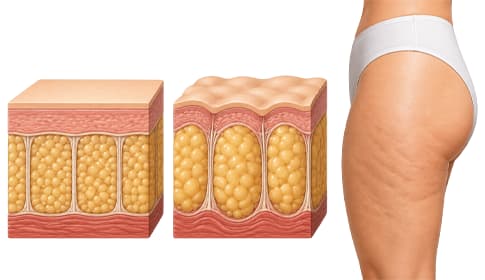
Cellulite is present to some degree in most women after puberty – it is estimated to affect around 80–90% of them1. Its development is multifactorial: hormonal, genetic, anatomical and microcirculatory factors may all play a role. It is much less common in men, which is partly explained by the different structure of the connective-tissue septa under the skin2: in women, they run more often perpendicular to the skin surface, which may make it easier for fat lobules to bulge towards the surface and contribute to the characteristic dimpled appearance. Lifestyle factors may affect its visibility and severity rather than being its sole causes.
 Not a disease – but not merely an aesthetic issue
Cellulite is not a disease, but it is not merely an aesthetic issue either: the processes behind it – reduced microcirculation, connective-tissue changes and redistribution of fatty tissue – also affect the general condition of the skin and the health of the tissues. Home device-based treatments act on these mechanisms.
 How does cellulite develop? – The stages of the process
Cellulite does not develop overnight. Four mutually reinforcing processes are involved. Once they start, they can become a self-perpetuating cycle. The good news is that there is an opportunity to intervene at every stage.
The first step is impaired microcirculation. The walls of small blood vessels become abnormally permeable, and blood and lymph flow slow down in the affected areas. This leads to fluid accumulation (oedema) at the boundary between the fatty tissue and the skin. The space between the cells swells, which also worsens the supply of nutrients and oxygen to the tissues. Cavitation treatments – for example, the low-frequency modes of the Lipozero device range – act mainly at this stage, helping to relieve stagnation by activating microcirculation.3
Circulatory impairment causes low-grade inflammatory processes in the tissues. The space between the cells becomes oedematous, further worsening microcirculation – and the cycle closes. Oedema also puts pressure on the fat compartments, increasing uneven fat distribution. Lymphatic massage may improve lymphatic drainage, reducing this oedematous burden.
Over the long term, oedema and inflammation alter the connective-tissue fibres (collagen and elastin fibres). The connective-tissue septa may thicken, become stiffer and lose their elasticity – this is the fibrotic stage of cellulite. The stiffened septa pull the skin down more strongly, deepening the dimpled appearance. Research suggests that ultrasound treatments may help loosen the connective-tissue structure and restart collagen production.4
Enlarged fat cells are pushed upwards between the stiffened connective-tissue septa towards the skin, creating the characteristic orange-peel appearance. The low frequencies of cavitation ultrasound (39–150 kHz) may help reduce fatty-tissue accumulation through mechanical pressure on the fat cells – the formation of microbubbles and their collapse.3
Types of cellulite – it matters which type you have
Not all cellulite is the same. When choosing a treatment strategy, it is important to know which type is involved. Age, hormonal status, lifestyle and the condition of the affected area all have an influence.
| Type | Characteristics | Areas mainly affected | Suitable treatment frequency |
|---|---|---|---|
| Oedematous cellulite | Soft to the touch, fluid stagnation is dominant, mild appearance | Inner thigh, ankle area | 526 kHz (NorAd mode), lymphatic drainage |
| Soft (flaccid) cellulite | Loose skin, more pronounced with movement, reduced muscle tone | Thighs, buttocks, upper arms | 150 kHz, 1–3 MHz cosmetic programme |
| Fibrotic cellulite | Hard to the touch, painful, deeply fixed connective tissue, long-standing | Outer thigh, buttocks | 39 kHz (deep-acting cavitation) |
| Mixed cellulite | A combination of the above, with different types in different body areas | Variable | Frequency-switching, combined programmes |
Why is it important to identify the type?
Different ultrasound frequencies may provide optimal results for different types of cellulite. The lower the frequency (e.g. 39 kHz), the deeper the ultrasound penetrates into the tissue – making it suitable for fibrotic, deeply fixed cellulite. Higher frequencies (526 kHz–3 MHz) act more favourably on the superficial layers, skin firmness and metabolism.
Why is anti-cellulite cream alone not enough?
You can find dozens of “anti-cellulite” creams, serums and gels in supermarkets and pharmacies. These products may contain useful ingredients (caffeine, retinol, L-carnitine), which can help stimulate circulation and moisturise the skin surface. However, they have one fundamental limitation:
Cellulite results from processes occurring at a depth of 4–8 mm – in the subcutaneous fatty tissue, connective-tissue septa and microvessels. Topically applied active ingredients penetrate only the uppermost layers of the skin and do not reach deeper tissue structures. By contrast, ultrasound cavitation acts directly in the fatty-tissue layer.
What do the studies show?
According to a 2018 review article, ultrasound appears to be an effective, successful and safe method for reducing skin laxity, supporting lipolysis and reducing the appearance of cellulite – with minimal side effects (sensitivity during the procedure, redness and mild swelling after treatment).4
Which technologies may help treat cellulite?
One recognised approach to home device-based cellulite treatment is ultrasound cavitation. This can be complemented by cosmetic ultrasound and iontophoresis to deliver active ingredients. The Lipozero device range combines these principles.
Cavitation is a physical phenomenon: low-frequency (39–150–526 kHz) ultrasound creates microbubbles in the fatty tissue. These bubbles undergo alternating cycles of compression and expansion until they finally collapse – releasing mechanical energy near the fat cells. The membranes of the fat cells are damaged, their triglyceride content enters the space between the cells and then the lymphatic circulation, and the body removes it naturally.3
Important: cavitation is effective only at frequencies below 600 kHz. At higher frequencies, bubbles cannot form in the fatty tissue. The lower the frequency, the deeper the wave penetrates (39 kHz can reach a depth of 5–8 cm).
Higher-frequency (1–3 MHz) ultrasound works not through cavitation, but through thermal and mechanical micromassage effects. In the layers close to the skin surface, it mildly raises tissue temperature, which may contribute to activating collagen synthesis and supporting skin firmness.4 This method also enables ultrasound-assisted active-ingredient delivery (sonophoresis): the absorption of cosmetics may increase up to 20-fold compared with ordinary application.
The 526 kHz frequency has a special property in the Lipozero G150 and G39 devices: according to some studies, this frequency may contribute to the release of noradrenaline (norepinephrine) in fatty tissue. Noradrenaline plays a key role in regulating fatty-tissue metabolism and initiating the lipolytic activity of fat cells. This so-called NorAd-526 mode may be particularly useful for oedematous areas and abdominal fat deposits.
After cavitation treatment, the broken-down fatty acids leave the treated area through the lymphatic circulation. For this reason, adequate fluid intake (2–2.5 l of water per day) and, where available, combining treatment with lymphatic massage (manual or mechanical) are essential for maintaining treatment effectiveness. The Lipozero G150 and G39 also include lymphatic activation protocols at the end of the cavitation programmes.
The Lipozero device range – choose the right one for your type of cellulite
Medimarket distributes the Globus Lipozero product range. The Italian manufacturer has brought its experience in medical electrotherapy to the field of cosmetic ultrasound. The main differences between the three models are the cavitation frequency range and the number of programmes: lower frequencies penetrate more deeply, while more programmes allow finer personalisation.
Lipozero Excel – Entry-level cosmetic ultrasound
The Lipozero Excel is the entry-level home cosmetic model in the range. Its 3 MHz ultrasound can be used for active-ingredient delivery (sonophoresis), skin tightening and treating the superficial layer of cellulite. Thanks to its beauty-care programmes, it can easily be incorporated into a daily body-care routine. It has no cavitation function – if you are looking for a deeper cavitation effect, the G150 and G39 models provide this.
Ideal for: Soft or oedematous cellulite; supporting skin-surface elasticity; prevention and complementary treatment.
Lipozero G150 – Combined cavitation and cosmetic ultrasound
The Lipozero G150 operates across four frequency ranges (3 MHz, 1 MHz, 526 kHz, 150 kHz), offering both cosmetic ultrasound and genuine cavitation treatment. The 150 kHz cavitation frequency is particularly suitable for oedematous and soft cellulite, while the 526 kHz NorAd mode may help support fat breakdown by activating metabolism. Its 26 cavitation and 16 beauty-care programmes make the treatment protocol flexible.
Ideal for: Oedematous and soft cellulite; the thighs, abdomen and buttocks; home and beauty-salon use.
Lipozero G39 – Professional cavitation, five frequency ranges
The Lipozero G39 is the top model in the range, operating at five frequencies (3 MHz, 1 MHz, 526 kHz, 150 kHz and 39 kHz). The 39 kHz ULTRA-CAV mode is the deepest-acting cavitation range. It may provide particularly good results for fibrotic, hard, long-standing cellulite and thick fat deposits. Its 49 pre-set programmes (including 30 customisable ones) allow the treatment protocol to be adjusted precisely to the type of cellulite, body area and treatment depth. Two treatment heads in different sizes (Ø 50 mm and Ø 42 mm) ensure that both large body areas and smaller zones can be treated effectively.
Ideal for: Fibrotic, hard cellulite; treating thick fat deposits; beauty professionals and demanding home users.
| Feature | Lipozero Excel | Lipozero G150 | Lipozero G39 |
|---|---|---|---|
| Cavitation | ❌ | ✅ (150 kHz, 526 kHz) | ✅ (39, 150, 526 kHz) |
| Cosmetic ultrasound | ✅ (3 MHz) | ✅ (1, 3 MHz) | ✅ (1, 3 MHz) |
| NorAd-526 mode | ❌ | ✅ | ✅ |
| Maximum penetration depth | Superficial layer | Medium depth | Deep layer (39 kHz) |
| Number of programmes | Beauty-care programmes | 26 cavitation + 16 beauty | 49 programmes (30 customisable) |
| Recommended cellulite type | Oedematous, soft, prevention | Oedematous, soft | Fibrotic, mixed, deep fat deposits |
 Before starting treatment – who should not use it?
Cavitation ultrasound can be used safely at home, but as with every device-based treatment, there are conditions and circumstances in which treatment is contraindicated. Read the list below carefully and, if you are uncertain, consult your doctor.
- Pregnancy and breastfeeding – ultrasound cavitation must not be used during pregnancy
- Implanted metal devices in the treatment area – prosthesis, metal clip or screw; ultrasound must not be used near the implant
- Pacemaker and cardiac rhythm regulator – ultrasound treatment is prohibited near a pacemaker
- Venous thrombosis, thrombophlebitis, phlebitis – ultrasound may cause embolic fragmentation
- Active cancer or malignant disease – ultrasound must not be used on tumour tissue
- Acute infection or inflammation in the treatment area – prohibited in cases of skin infection, wounds or ulcers
- Blood-clotting disorder or anticoagulant treatment – not recommended in cases of increased bleeding tendency
- Radiotherapy to the affected area (within 6 months) – irradiated tissues must not be treated
- Severe cardiovascular disease – consultation with a doctor is required
- Osteoporosis or involvement of the epiphyseal plate – must not be used close to bone
Important information
Lipozero devices are beauty-care devices intended to complement a daily body-care routine. They do not replace medical treatment and are not an alternative to medical or surgical approaches in cases of severe obesity. Treatment results depend greatly on lifestyle: a healthy diet, adequate fluid intake and regular exercise are essential requirements.
 Scientific background – what do the studies say?
Cellulite prevalence and pathophysiology – 2015 review
In their 2015 evidence-based review, Luebberding and colleagues state that cellulite is present in 85–90% of women, and that oestrogen, microcirculatory insufficiency and changes in connective-tissue structure all contribute to its development. The authors emphasise that no single treatment provides a lasting solution without lifestyle changes.1
Cavitation and fatty tissue – histological study
Using ex vivo skin samples and in vivo biopsies, Palumbo and colleagues (2014) demonstrated that ultrasound cavitation significantly reduced fat-cell size (p < 0.001), created micropores in the membranes of fat cells and triggered triglyceride release – without damaging healthy skin tissues (vessels, stroma and epidermis). The clinically measured result was a significant reduction in abdominal circumference in the treated group.3
Ultrasound for skin tightening and cellulite reduction – 2018 review
Werschler and colleagues’ 2018 review concludes that ultrasound appears to be an effective, successful and safe modality for correcting skin laxity, supporting lipolysis and reducing the appearance of cellulite. Side effects are minimal: sensitivity during the procedure, followed by redness and mild swelling.4
Non-invasive body contouring – systematic review, 2017
Derakhshan and colleagues (2017) screened 2024 studies from the Cochrane and PubMed databases. They concluded that high-intensity focused ultrasound and cavitation devices show clinically relevant reductions in fatty tissue, although optimal protocols and long-term maintenance require further study.5
Practical advice – how can you achieve good results?
Treatment protocol – what is worth following
For lasting results, plan a course of treatment: 8–12 sessions, once or twice a week. Leave at least 48 hours between treatments so that the broken-down fatty acids can leave the treated area. Drink 1–1.5 litres of water before every treatment. Good hydration is essential for the formation of cavitation bubbles and the removal of fatty acids through the lymphatic system.
Treatment technique
Never hold the treatment head still. Glide it over the treated area in circular movements at a speed of approximately 1–2 cm/s. Gel is essential: without gel, ultrasound energy is not transferred effectively to the skin. The recommended amount is 4–5 g (about one teaspoon) per treatment. During cavitation, you may hear a slight chirping sound in your ear – this is normal.
After-treatment care
Avoid hot baths and intense sun exposure for 1–2 hours after treatment. On the day of treatment, drink at least 2–2.5 litres of water to help remove the broken-down fatty acids. Gentle exercise (e.g. a 30-minute walk) after treatment may help maintain metabolic processes.
 Important: treatment is effective with realistic expectations
The cellulite-reducing and body-contouring effects of cavitation treatments are supported by scientific evidence – but it is not a miracle cure. Results develop gradually through a course of treatment and cannot be maintained in the long term without lifestyle changes (fluid intake, exercise and a balanced diet). In cases of severe obesity, device-based treatment is a complementary method, not the primary therapy.
Frequently asked questions
Individual experiences vary. Usually, the first visible change appears after 4–6 treatments. Results are generally assessed after completing the full course (8–12 sessions). The feel and firmness of the skin usually change sooner than its visual appearance. The course can be repeated if necessary.
If you mainly want to support skin firmness and active-ingredient delivery, the Lipozero Excel is suitable. If you also want a cavitation effect for oedematous or soft cellulite, the G150 is the ideal choice. If you have fibrotic, hard, long-standing cellulite or want to treat thick fat deposits, the deeper frequencies of the G39 work more effectively.
Use only ultrasound gel or a cosmetic gel suitable for this purpose (non-greasy, water-based). Ultrasound gel prevents air bubbles between the treatment-head surface and the skin and allows ultrasound energy to be transferred effectively. Greasy creams and oils are unsuitable because they obstruct the propagation of ultrasound.
Yes. Cavitation treatment combines well with lymphatic massage (preferably on the same day as ultrasound treatment, afterwards), dry body brushing (before treatment) and targeted body-care products (after treatment, taking advantage of improved skin absorption). A combined approach may generally produce better results than the individual methods on their own.
Generally, 8–12 sessions are recommended for a course of treatment, once or twice a week. To maintain the effect, 1–2 maintenance treatments every three months are recommended, together with lifestyle changes. Without lifestyle changes (fluid intake, exercise and dietary changes), fat cells regenerate and the improvement is not lasting.
 Summary – Quick overview
Sources
- Luebberding S, Krueger N, Sadick NS (2015). Cellulite: An Evidence-Based Review. Am J Clin Dermatol. PubMed: 25607807
- Bass LS, Kaminer MS (2020). Insights into the pathophysiology of cellulite: a review. Dermatol Surg. PubMed: 32004193
- Palumbo P, Cinque B, Miconi G et al. (2014). Histological and Ultrastructural Effects of Ultrasound-induced Cavitation on Human Skin Adipose Tissue. Plast Reconstr Surg Glob Open. PMC: 4174158
- Werschler WP, Werschler PS (2018). A Review of the Use of Ultrasound for Skin Tightening, Body Contouring, and Cellulite Reduction in Dermatology. J Clin Aesthet Dermatol. PubMed: 29846343
- Derakhshan N, Rahimi-Movaghar V (2017). Review of the Mechanisms and Effects of Noninvasive Body Contouring Devices on Cellulite and Subcutaneous Fat. World J Plast Surg. PMC: 5236497