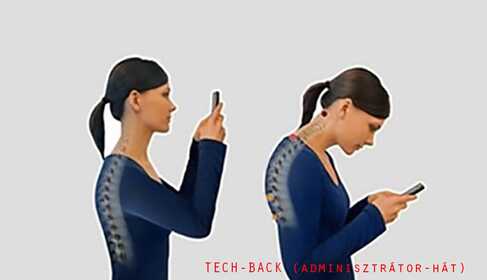

 What is tech back?
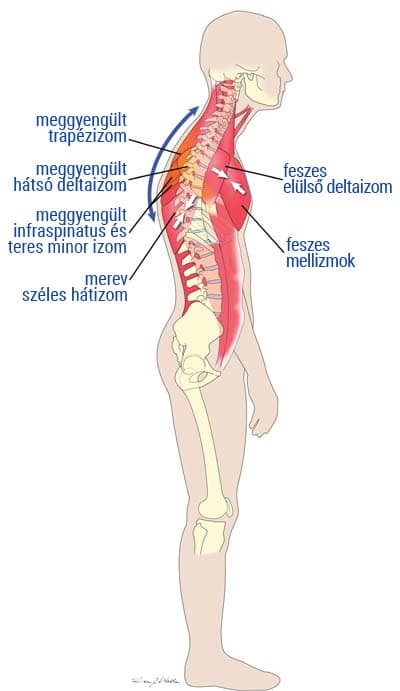
The mechanics are brutally simple. Your head weighs 4–6 kilograms – while it sits above your spine, holding it up takes hardly any effort. But as it tilts forwards, the neck muscles have to support an ever-greater load: just a few centimetres of forward shift multiplies the strain on the neck and upper back. The neck muscles, trapezius and back muscles hold this extra load for hours, without moving. Meanwhile, the chest muscles shorten, the muscles that stabilise the shoulder blades weaken, and the body slowly settles into the hunched posture.
 Key idea
Tech back is not a disease but an acquired postural problem – and that is good news: what your habits have built up, your habits can also break down. Research shows that targeted corrective exercises measurably improve forward head posture and the pain that comes with it. The formula has three parts: less uninterrupted screen time, a rearranged working environment, and systematic exercise for the weakened muscles.
 How can you recognise it? The stages of tech back
| Stage | What do you experience? | What happens meanwhile? |
|---|---|---|
| 1. Tension | Neck and shoulders feel heavy and tense by evening; the symptoms still go away at the weekend | The muscles are overloaded but can still recover |
| 2. Recurring pain | Regular neck, shoulder and back pain, headaches starting with tension; rest is no longer enough | Muscle tension becomes constant, the chest muscles shorten and the back muscles weaken |
| 3. Fixed posture | The hunched posture is visible in the mirror; straightening up requires conscious effort | The muscle imbalance becomes fixed, while the ligaments and joints adapt to the faulty posture |
| 4. Deformity | A characteristic prominence at the neck–back junction (“dowager’s hump”), persistent pain and restricted movement | The structure of the spine also changes – from here, the way back is long and difficult |
Research confirms what the table suggests: in adults, the degree of forward head posture is associated with the severity of neck pain and with how much it limits everyday activities.1 The earlier you intervene, the simpler the task.
 Why does it develop – and why does it not go away by itself?
A monitor that is too low, a laptop on your lap, a phone in your hand at waist level – all of them lead to the same posture: the head tilts forwards and the upper back rounds. An occasional episode is harmless; repetition is the problem. With 6–10 hours of screen time a day, this posture takes up more of your body’s time than any other – and the body adapts to the shape in which it spends most of its time.
In a hunched posture, the chest muscles work in a persistently shortened position, while the muscles that stabilise the shoulder blades and the deep neck flexors work in a persistently lengthened, weak position. Over time, this imbalance becomes self-perpetuating: the shortened muscles pull the shoulders and head forwards, while the weak muscles could no longer maintain good posture even if you wanted them to. That is why simply “sitting up straight” is not enough – willpower lasts for minutes; without restoring muscle balance, the body slips back into the old posture.
The third driving force behind tech back is what happens – or, more precisely, does not happen – away from the screen: lack of movement. With sedentary work, the supporting muscles as a whole lose strength, and a weakened muscular system gives up the fight for good posture much sooner. That is why the solution is never just neck exercises: it requires regular movement of the whole body.
 What can you do about it? Four steps to recovery
1. Rearrange your working environment. Keep the top edge of the monitor at eye level and within arm’s reach; use a stand and separate keyboard with a laptop; raise your phone close to eye level instead of lowering your head to it. This is not a comfort extra: while the environment forces you into the old posture, every exercise is an uphill struggle.
2. Break up uninterrupted sitting. Even the most careful posture is harmful if you remain still for hours. Get up for 2–3 minutes every hour: walk around, roll your shoulders backwards and look around. A phone reminder or smartwatch vibration can help until it becomes a habit.
3. Move your whole body. 40–50 minutes of movement a day – brisk walking, cycling, swimming, yoga or bodyweight training – provides the foundation on which targeted correction can build. Studies among office workers show that regular exercise programmes that can also be done at work substantially reduced neck, shoulder and back problems.3 Take the stairs instead of the lift, get off one stop early – small decisions add up.
4. Do targeted corrective exercises. Scientific analyses show that regular corrective training – exercising the deep neck flexors and shoulder-blade stabilisers and stretching the chest muscles – measurably improves head posture and reduces neck pain.2 It is most useful if a physiotherapist selects and teaches the exercise programme: exercises performed with poor technique achieve little. 10–15 minutes a day, for weeks – here too, regularity is the active ingredient.
 My advice
Link posture checks to habits you already have. Whenever you wash your hands, send an email or close the fridge: shoulders back and down, crown of the head towards the ceiling, two seconds. Twenty such micro-corrections a day are worth more than one determined weekly promise to “sit straight from now on” – because posture is not maintained by willpower but by habit.
When can muscle stimulation help?
An electrical muscle stimulator (EMS) may play a supportive role in managing tech back in two situations: when you cannot properly exercise the weakened back and shoulder-blade muscles on your own – you do not feel or “find” them – and when you would like to add extra muscle work passively alongside your daily exercises, for example while watching television. The device works the selected muscles with gentle impulses; it does not replace active exercise and ergonomics but can be used alongside them.
Rehalito
An entry-level, two-channel multifunctional device: it can work two muscle areas at the same time – for example, the two shoulder-blade stabiliser zones. If you are just getting to know muscle stimulation and your goal is better posture, this is a sensible place to start.
MyoBravo
A four-channel device with a wider range of programmes: several muscle groups can be treated at the same time – for example, the upper back and the neck–shoulder junction together. It is worth considering if you plan to use it over the longer term and for several purposes. One of the two is enough – your goals decide, not the number of devices.
You can find the full range in the muscle stimulators category. And the usual honest qualification: the device will not solve anything on its own – daily exercise, a rearranged desk and interrupted sitting do the real work; the stimulator may support that work.
 Before using a muscle stimulator
- Pacemaker or another implanted electronic device – electrical impulses may interfere with its operation
- The front of the neck – do not place an electrode over the larynx, thyroid gland or carotid arteries
- Pregnancy – stimulation applied to the trunk only after medical consultation
- Cancer in the area to be treated – stimulation is prohibited
- Skin injury or inflammation at the electrode site – allow the skin to heal before treatment
 When should you see a doctor about back pain?
If the pain radiates into the arm and is accompanied by numbness or muscle weakness; if it wakes you at night; if it occurs with fever or weight loss; or if the symptoms began after an accident – these are not signs of a postural problem but warning signs that require assessment. In children and adolescents, always show visible postural changes to a professional: scoliosis is a different matter from tech back.
Frequently asked questions
In the first three stages, yes: research shows that regular corrective exercise measurably improves head posture and pain. In the fourth, fixed and deformed stage, complete reversal is more difficult – but further deterioration can still be stopped and symptoms can still be reduced. The earlier you start, the more you can regain.
Not on its own. A passive posture corrector may work as a reminder for a short time, but if it does the work instead of your muscles, they become weaker – and once you take the brace off, everything stays as it was. Posture is maintained by muscle strength, which can only be rebuilt with exercise, supplemented by muscle stimulation if necessary.
Tension and pain may ease within a few weeks with regular exercise. Visible improvement in posture is slower: studies typically found measurable changes in head posture after 6–12 weeks of targeted training. Rewriting established habits takes months of work – but it pays off because the result is also lasting.
Yes – because of tablet and phone use, tech neck can already appear at school age. In children, the most important measures are setting limits on screen time and daily movement. An important distinction: in adolescents, research suggests that the link between forward head posture and pain is less clear than in adults. However, always ask a professional, such as a paediatric orthopaedic specialist or physiotherapist, to assess visible postural changes and rule out scoliosis.1
It may: persistent tension in the muscles at the back of the neck often triggers tension-type headaches that pull from the nape towards the top of the head. If your headache worsens in the afternoon or evening and occurs together with neck tension, this may well be the reason. I wrote about drug-free relief of neck pain in the neck TENS guide.
 What does the research say?
“Does my neck really hurt because of my head posture, or is that just an urban myth?”
In adults, the association is real. According to a review of the subject, adults with neck pain had a measurably more forward-tilted head posture than their pain-free peers, and the more pronounced the forward tilt, the greater the pain and its impact on daily life. Interestingly, the relationship is less clear in adolescents – but it is clear among adults who spend their working day sitting.1
“Do exercises really straighten you up?”
According to the measurements, yes. A review of corrective training found strong evidence that regular, targeted exercise – working the deep neck flexors and shoulder-blade stabilisers and stretching the chest muscles – substantially improves the position of the head in relation to the neck and also reduces neck pain. Not within days: the programmes studied generally involved several weeks of consistent exercise.2
“Do I have any chance at all if I work in an office?”
Yes – in fact, office workers are the group studied most often. A review of workplace exercise programmes found that regular exercise incorporated into working hours consistently reduced neck, shoulder and back problems compared with colleagues receiving usual care only. The key is fitting it in: exercise not despite your work but as part of your working day.
 Summary – Quick overview
Read more
Scientific sources
- Mahmoud NF, Hassan KA, Abdelmajeed SF, Moustafa IM, Silva AG (2019). The Relationship Between Forward Head Posture and Neck Pain: a Systematic Review and Meta-Analysis. Current Reviews in Musculoskeletal Medicine, 12(4), 562–577. DOI: 10.1007/s12178-019-09594-y
- Sheikhhoseini R, Shahrbanian S, Sayyadi P, O'Sullivan K (2018). Effectiveness of Therapeutic Exercise on Forward Head Posture: A Systematic Review and Meta-analysis. Journal of Manipulative and Physiological Therapeutics, 41(6), 530–539. DOI: 10.1016/j.jmpt.2018.02.002
- Tersa-Miralles C, Bravo C, Bellon F, Pastells-Peiró R, Rubinat Arnaldo E, Rubí-Carnacea F (2022). Effectiveness of workplace exercise interventions in the treatment of musculoskeletal disorders in office workers: a systematic review. BMJ Open, 12(1), e054288. DOI: 10.1136/bmjopen-2021-054288