

 What most commonly causes neck pain?
Neck pain is one of the common diseases of the computer age. In most cases, the spine has not “worn out”; the muscles are sending a signal: the trapezius and upper back muscles become tense and cramped from continuous, repetitive strain, and then start to hurt. The three most common triggers are well known:
The monitor and a forward head posture. When you hunch over the screen, your head slides forwards – and every centimetre it moves forwards adds extra load to the neck muscles. The muscles hold this position for hours without interruption, and by the end of the day they become stiff.
Stress. Work-related and emotional tension literally sits in your neck: stress causes the muscles around the shoulder girdle to tighten reflexively, and in people who remain tense for a long time, this muscle tension becomes permanent.
A poor sleeping position. A pillow that is too high, sleeping on your stomach with your neck twisted, or falling asleep sitting up can all lead to the familiar morning feeling of having “slept awkwardly on your neck”.
When it is more than muscle tension – rarer, more serious causes
Most neck pain can be traced back to the everyday causes above and treated well at home. In some cases, however, an underlying condition requires targeted treatment:
| Cause | What might it indicate? | Where to go next? |
|---|---|---|
| Cervical disc herniation | Pain radiating into the arm and fingers, with numbness or weakness | Spinal disc herniation – what can you do about it? → |
| Cervical spondylosis, degenerative changes | Typically over the age of 50; morning stiffness, a “crackling”, restricted neck with movement | Treating joint wear and inflammation → |
| Persistent hunched posture (“tech-back”) | Forward head, rounded back, symptoms linked to monitor and phone use | Tech-back: causes and what to do → |
| Scoliosis | Uneven shoulders, one-sided, recurring muscle tension | Scoliosis, or spinal curvature → |
| Rheumatoid arthritis | Symmetrical pain and swelling in several joints, prolonged morning stiffness | Rheumatoid arthritis → |
| Persistent stress | Neck and shoulder tension regularly returns during periods of strain | Persistent stress and its connection with disease → |
Two situations require urgent attention: if neck stiffness is accompanied by fever and headache (possible meningitis), or if the pain started after an accident or blow – do not start treating these at home; see a doctor immediately. You will find the other warning signs below, under red flags.
 Key point
Neck pain is usually muscular – caused by overloading the trapezius and upper back muscles. TENS is a drug-free pain-relief option: in two ways – with a high-frequency “gate control” treatment or, even more so, with a low-frequency, endorphin-type programme – it may quieten the pain signal. It is not a miracle cure and does not replace exercise or improving your posture, but it can help you get through painful periods without medication.
 How can TENS ease neck pain?
The high-frequency (60–100 Hz), short-pulse treatment works according to the gate control theory: the gentle tingling delivered through the skin “occupies” the spinal cord’s pain gate, making it harder for the pain signal from the neck muscles to reach the brain. Its effect appears quickly, but fades within a few hours after the treatment ends – so it is worth using during the day, timed for the painful hours. I explain how it works in detail in my article about pain-relieving impulses.
The low-frequency (2–10 Hz), longer-pulse programme produces rhythmic, visible muscle contractions and may trigger the release of the body’s own pain-relieving substances – endorphins. The effect builds more slowly, after 15–30 minutes, but lasts longer after the treatment. This programme is better suited to dull, persistent, “locked” neck and shoulder pain.
I do not want to dress it up: TENS is an adjunctive tool for managing pain; it does not address the cause. The scientific evidence for chronic neck pain is mixed,1,3 so the realistic expectation is this: drug-free relief during the more painful hours or days, while you work in parallel on a lasting solution – posture, movement, workplace ergonomics and stress management. Used this way, it is a useful tool. If you expect a miracle, you will be disappointed.
 Home protocol – step by step
1. Electrode placement
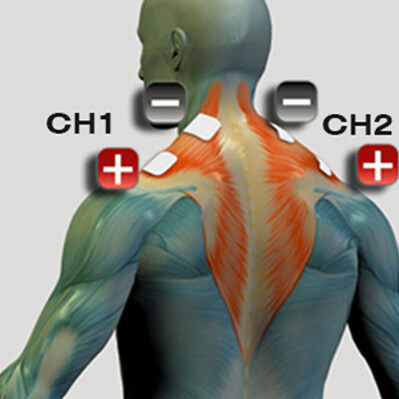
Use four self-adhesive electrodes, typically 5×5 cm, with a two-channel device. Place the two electrodes connected to the same cable on the same side, 6–10 cm apart, over the upper part of the trapezius and the upper back muscle area – on the muscles running alongside the spine, but never directly on the spinal column, and never on the front of the neck (voice box, thyroid or carotid artery area).
2. Choosing the programme
For sharp, currently troublesome pain, choose the conventional TENS programme (60–100 Hz, short pulse); for dull, persistent, “locked” pain, choose the endorphin programme (2–10 Hz, longer pulse). Most devices offer pre-set neck and shoulder programmes – Dolito, Elite SII, Genesy SII, MyoBravo and TensCare UniPro all include both types of programme.
3. Setting the intensity
Always start at zero and increase the intensity slowly. With conventional TENS, the aim is a pronounced but pleasant tingling – without muscle twitching or with only minimal twitching. With the endorphin programme, the aim is a clearly visible, rhythmic muscle contraction. It should not hurt in either case: “the stronger, the better” does not apply here.
4. Treatment time and frequency
One treatment lasts 15–30 minutes, 2–3 times a day, with at least 3–4 hours between sessions. During prolonged use over several weeks, take a 1–2-week break from time to time, or alternate the programmes – this helps prevent the nervous system from becoming accustomed to the stimulus and the treatment losing effect.
5. After treatment
Switch off the device and immediately put the electrodes back on the plastic storage sheet. You can extend the life of self-adhesive electrodes by storing them in the refrigerator (not the freezer!).
 My advice
The first few sessions are for learning – do not judge the device based on them. Try both programme types and different electrode positions: the exact pattern of neck and shoulder pain differs from person to person, and moving an electrode by a few centimetres can make a noticeable difference. Keep a short diary of which setting helped and by how much.
Which device may be suitable?
For neck pain, you need a two-channel device with TENS programmes. You do not need to start with the most expensive one – what matters is the order:
Dolito
An entry-level TENS device specifically intended for pain relief. If you are new to electrotherapy and are primarily looking for a drug-free solution for neck and shoulder pain, this is a good place to start – it is simple, compact and supports both types of TENS programme.
Globus Elite SII
A versatile TENS+EMS device for longer-term use: alongside pain relief, it also has muscle-stimulation programmes, so it can later be used to exercise weakened neck and shoulder-girdle muscles. It makes sense if you want to address more than your current pain and are looking for one device for several purposes – there is no need to buy both; choose one according to your needs.
TensCare Neck Pain electrode
A special one-piece electrode shaped for the curve of the neck: it can be applied in one movement, provides better skin contact than managing four separate electrodes, and can be reused 20–30 times. It works with any TENS device with a standard connector – a convenience accessory, not an essential item.
If you are unsure, the TENS device buying guide takes you through the key considerations, while you can find the full range in the TENS devices category. And most importantly: the device itself does not solve anything – regular use together with improving your posture does.
 When must neck TENS treatment NOT be used?
The neck is a sensitive area – electrotherapy rules must be followed more strictly here than elsewhere:
- Pacemaker, implanted defibrillator (ICD) or another electronic implant – the impulses may interfere with their operation; I describe the details in the article on implants and electrotherapy
- The front of the neck and the carotid artery area – electrodes must never be placed over the voice box, thyroid or carotid arteries
- Neck pain of unknown origin – medical assessment first, home treatment afterwards
- Recent neck injury or condition after an accident – only with the approval of an orthopaedic or neurological specialist
- Cancer in the treatment area – prohibited in the case of a known tumour or suspected tumour; read more in the article on electrotherapy in cancer
- Skin inflammation, wounds or a fresh surgical scar at the treatment site – allow the skin to heal before treatment
- Pregnancy – only after medical consultation
I have collected the general contraindications of electrotherapy in a separate article: contraindications of electrotherapy.
 When must you see a doctor?
If the pain radiates sharply or as a stabbing pain into the arm, hand or fingers; if you notice numbness, tingling or muscle weakness in the arm; if the symptoms started after a head or neck injury; if they are accompanied by fever, chills or feeling unwell; if they do not improve after two weeks of home treatment; or if unintentional weight loss or pain that flares at night occurs – these signs require medical assessment and are not suitable for TENS.
Frequently asked questions
The effect of conventional TENS may appear during the treatment, but fades within a few hours after it ends. The endorphin programme builds more slowly, after 15–30 minutes, but lasts longer. Neither is a one-off miracle cure: repeated, regular use is needed for meaningful day-to-day relief.
Do not. The electrodes are intended for the muscles running alongside the spine (paravertebral muscles), the upper trapezius and upper back muscles – always avoid the midline of the vertebrae and the front of the neck (voice box, thyroid and arteries).
Yes, compact devices are particularly suitable for this – but carry out the first few sessions in a calm home environment until you have learned the settings. Do not use it while driving or operating machinery.
No – and research confirms this: exercise is the foundation, while TENS is an adjunct.3 Pain relief makes movement easier, but lasting improvement comes from regularly exercising the neck and shoulder-girdle muscles, improving posture and adapting the work environment. I explain the exercises in the article on muscle stimulation and physiotherapy.
Yes, the nervous system may become accustomed to the stimulus over time (habituation), and the treatment may lose some of its effect. You can help prevent this by alternating programmes and electrode positions, and by taking a 1–2-week break after several weeks of continuous use.
Yes, TENS and medicinal pain relief work through different mechanisms, so they can be combined well. Many people use TENS specifically to reduce their need for medication – if you take painkillers regularly, discuss this with your doctor.
 What does the research say?
“Is it proven that TENS helps chronic neck pain?”
The evidence is mixed – it is important to say this. The most rigorous scientific review found few studies of low reliability on the subject, so it could not reach a clear conclusion about the independent effect of TENS in chronic neck pain.1 This does not mean that TENS does not work – it means that it is worth viewing as adjunctive pain relief, not as a treatment on its own. It is safe, drug-free and gives many users noticeable relief – but expecting a miracle is not realistic.
“I have muscle knots and trigger points – is it useful for that?”
The data is more encouraging here. In one clinical study, people with neck pain caused by muscle knots (myofascial trigger points) achieved measurable improvement with TENS over four weeks: their pain decreased and their neck range of movement improved. Dry needling was faster at reducing pain – but among treatments that can be administered at home, by yourself, TENS proved useful.2
“TENS or exercise – which should I spend my time on?”
Exercise – TENS can only come alongside it. In a carefully designed study, regular neck exercises alone significantly improved the participants’ condition, and adding TENS did not produce a measurable additional benefit.3 The lesson is clear: movement is the foundation, and no device can replace it. The role of TENS is to help you get through more painful days without medication – and to stop pain from preventing you from moving.
 Summary – Quick overview
Read more
Scientific sources
- Martimbianco ALC, Porfírio GJ, Pacheco RL, Torloni MR, Riera R (2019). Transcutaneous electrical nerve stimulation (TENS) for chronic neck pain. Cochrane Database of Systematic Reviews, 12(12), CD011927. DOI: 10.1002/14651858.CD011927.pub2
- Anjana G, Gupta AK, Kumar D, et al. (2023). Efficacy of Dry Needling Versus Transcutaneous Electrical Nerve Stimulation in Patients With Neck Pain Due to Myofascial Trigger Points: A Randomized Controlled Trial. Cureus, 15(3), e36473. DOI: 10.7759/cureus.36473
- Martins-de-Sousa PH, Fidelis-de-Paula-Gomes CA, Pontes-Silva A, et al. (2023). Additional effect of transcutaneous electrical nerve stimulation in a therapeutic exercise program for sedentary with chronic neck pain: A double-blind randomized controlled trial. Physiotherapy Research International, 28(1), e1978. DOI: 10.1002/pri.1978