
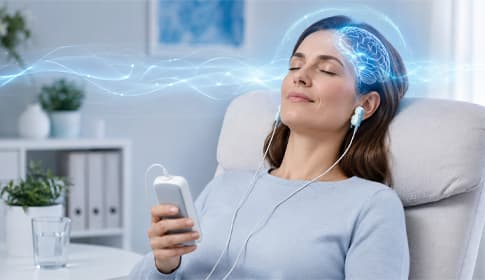

 Cranial stimulation (CES) — what it can and cannot do?
In this guide I will frankly present the current state of clinical evidence around CES, the mechanisms that are hypothesized, and which home devices are available. The method was briefly introduced in the electrotherapy methods pillar; the connection to the autonomic nervous system and to tVNS is discussed in the autonomic nervous system and vagus stimulation pillar.
 Key point
CES is an adjunct home treatment — NOT a standalone cure for insomnia, anxiety, depression, or migraine. Recent research shows:
Anxiety, depression, insomnia [1] — a summary review found meaningful improvement in anxiety patients.
Migraine [6] — forehead-applied neuromodulation devices can contribute as an adjunct to acute relief and prevention.
The evidence is promising but not yet definitive [2][3] — therefore start treatment only as an adjunct after medical consultation.
 How does CES affect your nervous system?
CES devices deliver a very gentle electrical signal across the head (typically to the ear lobe or forehead). The current is so low that you usually do not feel the treatment. Research [1][3] suggests the current may act through three main pathways:
EEG studies indicate that CES treatment can increase alpha-type brain activity — the wave associated with a calm, relaxed yet alert state (like when you rest quietly with closed eyes before sleep). This may explain CES's anxiety-reducing and relaxation effects. Research [3] finds alpha modulation reproducible, but its clinical significance requires further confirmation.
Modeling and brain imaging studies [3] suggest the fine current does not remain only at the subcutaneous surface — it can reach deeper brain areas that play central roles in mood, stress regulation, pain perception and sleep–wake cycle control. This helps explain why CES can affect a range of loosely related complaints (anxiety, depression, insomnia, pain). Important: current intensity is so low that it does not cause muscle contractions or sharp sensory spikes — it works at a background neuromodulatory level.
Research [3] suggests ear-delivered CES current may subtly stimulate auricular branches of the vagus nerve — the same pathway targeted by tVNS devices. Thus CES can potentially activate the body's parasympathetic "brake", contributing to relaxation. Although CES and tVNS are technically different (CES = imperceptible microcurrent; tVNS = mild perceptible tingling at the ear), the shared pathway may explain overlapping effects.
 Which complaints can CES be recommended for?
Find your situation in the list below. In each section I honestly describe how strong the evidence is, what you can expect, and what you should NOT expect. For every condition it is important to start treatment only as a supplement after medical consultation.
If chronic anxiety plagues you — you're tense, your heart races, it's hard to "switch off" — the recent summary review [1] indicates CES treatment can meaningfully reduce anxiety symptoms compared with control. Treatment is generally well tolerated and does not cause medication-like side effects. What you must know: treating anxiety disorders is a psychiatric specialty task. CES is an adjunct tool — it does not replace cognitive behavioral therapy (CBT) or prescribed anxiolytics/antidepressants. It can be part of a most-effective comprehensive package.
If persistent low mood, lack of motivation, sleep problems and loss of joy bother you, the recent summary review [1] suggests CES treatment can noticeably reduce depressive symptoms, especially when anxiety is also present. A larger UK clinical trial [4] is currently evaluating the Alpha-Stim AID device in primary care for moderate depression. What you must know: treating depression is a psychiatric specialty task. First-line treatments are antidepressants and psychotherapy (CBT, IPT). CES is only an adjunct — never stop your antidepressant on your own. Severe depression or suicidal thoughts require immediate specialist care.
If you struggle to fall asleep, toss and turn, wake early and can't return to sleep, recent research [1] suggests CES treatment can meaningfully improve sleep quality, especially when insomnia co-occurs with anxiety or depression. What you must know: sleep hygiene rules (fixed bedtime, dark quiet room, no screens in the evening, avoid caffeine after midday) and sleep-focused psychotherapy (CBT-I) remain first-line. CES is an adjunct — it can be part of an evening routine but does not replace lifestyle measures. For balance: some research [2] calls insomnia trial results "inconsistent", so evaluate individually.
If you suffer recurrent migraine attacks or cluster headaches — hours of severe pain, sensitivity to light and sound, nausea — the recent review [6] indicates forehead-applied neuromodulation can meaningfully contribute to acute relief and prevention. The Mynd Migraine Relief is the device developed for this purpose in the Medimarket portfolio. What you must know: migraine work-up and treatment is a neurologist's specialist task. Always coordinate device use with your treating physician — it does not replace acute (triptan) or preventive medications.
If you have chronic bodily pain (fibromyalgia, muscular or joint complaints), the evidence for CES is weakest here. A comprehensive review [2] did not find convincing effects of CES for these conditions, and a newer small study [5] also showed no superiority over control. What you must know: for chronic pain, CES is not a first-line option — pain clinic care, physiotherapy, exercise therapy and medications are better supported by evidence. CES may be tried at best as an adjunct if pain co-occurs with anxiety or sleep problems.
Which home device should you choose?
The Medimarket portfolio currently includes two home neuromodulation devices related to this field — for different purposes:
TensCare Somnus — if sleep disorder or anxiety is your main complaint
The TensCare Somnus is a classic CES device in an ear-lobe clip format. It is specifically designed as an adjunct for insomnia and anxiety-associated sleep disturbances. It is intended for home use and is a non-prescription device.
Who should consider it:
- Sleep disturbance associated with chronic anxiety — part of an evening routine
- People who have difficulty falling asleep and want a complementary tool alongside medication
- To support sleep hygiene and CBT-I (sleep-focused psychotherapy)
Mynd Migraine Relief — if you have recurrent migraine attacks
The Mynd Migraine Relief is a home neuromodulation device designed for acute migraine relief and prevention. It applies a gentle electrical impulse across the forehead [6] and can cause a mild perceptible tingling. It is CE-marked.
Who should consider it:
- Patients with recurrent migraine attacks
- Adjunctive treatment for cluster headache
- Those seeking a non-invasive neuromodulation option alongside drugs
What you must know: migraine diagnosis and treatment is a neurologist's specialist task — discuss treatment strategy with your neurologist.
Choice guide in one sentence
TensCare Somnus if your primary goal is calmer sleep or reduced anxiety. Mynd Migraine Relief if you are looking for an adjunct device for recurrent migraine attacks. The two devices do NOT replace each other — they were designed for different complaints. If your situation is complex (e.g., migraine + anxiety), consult a specialist to determine the priority.
What does a home CES course look like?
Devices come with factory programs — you do not need to tweak technical parameters. The table below is an informative guide:
| Parameter | Typical value | What it means for you |
|---|---|---|
| What will you feel? | typically nothing (CES) or mild tingling (e-TNS for migraine) | CES is subtle — not sharp or stinging; the Mynd produces perceptible forehead tingling |
| Where is the device placed? | ear-lobe clip (Somnus) or forehead (Mynd) | Device-dependent — follow the user manual |
| Length of one session | 20–60 minutes | Can be used while watching TV, reading, or relaxing in the evening |
| How many times per day? | once | Typically before going to bed |
| When is it most effective? | in a quiet environment | Before bedtime — part of your sleep routine |
| Course duration | 4–8 weeks | Patience is required — measurable change usually takes weeks |
 When NOT to start CES treatment?
General electrotherapy contraindications apply here as well (see: electrical treatment contraindications and electrical treatment and implants).
- You have a pacemaker, ICD, or implanted neurostimulator — only with cardiologist/arrhythmologist approval.
- You have an implanted hearing device — risk of electrical interference.
- You are pregnant — not recommended for safety reasons.
- You have poorly controlled epilepsy — individual specialist assessment required.
- You are in a severe psychiatric crisis (suicidal ideation, severe panic attack) — seek specialist/emergency care first.
- Fresh wound, inflammation, or skin infection on your ear or forehead — wait until healed.
- An active tumor in the head–neck region — avoid treatment.
- Previous major skull/brain injury or implanted metal prosthesis in your head — individual specialist assessment needed.
Never stop prescribed psychiatric or neurological medications (antidepressants, anxiolytics, antiepileptics, migraine drugs) on your own in favor of CES. Any change must be discussed with your treating physician.
Frequently asked questions about CES
Research is promising but requires further confirmation. The 2023 Chung meta-analysis [1] (8 RCTs, n=337) showed significant reductions in anxiety, depression and insomnia. However, the 2018 Shekelle Annals of Internal Medicine SR [2] and the 2021 Brunyé critical review [3] raised methodological concerns (small sample sizes, difficulties with sham control, high risk of bias). Consult a specialist for clinical decisions.
Most trials assessed outcomes after 4–8 weeks of regular daily use. The larger UK trial [4] uses an 8-week protocol; the Chung review [1] summarized 2–6 week protocols. Some users may notice changes within a few weeks, but a meaningful evaluation requires at least 4 weeks of regular use. Patience is important.
No. Recent studies [1][4] position CES as an adjunct — whether considered as medication-free interest or add-on therapy. Withdrawal or any change of psychiatric medication is exclusively the responsibility of your treating physician. Never stop prescribed drugs on your own and replace them with a CES device — this can be dangerous.
Classic CES (TensCare Somnus) current is so low that most users do not feel anything. Some may notice mild stinging or dizziness, which usually resolves by reducing intensity. Migraine-focused devices (Mynd Migraine Relief) can produce a mild perceptible tingling on the forehead — this is normal and not painful.
TensCare Somnus is a classic CES device in an ear-lobe clip format for adjunct treatment of insomnia and anxiety-related sleep disorders. Mynd Migraine Relief is designed for acute migraine relief and prevention and is worn on the forehead as a neuromodulation device. Different complaint, different mechanism — they do not replace each other.
Only with cardiologist/arrhythmologist approval. Active implants (pacemaker, ICD, hearing implant, neurostimulator) may be interfered with by electrical treatment. Details in the electrical treatment and implants article.
 Summary — cranial stimulation (CES) in brief
What every patient should know
- CES is a very subtle, typically imperceptible electrical treatment applied via the ear or the forehead.
- Most supportive evidence: anxiety [1], anxiety-associated depression [1], insomnia [1] and migraine [6] (with a specific device).
- Weaker evidence: chronic bodily pain [2][5] — not a first choice.
- CES is an adjunct treatment — it does not replace antidepressants, anxiolytics, sleep psychotherapy or specialist diagnosis.
- Typical course: 20–60 minutes/day, 4–8 weeks of regular use.
- Medimarket portfolio: TensCare Somnus (sleep/anxiety) and Mynd Migraine Relief (migraine).
- Contraindications (pacemaker, hearing implant, pregnancy, acute psychiatric crisis) must be strictly observed.
- In severe depression with suicidal thoughts seek immediate specialist care.
Scientific sources (2018+)
References [1]–[6] cited in the article correspond to the following studies (list order = reference number):
-
Chung FC, Sun CK, Chen Y, Cheng YS, Chung W, Tzang RF, Chiu HJ, Wang MY, Cheng YC, Hung KC.
Efficacy of electrical cranial stimulation for treatment of psychiatric symptoms in patients with anxiety: A systematic review and meta-analysis.
Frontiers in Psychiatry.
2023;14:1157473.
PMID: 37091717.
Brief summary: Systematic review and meta-analysis (8 RCTs, n=337) — CES was significantly better at reducing anxiety (ES=−0.96; p<0.00001), depression (ES=−0.69; p=0.003) and insomnia (ES=−1.02; p=0.0006) in anxiety patients; Alpha-Stim subgroup (4 RCTs, n=230) also showed consistent anxiety reduction. -
Shekelle PG, Cook IA, Miake-Lye IM, Booth MS, Beroes JM, Mak S.
Benefits and Harms of Cranial Electrical Stimulation for Chronic Painful Conditions, Depression, Anxiety, and Insomnia: A Systematic Review.
Annals of Internal Medicine.
2018;168(6):414-421.
PMID: 29435567.
Brief summary: A balanced systematic review — CES did not show clinically meaningful effects in fibromyalgia, headache, and musculoskeletal pain trials; insomnia trial results were "inconsistent or conflicting"; small sample sizes and high risk of bias noted. -
Brunyé TT, Patterson JE, Wooten T, Hussey EK.
A Critical Review of Cranial Electrotherapy Stimulation for Neuromodulation in Clinical and Non-clinical Samples.
Frontiers in Human Neuroscience.
2021;15:625321.
PMID: 33597854.
Brief summary: Critical review of CES neuromodulation mechanisms — alpha-wave modulation reproducible; computational modeling suggests current can reach subcortical and limbic regions; vagal afferent stimulation hypothesis; methodological concerns about sham-control. -
Patel S, Boutry C, Patel P, Craven MP, Guo B, Zafar A, Kai J, Smart D, Butler D, Higton F, McNaughton R, Briley PM, Griffiths C, Nixon N, Sayal K, Morriss R.
A randomised controlled trial investigating the clinical and cost-effectiveness of Alpha-Stim AID cranial electrotherapy stimulation (CES) in patients seeking treatment for moderate severity depression in primary care (Alpha-Stim-D Trial).
Trials.
2022;23(1):250.
PMID: 35379314.
Brief summary: Ongoing UK RCT protocol — Alpha-Stim AID CES vs. sham with an 8-week home protocol in primary care for moderate depression. -
Palmer A, Hamann T, Liese J, Müller B, Kropp P, Jürgens TP, Rimmele F.
Efficacy of cranial electrotherapy stimulation in patients with burning mouth syndrome: a randomized, controlled, double-blind pilot study.
Frontiers in Neurology.
2024;15:1343093.
PMID: 38419716.
Brief summary: 22-participant double-blind pilot RCT in burning mouth syndrome — active CES + TENS reduced pain at 28 days but was not significantly better than control (responder rates 36% in both groups). -
Urits I, Schwartz R, Smoots D, Koop L, Veeravelli S, Orhurhu V, Cornett EM, Manchikanti L, Kaye AD, Imani F, Varrassi G, Viswanath O.
Peripheral Neuromodulation for the Management of Headache.
Anesthesiology and Pain Medicine.
2020;10(6):e110515.
PMID: 34150578.
Brief summary: Review of peripheral neuromodulation (e-TNS, vagus stimulation, occipital stimulation) in headache management — Cefaly and similar devices can be useful adjuncts; specialist evaluation required.

This article is for general informational purposes and does not replace personal medical consultation. Cranial stimulation (CES) and related neuromodulation devices are CE-marked medical devices; the referenced clinical trials used different devices and protocols, and results may vary between individuals. CES is an adjunct treatment and does not replace psychiatric or neurological specialist diagnosis, prescribed medications, or a multidisciplinary treatment package. Contraindications (pacemaker, hearing implant, pregnancy, acute psychiatric crisis) must be strictly observed. For new, worsening, or unexplained symptoms, consult your treating physician. In cases of suicidal thoughts or severe psychiatric crisis, seek emergency psychiatric care immediately.

