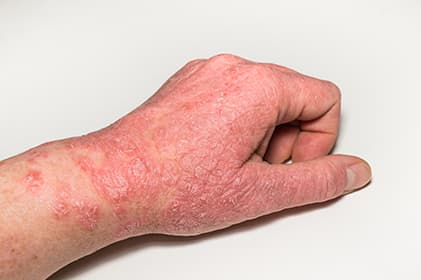

 Eczema, psoriasis and salt therapy
The relationship between salt and diseased skin is older than medicine itself: seawater bathing has been used for skin complaints for thousands of years, and the shores of the Dead Sea are still one of the world's most visited “natural skin clinics” – not by chance, since tens of thousands of people with psoriasis experience relief from their symptoms there year after year. Modern research has made this old observation measurable: a magnesium-rich salt bath improves the function of the skin barrier and reduces redness2, while the combination of a salt bath + phototherapy produces more benefit for psoriasis than phototherapy alone.34
This article presents the possibilities of salt from the perspective of the two most common chronic skin diseases – eczema and psoriasis: what happens in diseased skin, where salt can enter the picture (as a bath and as salty air), what the research actually says, and how to build a salt routine at home – ALONGSIDE dermatological treatment, not instead of it.
 Key point
Both diseases share a damaged skin barrier: eczematous and psoriatic skin loses water, dries out and opens its doors to irritants and pathogens – starting a vicious circle. Salt may slow this circle at several points: according to research, a salt bath improves the skin's water retention and reduces inflammatory redness2; a salty environment slows the growth of bacteria on the skin that aggravate eczema; and in psoriasis, phototherapy combined with a salt bath produced meaningful improvement in a larger proportion of patients than light alone.3 The framework remains unchanged: salt is complementary – the treatment prescribed by a dermatologist is the foundation.
 Eczema and psoriasis – two different diseases, one shared problem
The two diseases are often mentioned together, although their background is different. Eczema (medically known as atopic dermatitis) is a disease of allergy-prone, hypersensitive skin: it most often begins in childhood, with red, intensely itchy, dry patches – and eczematous skin is also more prone to infection because its barrier is weaker from the outset. Psoriasis, by contrast, involves an “overactive” immune system: instead of taking the normal 28-30 days, skin cells reach the surface in 3-4 days and form thick, silvery, flaky plaques – typically on the elbows, knees and scalp. It is important to know: psoriasis is NOT contagious, and neither disease is a matter of hygiene.
| Eczema (atopic dermatitis) | Psoriasis | |
|---|---|---|
| What causes it? | Over-sensitive immune response + weak skin barrier, often with an allergic tendency | Autoimmune process: accelerated skin-cell production |
| What does it look like? | Red, dry, intensely itchy patches, often in skin folds | Thick, sharply defined, silvery, flaky plaques |
| What makes it worse? | Dryness, sweating, irritants, stress, skin infection | Stress, sore throat, certain medicines, smoking, alcohol |
| What is the basic medical treatment? | Skin-barrier care + anti-inflammatory creams; internal treatment in severe cases | Topical treatments, phototherapy, modern systemic therapies in severe cases |
| Where can salt play a role? | Salt baths for the skin barrier2, a salty environment against skin bacteria, salt air as a course of treatment1 | Salt bath + phototherapy combination34, seaside/Dead Sea climate therapy |
When should you see a dermatologist (again)? If the disease appears for the first time (an accurate diagnosis determines the treatment); if a flare-up occurs despite your usual treatment; if the skin shows signs of infection (pus, honey-coloured crusts, fever); or if the symptoms are damaging your quality of life – effective, modern treatments are now available for both diseases, and nobody has to “live with” uncontrolled symptoms.
 How does salt work on diseased skin?
The German dermatology-clinic study measured exactly what people with eczema feel on their own skin. Volunteers with dry, eczematous skin immersed one forearm in a 5% magnesium-rich Dead Sea salt solution for 15 minutes every day for six weeks – and the other in ordinary tap water for comparison. The result: the water retention of skin soaked in the salt solution improved, its surface became smoother, redness – a visible sign of inflammation – decreased, and the skin barrier function also improved measurably, while none of this occurred on the tap-water side.2 The researchers mainly attribute the effect to magnesium, which binds water in the skin and supports restoration of the barrier – so it is worth choosing mineral-rich rock salt for bathing instead of pure, refined table salt.
The tiny salt particles floating in the air of salt rooms and salt chambers do not only reach the airways – they also settle on the skin surface, where they form a thin salty micro-layer. This layer attracts water, slows the growth of bacteria living on the skin that aggravate eczema (especially Staphylococcus aureus), and helps soothe the flaky, inflamed surface. In the largest study addressing this question, 112 children with eczema underwent a course in a chamber treated with salt spray: the skin condition completely improved in 58% of the children and partially improved in a further 20%, and the improvement lasted for 6-24 months – the researchers also observed favourable changes in immune-system measurements.1 A Hungarian literature review summarises international experience as follows: courses of dry salt inhalation may also have beneficial effects in skin diseases – psoriasis, eczema and purulent skin infections.6
For psoriasis, the strongest evidence involving salt concerns the combination. Phototherapy (medical UVB light) is an established treatment for psoriasis – and it turns out that it does more when paired with a salt bath. In a German study following 143 patients with moderate-to-severe psoriasis, half received phototherapy AFTER bathing in saline spring water, while the other half received light alone: after six weeks, symptoms had decreased by at least half in 73% of the salt-bath group, compared with 50% of those who received light alone.3 An international research review – 8 studies involving more than 2100 patients – produced the same result: significant improvement is more likely with the salt bath + light combination than with light alone.4 The mechanism is logical: soaking in salt loosens the flaky layer of plaques, allowing the light to reach the skin more effectively. If you attend phototherapy for psoriasis, ask your dermatologist about adding salt baths.
 How to build a salt-based skin-care routine at home
| Step | How? |
|---|---|
| 1. Partial bath for the affected area | The recipe used successfully in the study: approximately a 5% solution (50 g mineral-rich rock salt per 1 litre of pleasantly warm water), soaking the hand/foot/forearm for 15 minutes2 – in a smaller container this means a few spoonfuls of salt, not kilograms |
| 2. Full bath | 250-500 g rock salt for a bathtub of water (a milder, 0.3-0.5% solution), for 15-20 minutes in lukewarm-to-warm (not hot!) water – hot water dries the skin and worsens itching |
| 3. The 3 minutes after bathing are the secret | Rinse with lukewarm water, PAT DRY GENTLY (do not rub), then apply a moisturising/emollient cream within 3 minutes – cream applied to damp skin locks in water; this is the golden rule of eczema care |
| 4. Frequency and course of treatment | 3-4 baths per week for 4-6 weeks – the studies also used courses lasting several weeks23; allow 2-4 weeks before expecting the first noticeable change |
| 5. Salt air as a complement | Salt nebuliser in the bedroom: salt mist also reaches the skin surface at night – a convenient, non-cooperation-dependent complement for a child with eczema |
| 6. Alongside phototherapy (psoriasis) | If you attend UVB treatment: ask your doctor whether a salt bath can be added before treatment – the combination produces more benefit according to research34 |
 Use caution during flare-ups and on damaged skin
Salt is for maintaining CALM or mildly symptomatic skin. During an acute, weeping, open flare-up or on cracked, open skin, salt water may sting severely and may even make things worse – in this situation, let dermatological treatment calm the flare-up first, and only then reintroduce salt. For skin suspected of infection (pus, honey-coloured crusts, spreading redness, fever), see a doctor instead of taking a salt bath. And always test it the first time: try the solution on a small area of skin – if it stings strongly or is still redder several hours later, continue with a more dilute solution or leave it out.
 My advice
With skin diseases, most failures are not due to the method but to impatience: after one or two baths, people decide that it “doesn't work” and stop everything. Yet skin is a slow organ – its renewal cycle is measured in weeks, so every change in skin care should be given at least a month. My suggestion is to treat salt as a course, as the studies did – 4-6 weeks, 3-4 partial or full baths per week, moisturising within 3 minutes after EVERY bath, and a photo of the skin once a week in the same light. A series of photos does not lie: either improvement is visible (and then it makes sense to continue with 1-2 courses a year), or it is not (and then the dermatologist has the next word). In either case, do not stop your medicines on your own – salt supports the treatment; it does not replace it.
Salt air at home – what can a salt nebuliser add?
The dermatological use of salt air – technically called halotherapy – is known from salt-room courses: salt particles floating in the air settle on the skin surface and exert a soothing, bacteria-inhibiting effect, and in the large study of children with eczema this produced long-lasting improvement.1 In Hungary, institutional use of inhaled nebulised saline also has a long tradition: the patient information from the Department of Otorhinolaryngology at Semmelweis University describes the centuries-old practice of spa inhalation rooms8 – primarily for respiratory indications, although the beneficial effect of a salty climate on the skin is also discussed separately in the literature.567
What can a home ultrasonic salt nebuliser do?
A home device such as the SaltDome nebulises inhalable-sized droplets from saline into the bedroom air – so at night, salt not only reaches the airways, but also settles as a fine layer on exposed skin. With skin diseases, this needs to be kept in perspective: the main salt-based tool is the BATH (this is where the most salt reaches the skin, and this is where the strongest research evidence lies23), while salt air is a convenient, continuous complement – especially for a child with eczema, whom bathing can sometimes be a struggle but who sleeps every night. To be honest: no dermatological study has yet been carried out specifically with a home salt nebuliser – its expected effect can be inferred from salt-room research1. And respiratory complaints often accompany eczema and psoriasis (allergy, asthma) – this is where the device serves its primary purpose.
What you need for salt therapy at home
Natural, additive-free rock salt
Additive-free, mineral-rich Praid or Himalayan rock salt – this is the foundation for partial and full salt baths (instead of refined, iodised table salt), and it is also ideal for the salt nebuliser solution.
SaltDome salt therapy device
Ultrasonic salt generator for use at night while sleeping – a complement to a salt-bath course, especially practical for families with children affected by eczema or allergies. For several rooms, the Duo and Family sets provide a solution.
 When NOT to use it – and when to see a dermatologist
- Acute, weeping flare-up or open or cracked skin – medical treatment comes first; salt water stings and may worsen the condition
- Active skin infection – see a doctor in case of pus, honey-coloured crusts, spreading redness or fever; a salt bath does not treat the infection
- Severe cardiovascular disease or untreated high blood pressure – longer warm bathing courses only with medical approval
- Active tuberculosis or febrile infectious illness – suspend salt therapy (baths and salt air)
- Stopping medical treatment without authorisation – salt complements dermatological therapy; only your doctor should decide on medicine changes
Frequently asked questions
That is a fair question – and the answer depends on technique. In the study, the magnesium-rich salt solution actually IMPROVED the skin's water retention2, but under two conditions: do not use hot water, and moisturise after the bath. Problems arise if you take the salt bath hot (hot water removes the skin's own oils) or if you rub the skin dry after bathing and do not apply cream. The golden rule is: lukewarm-to-warm water, gentle patting, and an emollient cream within 3 minutes – this lets the salt do its work while keeping water in the skin.
The study used Dead Sea salt, and the researchers attributed much of the effect to its high magnesium content.2 The practical lesson is not about the brand but the principle: use untreated, mineral-rich salt – such as Praid or Himalayan rock salt – rather than refined, iodised table salt containing anti-caking agents. Refined salt is almost pure sodium chloride; the accompanying minerals (magnesium, calcium and potassium) are missing – yet the skin-barrier research attributes the additional benefit precisely to these minerals.
Its effect on its own is more modest – the strength of the psoriasis research lies in the COMBINATION: a salt bath + medical UVB phototherapy produced significantly better results than light alone (73% versus 50% meaningful improvement in the German study3, and the analysis of 8 studies also supported the combination4). At home, the practical version is this: if you attend phototherapy, discuss a salt bath before treatment with your doctor; if you do not, a salt bath may help loosen the flaky layer of plaques and reduce itching – but meaningful psoriasis treatment is a task for a dermatologist.
With the right technique, yes – the largest salt-and-skin study was carried out specifically with children, with good results and no reported side effects.1 Practical rules: start with a more dilute solution for a child (half strength), for a shorter time (5-10 minutes), and leave it out during a weeping or open flare-up. Quick moisturising within 3 minutes after the bath is even more important for a child than for an adult. And the first step for children is also a dermatologist: incorporate salt into the child's eczema treatment plan, rather than using it instead of treatment.
The timing of the studies provides a useful guide: measurable improvement was established over 6 weeks in the skin-barrier study2, the psoriasis study used a 6-week course3, and after the children's salt-chamber course, improvement lasted for 6-24 months.1 A realistic plan is therefore a 4-6-week course, first assessment at 2-4 weeks (with weekly photos), followed by maintenance with 1-2 courses per year and continuous basic skin care. Salt is not something you can “tick off” once – but it also requires no more than a few baths per week.
 What the research says – answers to readers' questions
“Was the effect of salt baths really measured, or is this just a seaside legend?”2
It was measured, and in an elegant design: at the dermatology clinic of the University of Kiel, adults with eczema and dry skin immersed one forearm in a 5% magnesium-rich Dead Sea salt solution for 15 minutes every day for six weeks, and the other in tap water – so each person served as their own control. On the salt side, the skin's water retention and barrier function improved, the skin surface became smoother and redness decreased; this did not happen on the tap-water side.2 The researchers concluded that the key to the effect was largely magnesium, which binds water in the skin and helps restore the barrier. This study also provides the recipe for a partial bath at home: a 5% solution, 15 minutes, for several weeks.
“What is the strongest evidence involving salt for psoriasis?”34
The combination of a salt bath + phototherapy. In the German study of 143 patients, following UVB phototherapy after a saline spring-water bath, symptoms decreased by at least half within six weeks in 73% of patients – compared with 50% among those who received light alone, and the difference was also statistically convincing.3 The international analysis of 8 studies involving more than 2100 patients reached the same conclusion: significant improvement is more likely with phototherapy combined with a salt bath – although the authors point out that the number of studies is limited, so the certainty is moderate.4 The practical message is still clear: for someone attending phototherapy, adding a salt bath after discussing it with a doctor is a particularly sensible step.
“And salt air? Salt rooms are also recommended for the skin – is that justified?”156
There is evidence, although less than for baths. In the largest study, 112 children with eczema underwent a course in a salt-spray chamber: complete skin improvement was reported in 58% and partial improvement in a further 20%, lasting for 6-24 months, while immune-system measurements also moved in a favourable direction.1 The dermatological review entitled “Salt and skin” summarises historical and current uses of salt and its relationship with the skin, from seawater treatments to salt baths5; the Hungarian review, based on international literature, lists psoriasis, eczema and purulent skin infections among the areas where dry salt-inhalation courses may be beneficial.6 The honest framework is this: these are smaller, older studies – so for the skin, salt air is complementary and the salt bath is the main tool.
Summary
What is this article about? A guide to complementary salt-based care for eczema and psoriasis: the differences between the two diseases, the three ways salt can play a role (partial and full baths, the salt bath + phototherapy combination, and salt air), the research findings in plain language, and the exact recipe for a 4-6-week course at home.
Who is it for? People living with eczema or psoriasis, and parents raising a child with eczema, who are looking for a safe, natural complement to dermatological treatment.
Main message: Salt may help with several problems affecting diseased skin: according to research, a magnesium-rich salt bath improves the skin's water retention and reduces inflammatory redness; for psoriasis, the salt bath + phototherapy combination produces more benefit than light alone; and salt-air courses have produced long-lasting improvement in children with eczema. The three conditions for success are lukewarm (not hot) water, moisturising within 3 minutes after the bath, and perseverance for 4-6 weeks – all ALONGSIDE the treatment prescribed by a dermatologist.
Next step: Obtain mineral-rich rock salt, start a partial or full bath course 3-4 times a week with moisturising after the bath, and document the process with a weekly photo – but see a dermatologist first during a flare-up or if infection is suspected.
Read more
Scientific sources
- Puryshev EA. (1994). The efficacy of speleotherapy in atopic dermatitis in children. Voprosy Kurortologii, Fizioterapii i Lechebnoi Fizicheskoi Kultury. PubMed: 7846884
- Proksch E, Nissen HP, Bremgartner M, Urquhart C. (2005). Bathing in a magnesium-rich Dead Sea salt solution improves skin barrier function, enhances skin hydration, and reduces inflammation in atopic dry skin. International Journal of Dermatology. DOI: 10.1111/j.1365-4632.2005.02079.x
- Brockow T, Schiener R, Franke A, Resch KL, Peter RU. (2007). A pragmatic randomized controlled trial on the effectiveness of low concentrated saline spa water baths followed by UVB compared to UVB only in moderate to severe psoriasis. Journal of the European Academy of Dermatology and Venereology. DOI: 10.1111/j.1468-3083.2007.02152.x
- Peinemann F, Harari M, Peternel S, et al. (2020). Indoor balneophototherapy for chronic plaque psoriasis: abridged Cochrane review. Dermatologic Therapy. DOI: 10.1111/dth.14588
- Manoharan P, Kaliaperumal K. (2022). Salt and skin. International Journal of Dermatology. DOI: 10.1111/ijd.15588
- Endre L. (2015). A szárazsó-belégzés elméleti alapjai és klinikai haszna. Orvosi Hetilap. DOI: 10.1556/650.2015.30267
- Wasik AA, Tuuminen T. (2021). Salt therapy as a complementary method for the treatment of respiratory tract diseases, with a focus on mold-related illness. Alternative Therapies in Health and Medicine. PubMed: 34726628
- Semmelweis Egyetem Fül-Orr-Gégészeti és Fej-Nyaksebészeti Klinika. A sóterápia hatásai – betegtájékoztató (intézményi forrás). semmelweis.hu. semmelweis.hu