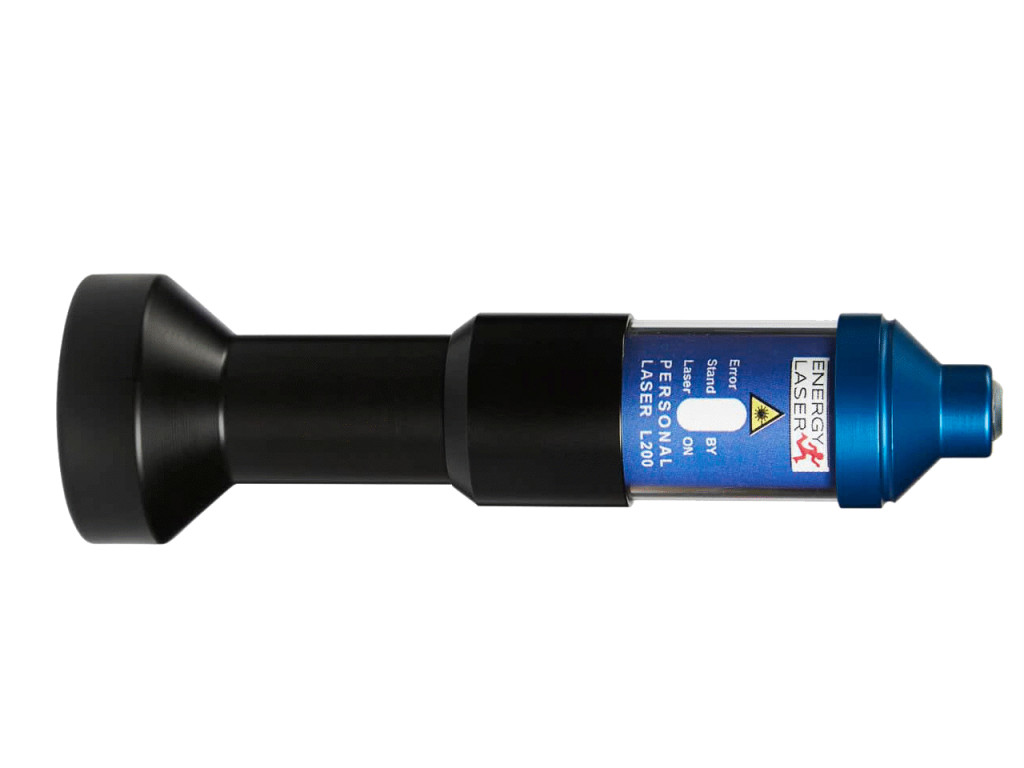
Slow-healing wound? Stubborn scar? Or is tinnitus keeping you awake at night? The Personal Laser L200 is one of the world’s smallest 200 mW medical lasers – small enough for your pocket, yet delivers serious performance. At home and without medication you can support tissue regeneration as a complementary therapy alongside medical treatment. Why choose the Personal Laser L200? Genuine medical diode laser – not an LED The coherent 660 nm laser light delivers energy concentrically and precisely into the tissues. It is not a scattered-light LED lamp – this is a real, CE-certified Class 3B medical laser like those used in clinical studies. 12 Joule per minute – ultra-fast sessions Treating a small area takes only half to one minute. You don’t have to hold it on one spot for 20 minutes like weak LED “miracle” devices. Use it in the morning or before bed — it fits easily into your routine. 42 grams – lighter than a pen Housed in aluminium and weighing only 42 g, the device fits in your pocket or bag. Take it on trips or vacations. The Li‑Ion battery provides roughly 3 hours of treatment per charge. Home treatment – no clinic visits required No need to book appointments or travel for treatments. Regular home use may help tissues regenerate faster when used as a complement to the therapy recommended by your physician. What can you use it for? Has your wound not healed for weeks? ▼ Sound familiar? A small cut, abrasion or surgical wound — and weeks later it still hasn’t closed properly. This is particularly frustrating in diabetes, circulatory disorders or simply slow healing. The 660 nm red laser light is absorbed in the upper layers of the skin where it can support cellular metabolic processes. Systematic reviews and meta-analyses indicate that LLLT treatment can statistically significantly aid wound healing in skin wounds (Khoja et al., 2024 – PubMed). Usage tip: Hold the laser about 1 cm from the wound and treat each area for 30–60 seconds once daily. For scars, a longer course (2–4 weeks) is recommended. Is your finger, ankle or wrist swollen and painful? ▼ Sound familiar? Small joint inflammation — whether in a finger, ankle or wrist — is particularly unpleasant because every movement reminds you of it. Anti-inflammatory creams only provide temporary relief, and you may not want long-term oral medication. Photobiomodulation (PBM) may help reduce inflammatory processes by increasing mitochondrial activity. The 660 nm wavelength penetrates approximately 1–2 cm, suitable for superficial structures of small joints — fingers, wrist and ankle (Glass, 2021 – PubMed). Usage tip: Treat the inflamed joint 1–2 times daily for 1–2 minutes. Pain relief is generally expected after regular use for 1–2 weeks. Does your ear buzz or ring quietly at night? ▼ Sound familiar? You switch off the light and it’s quiet — but not in your head. Chronic tinnitus can disrupt sleep, concentration and quality of life. Transmeatal low-level laser application (through the ear canal) is one of the most researched adjunctive treatments for tinnitus. Clinical trials used 660 nm lasers at 100–200 mW in the ear canal. Results are mixed — some studies showed improvement while others found no significant difference from placebo (Chen et al., 2020 – PubMed). The L200 parameters align with settings used in research. Usage tip: Place the laser at the entrance of the ear canal and treat for 10–15 minutes daily. Always wear protective goggles during use! Several weeks of treatment are needed to evaluate results. Troubled by a stubborn scar, keloid or recurring herpes? ▼ Sound familiar? A surgical scar becomes thicker instead of fading. Herpes blisters keep returning — always at the worst time. An ingrown nail keeps getting infected. The 660 nm red laser is an optimal wavelength for skin tissues. Research suggests it may support collagen production, which can help scars fade and become more flexible. For herpes, early laser treatment during the blister stage may help speed recovery based on clinical experience. Usage tip: Treat scars for 1 minute daily over 4–6 weeks. For herpes, apply the laser twice daily for 30–60 seconds during the blister stage. Is your dog’s or cat’s wound healing slowly? ▼ Sound familiar? Your pet was injured, underwent surgery, or has a chronic skin condition — and healing is slower than you’d like. Low-level laser therapy is widely used in veterinary medicine. The 660 nm wavelength is suitable for superficial tissue treatment in small animals — wounds, sutures, skin inflammations. Consult your veterinarian about the treatment protocol! Usage tip: Clip fur from the treated area. Hold the laser 1 cm from the skin and treat each area for 30–60 seconds daily. Ensure the animal does not look into the laser beam! How to use it? It’s that simple: 1 Put on the protective goggles Always wear the protective goggles included in the package for every treatment. A Class 3B laser can cause eye damage from direct or reflected beams. 2 Turn the laser on Press the power button. The device is immediately ready — no warm-up time, no complicated settings. 3 Hold it over the treatment area Keep the laser approximately 0.5–1 cm from the skin surface. Move slowly or hold on a single point for 30–60 seconds. The device delivers about 12 Joule per minute. 4 Repeat regularly Regular daily treatment is key. For most conditions a 1–4 week course is recommended, 1–2 times daily. The exact protocol is in the user manual and in the Low‑Level Laser Therapy guide. What’s included in the package? 1x Personal Laser L200 device (aluminium housing) 1x lithium‑ion battery (3.7 V) 1x battery charger + USB cable + USB power adapter 1x protective goggles (mandatory to wear!) Aluminium carrying case User manual Protective goggles – why are they mandatory? ▼ The Personal Laser L200 is a Class 3B medical laser. This means direct or reflected beams can cause eye damage. You must wear the protective goggles supplied with the package during every treatment — even if you are treating only your leg or hand. Aluminium carrying case – safe storage ▼ The premium aluminium case stores the device, charger and protective goggles. Ideal for travel and vacations — the laser stays protected from damage. Frequently asked questions Is home use safe? Yes, the device holds CE Class IIa medical certification. Protective goggles are included and must be worn for every treatment. Never point the laser directly at the eyes or reflective surfaces. Follow the treatment times and contraindications described in the user manual. What is the difference between the Personal Laser L200 and L400? The L200 operates at 660 nm (red) with 200 mW power — ideal for surface treatments (wounds, scars, skin, tinnitus). The L400 uses 808 nm (infrared) at 400 mW — it penetrates deeper tissues (joints, tendons, muscles). Choose L200 for surface complaints; choose L400 for deeper pain (knee, lower back, shoulder). How long does a treatment take? A single treatment typically lasts 1–5 minutes per area. The device delivers about 12 Joule per minute. Most surface treatments recommend 4–12 Joule, which corresponds to 30–60 seconds. For tinnitus, a 10–15 minute session is recommended. You can use it for roughly 3 hours on a single charge. Is this a real laser or just an LED? This is a genuine Class 3B diode laser, not an LED. A diode laser emits coherent light at a single wavelength (660 nm), delivering energy more precisely and deeper than a scattered-light LED. This is an important distinction from a medical perspective. Learn more: LED lamp or Diode laser — what’s the difference? How often can I use it? For acute complaints (fresh injury, herpes), 1–2 times daily is recommended. For chronic issues (scars, tinnitus), once daily is usually sufficient. Improvement is typically noticed after 1–2 weeks of regular use. The exact protocol is in the Low‑Level Laser Therapy guide. When NOT to use the device? Do not use over malignant tumors (cancer) Avoid the abdomen and uterus during pregnancy Do not apply in cases of photosensitivity DO NOT point at the eye or into the eye — always wear protective goggles! Consult a physician if you have epilepsy Do not use on actively bleeding areas Important information The device is intended for adjunctive treatment alongside physician‑prescribed therapy. It does not replace medical examination or treatment. Consult your treating physician if you have complaints! Technical specifications Feature Value Wavelength 660 nm (visible red light) Maximum power (CW) 200 mW continuous mode Penetration depth approx. 1–2 cm Energy output approx. 12 Joule/min Beam area 1 cm² Operating mode Continuous (CW – Continuous Wave) Laser class 3B (medical) Battery Li‑Ion, 3.7 V – approx. 3 hours runtime Weight 42 g Material Aluminium housing CE certification Class IIa LLLT medical device (MDR) Manufacturer Akeda Laser ApS (Denmark) Eye protection Protective goggles included (mandatory to wear) Scientific background Scientific publications supporting the device’s mechanism of action: Khoja A et al. (2024): The Effects of Low-Level Laser Therapy on Wound Healing and Pain Management in Skin Wounds: A Systematic Review and Meta-Analysis. Cureus, 16(11):e74385. PubMed Result: Significant improvement in wound healing (95% CI 13.93–37.70, p<0.0001) and pain reduction (VAS -2.52 – -0.19, p=0.02). Glass GE (2021): Photobiomodulation: The Clinical Applications of Low-Level Light Therapy. Aesthetic Surgery Journal, 41(6):723–738. PubMed Result: A comprehensive review of clinical LLLT applications for wound healing, pain relief and inflammation reduction. Zein R, Selting W, Hamblin MR (2018): Review of light parameters and photobiomodulation efficacy: dive into complexity. Journal of Biomedical Optics, 23(12):120901. PubMed Result: Critical review of wavelength, power and dose parameters — 660 nm is optimal for superficial tissue applications. Chen Y et al. (2020): Efficacy of Low-Level Laser Therapy for Tinnitus: A Systematic Review with Meta-Analysis. Ear, Nose & Throat Journal, 101(5):NP212–NP220. PubMed Result: Mixed findings — no significant difference from placebo in pooled analysis (MD -2.85, 95% CI -8.99 – 3.28, p=0.362). Zadik Y et al. (2019): Tumor safety and side effects of photobiomodulation therapy: A systematic review. Oral Oncology, 93:21–28. PubMed Result: PBM therapy appears safe — it did not increase tumor growth risk within studied parameters. Learn more Low‑Level Laser Therapy – comprehensive guide to home laser treatment → Low‑level laser devices → LED lamp or Diode laser — what’s the difference? → Low‑level laser therapy contraindications and safety information → Tinnitus and low‑level laser therapy → Low‑level laser treatment for herpes → Low‑level laser treatment for scars and keloids → Personal Laser L400 – for deeper treatments →