
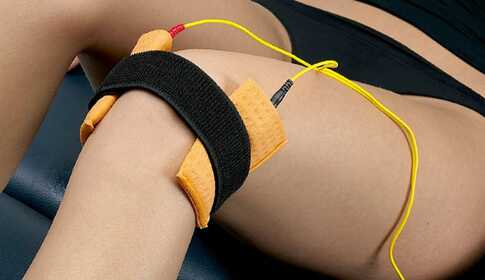

 What is iontophoresis, and how does it differ from TENS or EMS?
Iontophoresis is a special electrotherapy method whose goal is not pain relief or muscle strengthening but to deliver a drug or active substance through your skin to the source of the complaint, directly beneath the painful area. This is assisted by a very mild, unidirectional electric current (direct current). By contrast, TENS and EMS use alternating-direction impulses and serve different purposes (pain relief, muscle stimulation). You can find an overview of the methods in the electrotherapy methods article.
 Key idea
Iontophoresis is not a standalone treatment — its effect depends on the drug used. According to recent research, it is most useful for:
Tennis elbow [1] — with local delivery of an anti-inflammatory (dexamethasone) and a local anesthetic (lidocaine).
Palmar or plantar hyperhidrosis (excessive sweating) [2][3] — can work with tap water or a special gel, without drugs.
Neck pain [4] — with local delivery of magnesium sulfate.
The method is polarity-sensitive: the active substance must be delivered from the electrode with the correct charge — read more in the electrode polarity article.
 How does the current deliver the drug through your skin?
Research [5] shows that iontophoresis helps a drug penetrate deeper beneath the skin surface in three ways — more effectively than simple rubbing in a cream:
This is the most important mechanism and explains why polarity is critical: the electrode with the same charge "pushes" the like-charged active substance toward the skin. Positively charged drugs (e.g. lidocaine) start from the positive (+) electrode, negatively charged ones (e.g. dexamethasone, diclofenac) from the negative (–) electrode. If you connect the poles incorrectly, the drug will NOT enter — it may even move in the opposite direction. Practical tip: if you do not know the drug's polarity, swap the cables every 5 minutes during treatment — this way at least half of the session moves the drug in the correct direction.
Your skin surface carries a slight negative charge. Therefore, when current flows between the two electrodes, water also moves from the positive electrode toward the negative one — carrying dissolved drug molecules with it. This helps for substances that do not have a strong charge (e.g. protein-like drugs) — the fluid flow "carries" them toward deeper layers.
The mild current temporarily "loosens" the outer protective layer of the skin — allowing larger drug molecules to pass that would not penetrate by simple rubbing. This effect is reversible: after treatment the skin's barrier function restores within a few hours. The method is safe — it does not create a "hole" in your skin.
 For which complaints is iontophoresis recommended?
Find your complaint in the list below. In each section you will find which active substance is used, what to expect, and what NOT to expect from the treatment.
If your palms or soles sweat enough to interfere with daily life — steering wheel slips, papers blot, you avoid handshakes — iontophoresis is one of the best-established solutions. A literature review [3] found a substantial improvement in the majority of treated patients, and recent research [2] confirms that just a few weeks of regular treatment can significantly reduce sweating. The method is interesting because here a drug is not necessarily required — simple tap water can be effective (details below). The detailed treatment protocol is described in the hyperhidrosis article.
If your tennis elbow has persisted for months — pain on the outer elbow, weak grip, even lifting a kettle hurts — iontophoresis combined with an anti-inflammatory (dexamethasone) and a local anesthetic (lidocaine) can provide meaningful relief [1]. The study found the treated group improved significantly in pain, grip strength and elbow function compared to the control. What to do: consult your treating physician to obtain the active substance — start iontophoresis under the supervision of a physiotherapist or physician to ensure correct polarity and protocol.
If your neck regularly cramps, you wake up stiff and sore, and you can feel hard muscle knots in the trapezius, iontophoresis with magnesium sulfate can give meaningful relief [4]. Recent research showed the treated group achieved a noticeably greater pain reduction and greater range-of-motion improvement compared to conventional physiotherapy — and was comparable to high-power ultrasound. Important to know: many causes underlie neck pain (disc problems, nerve issues). Obtain a medical diagnosis first before starting treatment.
If you experience sharp pain in the heel with your first step in the morning, it is likely caused by a heel spur or plantar fasciitis. Iontophoresis for this indication often uses acetic acid — acetic acid may help dissolve calcifications on the heel bone. What to know: heel spur is a complex problem — insoles, appropriate footwear, individualized physiotherapy and weight loss (if overweight) matter at least as much as local treatment. I discuss the detailed protocol in my article on acetic acid iontophoresis for heel spur.
If pain in a specific joint or muscle is due to inflammation — e.g. shoulder tip inflammation, wrist pain, knee osteoarthritis — iontophoresis with anti-inflammatory gels (diclofenac, ketoprofen) delivers the active ingredient noticeably deeper than traditional ointment application. What to know: for tendinopathies a 2020 umbrella review [6] concluded iontophoresis is not first-line (laser, shockwave are more powerful) but complements those treatments. Drug selection is a medical task — consult your treating physician.
 Polarity rule: which drug from which electrode?
This is the most important practical rule in iontophoresis. The active substance must always be paired with the electrode that has the same charge — because that electrode "pushes" it under your skin. If connected incorrectly, the treatment will be ineffective. The table below shows the polarities of the most common active substances:
| Electrode | Active substances | What we use it for |
|---|---|---|
| Positive (anode, +) | lidocaine, procaine, vitamin B1, calcium chloride | local anesthesia, muscle spasm relief |
| Negative (cathode, –) | dexamethasone, diclofenac, ketoprofen, magnesium sulfate, acetic acid | anti-inflammatory, pain relief, local decalcification |
| Both work | tap water, aluminum chloride hexahydrate gel | excessive sweating (hyperhidrosis) [2][3] |
The detailed polarity principle is described in the electrode polarity article. Never mix up the electrodes: wrong polarity makes the treatment ineffective.
Important — active substance name or brand?
In the table I intentionally use the names of the active substances (diclofenac, ketoprofen etc.), not commercial brand names (Voltaren, Fastum etc.). Any CE-certified preparation containing the given active substance may be used — but selecting the specific drug and its concentration is a medical or pharmaceutical task.
How does an iontophoresis treatment proceed — step by step
- Decide on active substance and polarity. Agree with your treating physician which drug you will use and to which electrode it should be applied.
- Skin preparation. Wash the treatment area with lukewarm soapy water and dry thoroughly. Do not have cream, lotion or oil on the skin.
- Apply the active substance. Spread the drug (solution or gel) evenly on the sponge insert of the designated (same-charge) electrode or directly on the skin.
- Electrode positioning. The active electrode with the drug is placed directly over the painful area; the other (return) electrode is placed on the opposite side of the targeted area or 8–12 cm away.
- Current intensity. Typically 0.5–5 mA. The sensation may be pleasant tingling or slight warmth — if painful, reduce the intensity.
- Treatment time. Typically 15–20 minutes; for hyperhidrosis treatment up to 30 minutes.
- Course. One treatment per day, a 10–15 session course. For hyperhidrosis the study [2] used an every-other-day, 7-session protocol.
- Finish. At the end the device stops automatically. Remove the electrodes and wipe the skin from any residual active substance.
Which devices can perform home iontophoresis?
Important to know: not every TENS device can perform iontophoresis — a special direct current (DC) mode is required. In Medimarket's portfolio the following devices have a factory iontophoresis program:
- IontoBravo — specifically designed for iontophoresis, specialized for hyperhidrosis and local pain treatment.
- Globus Genesy 3000 — 4-channel multifunction device; besides iontophoresis it includes TENS, EMS and microcurrent programs.
- Globus Genesy 1500 — 2-channel entry-level multifunction device with basic programs.
For electrodes: adhesive or sponge electrodes can be used — the liquid solution is better retained by the sponge insert.
 When NOT to start iontophoresis?
With iontophoresis watch two things: the general electrotherapy contraindications (see electrical treatment contraindications and electrical treatment and implants), and the contraindications of the drug used (allergy, sensitivity).
- You have a pacemaker, ICD, or implanted nerve stimulator — only with cardiologist/arrhythmologist permission.
- You are pregnant — should be avoided, especially with drug delivery.
- There is a tumor in the area to be treated — do not treat.
- You are allergic to the chosen drug (e.g. lidocaine sensitivity) — use another active substance after medical consultation.
- Fresh wound, extensive eczema, skin infection at the electrode site — the penetrating drug would not remain at the treatment area.
- You cannot feel hot/cold on the affected skin — it is difficult to set current intensity safely.
- On the front of your neck — do not place an electrode near the carotid artery.
- Placement over the chest / heart — avoid even without a pacemaker.
- Poorly controlled epilepsy — requires individual medical assessment.
- Metal implant (screw, plate) under the electrode — risk of electrical heating.
For new, worsening or unknown complaints always see a doctor first. Always coordinate the drug used with your treating physician or pharmacist.
The place of iontophoresis within electrotherapy
Iontophoresis is one of many electrotherapy tools — it does not replace other proven methods. The links below help you place it within the available options:
- Electrotherapy methods — a complete overview of methodologies.
- TENS — drug-free pain relief — if you want pain relief without medication.
- Microcurrent (MENS) main topic — cellular-level regeneration without active substances.
- Electrode polarity — detailed polarity principles.
- Palmar/plantar hyperhidrosis — iontophoresis focus spoke.
- Acetic acid iontophoresis for heel spur — iontophoresis for heel spur complaints.
Frequently asked questions about iontophoresis
Iontophoresis works with direct current and aims to transport a drug through your skin. TENS uses alternating current pulses and aims for nerve-level pain relief, without drugs. The two methods do not replace each other — but both modes can be available on the same multifunction device (e.g. Globus Genesy 3000).
Research indicates effects are noticeable after 7–15 treatments. For tennis elbow [1] a 10–15 session course produced meaningful improvement; for hyperhidrosis [2] a 7-session (every-other-day) protocol showed measurable reduction. For local anesthesia the numbing effect can occur during the session, but sustained results typically require 2–3 weeks of regular treatment. Results vary between individuals.
No. Only charged (ionizable) molecules can be driven in effectively, and only those capable of crossing the skin barrier. Drug selection is a medical task — consult your treating physician or pharmacist. Do not experiment with unprescribed preparations, and never place corrosive, concentrated chemicals under an electrode.
If you try to introduce the drug from the wrong electrode (oppositely charged), the treatment will be ineffective — the substance may even be pulled away from the skin surface. Therefore knowing the polarity rule is critical. The polarities of the most common substances are in the table above. See details in the electrode polarity article.
Prolonged use at too high intensity can cause skin irritation — therefore it is important to use the appropriate current (0.5–5 mA), adhere to treatment time (15–30 minutes), and keep the electrode/sponge properly moist. If you feel stinging, itching or any unpleasant sensation, reduce the current immediately or stop the treatment. Check the skin under the electrode after treatment.
Only with cardiologist/arrhythmologist permission. Active implants (pacemaker, ICD, nerve stimulator) can be interfered with by any electrical treatment. Details are in the electrical treatment and implants article.
 Summary — iontophoresis in a nutshell
What everyone interested in iontophoresis should know
- Iontophoresis uses direct current to deliver an active substance into subcutaneous layers — it serves a different purpose than TENS or EMS.
- Polarity rule is critical: positive drugs (lidocaine, vitamin B1) are given from the positive electrode, negative ones (dexamethasone, diclofenac, acetic acid, magnesium sulfate) from the negative electrode.
- Most helpful for: tennis elbow [1], excessive sweating (palms, soles) [2][3], neck pain [4].
- Typical treatment parameters: 0.5–5 mA, 15–20 minutes, once daily, 10–15 session course.
- Iontophoresis is a complementary treatment — it does not replace medical diagnosis or baseline pharmacotherapy.
- Home devices: IontoBravo (specialized), Globus Genesy 3000 / 1500 (multifunctional).
- Contraindications (pacemaker, pregnancy, tumor, drug allergy, fresh skin wound) must be strictly observed.
- Drug selection is a medical task — do not experiment with unprescribed preparations.
Scientific sources (2019+)
-
da Luz DC, de Borba Y, Ravanello EM, Daitx RB, Döhnert MB.
Iontophoresis in lateral epicondylitis: a randomized, double-blind clinical trial.
Journal of Shoulder and Elbow Surgery.
2019;28(9):1743-1749.
PMID: 31447123.
Short summary: 24-patient double-blind RCT in tennis elbow — after a course of dexamethasone + lidocaine iontophoresis the treated group improved significantly more in pain, grip strength and function compared to galvanic current control (p < 0.05). -
Majid Hosseini S, Ghandali E, Reza Moghimi H, Khademi-Kalantari K, Talebian Moghaddam S, Akbarzadeh Baghban A, Maryam Mortazavi S.
A comparative evaluation of aluminum chloride hexahydrate gel iontophoresis versus tap water iontophoresis in people with primary palmar hyperhidrosis: A randomised clinical trial.
Indian Journal of Dermatology, Venereology and Leprology.
2024;90(1):52-58.
PMID: 37436009.
Short summary: 32-patient RCT in primary palmar hyperhidrosis — aluminum chloride hexahydrate gel vs. tap water iontophoresis, 7 sessions (every other day); both groups had statistically significant reduction in sweating rate (p < 0.001), with larger effect size for the gel. -
Chudry H.
The treatment of palmar hyperhidrosis – a systematic review.
International Journal of Dermatology.
2022;61(11):1303-1310.
PMID: 34653261.
Short summary: Systematic review of treatment options for palmar hyperhidrosis — iontophoresis characterized by approximately 81% symptomatic improvement. -
Ibrahim NA, Hamdy HA, Elbanna RHM, Mohamed DMA, Ali EA.
Transdermal iontophoresis versus high power pain threshold ultrasound in Mechanical Neck Pain: a randomized controlled trial.
Journal of Orthopaedic Surgery and Research.
2024;19(1):658.
PMID: 39407315.
Short summary: 75-patient RCT in mechanical neck pain — magnesium sulfate iontophoresis vs. high-power ultrasound vs. conventional physiotherapy; MgSO₄ iontophoresis significantly outperformed conventional therapy and was equivalent to ultrasound. -
Wang Y, Zeng L, Song W, Liu J.
Influencing factors and drug application of iontophoresis in transdermal drug delivery: an overview of recent progress.
Drug Delivery and Translational Research.
2022;12(1):15-26.
PMID: 33486687.
Short summary: Literature overview of iontophoresis mechanisms: electrochemical migration (electro-repulsion), electroosmotic fluid flow, increased stratum corneum permeability. -
Girgis B, Duarte JA.
Physical therapy for tendinopathy: An umbrella review of systematic reviews and meta-analyses.
Physical Therapy in Sport.
2020;46:30-46.
PMID: 32877858.
Short summary: Umbrella review on physiotherapy for tendinopathies — iontophoresis is not first-line but is listed as a complementary modality. -
Ghandali E, Hosseini SM, Moghimi HR, Khademi-Kalantari K, Talebian Moghadam S, Baghban AA, Mortazavi SM.
Intra tester reliability of sympathetic skin responses in subjects with primary palmar hyperhidrosis.
Journal of Bodywork and Movement Therapies.
2020;24(4):57-62.
PMID: 33218563.
Short summary: Methodological study on objective measurement of palmar hyperhidrosis (sympathetic skin response) — the measurement background literature for iontophoresis research.

This article is for general informational purposes and does not replace personal medical consultation. Selection of the drug used for iontophoresis and determination of its concentration is exclusively a medical task. Contraindications (pacemaker, pregnancy, tumor, drug allergy, fresh skin wound) must be strictly observed. The presented devices are CE-marked medical devices; the cited clinical trials were conducted with different devices and protocols. Individual results may vary. For new, worsening or unknown complaints consult your treating physician or physiotherapist.

