
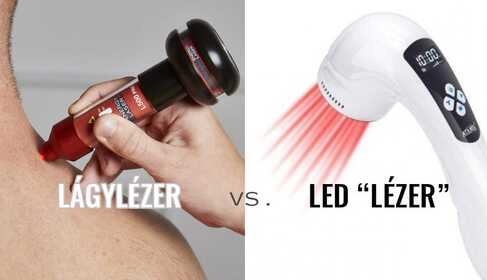
Watch out! You're being scammed! LED lamp or Diode laser — what's the difference?
Many companies shamelessly lie about products marketed for medical use. Trading companies use ruthless advertising campaigns to foist devices on unsuspecting buyers that are not suitable for the purposes they're promoted for. Nowadays — because of their effectiveness — soft laser devices are increasingly popular. However, their price is quite high. That attracted hyenas who sell colorful LED lamps as "lasers". You might think light is light... but LED and diode laser are about as similar as a plastic pedal car and a Mercedes. I'll explain!

👉 If you want a comprehensive overview of soft laser scams and how to choose the right device, read our Soft laser buying guide.
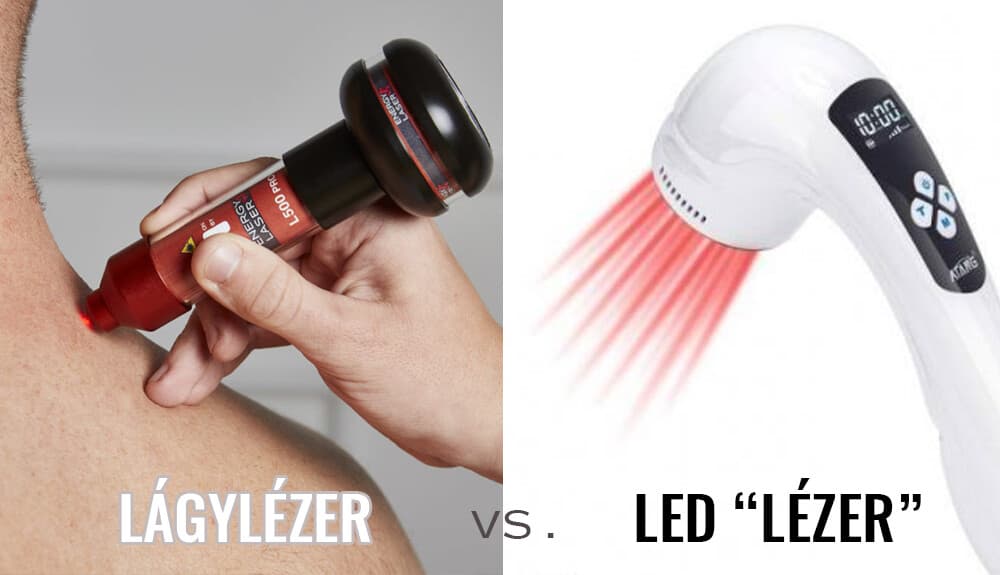
Fundamental differences between LED and LASER
Let's start by going over the main technical facts:
| Property | LED | LASER |
|---|---|---|
| Light source | Small in size, low energy requirement | Larger, requires more energy |
| Mechanism of action | Heats tissues, may slightly improve superficial blood circulation. Cannot penetrate deeper. | Cellular-level effects by supporting cellular ATP production. No heating effect. Can penetrate several cm into tissues. |
| Nature of beam | Non-coherent (waves are not in the same phase), non-collimated (diverging), generates a broader wavelength band (~20 nm) | Coherent (same wave phase), collimated (parallel beams, no dispersion), monochromatic (single wavelength, ~1-2 nm) |
| Output power | Generally 1-5 mW | For home devices 200-500 mW |
| Light color | Composed of multiple colors (even if one dominates) | Single, precise color |
| Price | Cheap | Not cheap |
Why does wavelength matter?
According to medical studies, the ability of light to penetrate the body depends on wavelength:
- 650-660 nm (red): Penetrates up to 1-2 cm — suitable for superficial skin problems
- 808-830 nm (infrared): Can reach 2-4 cm — for deeper tissues, joints, muscles
Diode lasers emit a very precise single wavelength of light, so the expected penetration depth can be determined accurately and dosing can be calculated reliably.
LEDs, on the other hand, cannot emit such a precise wavelength — their light often spans a band of roughly 20 nm. Therefore you cannot know exactly how deep the light will penetrate, and dosing cannot be calculated precisely.
The problem of beam divergence
The main strength of a diode laser is its beam, which travels practically parallel without divergence. A large amount of energy can be concentrated on a given area. Because there is no divergence, reflection losses are also low.
An LED source emits an uneven and divergent beam. For that reason it cannot be focused onto a small area, reflection losses are high, and the dose cannot be calculated with adequate accuracy.
The language of therapy: not Watts, but Joules/cm²
The effectiveness of laser therapy does not depend on how many "watts" the device is, but on how much energy (Joules) reaches a given cm² area and in what time.
According to the World Association of Laser Therapy (WALT), the therapeutic dose is usually 4-12 J/cm² in the target tissue. This is determined by three factors:
- Power (mW) – how strong the light source is
- Spot size (cm²) – how large an area the light is concentrated on
- Time (seconds) – how long you illuminate one spot
Let's calculate together: treatment time comparison
Let's see how long it takes with different power devices to treat a single point:
| Target energy | 1 mW LED | 5 mW LED | 200 mW laser | 500 mW laser |
|---|---|---|---|---|
| 5 Joule | 83 minutes | 16.5 minutes | 25 sec | 10 sec |
| 20 Joule | 5.5 hours | 66 minutes | 100 sec | 40 sec |
Important: These treatment times refer to a single point! For a knee joint, for example, you must treat at least 5 points, so multiply these times by 5.
For example, with a 5 mW LED device to treat one knee (in case of arthritis): 5 × 16.5 minutes = 82.5 minutes (almost one and a half hours). Meanwhile with a 500 mW laser: maximum 2-3 minutes.
But does coherence matter at all?
This is a much-debated question in science. Earlier studies suggested that coherent laser light is more effective. However, the latest systematic reviews from 2024-2025 (e.g. Miranda et al., 2025) indicate that the effects of photobiomodulation depend primarily on the energy dose, not necessarily on coherence.
In practice, however, this does not change the main point:
- Because of their higher power, lasers reach the therapeutic dose faster and more effectively
- The focused beam allows more precise dosing
- Low-power LED devices would require unrealistically long treatment times
So it is not necessarily coherence that decides, but whether you can deliver sufficient energy to the target tissue within a reasonable time. In this respect, lasers far outperform cheap LED devices.
How to protect yourself from being misled?
| # | Checkpoint | What to ask/check? |
|---|---|---|
| 1 | LED or diode laser? | Ask the distributor clearly! |
| 2 | Power | If it is under 200 mW, there is a high probability you are dealing with LEDs |
| 3 | Medical device certification | Request the CE/MDR conformity certificate for the specific model |
| 4 | Don't be fooled by "total power" | If many small LEDs are placed next to each other, that doesn't make it stronger — it just lights multiple spots weakly |
Summary — Quick overview
What is this article? A technical explanation of the fundamental differences between LED lamps and real diode lasers.
Who is it for? For those who have seen cheap "lasers" and want to understand why their effects are not the same as real medical lasers.
Main message: LED light is divergent, unfocused and typically weak (1-5 mW). Diode lasers, on the other hand, emit a focused, precise beam at higher power (200-500 mW). A 5 mW LED would need more than 80 minutes to achieve what a 500 mW laser reaches in 10 seconds. For therapeutic effectiveness, it's not coherence that is decisive, but whether you can deliver adequate energy to the target tissue within a reasonable time.
Recommended devices
If you want a device with medical effect, choose real diode lasers:
- B-Cure Laser Pro – Class 1 laser, pulsed mode, can be used without protective goggles
- Personal Laser L400 – 400 mW, Class 3 laser
- Energy-Laser L500 Pro – 500 mW, Class 3 laser
👉 Full range of soft laser devices →
Related articles
If you already understand the LED vs laser difference but have heard of "shower lasers", read the follow-up:
👉 Shower laser scam – Why "total power" means nothing →
👉 Soft laser therapy – Comprehensive guide to home laser treatment →
Sources
- Photobiomodulation: Lasers vs Light Emitting Diodes? PMC6091542
- Only lasers can be used for low level laser therapy – PMC5682984
- Miranda et al. (2025). Qualitative Comparison of LED and LASER Effects on Cutaneous Wound Healing. Cell Biochemistry and Function
- World Association of Laser Therapy (WALT) – Recommended treatment doses. WALT Guidelines
The information in this article is for informational purposes. Home therapeutic devices are intended to complement medical treatment and do not replace specialist medical care.

