Who is the PeroBravo for and what is it good for?
Peroneal paresis is paralysis of the muscles that lift the foot – typically after lumbar disc surgery, tibial fractures, prolonged immobilisation or direct nerve injury. The patient may "slap" the foot, show a steppage gait, and lift the knee higher to avoid catching the toes. PeroBravo's selective stimulation can activate denervated peroneal muscles, and the foot-switch ETS mode gives targeted help for relearning gait.
Bell's palsy is a sudden unilateral facial nerve paralysis – often of unknown or viral origin. The patient cannot move half the face: cannot smile, close the eye, or puff the cheek. Classic EMS CANNOT treat this because the motor pathway of cranial nerve VII is damaged. PeroBravo's selective stimulation can target denervated mimic muscles and support recovery. IMPORTANT: facial stimulation requires specialist supervision (neurologist, ENT) and extremely precise electrode placement.
Peripheral nerve injuries arise from trauma (cuts, fractures, accidents), compression (prolonged awkward positions), inflammation, or other neurological diseases. Common examples: radial nerve (wrist/hand extensors), median nerve (carpal tunnel), brachial plexus (shoulder-to-arm). PeroBravo's selective stimulation protocols (PRG 1–11, 17–18) are optimised for these denervated muscles. Recovery often takes 6–12 months, during which intensive home selective stimulation can support the process.
ETS (EMG-Triggered Stimulation) is clinically valuable: the patient attempts a voluntary contraction, the device detects even minimal efforts and supplements them with electrical stimulation. This allows the patient's own nervous system to relearn connection to the muscle – active participation is key for neuroplasticity. The PeroBravo ETS function is especially valuable in the mid-to-late recovery phases.
The SDC program (PRG 12 – Strength-Duration Curve) enables mapping of denervated muscles: which pulse width requires what current to elicit contraction. This is part of classical electrodiagnostics and allows tailoring treatment parameters precisely to the patient. PRG 19 and 20 are customisable programs for saving patient-specific protocols. 60-day statistics + real-time clock for treatment logging.
Spasticity (muscle stiffness, involuntary contractions) often follows neurological injury (stroke, multiple sclerosis, spinal cord injury). Certain PeroBravo programs (PRG 10, 19, 20) can help reduce spasticity and improve muscle balance (uneven muscle tone between sides). IMPORTANT: never start treating spastic patients without approval from a specialist (neurologist, physiotherapist).
PeroBravo's TENS function (PRG 19, 20 with individual settings) enables classic pain therapy: suitable for arthritis, chronic back/neck/lumbar pain, neuropathic pain, post-fracture pain, even phantom pain. It can operate with biphasic or monophasic pulses. Although not the primary focus, this is a useful complementary function for patients with peripheral paralysis who often have secondary chronic pain.
Peripheral paralysis recovery often takes 6–12 months or longer. Weekly clinic physiotherapy (1–3 sessions) is usually insufficient – daily home intensive treatment is needed for maximal recovery chance. The PeroBravo is designed for this long-term, intensive home rehab phase under physician/physiotherapist supervision. Rechargeable NiMH AA batteries and 60-day statistics for clinical documentation provide a secure foundation.
The 20 programs in 4 main groups
The PeroBravo program library follows the treatment path for peripheral paresis: from the severe initial phase through improving rehabilitation, plus diagnostic and customisation options.
In the initial phase of severe peripheral paralysis the muscle is fully denervated – the motor nerve does not send signals. Classic EMS is ineffective here. These programs use long (hundreds to thousands of milliseconds) triangular or trapezoidal waveforms that can directly target muscle fibres. Goal: slow muscle atrophy and preserve muscle mass during recovery.
As the nerve gradually reinnervates the muscle, it becomes partially re-innervated – classic EMS signals begin to be accepted. These programs gradually shift to shorter pulse widths approaching classic EMS parameters. PRG 10 supports rehabilitation of muscle with intact innervation; PRG 19 and 20 are clinician-customisable.
SDC measurement is a classical electrodiagnostic procedure. The clinician measures at various pulse widths and currents to determine the threshold for visible muscle contraction. From these data a curve is drawn that characterises the denervated muscle. Curve parameters allow calculation of optimal treatment settings (pulse width, frequency, intensity) for the patient.
Three dedicated gait-retraining programs for drop foot. The foot-switch ETS mode automatically activates stimulation at heel lift — exactly when the foot-lift muscles would be used in the physiological gait cycle. Uses biphasic square pulses. Delay time (0–1000 ms) can be fine-tuned to the patient's step rhythm.
PRG 19 and 20 can be defined to individual needs — the clinician can configure them specifically for the patient's pain pattern. They can use biphasic or monophasic pulses. Typical uses: arthritis, chronic back/neck/lumbar pain, neuropathic pain, phantom pain, post-fracture pain. This makes the PeroBravo multifunctional — besides treating denervated muscle it can help relieve associated peripheral paralysis pain.
PeroBravo's selectable waveforms:
- Monophasic triangle: for denervated muscle — the steep rise/fall is gentler on vulnerable muscle tissue. Triangle shape is adjustable.
- Monophasic trapezoid: similar and gentle but with a longer plateau. Trapezoid shape is adjustable.
- Biphasic symmetric square: for innervated muscle with classic EMS characteristics.
- Monophasic positive square: for envelope-shaped pulses, resembling TENS-type treatment.
Polarity changes continuously. Pulse width: 1 ms–1000 ms (monophasic) or 50 µs–350 ms (enveloped).
Frequently asked questions
No. A pacemaker, implanted defibrillator (ICD) or any electronic implant is an absolute contraindication. Selective stimulation — being longer and often stronger than classic EMS pulses — may interfere with implant function to an even greater extent. If you have such a device, do not use the device under any circumstances.
PeroBravo is not a hobby-level home device — physician (neurologist, rehabilitation specialist) or qualified physiotherapist supervision is MANDATORY:
- Initial diagnosis: only a specialist can determine the type and severity of paresis.
- Protocol selection: the appropriate program among the 20 must be set by a specialist.
- SDC measurement: PRG 12 diagnostic results must be interpreted by a specialist.
- Custom program setup (PRG 19, 20): configured by the specialist for the patient.
- Process monitoring: 60-day statistics should be reviewed at clinical visits.
Home use is carried out according to the protocol set by the specialist — the patient should not change parameters independently.
The fundamental physical difference is pulse width:
- Classic EMS (Globus, Lito line): short pulses, 50–450 µs (microseconds). Can only activate muscle with intact neural control. It stimulates motor nerve fibres which then cause muscle contraction.
- Selective stimulation (PeroBravo): long pulses, 1–1000 ms (milliseconds). Thousands to tens of thousands times longer. It directly stimulates MUSCLE fibres, bypassing the damaged motor nerve. Therefore it can activate denervated muscle.
In other words: if the motor nerve is intact, classic EMS is sufficient. If the motor nerve is damaged (peripheral paralysis), selective stimulation is needed. Classic EMS devices would be ineffective in paralysis — that's when PeroBravo is required.
Both are in the MTR+ Bravo line but with different profiles:
- PeroBravo: single-channel, selective stimulation (up to 1–1000 ms pulse width!), specifically for denervated muscle treatment. Foot switch for gait retraining. SDC diagnostics. ETS (EMG-trigger).
- DuoBravo: two-channel, classic EMS range (microsecond pulses), muscle stimulator + ETS (EMG-triggered stimulation). Suited for post-stroke rehabilitation (central paresis) and weak muscles with intact neural control.
If denervated muscle (peripheral palsy, drop foot, Bell's palsy) → PeroBravo. If weak but innervated muscle (post-stroke muscle loss, atrophy from prolonged inactivity) → DuoBravo.
Recovery from peripheral paralysis is complex and depends on many factors (degree of nerve injury, patient age, general health, adherence, etc.):
- Bell's palsy: significant improvement is often expected in 3–6 months. Some patients may take longer or have residual symptoms.
- Peroneal paresis after surgery: typical recovery 6–12 months, but in some cases up to 2 years.
- Severe brachial plexus injury: 12–24 months, sometimes longer.
Intensive home selective stimulation (daily 1–2 sessions of 20–30 minutes) can support recovery. IMPORTANT: recovery is not guaranteed and depends on biological nerve regeneration. The treating physician provides a realistic prognosis based on the individual case.
The foot switch is placed in the patient's shoe under the heel (or at another sole point as instructed by the physiotherapist). When the heel contacts the ground and the patient attempts to lift the toes, the switch makes electrical contact and activates peroneal stimulation. This times stimulation within the gait cycle.
Initial training with the physiotherapist is necessary to set switch placement and intensity. During home practice the patient can gradually increase walking distance. Delay time (0–1000 ms) can be fine-tuned — slower walkers may need longer delay than faster ones.
SDC (Strength-Duration Curve) is a classical electrodiagnostic measurement. The method:
- The clinician measures at various pulse widths (e.g. 1 ms, 10 ms, 100 ms, 300 ms, 1000 ms) the current required to produce visible contraction.
- From the measured values a curve is drawn.
- The curve shape characterises the denervated muscle: healthy muscle yields a flat curve, severely denervated muscle a steeply rising one.
- Curve parameters help set optimal treatment values into PRG 19/20 custom programs.
SDC measurement helps tailor treatment precisely to the individual patient, not according to a generic protocol.
How to use it step by step?
1
Physician/physiotherapist consultation
Use of the PeroBravo must begin with approval from a physician or a qualified physiotherapist. The specialist determines the type and severity of the paresis (peroneal, Bell's, brachial plexus, etc.) and selects the appropriate protocol from the 20 programs. Initial severe phase: PRG 1–6 or 17–18. Improving phase: PRG 7–11 or 19–20. Gait retraining: PRG 13–16.
2
SDC measurement (Strength-Duration Curve)
The clinician can perform PRG 12 (SDC) diagnostic measurement — this determines which pulse width requires what current to elicit contraction in the patient's muscle. Based on the curve, individualised treatment parameters can be set into PRG 19/20 custom programs.
3
Electrode placement (peroneal or facial)
The package contains 4 adhesive 40×40 mm electrodes + 2 rubber electrodes + sponge holders + 2 elastic fasteners. For peroneal treatment the electrodes are placed on the outer lower leg at the peroneal muscle motor points. For facial stimulation electrode placement must be extremely precise (mimic motor points) — always have a specialist perform the first placements. In some cases the rubber electrode + sponge holder can be used on moist skin with the sponge wetted.
4
Start program + intensity (0–60 mA)
Set intensity on the single channel — gradually increase until you observe visible muscle contraction. In denervated muscle you may see a contraction twitch (in peroneal palsy the toes or even the whole foot may move slightly). Without sufficient current the denervated muscle will not respond. However, NEVER use painful intensity — if you feel discomfort reduce or stop.
5
Use ETS mode (EMG-trigger) in the improving phase
This function is pointless in a completely flaccid paralysis. Begin when the patient starts attempting voluntary activation during recovery. The ETS mode detects this effort (however small) and supplements it with electrical stimulation. Thus treatment proceeds with active participation, which is beneficial for neuroplasticity. The clinician sets the EMG sensitivity threshold.
6
Gait retraining (peroneal paresis, with foot switch)
For drop foot use the included foot switch for gait retraining. The switch automatically activates stimulation at heel lift — foot dorsiflexion occurs at the optimal biomechanical moment of gait. There are 3 dedicated programs (PRG 13–16) optimised for gait retraining. The delay time (0–1000 ms) can be fine-tuned to the patient's step rhythm.
What's included in the package?
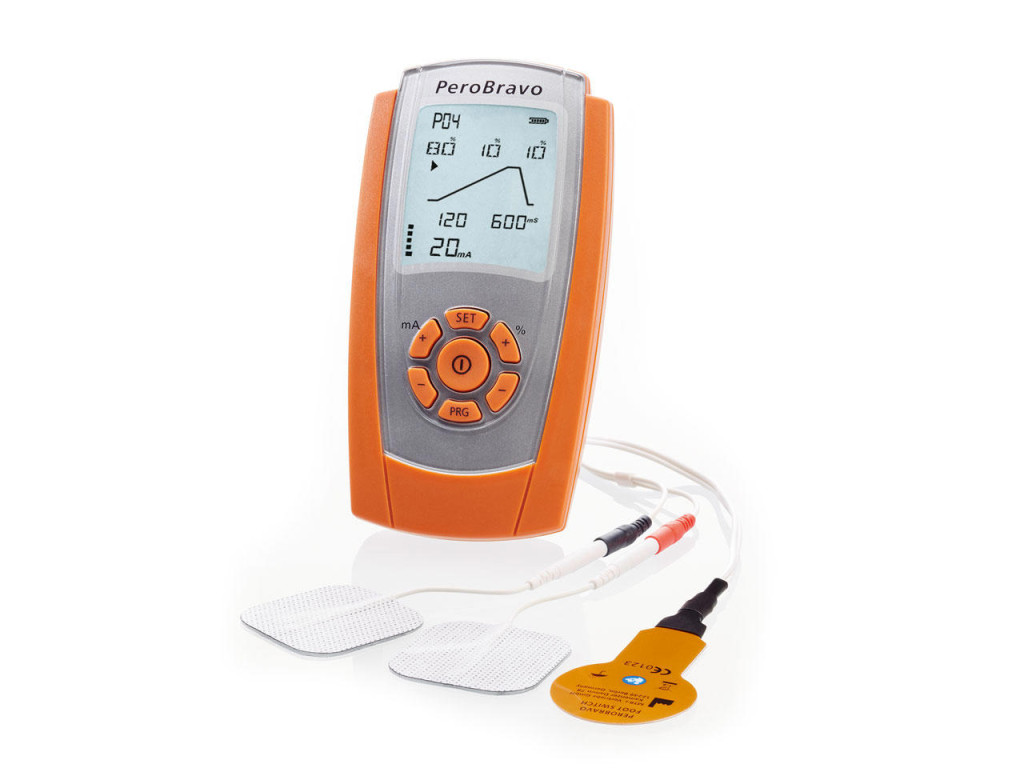
The PeroBravo professional package includes the foot switch, rubber electrodes with sponge holders, and rechargeable NiMH AA batteries.
- 1 pc PeroBravo device (single-channel)
- 4 pcs 40×40 mm adhesive electrodes
- 1 pc stimulation cable
- 1 pc foot switch (for gait retraining)
- 2 pcs rubber electrodes (reusable, gel-free)
- 2 pcs sponge holders (for rubber electrodes, for moist contact)
- 2 pcs elastic fasteners (to fix rubber electrodes)
- 4 pcs AA NiMH rechargeable batteries
- 1 pc battery charger
- 1 pc carrying bag
- 1 pc Hungarian user manual
Adhesive electrodes: adhesion gradually decreases after 25–30 uses. Replacements in 40×40 mm size can be ordered separately. After use, return them to the protective foil.
Rubber electrodes + sponge holders: the rubber electrode is reusable; the sponge holder needs regular cleaning. Before use moisten the sponge with saline or distilled water to ensure conductivity. Cleaning: rinse with warm water and air-dry.
NiMH batteries: 4×AA included with charger. Designed for 500+ full cycles. If unused for long periods charge every 1–2 months to avoid deep discharge. Typical replacement after 3–5 years of use.
Device cleaning: wipe exterior with a dry or slightly damp cloth. Wipe contact points (cable connectors, foot switch) with a dry cloth.
PeroBravo can be supplemented with additional accessories:
- Spare electrode sets: 40×40 mm replacement after 25–30 uses.
- Different size and shaped electrodes: small round targeted electrodes may be better for facial treatment (precise stimulation of mimic muscles).
- Replacement sponge holders for rubber electrodes: if the sponge wears out or for hygiene replacement.
- Cable extension: for reaching more difficult body areas.
Technical specifications – detailed
| Feature | Value | What it means for you |
|---|---|---|
| Number of channels | 1 (versatile, digital electrostimulator) | Precise treatment of a targeted area (e.g. peroneal or facial muscle) |
| Stimulation modes | TENS, EMS/NMES, ETS (EMG-trigger), selective stimulation, biofeedback | 5 different modes from denervated muscle therapy to classic pain treatment |
| Number of programs | 20 programs (11 preset + 1 SDC + 3 gait + 5 custom) | Complete coverage of the peripheral paresis treatment pathway |
| Special sport – gait retraining | 3 programs (PRG 13–16, with foot switch) | Drop foot–specific gait retraining |
| SDC diagnostics | PRG 12 – Strength-Duration Curve | Classical electrodiagnostic measurement for individual protocol settings |
| EMG-trigger (ETS) | Yes, built-in | Active patient participation combined with stimulation |
| Intensity | 0–60 mA | Moderate range optimised for denervated muscle |
| Frequency | 1–120 Hz | Wide range for different paresis protocols |
| Custom pulse width | 1 ms – 1000 ms (1000 µs – 1 000 000 µs) | THOUSANDS TO TENS OF THOUSANDS times longer than classic EMS — for denervated muscle |
| Enveloped pulse width | 50 µs – 350 ms (positive part) | Classic TENS and EMS–like range also available |
| Custom waveforms | Triangle and trapezoid (both shapes adjustable) | Gentle shapes optimised for denervated muscle fibres |
| Enveloped waveform types | Biphasic symmetric rectangle / monophasic positive rectangle | Classic TENS and EMS–style treatments |
| Delay time (gait training) | 0–1000 ms | Stimulation activates at the optimal moment in the step cycle |
| Foot switch | Included (for gait retraining) | Automatic stimulation at heel lift |
| Statistics | 60 days of treatment data, detailed channel logging | Treating physician can review usage during clinical visits |
| Real-time clock | Built-in | Accurate timestamps for every treatment |
| Display | Shows pulse shape, intensity, remaining time | Continuous feedback on treatment status |
| Start | Automatic or manual | Flexible use — timed or manual start |
| Power supply | 4×AA NiMH rechargeable batteries, 1.5 V | High-capacity, long-life batteries |
| Charger | Included | No separate order needed |
| Certification | CE 0123; Class IIa; ISO 13485:2021; MDD 93/42/EEC | European conformity, clinical quality assurance |
| Manufacturer | MTR+ Vertriebs GmbH (Germany) | Manufactured to German quality assurance standards |
 When NOT to use the PeroBravo
The following situations may make selective stimulation dangerous or cause adverse effects. Because the PeroBravo operates with longer pulse widths than classic EMS devices, safety considerations are especially strict. If any of these apply to you, do not begin using the device without consulting your physician.
- Wearing a pacemaker, implanted defibrillator (ICD) or any electronic implant — selective stimulation can interfere with their function
- Arrhythmia, myocardial damage, or severe cardiovascular disease
- Pregnancy (treatment of the lower abdomen, abdomen and lumbar area is prohibited throughout pregnancy)
- Epilepsy or other seizure disorders (extra caution due to long pulse widths)
- Active malignant tumour near the treatment area
- Acute inflammation or infection on the treated skin area
- Deep vein thrombosis or known clotting tendency in the treated limb
- Skin injury, fresh scar or open wound on the treatment area (avoid until healed)
- Placement of electrodes on the anterior neck (carotid sinus region), skull, or chest area (unless explicitly approved by the treating physician for facial stimulation)
- Reduced or absent skin sensation on the treated area — denervated muscle–adjacent numbness may require higher intensity, increasing burn risk
- Recent metal implant (screw, plate) loosening or inflammation in the immediate area — consult your physician
- Presence of flammable anesthetic gases (hospital environment, near oxygen concentrators)
- Children for unsupervised use (under 12 only with an adult + physiotherapist supervision)
Not sure? Consult your physician, neurologist or physiotherapist before use — especially for peripheral paralysis where diagnosis and treatment protocols must be set safely by a specialist. For detailed information see Dr. Zsolt Zátrok's article on contraindications to electrotherapy at electrotherapy contraindications.
 Important information
The PeroBravo is a CE-certified Class IIa medical device (CE 0123, according to MDD 93/42/EEC), a clinical-level professional neurorehabilitation device. Home use MUST be under the supervision of a physician (neurologist, rehabilitation specialist) or physiotherapist. The device does not replace medical diagnosis, a qualified physiotherapist's individual protocol, or prescribed medication. It is an adjunct to comprehensive rehabilitation therapy.
If new or worsening symptoms occur (e.g. new muscle weakness, numbness, shortness of breath, dizziness) seek immediate medical attention — any new symptoms during use require urgent evaluation.
For Bell's palsy or facial nerve treatment electrode placement must be especially precise — a specialist (neurologist, ENT, physiotherapist) determines facial motor points initially. Never place electrodes on the face on your own.
Recovery from peripheral paralysis is complex and time-consuming — intensive home use of PeroBravo can support recovery but does not guarantee full restoration. The treating physician provides a realistic prognosis for the individual case.
Use only original accessories, replace and clean electrodes and sponge holders regularly. Keep the device out of reach of children.
The information on this page is for general guidance and does not replace individual medical advice, diagnosis, or treatment. Always consult your physician regarding specific complaints.