
 What is peroneal nerve palsy?
Peroneal nerve palsy means weakness or loss of function of the muscles that lift the foot, caused by damage to the common peroneal nerve (nervus peroneus communis). This nerve is a branch of the sciatic nerve and runs around the head of the fibula – this anatomical location makes it particularly vulnerable.
The characteristic symptom of the palsy is “foot drop”: when walking, the foot does not lift clear of the ground, and the affected person walks with a “waddling”, side-swinging gait. The condition may result from peripheral nerve damage (more common) or a central nervous system cause (less common) – and this distinction fundamentally influences which type of electrical treatment is suitable.
 Key point
Peroneal nerve palsy rehabilitation rests on two pillars: electrical stimulation (selective stimulation for peripheral causes, classic NMES for central causes) + movement therapy. Nerve regeneration is slow (1 mm per day), so regular stimulation keeps the muscle ALIVE during regeneration – without it, the muscle undergoes irreversible atrophy within 1.5–2 years.
 How does peroneal nerve palsy develop?
It is useful to know the three main categories of peroneal nerve palsy – they also determine the treatment strategy:
The most common causes of peripheral peroneal nerve palsy are:
- Direct injury to the nerve (trauma): accident, bone fracture, sports injury.
- Prolonged compression at the head of the fibula: even an “innocent situation” can trigger it. For example, at a party, you may fall asleep slightly intoxicated on a chair with your legs crossed – and wake up with paralysis. The edge of a plaster cast or bandage that has been applied too tightly can cause a similar problem.
- Iatrogenic nerve injury (caused by a medical intervention): during surgery involving the knee or lower leg, a hook or clamp may compress the nerve.
- After knee surgery: joint replacement, tendon reconstruction.
In this case, the nerve is damaged or severed – the basis of treatment is selective stimulation (stimulation of the denervated muscle).
Central nervous system disorders can also result in peroneal nerve dysfunction:
- Stroke (cerebral infarction or haemorrhage) – mainly as part of one-sided paralysis.
- Multiple sclerosis – developing as a relapse or gradually.
- Spinal cord injuries affecting the L4–S1 segments – for example, a herniated disc or spinal trauma.
These central causes typically occur with additional neurological symptoms and often affect the distribution of several nerves. Here, treatment is NOT selective stimulation, but classic NMES or ETS (the peripheral nerve is INTACT; only central control is damaged).
The characteristic appearance of peroneal nerve palsy is foot drop – the inability to dorsiflex the foot (lift it upwards) and extend the toes.
This results in the typical “waddling” gait: the toes do not lift clear of the ground, so the affected person swings the foot forwards in a wide, sideways arc. The hip also has to be lifted, causing the trunk to sway from side to side – this also puts strain on the hip and spine.
Sensory disturbances may also occur, particularly on the dorsal surface of the foot and the lateral part of the lower leg. Reduced or absent sensation may indicate peripheral nerve injury.
How is the diagnosis made?
A thorough clinical examination is essential for an accurate diagnosis:
- Muscle strength testing: measuring the strength of the muscles that lift the foot.
- Sensory examination: testing touch, temperature and pain sensation on the foot and the lateral part of the lower leg.
- Reflex testing: assessing the Achilles reflex and other reflexes.
- Electrodiagnostics (EMG, nerve conduction study): this plays a key role in confirming the diagnosis and determining the location and severity of the damage.
The EMG result determines whether the palsy has a peripheral or central cause – and the specialist or physiotherapist uses this information to decide on the appropriate treatment strategy.
The two pillars of peroneal nerve palsy treatment
The first step is to treat the underlying cause – removing the compression, taking off a tight plaster cast or bandage, and treating any space-occupying lesion. These interventions prevent further complications from developing.
After this, the actual rehabilitation progresses on two parallel pillars:
| Pillar | Purpose | Method |
|---|---|---|
| 1. Electrical stimulation | Keeping the muscle alive during nerve regeneration (preventing atrophy) | Selective stimulation (peripheral cause) or classic NMES (central cause) |
| 2. Movement therapy | Maintaining joint mobility, preventing contractures, relearning movement patterns | Passive → active-assisted → active exercises, guided by a physiotherapist |
The two pillars together offer a better chance of recovery – neither replaces the other.
 Why is stimulation of the denervated muscle essential?
Contraction is vital to a muscle. The brain sends the impulse needed for this through the spinal cord and motor nerve to the motor nerve ending (the point where the muscle and nerve meet). If this communication pathway is interrupted, the muscle no longer receives a contraction impulse and begins to atrophy very quickly.
 A race against time
Nerve regeneration is slow – according to current understanding, a few tenths of a millimetre per day, and no more than 1 mm even in the most favourable case. The peroneal nerve may begin 60–80 cm from the spine, so months may pass before the regenerating nerve “reaches the muscle” again.5,6
The muscle cannot survive this long without stimulation. If it receives no stimulation and does not contract, the muscle degenerates within one and a half to two years, and connective tissue replaces the muscle tissue. Even if the nerve regenerates, the muscle is then unable to function, and the paralysis remains permanent.3
That is why, during the long recovery from paralysis, the most important thing is persistent stimulation – to maintain the muscle's functional state even if no visible result appears for 1–2 years.
The muscle contracts in response to the impulse delivered by an electrostimulator just as it does in response to an impulse from the brain. Contraction is vital for maintaining muscle health, strength and mass. Electrical stimulation:
- Prevents muscle atrophy.
- Maintains tissue blood flow.
- May support nerve regeneration (see the selective stimulation pillar article).
- Keeps the muscle ready for the “arrival” of the regenerated nerve.
Electrode placement guide
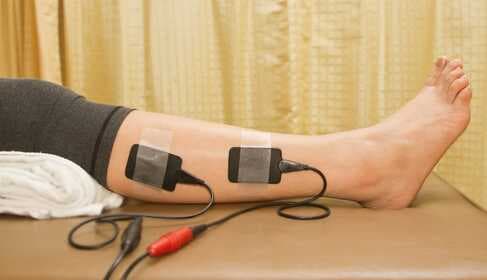
Peroneal nerve palsy affects the muscles on the outer-front side of the shin, particularly the tibialis anterior muscle. Correct electrode placement is essential for effective stimulation.
 Accurate placement step by step
- Find your bearings: feel along the edge of your shin (the section marked by the red line in the illustration below).
- First electrode (negative / cathode): place it over the muscle 5–8 cm below your kneecap. The inner side of the electrode should touch the edge of the shin and lie towards the outside of it.
- Second electrode (positive / anode): place it lower down on the muscle, approximately level with the middle of the shin or slightly below it.
The choice of polarity affects treatment effectiveness – you can find a detailed explanation in the article on electrode polarity.

If you use rubber electrodes and a sponge instead of self-adhesive electrodes, you can see this solution in the image below: secured in place in a wet sponge holder with an elastic strap.

Which pulse shape is suitable?
The shape, duration and rise time of the denervated stimulation pulse vary according to the severity of the nerve damage. This sequence progresses gradually as regeneration advances:
In severe peripheral nerve damage, you should start with a triangular pulse lasting 300–900 milliseconds. If the device allows it, it is worth setting the pulse rise/fall ratio to 90%/10%. The PeroBravo device has this setting. According to a study by the Medical University of Vienna, a 200 ms triangular pulse with the cathode placed proximally produced the more favourable result for the tibialis anterior muscle.1
When nerve damage is moderately severe, the triangular pulse and the almost one-second pulse may be too long and too intense for the nerve, causing an unpleasant sensation. For a moderately severe injury, a trapezoidal pulse is therefore recommended instead of a triangular pulse.
As nerve regeneration improves, a long-duration (100–300 msec) square wave may be suitable. If the muscle responds well to the denervated square pulse, this means that the nerve damage is moderate. This offers a better chance of regeneration. Naturally, the more severe the damage, the longer the regeneration period is expected to be, and the chance of complete recovery also decreases.
There are two ways:
- Trial and error: try the programmes one after another. Don't worry – none of them can cause harm; at most, you will notice that one is not ideal. You can find the right one after trying for a few minutes.
- Device measurement: PeroBravo, Genesy 1500 and Genesy 3000 allow the physiotherapist to determine the most suitable pulse and duration. This is usually carried out by professionals in a clinic. If you cannot get help from a physiotherapist, the first method (trial and error) will give you approximately the same result.
The detailed waveform theory (chronaxie, accommodation, pulse duration comparison) can be found in the selective stimulation pillar article.
 Which device is suitable for treating peroneal nerve palsy?
For a peripheral cause of peroneal nerve palsy – which is the most common – you need a device suitable for selective stimulation. For a central cause (after stroke or in MS), a different type of device is recommended.
For peripheral peroneal nerve palsy (selective stimulation required)
PeroBravo – the device specialised in selective stimulation
Medimarket's first-choice recommendation for home treatment of peripheral peroneal nerve palsy. A highly capable device developed specifically for selective stimulation, offering the physiotherapist a wide range of settings: denervated programmes with triangular, trapezoidal and square pulses, adjustable pulse duration, and rise/fall ratio. The package also includes a foot switch, which can be used to relearn walking (FES gait assistance). Custom programmes allow the physiotherapist to fine-tune the parameters as regeneration progresses.
Versatile Genesy devices that also provide selective stimulation – these are not specialised only in selective stimulation, but also offer extensive NMES functionality:
Genesy 3000 – professional-level versatile device
The flagship of the Globus Genesy range. Selective stimulation programmes for treating denervated muscle + extensive NMES programmes. Ideal for patients who want to cover several indications with a single device.
Genesy 1500 – versatile top-of-the-range device for home use
The most advanced home-use solution in the Genesy range. It provides the same selective stimulation programmes as the Genesy 3000 AND extensive NMES functionality.
Genesy 600 – versatile mid-range device
The mid-range member of the Genesy family: it contains basic selective stimulation programmes for treating denervated muscle, as well as extensive NMES functionality for other rehabilitation purposes. A cost-effective choice for home treatment and mild or moderately severe palsy.
For a central cause (after stroke or in MS) – NOT selective stimulation!
If the peroneal nerve palsy has a central cause (stroke or multiple sclerosis), the peripheral nerve is intact – in this case, NOT selective stimulation but classic NMES or ETS is required:
DuoBravo N – ETS stimulator for post-stroke rehabilitation
The specialist for post-stroke paralysis: it uses ETS (EMG-Triggered Stimulation) technology, which starts stimulation in response to the patient's own voluntary effort. It is an ideal choice for peroneal nerve palsy of central origin.
Genesy 300 Pro – classic NMES for post-stroke rehabilitation
A classic NMES device suitable for treating post-stroke paralysis. It does NOT contain selective stimulation programmes AND does NOT include an ETS function, so it can be used as a basic muscle rehabilitation device.
 Movement therapy – the second pillar of rehabilitation
Regular movement helps maintain joint mobility, prevent contractures (joint stiffness) and support appropriate muscle activation patterns. The exercises should cover all of the following movements:
- “Foot lifting” (dorsiflexion): lifting the foot upwards.
- “Pointing the toes” (plantar flexion): rising onto the toes.
- Rotational movements: pronation and supination of the ankle.
Progression of the exercises:
- Passive movement: the physiotherapist or a family member moves the patient's leg.
- Active-assisted movement: the patient tries to move but also receives help.
- Active movement: the patient performs the movements independently – in parallel with the return of nerve function.
Balance and proprioceptive exercises become increasingly important as recovery progresses. They help re-establish normal movement patterns and improve functional stability during walking and other activities. Particular attention should be paid to walking mechanics – initially, a compensatory movement has to be developed; later, as nerve regeneration progresses, increasing focus should be placed on heel strike, lifting the foot during the swing phase and overall walking efficiency.
Using movement therapy and electrical stimulation together offers a better chance of recovery.
Expected recovery time and the role of orthoses
Expected recovery time
Recovery from peroneal nerve palsy follows a variable course:
- Mild compression injuries: may recover within weeks or months.
- More severe injuries: may take 6–12 months.
- Residual symptoms: may occur even with optimal treatment.
The role of orthoses – take care!
Ankle-foot orthoses (AFOs – Ankle Foot Orthoses) are often recommended for people with foot drop. These devices help prevent falls, improve walking efficiency and maintain proper joint alignment.
Continuous use of an orthosis is not recommended!
The muscle held by an orthosis quickly loses strength and mass. In other words, continuously wearing an orthosis may reduce the chance of recovery. It can be important in many situations – for example, when you need to run an errand in town, it helps you walk safely. However, do not use it at home or during exercise. Active movement (and electrical stimulation) is needed to regain muscle strength and function.
Frequently asked questions
The sooner, the better. Muscle atrophy begins shortly after the nerve impulse stops – based on the condition assessed by the physiotherapist or specialist, treatment should be started within a few weeks of diagnosis. The longer the period without atrophy-preventing stimulation, the lower the chance of regaining full function if the nerve regenerates.
A neurologist determines this based on EMG (electromyography) and nerve conduction studies. The difference is critical for the treatment strategy: peripheral causes require selective stimulation (PeroBravo, Genesy 600/1500/3000), while central causes are treated with classic NMES or ETS (DuoBravo N, Genesy 300 Pro). DO NOT start treatment on your own BEFORE the examination.
The physiotherapist determines the exact protocol, but the general recommendation is daily treatment at the beginning of rehabilitation – 5–6 times a week, with sessions lasting 20–30 minutes. A sufficient number of contractions is needed each day to prevent muscle atrophy. As regeneration progresses, the specialist adjusts the parameters and frequency.
The long, high-charge pulses used for denervated stimulation can indeed feel uncomfortable – especially if sensation is intact. A good approach is to get used to the intensity on the healthy side first, then start on the affected side at the level you are accustomed to there. If the sensation remains unpleasant, reduce the intensity or try another waveform (square instead of trapezoidal if the nerve has partially regenerated).
Nerve regeneration is slow – it progresses at a rate of 1 mm per day. If the peroneal nerve is injured 60–80 cm from the spine, it may take 1–2 years for the nerve to “reach” the muscle. No visible improvement should be expected during this period – BUT stimulation must continue because it keeps the muscle alive. If there is still no sign of nerve regeneration after 1.5–2 years (EMG follow-up), the specialist may consider alternative treatment strategies (surgery or orthosis-based function).
No. An orthosis makes walking safer (preventing falls), but with continuous use the muscle quickly loses strength. DO NOT use it at home or during exercise. Put it on only when genuinely necessary (walking in town or over longer distances). Active movement and electrical stimulation are the keys to recovery, not the orthosis.
 Before starting treatment
Home electrical treatment of peroneal nerve palsy is safe, but there are conditions in which it must not be used. Always consult your treating doctor before starting treatment!
When should you be cautious?
- Implanted cardiac pacemaker or defibrillator – the electrical impulse may interfere with the implanted device
- Active cancer in the treatment area – electrical stimulation in the treatment area should be avoided
- Pregnancy – consultation with a gynaecology specialist is mandatory
- Epilepsy – electrical stimulation may provoke a seizure (relative contraindication; specialist consultation required)
- Skin inflammation or an open wound in the electrode area – an electrode must not be placed on damaged skin
- Thrombosis or thrombophlebitis in the treatment area – muscle contraction in the affected area may be dangerous
- Nerve damage not yet diagnosed – EMG/nerve conduction testing is required first
- Severe loss of sensation in the treatment area – extra caution is needed because you may not feel possible overheating or skin irritation
 An adjunctive treatment, not a standalone therapy
Home electrical stimulation is an adjunct to physiotherapy or medical treatment, not a replacement for it. Diagnosis, treatment planning and follow-up checks must always be carried out by a professional. Home treatment is safe only with the programmes set by the professional and at the parameters specified by them. A detailed list of contraindications is available in the article on electrotherapy contraindications.
 Summary – Quick overview
Sources
- Pieber K, Herceg M, Paternostro-Sluga T, Schuhfried O. (2015). Optimizing stimulation parameters in functional electrical stimulation of denervated muscles: a cross-sectional study. Journal of NeuroEngineering and Rehabilitation, 12, 51. PubMed: 26048812
- Enovis/DJO Global. (n.d.). Electrotherapy of denervated muscle – clinical review. djoglobal.ch. Source
- Paternostro-Sluga T, Schuhfried O, Vacariu G, Lang T, Fialka-Moser V. (2002). Chronaxie and accommodation index in the diagnosis of muscle denervation. American Journal of Physical Medicine & Rehabilitation, 81(4), 253-260. PubMed: 11953548
- Kern H, Salmons S, Mayr W, Rossini K, Carraro U. (2005). Recovery of long-term denervated human muscles induced by electrical stimulation. Muscle & Nerve, 31(1), 98-101. PubMed: 11940016
- ElAbd R, Alabdulkarim A, AlSabah S, et al. (2022). Role of Electrical Stimulation in Peripheral Nerve Regeneration: A Systematic Review. Plastic and Reconstructive Surgery – Global Open, 10(3), e4314. PubMed: 35317464
- Gordon T, English AW. (2022). The Effect of Electrical Stimulation on Nerve Regeneration Following Peripheral Nerve Injury. Biomolecules, 12(12), 1856. PubMed: 36551289
- Carolus AE, Becker M, Cuny J, Smektala R, Schmieder K, Brenke C. (2019). The Interdisciplinary Management of Foot Drop. Deutsches Ärzteblatt International, 116(20), 347-354. PubMed: 31288917
- Marciniak C. (2013). Fibular (peroneal) neuropathy: electrodiagnostic features and clinical correlates. Physical Medicine and Rehabilitation Clinics of North America, 24(1), 121-137. PubMed: 23177034
All sources are clickable – the PubMed link leads to the abstract and, where applicable, to the full text with a subscription. The list is based on clinical literature on selective stimulation and interdisciplinary reviews of peroneal nerve palsy treatment.