Who and what is the DuoBravo N suitable for?
After the acute phase (1–3 weeks), outpatient rehabilitation typically follows — 2–3 physiotherapy sessions per week. Full recovery requires daily, intensive practice. Using the DuoBravo N at home under physiotherapist guidance lets the patient keep training when the clinic is closed. The ETS function is especially suitable for reactivating the paretic side — voluntary effort plus stimulation supports brain neuroplasticity.
Central (brain/spinal cord) paralysis can also result from head trauma (car accidents, sports injuries), post-brain-tumour surgery phases, severe stages of multiple sclerosis (MS), or certain levels of spinal cord injury. The common feature is that the motor nerve to the muscle and the muscle itself are INTACT; only the brain command (motor neuron pathway) is damaged. DuoBravo N's ETS function targets this situation: remaining voluntary activity combined with stimulation assistance can help re-establish connections.
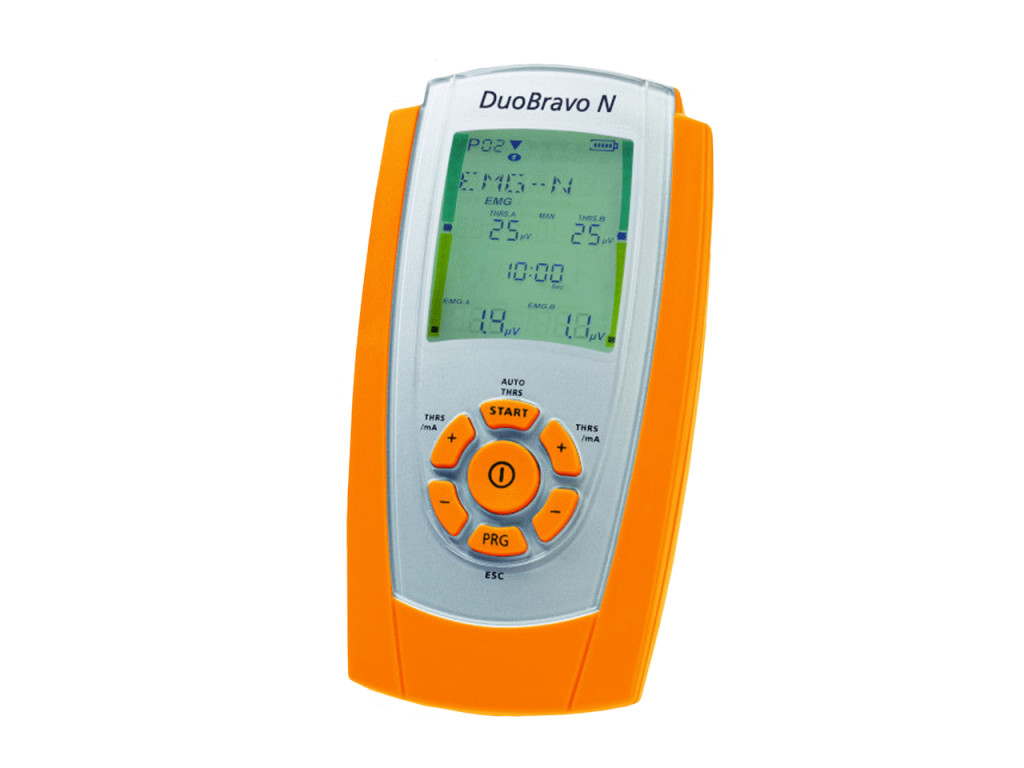
EMG biofeedback is a key method in modern physiotherapy. DuoBravo N's 0.2–2000 µV EMG range and the visual bar chart on the display enable patient re-education: the patient can see their own muscle activity, which helps develop conscious muscle control. This is useful beyond stroke rehab, e.g., pelvic floor training, post-operative rehab, or sports rehab. The desktop stand supports patient-facing positioning (useful with a mirror).
Extended hospital stays, bed confinement, casting, or ICU care can cause significant muscle wasting even when the nervous system is intact. DuoBravo N's strengthening programs (Force 1–4) support muscle mass restoration with classical EMS protocols, while ETS provides a tool for active participation–based rehab. Typical regimen: 3–5 sessions per week under physiotherapist supervision.
Spasticity (muscle stiffness, involuntary contractions) is a common consequence of central nervous system injuries: stroke, brain trauma, MS, spinal cord injury. DuoBravo N's low-frequency Relaxation program (8–12 Hz) can help reduce spasticity, and EMG-controlled stimulation of antagonists can restore muscle balance. IMPORTANT: spasticity treatment should always follow protocols recommended by a specialist (neurologist, physiotherapist).
DuoBravo N includes two dedicated pain-relief programs (14–15) using classic TENS protocols: high-frequency modulation (70–110 Hz) and Han stimulation (2/100 Hz alternation). 30-minute session length. While not the primary indication, this is a useful adjunct because centrally paralyzed patients commonly suffer secondary chronic pain from spasticity, compensatory posture (back/neck pain), or joint overload.
Program 13 (Partial Peripheral Paralysis, 60 Hz, 450 µs pulse width) is for special cases where peripheral paralysis has partially recovered and the muscle is partially reinnervated. The upper range of classic EMS (50–450 µs) can recruit the muscle. If you have complete denervation, the PeroBravo's selective long-pulse current (1–1000 ms) is the appropriate device — DuoBravo N cannot reach the long pulse durations needed to activate denervated muscle.
Stroke rehabilitation typically spans 6–24 months, sometimes longer. Such prolonged treatment must largely take place at home; daily clinic visits for years are impractical. DuoBravo N's 200-day data storage allows the treating physician and physiotherapist to monitor session frequency, intensity, and EMG activity values throughout the process. The optical PC connection (with optional software and cable) enables clinical use of the data. This level of documentation is rare at this price point.
The 12+4 programs in detail
The DuoBravo N program library covers the full spectrum of central paralysis rehabilitation: from EMG-only biofeedback training to combined STIM+ETS protocols, plus pain therapy and individual customization options.
Program 1 – alternating STIM and EMG (Neurological): 45 Hz, 250 µs, 15 repetitions alternating stimulation and EMG phases. Builds muscle activity step by step.
Program 2 – EMG baseline program: 30 repetitions, 8s work / 12s rest. Biofeedback only – the patient learns to observe their own muscle activity without stimulation.
Program 3 – ETS: 25 repetitions, 45 Hz, 8s work / 16s rest. Classic EMG-triggered stimulation – the key program for stroke rehab.
Four strengthening programs combining different STIM, EMG and modulated current forms. Variable work/rest ratios, 45 Hz base frequency, 20–15 repetitions. The four variants correspond to different stages of rehabilitation:
- Force 1: low intensity for initial treatment of weak muscles.
- Force 2–3: medium intensity with gradual load increase.
- Force 4: higher intensity for advanced strength restoration.
The physiotherapist decides which level to use at each stage.
Combination of modulated and EMG phases, frequency between 8–12 Hz, 20 repetitions. Low-frequency stimulation can support relaxation of spastic muscles and help restore circulation. In stroke rehab context this is especially important: the paretic side is often spastic, which significantly impairs gait function and quality of life.
Programs 9–10 (Rehabilitation): different work/rest rhythms, 50–60 Hz frequency range, gradual intensity increase. For post-rehab phase when the patient can generate higher muscle activity.
Programs 11–12 (Strength-endurance and explosive power): alternating short and long contractions, 45 Hz frequency, variable ramp times. For the final recovery phase as the patient regains functional movement capacity.
Program 13 – Partial Peripheral Paralysis: 60 Hz, 450 µs pulse width. Suitable when peripheral paralysis has partly improved and the muscle is partially re-innervated. For complete peripheral paralysis, the PeroBravo selective current is the suitable tool.
Programs 14–15 (Pain relief): high-frequency modulation (70–110 Hz) and Han stimulation (2/100 Hz alternation). 30-minute session length. For relief of secondary chronic pain (from spasticity or compensatory posture).
Four freely programmable slots for therapist-customized protocols:
- PC1: custom STIM program (classic stimulation parameters).
- PC2: custom EMG program (biofeedback only, no stimulation).
- PC3: custom ETS program (EMG-controlled stimulation).
- PC4: combined STIM-EMG-ETS program (multi-phase sequence).
Adjustable parameters: frequency (1–100 Hz), pulse width (50–450 µs), work time (1–99 s), rest time (1–99 s), ramp times (0.1–9.9 s), treatment duration (1–99 min), intensity (0–80 mA).
Frequently asked questions
No. A pacemaker, implanted defibrillator (ICD) or any electronic implant is an absolute contraindication. EMS pulses can interfere with implant function. If you have such a device, do not use the device under any circumstances — not even on the limbs.
DuoBravo N is a professional neurorehabilitation device — physician/physiotherapist supervision is MANDATORY:
- Initial diagnosis: determining type and severity of central paralysis and affected muscle groups is the specialist's responsibility.
- Protocol selection: selection among the 12+4 programs is done by a professional.
- EMG threshold setting: optimal sensitivity and activation level need specialist adjustment.
- Custom programs (PC1–PC4): configured by the specialist.
- Progress monitoring: 200-day statistics should be checked during clinical visits.
Home use follows the protocol set by the specialist — the patient trains intensively at home between clinic visits.
Both are MTR+ Bravo-line neurorehabilitation devices, but there is a FUNDAMENTAL DIFFERENCE:
- DuoBravo N (central paralysis): 2-channel, classic EMS range (50–450 µs pulses). For post-stroke cases where the motor nerve is INTACT but the brain command is impaired. EMG biofeedback + ETS are key features.
- PeroBravo (peripheral paralysis): 1-channel, selective long-pulse current (1–1000 ms pulses). For conditions like peroneal paresis, Bell's palsy, or brachial plexus injury where the motor nerve is damaged. Long pulse-width waveforms recruit denervated muscle.
They do not replace each other. For central paralysis after stroke → DuoBravo N. For peripheral paralysis (drop foot, facial palsy, etc.) → PeroBravo. Your treating physician will determine the correct type.
Both have EMG-biofeedback, but differ in approach:
- DuoBravo N: combination of EMG measurement + electrical stimulation. ETS function (voluntary attempt + electrical assistance). The patient actively tries to move and the device helps.
- SineBravo: EMG-biofeedback only, NO stimulation. The patient learns to activate the muscle alone, using visual feedback. Purely volitional training without electrical assistance.
SineBravo is useful in later rehabilitation stages when the patient can already generate higher voluntary activity and the goal is pure volitional control. DuoBravo N is used earlier when electrical assistance is still needed. The two devices can complement each other through the rehabilitation process.
Recovery time and outcome after stroke depend on many factors:
- 1–3 months: the most important period, fastest natural recovery — the largest gains occur here. Intensive EMS+ETS rehab can support this phase.
- 3–12 months: gradual, slower recovery. Home-based intensive use of DuoBravo N (3–5 sessions/week under physiotherapist supervision) is especially valuable.
- 12–24 months: the maximal recovery window. Further functional improvements are possible but slower.
- After 24 months: recovery often plateaus at the maximal achievable level. Maintenance treatment remains useful to preserve function.
The treating physician will provide an individualized prognosis. Treatment intensity and frequency significantly affect outcomes.
The 2 channels allow several strategies:
- Bilateral (left–right) treatment: channel 1 on the paretic side, channel 2 on the intact side. This bilateral training method can support neuroplasticity by transferring activity from the intact to the paretic side.
- Agonist–antagonist: channel 1 on the target muscle (e.g., quadriceps), channel 2 on the opposing muscle (e.g., hamstrings). Aims to improve muscle balance.
- Paretic side only: both channels on the same-side muscle group for larger stimulation area and more intensive treatment.
The physiotherapist chooses the exact strategy based on the patient's situation.
Home EMS treatment for a post-stroke patient requires special precautions:
- Never leave the patient alone if they have cognitive or balance problems — a caregiver or family member should be present.
- Reduced sensitivity: the paretic side often has reduced skin sensitivity and the patient may not feel the electrical current! Increase intensity gradually and regularly check the skin for signs of burning or irritation.
- Spasticity: if stimulation increases spasticity, the intensity is likely too high. Reduce intensity and consult the physiotherapist.
- New symptoms: stop treatment and notify the treating physician for any new symptoms (increased weakness, pain, numbness). New symptoms in a post-stroke patient can indicate various issues and require urgent evaluation.
How to use it step by step?
1
Setup by neurologist/physiotherapist
Initial use of the DuoBravo N must start after assessment by a specialist (neurologist, rehabilitation physician, physiotherapist). The specialist determines the type and severity of paralysis, targeted muscle groups, ETS threshold value, and the appropriate program (one of the 12 presets or a custom PC1–PC4 setting).
2
Precise electrode placement
The package contains eight 40×40 mm self-adhesive electrodes. Placement over the motor point (the muscle spot most effectively activated) is critical. The reference cable provides the basis for EMG measurement. The two channels allow simultaneous treatment of left and right sides or stimulation of an agonist–antagonist muscle pair.
3
Desktop stand + hands-free use
Placed on the supplied desktop stand, the DuoBravo N can be used hands-free. This is especially important in hemiparesis, where we practice voluntary effort on the paretic side — the patient can watch EMG activity on the display and "prove" to themselves they can generate slight activity. Combined with mirror feedback, visual feedback is even more effective.
4
EMG threshold setting (automatic or manual)
The sensitivity threshold (how much EMG activity triggers stimulation) can be set automatically or manually. Initially the physiotherapist sets the optimal level for the patient. The device can fine-tune the threshold automatically during treatment if muscle activity changes (e.g., the patient gradually improves).
5
Active ETS treatment (patient attempts to move)
During an ETS program the patient attempts to VOLUNTARILY activate the muscle. When the EMG reaches the threshold, the device automatically activates stimulation, eliciting additional contraction. This gives near real-time feedback: "you managed to move!" A 25-repetition cycle (8s work / 16s rest) enables gradual relearning of the muscle.
6
Logging + PC transfer for the physician
The device automatically records each treatment's timestamp, EMG activity patterns, and intensity used. It stores 200 treatment days. The optical cable and optional software enable transfer to a PC so the treating physician and physiotherapist can analyse continuous progress.
Demo and usage video
The video below demonstrates the DuoBravo N device and general usage.
DuoBravo N device demonstration
Presentation of the DuoBravo N stroke-rehabilitation device, the operation of EMG biofeedback and ETS (EMG-triggered stimulation), electrode placement and basic usage.
What is included in the package?
The DuoBravo N professional rehabilitation package includes the desktop stand for hands-free use, the reference cable for EMG measurement, and 8 electrodes.
- 1 pc DuoBravo N device (2-channel)
- 1 pc carrying bag
- 2 pcs stimulating cables (one per channel)
- 1 pc reference cable (for EMG measurement)
- 2 packs (8 pcs) 40×40 mm self-adhesive electrodes
- 1 pc desktop stand (for hands-free use)
- 4 pcs AA batteries
- 1 pc Hungarian user manual
Self-adhesive electrodes: adhesion gradually decreases after 25–30 uses. Replacements in 40×40 mm size can be ordered separately. After use place them back on the protective film. In a stroke-rehab context with 3–5 sessions per week, one electrode set lasts about 5–6 weeks.
AA batteries: 4 pcs included. Under average use they provide about 12 hours of operation. Remove them if the device will be unused for a long time. Rechargeable (NiMH) batteries may be used — for a 36-month warranty period you may need multiple sets.
Device cleaning: wipe the exterior with a dry or slightly damp cloth and mild detergent. Wipe connectors (cable plugs) with a dry cloth.
DuoBravo N can be supplemented with additional accessories:
- Replacement electrode sets: available in several sizes for replacement after 15–20 uses.
- USB fiber-optic adapter + PC software: for clinical documentation and data export.
- Replacement cables: for replacing stimulation or reference cables if damaged.
- Rechargeable NiMH AA batteries + charger: recommended for daily long-term use.
Technical specifications – detailed
| Property | Value | What it means for you |
|---|---|---|
| Number of channels | 2 (independent) | Bilateral treatment or agonist–antagonist stimulation |
| Stimulation modes | TENS, EMS/NMES, Biofeedback (EMG), ETS (EMG-triggered stim.) | 4 different modes covering the full rehab spectrum |
| Number of programs | 12 preset + 4 custom (PC1–PC4) | Full rehab process + therapist-customizable |
| EMG range | 0.2 - 2000 µV RMS | Extremely sensitive – detects the SMALLEST voluntary effort |
| EMG sensitivity | 0.1 µV RMS | Microvolt resolution – clinical EMG-level performance |
| Intensity | 0–80 mA | Moderate, safe rehab range |
| Frequency | 2–100 Hz | Covers relaxation (8–12 Hz) and strengthening (45–60 Hz) ranges |
| Pulse width | 50–450 µs | Classic EMS range – suitable for innervated muscle |
| Waveform | Symmetric, rectangular, biphasic, zero DC | Even signal quality without polarization |
| Work/Rest time | 1–99 s / 1–99 s | Flexible interval settings for all protocols |
| Repetitions | 1–99 | Cycle count freely adjustable |
| Ramp time (up/down) | 0.1–9.9 s | Gentle intensity transitions at start/end |
| EMG threshold setting | Automatic or manual | The device can fine-tune the threshold during treatment |
| Desktop stand | Included | Hands-free use – patient can watch the display |
| PC connection | USB fiber-optic adapter (optional with software) | Export treatment data for medical analysis |
| Data storage | 200 treatment days of statistics | Long-term rehab documented |
| Display | EMG bar chart + numerical value + program parameters | Visual biofeedback for the patient + clear control |
| Device dimensions | 142 × 74 × 35 mm | Desk-mountable, versatile |
| Weight | 275 g (with batteries) | Stable, robust yet portable |
| Power supply | 4 × AA batteries (12 hours runtime) | Long usage cycles, easy battery replacement |
| Certification | CE 0123; Class IIa; ISO 13485:2021; MDD 93/42/EEC | European conformity, clinical quality assurance |
| Manufacturer | MTR+ Vertriebs GmbH (Germany) | Manufactured to German quality assurance standards |
 When NOT to use the DuoBravo N?
The following situations make EMS/ETS treatment dangerous or may cause adverse effects. For post-stroke patients treatment ALWAYS begins under physician and physiotherapist supervision — comorbidities often raise special considerations.
- Wearing a pacemaker, implanted defibrillator (ICD) or any electronic implant — EMS pulses can interfere with their function
- Cardiac arrhythmia, myocardial damage or severe cardiovascular disease (common comorbidity in post-stroke patients, warrants extra caution)
- Epilepsy or other seizure disorders (post-central nervous system injury epileptic activity is common, so neurological assessment should precede use)
- Pregnancy (especially treatment of the lower abdomen, abdomen and lumbar region is prohibited throughout pregnancy)
- Active malignant tumour near the treatment area
- Acute local inflammation or infection at the treatment skin area
- Deep vein thrombosis or known clotting tendency in the treated limb (higher risk in post-stroke patients)
- Skin injury, fresh scar or open wound at the treatment area (avoid until healed)
- Fever or acute infectious diseases
- Placing electrodes on the front of the neck (carotid sinus region), on the skull or over the heart — FORBIDDEN
- Reduced or absent skin sensation at the treatment area (common on the paretic side in hemiparesis; increase intensity gradually)
- Loosening or inflammation around fresh metal implants (screws, plates) — consult your treating physician
- Presence of flammable anesthetic gases, operating machinery or driving — never
Unsure? Before use always consult your treating physician, neurologist or physiotherapist — especially in post-stroke rehabilitation where treatment must be tailored to the complex health situation. Detailed information can be found in Dr. Zátrok Zsolt's article on electrotherapy contraindications.
 Important information
The DuoBravo N is a CE-certified Class IIa medical device (CE 0123, MDD 93/42/EEC), a clinical-grade professional neurorehabilitation device. Home use MUST be supervised by a neurologist, rehabilitation physician or physiotherapist. The device does not replace medical diagnosis, a specialist physiotherapist's individualized protocol, or prescribed medication. It is an adjunct device used alongside comprehensive stroke rehabilitation therapy.
If new or worsening post-stroke symptoms occur (e.g., new muscle weakness, speech disturbance, vision loss, dizziness, severe headache, sensory loss) seek IMMEDIATE medical attention or call emergency services — some symptoms may indicate a new stroke requiring urgent evaluation.
Home EMS treatment of a hemiparesis patient requires special precautions: on the paretic side with reduced skin sensation increase intensity gradually and under caregiver supervision. During spasticity treatment monitor that stimulation does not provoke seizures. When starting a new medication (especially anticoagulants or antiepileptics) consult the physician to determine if treatment is safe to continue.
The ETS function combines voluntary effort with stimulation. The patient's subjective experience matters — if discomfort, pain or dizziness occurs, reduce intensity or stop treatment and notify the treating physician.
Use only original accessories; replace electrodes regularly (after 25–30 uses). Keep the device away from children.
The information on this page is for general informational purposes and does not replace individual medical advice, diagnosis or treatment. Consult your treating physician regarding your specific complaints.