

Who is the Power Q-8120 recommended for?
The multiple air chambers enable a more precise, finer treatment — this difference really matters where visible results must be achieved within a few days. At home, consistency is the decisive factor: regular daily treatment with a 4-chamber device can also produce results. In the sections below I explain who benefits from the flagship model and who may be fine with a simpler machine.
In a clinic patients come one after another, and visible results must be achieved during a short multi-day course. Here the finer, more precise pattern of the 12 chambers makes a real difference: experience suggests high-chamber devices can provide 20–25% more effective treatment than simpler 4-chamber machines.
Another decisive factor is duty cycle. The Power Q-8120 is built for continuous operation — not just 2–3 hours per day like home devices. This means a more robust, higher-performance construction. In return the device is heavy: not portable, and it is awkward to move between treatment rooms — allocate a fixed location for it.
Full programmability allows tailoring treatments to each patient’s individual needs.
For chronic lymphoedema the 12-chamber inflation pattern enables finer fluid mobilization than simpler home devices.
Let’s be realistic! Few can afford such a device for home use, and it is not always necessary. For machine lymphatic drainage, daily consistent treatment with a 4-chamber device also yields results. If you can afford it, a higher chamber-count device delivers a finer and somewhat more effective treatment and can pay off in the long run.
Stage-3 lipedema is associated with significant tissue volume and skin irregularities. According to clinical studies, 12-chamber sequential compression may contribute to improved fluid distribution and pain relief — the finer pattern adds the most in such complex anatomical situations.
The Power Q-8120 is compatible with a separately sold pant cuff that can treat bodies with waist-hip circumferences up to 160 cm, which is unique.
Read the detailed clinical background in the Lipedema (fat edema) symptoms and treatment guide.
For more severe forms of BCRL or for long-term maintenance therapy, clinical-grade IPC can provide sustained benefits. The detailed clinical background is in the BCRL section of the Lymphoedema – forms and causes guide.
The higher pressure range and fine sequential pattern are suitable for sports protocols. Useful for post-training or post-competition recovery and to relieve DOMS (delayed onset muscle soreness). For clubs, gyms and sports medicine clinics continuous operation is an advantage — as an individual athlete consider whether a portable device might better suit your needs. Detailed sports protocols are in the Compression therapy for athletes guide.
I don’t want to give the impression that only 6- or 12-chamber devices are good. For daily home use, 4-chamber devices also produce results — they are designed for daily sessions totaling about 2–3 hours and reliably fulfill that role.
Advantages of a 4-chamber device:
- significantly lower price — many cannot afford 6/8/12-chamber machines,
- lightweight and portable — you can take it when traveling so treatment doesn’t get skipped,
- designed for everyday home routines.
The most important thing is that the treatment actually happens: anything is better than no treatment. If you can afford it, consider a higher chamber-count device. If you’re still deciding, the Lymphatic massage device – what it’s for and how to choose guide may help.
What does 12-chamber sequential IPC affect?
Classic 4-chamber compression produces a simple ascending pressure wave. The 12-chamber Power Q-8120, by contrast, creates a finer, multi-segment pattern — closer to the hand techniques of manual lymphatic drainage (MLD). In clinical practice this finer pattern may contribute to:
- mobilizing protein-rich interstitial fluid toward patent lymphatic pathways,
- supporting venous return,
- improving microcirculation with respect to endothelial function,
- reducing pain in chronic swelling cases,
- providing long-term stability for maintenance therapy.
In the maintenance phase of complex decongestive therapy (CDT), home IPC is one of the most important physical tools alongside compression garments and exercise. Detailed clinical background is available in the Lymphatic drainage – manual and machine lymphatic massage guide.
Frequently asked questions
Yes, the Power Q-8120 can be used at home if your physician or lymph therapist recommends this device level. The user interface is intuitive and the basic functions are similar to simpler home devices. The 12-chamber sequential pattern provides a finer effect — particularly beneficial for stage-3 lipedema or complex lymphoedema.
It depends on the indication. For lymphoedema generally 30–50 mmHg, for lipedema 30–60 mmHg, for sports recovery 60–100 mmHg. Always agree exact settings with your physician or lymph therapist. Start at lower pressures for initial sessions.
Both devices are professional-level sequential IPC. The 8060 is 6-chamber with up to 18 channels, while the 8120 is 12-chamber with up to 24 channels. The 8120 provides a finer sequential pattern and can treat more limbs simultaneously — so choose based on whether the 8060 meets your needs or the 8120 flagship is required.
The Power Q-8120 is compatible with the Power Q series 12-chamber cuff system. Leg, arm and trunk cuffs are available. The detailed compatibility list is in the Lymphatic massage accessories category.
NO. In case of acute skin infection (erysipelas, cellulitis) or suspected deep vein thrombosis, treatment must be suspended and you should see a doctor immediately. After completion of antibiotic treatment or exclusion of thrombosis, use may be resumed with medical approval. Detailed contraindications are listed in the section below.
General knowledge about lymphatic massage devices
In the video I review how a lymphatic massage device works, why the correct pressure range and chamber number matter, and what to consider when choosing one.
- Importance of chamber number (4, 6, 12)
- Pressure range by stage
- Cuff selection and compatibility
- Home vs. professional use
How does the Power Q-8120 work?
1
Applying the cuff
Place the 12-chamber leg, arm or trunk cuff on the treated limb. The cuff should fit snugly but not tightly.
2
Select program or recall saved protocol
Recall a protocol set by your physician or lymph therapist, or choose a factory preset adapted to your condition.
3
Set pressure and treatment time
Typically 30–60 mmHg for lymphoedema, 30–60 minutes duration. For sports recovery, higher pressure (60–100 mmHg) and shorter time (15–30 minutes).
4
Start the treatment
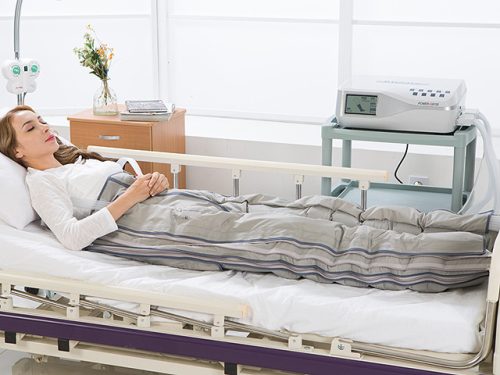
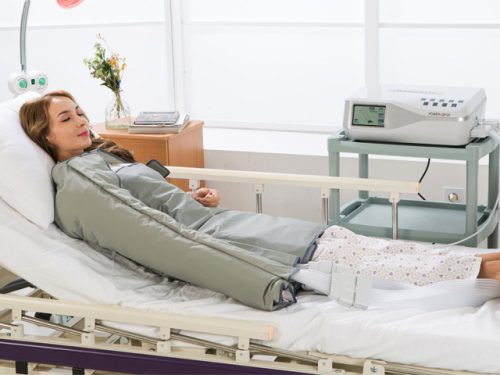
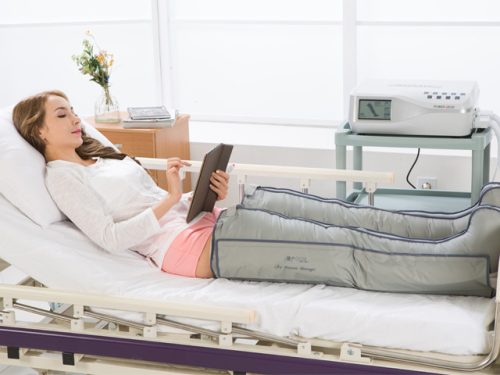
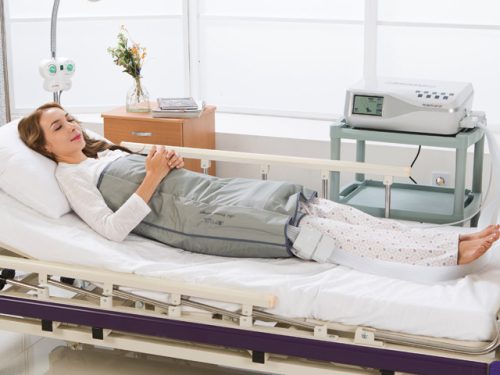
The 12 chambers sequentially inflate with increasing pressure, "smoothing" fluid along the limb toward patent lymphatic pathways. Perform while sitting comfortably or lying down, with the limb slightly elevated.
5
Wear compression garment after treatment
To stabilize volume, put on the compression stocking/arm protector immediately after the session. This ensures durability of the IPC result.
What's included in the package?
The Power Q-8120 base package includes:
- 1 pc Power Q-8120 control unit
- 2 pcs air hoses
- 1 pc blind plug
- 1 pc stop button
Attention! Treatment cuffs are sold separately and are not included in the base price.
The inner surfaces of cuffs can be wiped regularly with a damp cloth and disinfectant weekly. The control unit should only be wiped with a dry cloth. Keep air hoses free of twists and avoid sharp folds during storage.
Multiple cuff types are available for the Power Q-8120: arm cuffs, trunk cuffs, leg cuffs, expansion protective stockings, and replacement air hoses. The full list is in the Lymphatic massage accessories category.
Technical specifications
| Model | Power Q-8120 |
| Number of chambers | 12 |
| Number of channels (max.) | 24 |
| Pressure range | 20–250 mmHg |
| Programs | Full programmability and program saving |
| Treatment time | 5–60 minutes, adjustable |
| Compatible cuffs | 12-chamber leg, arm, trunk cuffs (S/M/L/XL) |
| Power supply | 220V/50Hz |
| CE / MDR compliance | CE medical device, registered according to MDR |
 When NOT to use the device?
- Acute deep vein thrombosis or suspected DVT – treatment only with medical approval
- Severe heart failure – increased venous return may cause decompensation
- Active skin infection (erysipelas, cellulitis) in the treated area
- Severe peripheral arterial disease – individual assessment and low pressure recommended
- Uncontrolled high blood pressure – use after stabilization and medical advice
- Active malignant tumor in the treated region – only with oncologist approval
- Recent postoperative period – not recommended until wound healing
- First trimester of pregnancy and complicated pregnancies – only after obstetric consultation
Not sure? Consult your treating physician before use!
 Important information
The Power Q-8120 lymphatic massage device holds CE medical device certification according to the European MDR (Medical Device Regulation). Its use is intended as an adjunct to medical and physiotherapy treatment and does not replace them. In case of new symptoms, increasing swelling, pain or skin changes, consult your treating physician.
The information provided here is for guidance only. Precise treatment protocols must be determined by your physician or lymph therapist.
Scientific sources
The clinical effectiveness of pneumatic compression is supported by the following randomized studies:
- Su L, Huang H, Tong Y, and colleagues (2025). Intermittent pneumatic compression devices for the prevention and treatment of breast cancer-related lymphedema – a systematic review and meta-analysis. Supportive Care in Cancer. PubMed
- Herbst KL, Zelaya C, Sommerville M, and colleagues (2025). An Advanced Pneumatic Compression Therapy System Improves Leg Volume and Fluid, Adipose Tissue Thickness, Symptoms, and Quality of Life and Reduces Risk of Lymphedema in Women with Lipedema. Life (Basel). PubMed
- Pajero Otero V, García Delgado E, Martín Cortijo C, and colleagues (2022). Intensive complex physical therapy combined with intermittent pneumatic compression versus Kinesio taping for treating breast cancer-related lymphedema. European Journal of Cancer Care. PubMed
- Kulchitskaya DB, Fesyun AD, Konchugova TV, Apkhanova TV (2024). Influence of intermittent pneumatic compression on microvasculature condition in lymphedema – Prospective randomized clinical trial. Voprosy Kurortologii, Fizioterapii, i Lechebnoi Fizicheskoi Kultury. PubMed
Related guides and content
 Lymphatic massage device – multi-indication hub and product overview →
 Lymphatic massage device – what it's for, how to choose? →
- Lymphoedema – forms, causes and stages →
 Lipedema (fat edema) symptoms and treatment →
 Lymphatic drainage – differences between manual and machine lymphatic massage →
 Lymphatic massage accessories – cuffs and extras →