
 What is lymphatic drainage (lymphatic massage)?
Lymphatic drainage — also called lymphatic massage or lymph drainage — is a targeted, gentle, superficial manipulation technique that directs interstitial fluid and proteins toward the lymphatic pathways, thereby helping to reduce lymph stasis. There are two main forms: manual lymphatic drainage (MLD) performed by a trained specialist, and device-based lymphatic massage (pneumatic compression, IPC) that can be applied at home according to the patient’s own schedule.
The two methods are not competitors but complementary tools. Manual lymphatic drainage is fine-tuned, targeted and patient-specific — ideal where a complex anatomical problem needs to be addressed. Device-based lymphatic massage, on the other hand, forms the basis of long-term maintenance therapy, providing hours of regular home treatment per week. Together they form the backbone of complex decongestive therapy (CDT).
 Key point
Classic “massage” and lymphatic drainage are not the same! Classical deep muscle massage uses strong pressure — which can be harmful in lymphoedema. Lymphatic drainage is gentle, superficial, and targets the subcutaneous lymphatic vessels. This distinction is a key factor in successful treatment.
Indications for lymphatic drainage
In clinical practice lymphatic drainage is used for five main indications, each with a different protocol:
- Lymphoedema (lymphedema): both primary (congenital) and secondary (post-surgery, post-radiation) forms. It is the primary physical modality of complex decongestive therapy (CDT).
- Breast cancer–related lymphedema (BCRL): meta-analyses of clinical trials show that pneumatic compression significantly reduces the development of BCRL. Detailed clinical background is in the BCRL section of the Lymphoedema – forms and causes guide.
- Lipedema: the clinically supported approach is compression garment + IPC + exercise. Details are in the Lipedema (fat oedema) symptoms and treatment guide.
- Chronic venous insufficiency and varicose vein complaints: as an adjunct to compression stockings or to relieve heaviness and swelling of the legs.
- Sports recovery: as part of a post-training or post-competition routine to relieve DOMS (delayed onset muscle soreness), using higher pressure ranges.
In every indication the method is part of a comprehensive treatment package — never a standalone therapy. Daily wearing of a compression garment, exercise and a suitable lifestyle are equally indispensable elements.
Manual lymphatic drainage (MLD) – treatment by a trained therapist
Manual lymphatic drainage (MLD) is a specific technique that should be performed correctly only by a specially trained professional. The method’s history goes back to the Vodder and Földi lymph therapist schools, and today physiotherapists and lymph therapists with MLD certification still follow those protocols.
Characteristics of the treatment:
- Gentle, superficial pressure: the manipulation affects the skin and the immediately underlying tissues, not deeper layers.
- Slow rhythm: follows the natural pumping rhythm of the lymphatic vessels (approx. 6–10 cycles/min).
- Central evacuation: the therapist first “empties” proximal lymph regions near the base of the limb and only then moves toward peripheral (distal) areas.
- Individually tailored: the direction and depth of treatment are adapted to the patient’s anatomy and the localization of the impairment.
A typical MLD session lasts 45–60 minutes, and during the intensive initial phase treatment is recommended 3–5 times per week. In the maintenance phase the lasting result is achieved with once-weekly clinic sessions plus daily home self-MLD or device-based lymphatic massage.
MLD services have expanded in Hungary in recent years. The list of lymph therapists and the referral process begins with a treating physician consultation. One relevant clinical study in practice:
Pajero Otero et al. (2022) – CPT+IPC vs Kinesio tape, 43 women with BCRL
The combination of complex physical therapy + intermittent pneumatic compression produced a significantly greater volume reduction (-2.2%) than Kinesio taping (-0.9%, p=0.002). Improvement in shoulder range of motion was also better — therefore the combination of manual treatment and machine pneumatic compression provides an evidence-based benefit.1
Self-lymphatic drainage (self-MLD) at home
Self-MLD is a simplified, home-adapted version of manual MLD that the patient performs on themselves. It does not replace MLD performed by a specialist, but as a daily maintenance routine it complements compression garments and pneumatic compression well.
Self-MLD rests on three basic principles. First, superficial touch — the skin is only gently “moved”, not pressed. Second, the order of central evacuation — start with regions near the abdomen or axilla, then progress outward along the limb. Third, patience — a full lower-limb self-MLD takes 5–10 minutes, forearm/upper arm 3–5 minutes, and it is worth doing several short sessions per day.
Precise hand positions and directional sequences are best learned from a lymph therapist in person. Several Hungarian-language video guides also help with learning (see the next section).
How to perform manual self-massage?
The description is only a guideline — every individual treatment should be refined with your lymph therapist. The following basic protocol applies most often to lower-limb self-MLD.
- Preparation. Put on comfortable clothes, sit or lie down with the treated leg slightly elevated (use a pillow). No skin creams or oils are needed — dry skin is best for superficial manipulation.
- Central evacuation (1 minute). Place your hand on your abdomen and stimulate the abdominal lymph region with gentle circular movements clockwise.
- Prepare the groin (1 minute). On the inner thigh near the groin, gently “brush” from the thigh toward the abdomen to “open” the central evacuation.
- Thigh (1–2 minutes). From the knee gradually toward the groin, make gentle “strokes” on the skin. Do not press or rub — merely displace the skin 2–3 cm along the length of the thigh.
- Knee and calf (2–3 minutes). Using the same method, proceed gradually from below the knee toward the knee.
- Ankle and foot (2–3 minutes). With gentle circular movements, sweep from the forefoot toward the ankle and calf, using careful upward “clearing” strokes.
- Closing phase (1 minute). Repeat steps 1–2 (central evacuation, activation of the groin) so the moved fluid can be absorbed more quickly.
The complete lower-limb self-MLD therefore lasts about 8–12 minutes. The upper-limb protocol follows a similar logic, but central evacuation is performed at the axilla or the supraclavicular region. Precise hand positions are best learned in person — Dr. Zátrok Zsolt’s YouTube channel also contains a detailed self-massage video (see the video guides in article #04 in the Lymphoedema treatment at home guide).
Device-based lymphatic massage (pneumatic compression)
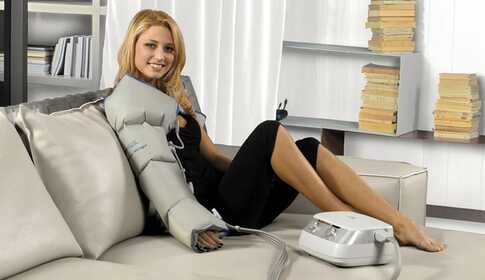
Device-based lymphatic massage — medically termed intermittent pneumatic compression (IPC) — consists of a compressor and a cuff system applied to the limb (or trunk), where the device sequentially applies ascending pressure to “move” fluid toward the patent lymphatic pathways. The method is analogous to MLD but mechanized and requires far less therapist time.
The main advantages of IPC for home treatment:
- Long-term availability: the patient can perform daily 30–60 minute treatments without visiting a lymph therapist.
- Reproducible pressure protocol: the same pressure and the same sequence every time — it eliminates manual variability.
- Can be combined with other activities: it can be done while watching TV, reading or eating.
- Clinical evidence base: randomized trials support its efficacy in prevention and treatment of BCRL.
Kulchitskaya et al. (2024) – IPC microcirculation RCT, 60 patients
In patients with lower-limb lymphedema (stages I–III), home IPC + baseline therapy significantly improved endothelial function, reduced arteriolar spasm and increased capillary perfusion compared with the control group. This explains why patients feel relief even after the first sessions and why swelling gradually decreases during weekly–monthly protocols.2
When choosing a home IPC device, consider the disease stage and usage frequency:
- Power Q-2200 – entry-level home basic system – 4 chambers, for stage 1 maintenance therapy.
- Power Q-1000 Plus – 4-chamber home device – good value for money, for daily treatment in stages 1–2.
- Power Q-1000 Premium – advanced home device – with program memory, for long-term daily use.
- Power Q-8060 – 6-chamber professional system – more precise sequential massage, for stage 3 or demanding users.
- Power Q-8120 – 12-chamber top-tier device – most detailed sequence control, for intensive protocols.
The full selection logic is in the Lymphatic massage device — what it is for and how to choose? guide, and the multi-indication hub can be found on the Lymphatic massage device category.
Manual or device-based lymphatic massage? When to choose which?
Manual and device-based lymphatic massage do not compete — in clinical practice they are most effective when used together. The table below helps with selection:
| Aspect | Manual MLD | Device IPC |
|---|---|---|
| Who performs it? | Trained specialist (lymph therapist, MLD physiotherapist) | The patient themself, at home |
| Individualization | High (anatomy-specific) | Limited (preprogrammed) |
| Frequency | 1–5 times/week (intensive vs maintenance) | 1–2 times/day |
| Cost | Pay per session | One-time device investment, cheaper long-term |
| Location | Clinic, practice | Home |
| Best use | Initial (intensive) phase, complex anatomical cases | Maintenance therapy, long-term stability |
| For sports recovery | Limited availability | High-pressure sport protocols |
An ideal combination in the CDT introductory phase is 3–5 weekly MLD sessions by a specialist + daily home IPC, then in the maintenance phase once-weekly MLD + daily IPC + compression garment. Your physician and lymph therapist will help set the right balance.
When should you consult a specialist?
A lymphoedematous condition requires specialist consultation in the following situations:
- New-onset swelling of the arm or leg — especially after oncological surgery or over age 30, without another clear cause.
- Progressive trend — if weekly home measurements show increasing limb volume.
- Recurrent skin infection (erysipelas, cellulitis) — medical consultation and antibiotic treatment are required after every episode.
- Skin changes — tightness, nodularity, hyperkeratosis, fungal infection.
- Persistent pain or reduced mobility despite home treatment.
The detailed diagnostic process — Stemmer sign, lymphoscintigraphy, MR-lymphangiography — is described in the Lymphoedema – forms and causes guide. Surgical options (LVA, VLNT, liposuction, debulking) are covered in the Lymphatic reconstructive surgery guide and in the interview with surgeon Dr. Balázs Mohos: Interview.
Deeper guides on the topic
The cluster of available guides on lymphatic drainage and lymphoedema treatment:
- Lymphoedema – forms, causes and stages – pillar guide
- Lymphoedema treatment at home – detailed daily routine
- Lymphatic reconstructive surgery – types and indications – surgical overview
- Interview with Dr. Balázs Mohos, surgeon – specialist opinion
- Radiation therapy and lymphoedema – BCRL context
- Lipedema (fat oedema) symptoms and treatment – differential diagnosis
- Lymphatic massage device — multi-indication hub – device selection
- Lymphatic massage device — what it is for and how to choose? – technical buying guide
- Lymphatic massage accessories – cuffs, hoses, accessories
 When NOT to use lymphatic drainage?
Lymphatic drainage (both manual and device-based) is a safe procedure, but there are some conditions when you should definitely consult a physician before home use or specialist treatment.
Contraindications
- Acute deep vein thrombosis or suspicion of it – treatment only with medical approval and under monitoring.
- Severe heart failure – increased venous return may cause decompensation.
- Active skin infection (erysipelas, cellulitis) – not recommended until the infection has healed; may be restarted after completion of antibiotic therapy.
- Severe peripheral arterial disease – individual assessment and low-pressure settings are required.
- Active malignant tumor in the treated region – only with oncologist approval.
- Early postoperative period – treatment is paused until wound healing; treating physician’s permission is necessary.
 Important note
Manual and device-based lymphatic massage are elements of a complex treatment package and do not replace medical or specialist care. In case of new symptoms, increasing swelling, pain or skin changes, consult your treating physician.
Frequently asked questions
Classic Swedish-style or deep tissue massage uses strong pressure and targets muscles and connective tissue layers. Lymphatic drainage, by contrast, uses a gentle, superficial touch to stimulate the subcutaneous lymphatic vessels. In lymphoedema classical deep massage can be harmful because deep pressure may push additional fluid into already damaged tissues — only the special, gentle MLD is recommended.
In the introductory (intensive) phase typically 3–5 times per week for 2–4 weeks. In the maintenance phase once weekly plus daily home self-MLD or device IPC provides a stable result. The exact protocol is determined by your treating physician or lymph therapist based on stage and clinical presentation.
The basic self-MLD protocol can be learned from video guides, blog articles or books, but the first few sessions should ideally be reviewed in person with a lymph therapist. Exact hand positions, directional sequences and correct pressure level are difficult to master from written text or one-way video alone. A 1–2 hour teaching session with a specialist is usually a worthwhile long-term investment.
Reduce the pressure or the treatment time and observe the limb. At the start of pneumatic compression some mild sensitivity or numbness may occur for a few sessions — this usually resolves if you start at a lower pressure. If discomfort persists (lasting more than 30 minutes after treatment), you experience severe pain or skin discoloration, stop and consult your treating physician.
The recommended range depends on the indication. For lymphoedema typically 30–50 mmHg, for BCRL prevention ≤40 mmHg, for lipedema 30–60 mmHg, for pregnancy-related varicose veins 15–30 mmHg, for sports recovery 60–100 mmHg. Always agree the exact settings with your treating physician or lymph therapist and start at a lower pressure.
No. Pneumatic compression moves fluid intermittently for some hours, but volume stabilization depends on daily use of a compression garment. The most effective approach is always a combination: daily compression stockings + daily device-based lymphatic massage + weekly or monthly specialist treatment in the maintenance phase.
 Summary – Lymphatic drainage in brief
Sources
- Pajero Otero V, García Delgado E, Martín Cortijo C, and colleagues (2022). Intensive complex physical therapy combined with intermittent pneumatic compression versus Kinesio taping for treating breast cancer-related lymphedema of the upper limb: A randomised cross-over clinical trial. European Journal of Cancer Care. DOI: 10.1111/ecc.13625
- Kulchitskaya DB, Fesyun AD, Konchugova TV, Apkhanova TV (2024). Influence of intermittent pneumatic compression on microvasculature condition in lymphedema – Prospective randomized clinical trial. Voprosy Kurortologii, Fizioterapii, i Lechebnoi Fizicheskoi Kultury. DOI: 10.17116/kurort202410106148