
Soft laser for treating heel pain – Heel spur, plantar fasciitis
You get out of bed in the morning, and as soon as you put your foot on the floor, a sharp, stabbing pain shoots into your heel. It feels like stepping on a pin cushion. After a few steps it eases a little, but it returns again and again during the day. If this sounds familiar, you likely have plantar fasciitis or a heel spur — and low-level laser therapy can help.

Why does your heel hurt?
The most common causes of heel pain:
Plantar fascia inflammation (plantar fasciitis)
Your sole is supported by a thick connective tissue band – the plantar fascia (fascia plantaris) – running from your toes to your heel bone. If you overload it, tiny tears develop and inflammation occurs. This causes the characteristic stabbing pain of the first steps in the morning.
Heel spur
If the inflammation persists for a long time, minerals deposit into the inflammatory exudate. It is like stalactite formation — each day of inflammation adds "one drop" to the deposit. This is how the bony outgrowth visible on X-ray, the heel spur, develops.
Achilles tendon problems
The Achilles tendon connects the calf muscles to the heel bone. Overload, improper shoes, or sudden increases in training load can cause inflammation and pain.
How can low-level laser therapy help with heel pain?
Low-level laser therapy (LLLT) works at the root of the pain — the inflammation. The laser light penetrates the tissues and acts at the cellular level:
- It may favorably influence inflammatory processes
- It can support ATP (cellular energy) production
- It may contribute to tissue regeneration
- It can help relieve pain
Scientific studies support the beneficial effects of low-level laser therapy for heel pain. A 2019 systematic review and meta-analysis analyzing 6 randomized controlled trials concluded that laser treatment had a favorable effect on heel pain in patients with plantar fasciitis, and the improvement persisted for 3 months after treatment.1
In another 2014 prospective study of 30 patients with chronic plantar fasciitis, the pain measured on the VAS scale decreased on average from 67.8 to 6.9 during 12 months of follow-up.2
Treatment points for heel pain
Heel spur, plantar fasciitis
Treat the following points:
- The plantar surface of the heel (the painful point)
- The medial edge of the foot
- Both sides of the heel bone (right and left)
- The posterior part of the heel
Achilles tendon inflammation, injury, post-op
- The posterior heel and the point above it
- The right and left sides of the heel bone
- Along the full length of the tendon, if necessary
Soft laser treatment procedure
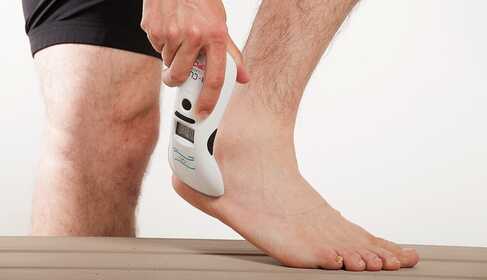
Using the B-Cure soft laser
The three members of the B-Cure device family (Classic, Sport, Pro) all emit the same 808 nm wavelength laser beam, but differ in energy output:
| Device | Treatment time per point |
|---|---|
| B-Cure Laser Classic | 6 minutes |
| B-Cure Laser Sport Pro | 5 minutes |
| B-Cure Laser Pro | 5 minutes |
Steps of the treatment
- Turn on the device and set the recommended treatment time using the plus button
- Place the device on the painful area, directly on the skin
- Keep it still until the set time has elapsed
- Move to the next treatment point and repeat
Important! Laser light does not pass through clothing or bandages, so the treatment will be ineffective. Always apply directly to the skin!
Treatment frequency
- Acute pain: 2–3 times daily
- Chronic complaints: 1–2 treatments daily
Critical rule: Doubling the treatment time DOES NOT increase effectiveness! Too much energy can halt the regeneration processes. Treat each point only for the recommended duration.
What to expect?
Early stage (pain present for 1–2 months)
Low-level laser therapy can favorably influence inflammation and may prevent the formation of a heel spur. A heel spur is a consequence of prolonged inflammation — if you eliminate the inflammation, the bony deposit will not form.
If a heel spur has already formed
Low-level laser will not remove the bony heel spur visible on X-ray — that is already a "done deal." However, laser therapy can help reduce the inflammation and pain around it. The problem is that the excess bone irritates the tendon with every step, so inflammation tends to flare up again.
If the heel spur causes significant problems, surgical removal may be considered as a last resort.
Duration
A minimum of 10–12 days of regular treatment is required to reduce the inflammation. If you feel improvement, do not stop — continue until full recovery!
During the first treatments it is possible that pain temporarily increases. Don’t be alarmed — this is a natural reaction and may indicate the start of healing processes. This usually subsides after 1–2 treatments.
Before you start treatment
When NOT to use it?
Do NOT use the soft laser device if:
- You have an implanted pacemaker
- You have active thrombosis in the treatment area
- You have an active malignant tumor
- You are pregnant (for the abdominal area it is forbidden)
- You are taking photosensitizing medication
Detailed information about contraindications: Contraindications of soft laser therapy
If in doubt, consult your doctor!
Other effective treatments for heel pain
Besides low-level laser therapy, other home physiotherapy methods can help. Combining these methods is often more effective than using a single method:
- Therapeutic ultrasound: Heats the tissues, improves blood circulation
- Magnetic therapy: May favorably influence inflammatory processes
- TENS treatment: Can help reduce the sensation of pain
- Microcurrent (MENS): Can support tissue regeneration
- Contrast cold–hot therapy: Can reduce swelling and pain
Read more about how the method works and how to apply it in the comprehensive guide to soft laser therapy.
Recommended devices
| Device | Advantage |
|---|---|
| B-Cure Laser Pro | Fast treatment, compact size |
| B-Cure Laser Sport Pro | For athletes, active lifestyles |
| Personal Laser L400 | Good price–performance ratio |
Find the full range of soft laser devices here.
Other applications of soft laser
Soft laser therapy can support the treatment of many other conditions and complaints. For an overview of all home application areas read the Soft laser therapy at home – Treatable conditions article.
If you are unfamiliar with the basics of soft laser therapy, start with the Comprehensive guide to soft laser therapy article.
Summary – Quick overview
What is this article? A practical guide on applying soft laser therapy for heel pain, heel spur and plantar fasciitis.
Who is it for? People suffering from heel pain, heel spur, plantar fasciitis or Achilles tendon problems.
Main message: Research indicates that low-level laser therapy can favorably influence heel pain. In early stages it may help prevent heel spur formation, but it does not remove an already formed bony growth.
Important facts:
- An 808 nm wavelength device is required
- Treat multiple points on the heel (sole, sides, posterior part)
- Apply directly on the skin
- A minimum of 10–12 days of regular treatment is necessary
- The earlier you start, the better the result
Frequently asked questions:
Does soft laser remove a heel spur?
No, soft laser does not remove an already formed bony heel spur. However, it can help reduce the inflammation and pain around it.
When should I see a doctor?
If the pain is very severe, you can hardly walk, or your symptoms do not improve after several weeks of treatment, consult an orthopedic specialist.
Can I combine it with other treatments?
Yes, soft laser combines well with other physiotherapy methods (ultrasound, magnetic therapy, TENS). Combined treatment is often more effective.
Related musculoskeletal articles
- Soft laser for knee pain and knee osteoarthritis – if other joints hurt
- Soft laser for tendon inflammation – tennis elbow, golfer's elbow, other tendon problems
- Soft laser for joint inflammation (arthritis) – if you have inflammatory joint disease
- Soft laser for herniated disc, back pain – for radiating pain
- Treating sports injuries with soft laser – for athletes, active lifestyles
Sources
- Wang W, et al. (2019). Clinical efficacy of low-level laser therapy in plantar fasciitis: A systematic review and meta-analysis. Medicine (Baltimore). PubMed: 30653125
- Jastifer JR, et al. (2014). Low-Level Laser Therapy for the Treatment of Chronic Plantar Fasciitis: A Prospective Study. Foot & Ankle International. PubMed: 24510123
- Macias DM, et al. (2015). Low-Level Laser Therapy at 635 nm for Treatment of Chronic Plantar Fasciitis: A Placebo-Controlled, Randomized Study. Journal of Foot and Ankle Surgery. PubMed: 25769363
The information in this article is for guidance only. Home therapeutic devices are intended to complement medical treatment and do not replace professional medical care. If you have complaints, consult your doctor.

