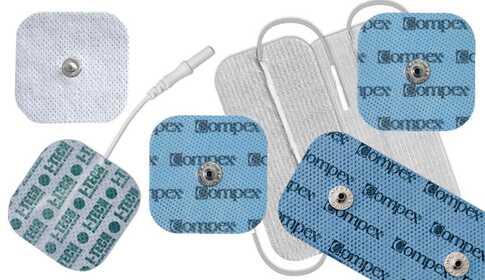

The right pad choice depends on three main factors: how it is applied (self-adhesive or silicone-carbon), the connector type (PIN or SNAP), and the pad’s size and shape. This article reviews which pad type suits different electrotherapy methods, how to maintain pad lifespan, and what to do if skin sensitivity occurs.
 Key idea
TENS, EMS, microcurrent, iontophoresis and IF devices use compatible pads when the connector (PIN or SNAP) matches. Pad lifespan is typically 15–40 applications, depending on skin preparation, storage and usage frequency. If skin irritation occurs, consider hypoallergenic pads or silicone-carbon electrodes.
Pad types – the basic differences
Based on application and conduction there are three main groups. The choice usually depends on how often you treat, the area being treated and the user’s skin sensitivity.
The most commonly used type. It consists of a conductive hydrogel applied to a fabric or foil backing that adheres directly to the skin. Advantages: even current distribution, quick application, no separate fixation needed, optimal for home use.
Lifespan: 15–40 applications, approx. 1–3 months with regular use. A 2022 study by Flodin et al. examined electrode size and comfort in NMES: smaller electrodes produce higher current density and can make low-intensity treatments less comfortable.
A conductive silicone-carbon composite pad that is coupled to the skin via a moistened sponge insert and fixed with a rubber strap or belt. Advantages: many years of use (often 3+ years), safely conducts higher currents, suitable for professional rehabilitation or clinical settings.
Disadvantages: time-consuming application, the moist sponge requires care and is less movement-friendly. For long, large-area treatments (e.g., WB-EMS, extended rehab cycles) they are cost-effective.
- Facial pads – small, delicate pads for cosmetic microcurrent treatments (G-Pulse and similar systems)
- Internal probes – for incontinence and pelvic rehabilitation, vaginal or anal electrodes
- Glove/sock electrodes – for diabetic neuropathy, polyneuropathy treatments
- Stimulation belt (EMS belt) – for abdominal and lower back use
- WB-EMS suit electrodes – for whole-body stimulation
- Iontophoresis electrode – used as a drug-carrier insert, polarity-sensitive
 Connector and size – compatibility
The pad connector must match the connector at the end of the cable. The two most common types are PIN and SNAP. The connector type is defined by the device’s factory-supplied pad.
| Connector | Description | Common devices |
|---|---|---|
| PIN (2 mm pin) | A small pin protruding from the pad plugs into the cable. European standard. | All Globus, MTR, Tenscare, BeacMed devices use this type |
| SNAP (3.5 mm snap button) | Connects via a snap-button mechanism. American standard. | American and some Chinese devices belong here. |
 Size and shape selection
- Small (3×4 cm or ≤ 30 mm diameter): neck, wrist, face, hand – precise localization
- Medium (5×5 cm or 50 mm diameter): shoulder, thigh, calf – general rehab
- Large (5×9 cm or 9×14 cm): back, quadriceps, gluteus – large muscle groups
- Elongated (5×9, 5×13 cm): lower back, paraspinal muscles, buttocks
- Round vs square: mostly aesthetic difference; current distribution is similar
Lifespan and maintenance
Self-adhesive pads’ lifespan can vary between 15–20 applications, depending heavily on usage conditions. Proper skin preparation, correct application procedure and storage can even double a pad’s usable life.
 Rules to extend lifespan
- Place on clean, dry skin – details in the hydration article
- Shave or trim hair under the pad – hair damages the adhesive
- Do NOT use oily creams or ointments under the pad – they insulate
- After removal, stick back onto the protective film to avoid hydrogel drying
- Store cooled – colder temperature slows gel drying
- Replace damaged cables – a damaged cable causes contact faults and energy loss
When to replace the pad?
- No longer adheres properly (corner lifts during treatment)
- Surface is cracked, dried out, or blotchy
- Treatment causes a sharper/stinging sensation than usual
- The cable connector area becomes loose or deformed
- Skin irritation appears under the pad
 Skin sensitivity and allergy
Self-adhesive pads can cause temporary skin sensitivity and, less commonly (1–2%), allergic reactions to adhesive ingredients (polyacrylate) in the hydrogel. Studies from Weber-Muller (2004) and Johnson (2025) have documented such cases in TENS users.
| Symptom | Possible cause | What to do? |
|---|---|---|
| Transient redness (30–60 minutes after treatment) | Normal vasodilation | Wait, no intervention needed |
| Persistent redness (hours), mild itching | Skin sensitivity to adhesive | Switch to hypoallergenic pads, hydrate skin |
| Blisters, extensive redness | Allergic contact dermatitis | Replace pad, consult a dermatologist |
| Stinging at pad corners | Current concentration under the corners | Use larger pad or silicone-carbon electrode |
| Burning, persistent pain (in case of sustained DC) | Alkaline/acid skin effect (cathode/anode) | Swap polarity, reduce intensity, stop treatment |
Allergic contact dermatitis requires dermatology or allergy consultation. If allergic to polyacrylate, switch to latex-free, hypoallergenic pads or silicone-carbon electrodes (with a moist sponge). Polarity issues are discussed in detail in the polarity article.
 Which pad for which method?
| Method | Pad type | Size | Note |
|---|---|---|---|
| TENS – pain relief | Self-adhesive hydrogel | Typically 5×5 cm | Ideal for daily home use |
| EMS – muscle strengthening | Self-adhesive hydrogel / silicone-carbon | 5×9 cm for large muscle groups | For long rehab cycles, silicone-carbon is more economical |
| Microcurrent (MENS) – general | Self-adhesive hydrogel | 5×5 cm | Low current reduces skin irritation risk |
| Microcurrent (MENS) – face/cosmetic | Special facial pads | small, round or 5x5cm | Factory G-Pulse handpiece optional |
| Iontophoresis – drug delivery | Silicone-carbon + sponge insert | 5x5 or 5x9cm | Polarity-sensitive, follow instructions |
| Iontophoresis – hyperhidrosis | Tap water / metallic plate | tray size | For hand/foot tray devices |
| IF (interferential) | Self-adhesive / silicone-carbon | 5×5 cm or 5×9 cm | Two-channel square placement |
| Incontinence / pelvic floor | Vaginal / anal probe | standard size | Factory-supplied, for individual use |
| WB-EMS | Special suit electrodes | large surface | Only for factory WB-EMS systems |
Frequently asked questions
Generally yes, if the connector type matches (PIN-PIN or SNAP-SNAP). The pad material can be conductive hydrogel or silicone-carbon. A pad is merely a medium for transmitting impulses; the treatment itself depends on the device.
The usability threshold is typically reached around 15–20 applications. If the pad lifts during treatment, the surface is cracked, or a stinging sensation appears during use, replace it. Proper skin preparation (warm water cleansing) and storing pads cooled can extend lifespan.
Transient redness (30–60 minutes after treatment) is a sign of normal vasodilation (small vessel dilation). Persistent redness (several hours), itching or blisters may indicate an allergic reaction—typically to a hydrogel component. Try hypoallergenic / latex-free pads, or switch to silicone-carbon + moist sponge system. For persistent symptoms, consult a dermatologist or allergist.
For hygiene reasons, direct sharing of pads between people is never recommended, because skin microflora can embed into the hydrogel. Sharing the device (cables and control unit) is safe if each person uses their own pad set.
If you have a 2- or 4-channel device (e.g., Globus Premium 400 or Activa 700), you can wire two pairs across two channels to cover a larger area. However, pad placement is important! Never connect opposite-sited pads on the same cable across the thigh’s inner and outer sides—this can cause a painful experience. Follow the device manual illustrations or your physiotherapist’s guidance for correct electrode placement.
 Summary
A guide to selecting electrotherapy pads and electrodes – for TENS, EMS, microcurrent, iontophoresis, IF and selective stimulation devices. Types, sizes, connectors, lifespan and allergy considerations.
Home electrotherapy users, sports physiotherapists, physical therapists, and anyone planning pad replacement or first-time pad purchase.
The pad is a universal accessory – the same hydrogel or silicone-carbon pad can be appropriate for different methods if the connector (PIN/SNAP) matches. Proper skin preparation and storage will provide a lifespan of 15–40 applications. Switch to hypoallergenic pads if skin irritation occurs.
Learn the hydration rules, read about electrode polarity, or check general electrotherapy contraindications.
Scientific references
- Flodin J, et al. Effects of electrode size and placement on comfort and efficiency during low-intensity NMES – BMC Sports Science, Medicine and Rehabilitation, 2022. PubMed: 35034633
- Weber-Muller F, et al. Contact dermatitis from polyacrylate in TENS electrode – Annales de Dermatologie et de Vénéréologie, 2004. PubMed: 15235538
- Meuleman V, et al. Contact allergy to a device for transcutaneous electrical neural stimulation – Contact Dermatitis, 1996. PubMed: 8896964