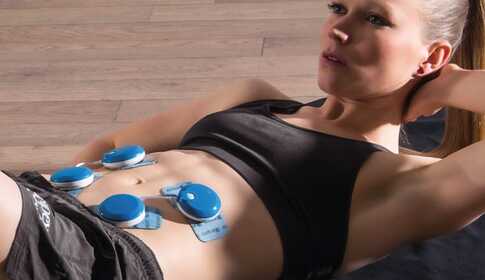

EMS, i.e. electrical muscle stimulation
The EMS, or electrical muscle stimulation method has been used for decades in athlete preparation… well… NOT in our country. Why is that? In my firm opinion the reason is simple: lack of language skills. Because most Hungarians do not know any foreign language, they do not read international literature, cannot keep up with world trends, and remain stuck in the familiar. The majority still firmly believe that training equals: “train a lot and eat lots of grilled chicken with rice.” They have no clue about most of the modern, drug-free possibilities offered by technology — as evidenced by the reactions to my articles. Knowledge is, to put it mildly, patchy about what a muscle stimulator is for, how it works, and how to use it. Let’s look at the basic info…
What is electrical muscle stimulation (EMS)?
EMS is an abbreviation of the English Electric Muscle Stimulation, meaning in Hungarian electrical muscle stimulation, which is used to treat the voluntary muscles, i.e. the so-called striated (skeletal) muscles. It does not significantly affect the viscera or smooth muscles.
During muscle stimulation, the muscle stimulator device delivers an electrical impulse measured in milliamps (mA) to the treated muscle through electrodes attached to the skin, causing it to contract. By adjusting the impulse frequency, intensity and duration, you can determine the type of contraction, which fiber types contract, and how many fibers take part. The effect corresponds to the impulse settings.
In this video I show how to perform muscle stimulation and “what you see” during the treatment.
From the recording you can see that stimulation can only be focused on a specific muscle or muscle group, so its effect is limited to those — which means it is not a replacement for training, but a complement, and that is precisely its main strength.
Normally, a muscle contraction is initiated by an electrical signal from your brain. Muscle stimulation delivers artificial impulses similar to these.
FOR THE MUSCLE THERE IS NO DIFFERENCE BETWEEN AN IMPULSE FROM THE DEVICE OR FROM THE BRAIN!
In both cases the muscle contracts by exactly the same mechanism, the same metabolic processes take place, it fatigues, becomes acidic, and the filaments tear in the same way.
If you accept that a muscle's capabilities can be improved by training (repeated muscle work), then based on the above you must accept that muscle stimulation will produce the same result!
What can electrical stimulation do better?
When you perform a voluntary movement, the contraction reaches your muscle through the brain's regulatory systems. This is described by Hennemann's principle.
According to this, during a contraction smaller motor units are recruited first, then the larger ones. Within a muscle bundle, type I fibers are activated first, then IIa and finally IIb fibers.
It is also important that the brain always “saves” during voluntary contractions, meaning it does not allow all fibers to contract at once. That is why stress or danger can multiply strength — an adrenaline rush is released into the blood, which disables the conservation mechanism. This explains why in competition some people can use that adrenaline and hype themselves up to push beyond their normal limits and produce greater force. That is why an otherwise 50-kilogram mother may lift a log off her child that has fallen on them.
Electrical muscle stimulation bypasses this “conservation system”. Nothing limits the number of activated fibers. Therefore EMS can activate a much larger number of muscle fibers.
A complete, 100% contraction cannot be achieved even with stimulation, because there are always some muscle fibers that are in a refractory phase and thus incapable of contracting (for example they are taking their “mandatory rest” after a previous contraction).
Another important ability of electrical muscle stimulation is “teaching” the neuromuscular (nerve-muscle) connection. Some studies suggest that the brain and the motor neuron running from the brain to the muscle need at least 10,000 repetitions to learn how to perform a movement as quickly and efficiently as possible. Athletes therefore repeat and refine a movement endlessly. Stimulation can significantly accelerate the optimization of muscle performance.
You may have experienced that after an injury you have to relearn proper movements and engrain them again. Muscle stimulation is excellent for relearning optimal movement coordination.
There are some conditions in which muscle stimulation is FORBIDDEN!
Electrical muscle stimulation must not be used in people with an implanted pacemaker or defibrillator, and is contraindicated in acute thrombosis, tumors, epilepsy, and infectious diseases. It should be used with caution during pregnancy and menstruation. Read detailed contraindications here.
Who is electrical muscle stimulation recommended for?
Muscle stimulation can be used by both professional and amateur athletes, as well as by people with musculoskeletal conditions. But not for the same purposes.
Amateur athletes train relatively less, so for them the main uses of muscle stimulation are injury prevention, gaining passive training time, and accelerating muscle recovery.
Professional athletes mainly use it to speed up muscle recovery, prevent overuse injuries, and accelerate return from injury.
If you are an athlete, continue learning about muscle stimulation here: Muscle stimulation — how can an athlete use it?
There are numerous muscle and joint conditions where muscle stimulation is applicable. Major areas include prevention of muscle wasting and treatment of various forms of paralysis (ALS, multiple sclerosis, stroke, spinal cord injury), and strength recovery and accelerated rehabilitation after surgeries. These deserve a separate topic and I will address them in another article.
If you're interested in muscle stimulation in relation to a disease, continue here: Application of muscle stimulation for treating disease symptoms