
Achilles pain — is your heel tormenting you?
It's morning. You get out of bed feeling tired and your calf feels stiff. Every day you get more and more of a nagging feeling that something isn't right. You wonder whether to go for today's run or whether it's time to suspend running until the complaint disappears. You think you need to move — so you set off. Achilles pain increasingly torments you while running and you eventually switch to walking. But it doesn't get better: your lower-leg muscles remain stiff and ache. What could this be?

Did you know that Achilles tendon injuries account for 5–12% of all running injuries? And that they occur more often in men?
How does Achilles pain develop and what can you do about it?
Let's start at the very beginning: the Achilles is the largest tendon in your body. It connects your calf muscles to the heel bone. You stress it with every step: when you walk, run, climb stairs, jump, or stand on tiptoe.
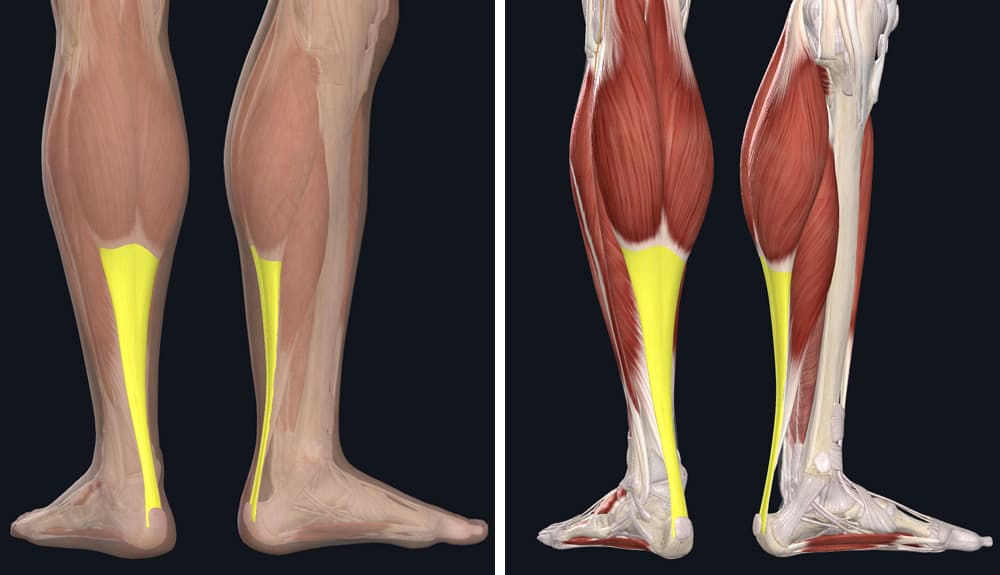
Despite being able to withstand very high loads, it can sometimes be overloaded. Irritation can lead to degeneration and inflammation. The Achilles is like a bungee cord made of many thin rubber threads twisted together, except that it is composed of elastic protein fibers. In an Achilles tendon injury these so‑called collagen fibers are damaged. Healthy tendon fibers run side by side in smooth, even bundles. But when something is wrong, these fibers become tangled and their orientation becomes disorganized.
Besides heavy use and load, another problem is that the Achilles tendon has poor blood supply "by default", making it particularly susceptible to injury and slow to heal once damaged.
Achilles tendinopathy — the cause of the pain
Achilles tendinopathy is usually not the result of a single specific injury but rather of repeated micro‑injuries from faulty movement patterns or overuse. It can also be triggered by a sudden increase in training intensity, bad equipment, overly tight muscles, or an overly aggressive training program.
Symptoms are most common in people who train actively. It is especially frequent in runners, triathletes and footballers, and also affects handball, basketball and volleyball players. In the mornings you may feel pain and stiffness in the Achilles tendon or heel area that can improve with a little movement. The tendon may be thickened or slightly swollen, which can worsen during the day or by the end of exercise. Achilles pain falls into two main groups: pain in the mid-portion of the tendon (66.6%) or at the point where the tendon attaches to the heel bone (33.3%). At the latter site, with persistent inflammation, a bony outgrowth can form beneath the tendon insertion, rubbing on the tendon and causing severe pain. A bursa inflammation (bursitis) may also appear, worsening symptoms. The bursa is a fluid-filled sac whose normal role is to reduce friction between tendon and bone. In both situations cells can calcify — calcium deposits form and the tissue hardens.
What should you do if you notice these symptoms?
The first and most important thing: show it to a knowledgeable doctor!
Because Achilles pain can lead to more serious injury — even rupture — leave diagnosis and treatment direction to a specialist.
Treatment options
There are several methods that can be used singly or in combination for Achilles pain:
- Nonsteroidal anti-inflammatory drugs (NSAIDs)
- Physiotherapy
- Physical therapy treatments
The main aims of treatment are to relieve pain, reduce swelling and support the anti‑inflammatory (healing) processes.
The choice of rehabilitation protocol depends on the severity of the condition and whether the patient is a professional athlete. Complete offloading is now considered an outdated approach, but any intervention must be done with care. Rest does not mean lying on the couch. Reduce intensity, try to offload the injured limb (for example with kinesio tape). Replace running with activities that improve circulation without overloading the calf and Achilles tendon: cycling or using an elliptical trainer are good options since they place less demand on the Achilles.
Replace worn‑out running shoes! If you see outsole wear at the heel, or if the heel counter is very stiff or the insole too soft, consider a new pair. In many cases a simple heel lift can solve the problem.
Calf relaxation
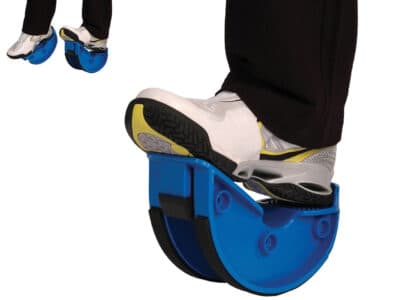
The simplest but highly important issue is the condition of your calf muscles. Tight calves constantly pull on the Achilles and contribute to overload and inflammation. If your muscles are stiff and tight, stretching and loosening them may by itself resolve your complaints. The Fit Stretch device, for example, is specifically designed to relax the foot muscles and improve ankle mobility. Just a few days of practice can reduce tension. Another tool to relax the calf muscles is the foam roller.
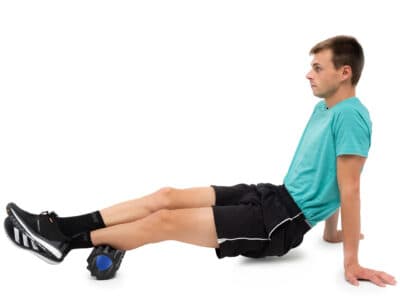
SMR roller
The SMR roller can be used to relieve muscle pain, reduce muscle stiffness and knots, for stretching, warming up, and improving muscle regeneration.
The greatest advantage of the roller is that it provides many of the benefits of physiotherapy and massage. At the same time it is cheaper than a single therapy session and can be used for years. Of course it does not replace exercise or massage entirely, but for those who can afford few treatments, the roller is a very worthwhile investment and to use regularly.
During rolling the muscles lengthen and loosen. The roller squeezes blood out of the muscles and fresh blood flows back in, delivering vital nutrients such as oxygen and glycogen to muscles, fascia and tendons. You can regulate the "pressure" of the roller — the intensity of the massage — by how much bodyweight you place on it: the more weight you put on it, the greater the pressure.
Better‑perfused and more relaxed muscles hurt less during movement. Increased circulation removes accumulated metabolic waste. Muscles receive nutrients faster, resulting in better regeneration.
For calf relaxation I recommend the 3‑in‑1 set, the Hollow (hollow) and the Spiky (spiky) rollers. In the 3‑in‑1 kit the roller is the softest and gentlest.
The Hollow roller is firmer, while the Spiky roller is for the "connoisseurs" — or, you might say, the hard‑core users.
Physical therapy treatments you can do at home
- EMS treatment, i.e. muscle stimulation: it relaxes tight muscles, helps strengthen the calf in phases when exercise is still not possible; it speeds up blood flow, aiding waste removal and delivery of nutrients.
- NEMS, i.e. microcurrent nerve stimulation: one of the newest and most effective electrotherapy methods. It strongly reduces pain, restores the membrane potential of injured cells and thus initiates ATP and protein production and the healing processes.
- Therapeutic ultrasound: ultrasound directed into the body is absorbed by tissues, accelerating blood flow in the treated area and stimulating healing processes.
- Softlaser treatment: extremely simple to perform — just point the laser beam at the painful area and hold it there for a few minutes. The laser beam penetrating the tissues stimulates cellular regeneration and thereby accelerates healing.
- Heat therapy: for complaints that have been present for several months, heat increases local blood flow, removes toxins and brings healing substances to the affected area — speeding recovery.
- Manual therapies: it is worth visiting a manual therapist (e.g. a masseur).
- Movement therapy: a movement therapist can help increase the ankle joint's range of motion so you can work on appropriate home exercises to relieve tendon overstrain.
You can reduce the risk of Achilles tendon overload if you follow these:
- Increase intensity gradually, whether speed or distance!
- Choose shoes carefully! They should be comfortable and provide adequate cushioning. Throw away worn, damaged shoes! If you often wear high heels, perform regular stretching and mobilization exercises.
- Perform ankle mobilization exercises to avoid tension in the Achilles tendon and calf!
- If you have flat feet or fallen arches, deal with it — do the appropriate physiotherapy!
- Strengthen your calf with eccentric exercises.
If you delay dealing with the problem it can have serious consequences: the Achilles tendon can even rupture, requiring surgery and taking you out of training for a long time. So as soon as you notice symptoms, follow the advice and act for your recovery!

