Gout symptoms and treatment
Gout is a common form of arthritis that can affect anyone. It causes excruciating pain, swelling and redness, most often in the joints of the big toe. The area is extremely sensitive. A gout attack often appears suddenly, frequently waking you in the middle of the night with the sensation that the big toe is "on fire." The joint is hot, swollen and so tender that even the weight of a blanket may feel unbearable. In some cases the symptoms "come and go" and resolve on their own. Most often, however, they require treatment and the person affected must take steps to prevent future flares.
The symptoms almost always start suddenly, often at night. The most characteristic ones are:
- Severe, excruciating joint pain. Gout typically affects the base joint of the big toe but can occur in any joint. Commonly affected joints include the ankle, knee, elbow, wrist and finger joints. Pain is worst during the first 6–12 hours after onset.
- Prolonged discomfort. After the most intense pain subsides, joint complaints can persist from a few days to several weeks. Later recurrent attacks tend to last longer and involve more joints.
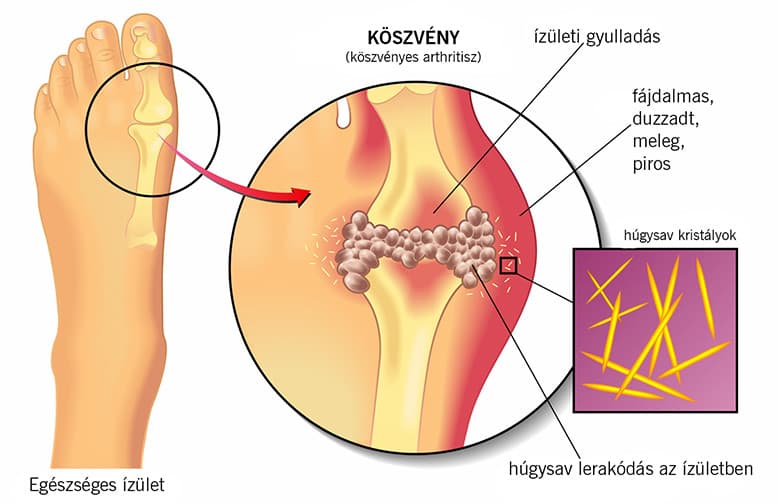
- Inflammation and redness. The affected joint is swollen, warm and red.
- Limited range of motion. Severe pain restricts joint movement.
When should you see a doctor?
If you notice sudden, intense pain and swelling around a joint. Untreated gout can lead to increasing pain and joint damage.
In case of gout, see a doctor immediately — for example, if the joint is warm, reddened and fever develops. This could even be a sign of infection.
Causes of gout
Gout occurs when urate crystals accumulate in a joint. This triggers inflammation and intense pain. Urate crystals form when blood levels of uric acid are persistently high. The healthy body naturally produces uric acid, so it is normally present in the body.
Uric acid comes from the breakdown of purine compounds. Certain foods — such as pork, beef, turkey, fish and offal (e.g., liver, spleen, kidney) — provide large amounts of purines. Alcoholic drinks, especially beer, and beverages sweetened with fruit sugar (fructose) increase uric acid levels.
Normally uric acid is dissolved in the blood, passes through the kidneys, which filter it and excrete it in the urine. However, if too much is produced or the kidneys excrete too little, uric acid can accumulate and sharp, needle-like urate crystals form in the joints and surrounding tissues. These crystals cause pain, inflammation and swelling.
Risk factors
Gout is more likely to develop if your blood uric acid level is high. Factors that raise uric acid include:
- Diet. A diet rich in meat and seafood and regular consumption of drinks sweetened with fruit sugar raise uric acid levels. Alcohol consumption — especially beer — increases risk.
- Obesity. When overweight, the body produces more uric acid and the kidneys cannot remove it quickly enough.
- Health conditions. Certain diseases — such as high blood pressure, diabetes, metabolic syndrome, heart and kidney disease — raise the risk of gout.
- Certain medications. Some diuretics (thiazides) commonly used to treat high blood pressure and aspirin can also increase uric acid levels.
- Family history. If family members have had gout, you are more likely to develop it.
- Age and sex. Gout occurs more often in men. Women generally have lower uric acid levels, but levels rise after menopause and approach those of men. In men symptoms most often appear between ages 30 and 50, while in women they tend to appear after menopause.
Complications
- Recurrent gout. For some people a single gout attack never recurs; others may experience attacks several times a year. Medications can help prevent repeated flares. If untreated, recurrent gout slowly destroys the joint and leads to joint damage. Urate crystals deposit in lumps under the skin. These nodules are called tophi. They appear in many areas, such as the fingers, hands, feet, elbow area or Achilles tendon. Tophi are usually not painful, but they may become swollen and tender during gout attacks.
- Kidney stones. Urate crystals can accumulate in the urinary tract, causing kidney stones. The risk of stone formation can be reduced with medication.
Reduce your risk with lifestyle changes
During symptom-free periods, the following dietary guidelines can help prevent future gout attacks:
- Plenty of fluids. Stay well hydrated by drinking lots of water. Avoid sweetened beverages, especially those high in fructose.
- Limit — or better yet avoid — alcohol. Recent studies indicate that beer in particular increases the risk of gout symptoms, especially in men.
- Choose low-fat foods! Low-fat foods may have a protective effect against gout and are the most optimal sources of protein.
- Avoid large amounts of meat! Small amounts may be acceptable, but pay attention to the type and quantity of meat you consume.
- Avoid binge eating. Gout attacks often occur the night after heavy meat feasts or a rich, meat-based meal.
- Maintain a healthy weight appropriate for your body type. Eat portion sizes that help you keep a healthy weight. If your weight increases, you are eating too much! Weight loss can lower uric acid levels — but avoid drastic weight loss because it can temporarily increase uric acid.
Diagnosis
Diagnosing gout usually does not require much; the following are generally sufficient:
- Physical examination: The disease presents with such characteristic symptoms that it is often recognizable at first sight. The localization (base joint of the big toe), swelling, redness and excruciating pain together should immediately alert the doctor. Tests are more useful for excluding other diseases than for "proving" gout.
- Laboratory tests. Measurement of blood uric acid and creatinine. Laboratory results can sometimes be misleading. Some people have high uric acid levels but never develop gout. Others show signs and symptoms of gout without elevated values.
- X-ray. May be useful to exclude other forms of arthritis.
- Ultrasound examination. Ultrasound can detect urate crystals in the joint or within tophi.
- CT scan. Although CT can accurately detect urate crystals in a joint, it is not used routinely in clinical practice because it is very expensive and adds little to diagnosis and treatment.
Treatment of a gout attack
- The primary immediate goal is to reduce pain. Traditionally, nonsteroidal anti-inflammatory drugs (NSAIDs) and analgesics are used for this purpose.
- Reducing inflammation. Corticosteroids relieve inflammation. They can be given orally or injected directly into the joint. Steroids are generally used only when nonsteroidal drugs cannot be used for some reason. Steroids — especially when used long term — can have many undesirable side effects.
- Soft laser treatment: It can quickly and significantly reduce the pain, swelling and inflammation of the joint capsule associated with an acute gout attack. At the same time it reduces the required medication dose.
With high-performance clinical lasers, complete pain relief is usually achieved after 1–3 pain-relief sessions. With lower-energy home devices, more sessions may be needed, even up to 10 treatments (5–8 minutes per session with a 5-minute break between). A recent study on the treatment of acute gout showed that soft laser therapy was more effective than nonsteroidal anti-inflammatory drugs.
Preventive medication
The main goal of prevention is to avoid recurrent attacks by lowering blood uric acid levels. I already mentioned diet and lifestyle measures above. Now I will outline the medication options. Note that if you do not follow the dietary recommendations above, your complaints will recur despite medication.
- Medications that inhibit uric acid production. Xanthine oxidase inhibitors, such as allopurinol, belong to this group. They limit the body's production of uric acid. This can lower blood uric acid levels and reduce the risk of gout.
Allopurinol side effects can include rash and low blood cell counts. Other agents may cause nausea and reduced liver function. - Medications that increase uric acid excretion. These drugs stimulate the kidneys' ability to remove uric acid. They can lower blood uric acid and reduce the risk of gout, but uric acid levels in the urine increase. Side effects include skin rash, stomach pain and the formation of kidney stones.