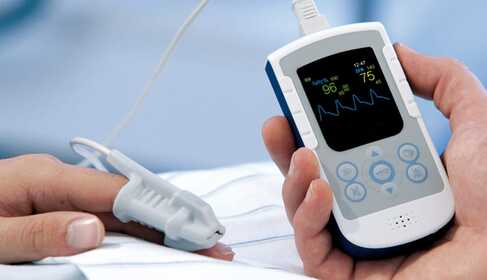
Measuring Blood Oxygen Level with a Pulse Oximeter
Regular at-home monitoring of the blood's oxygen-carrying capacity and condition is necessary in heart and respiratory diseases and in anemia. A pulse oximeter device provides this.

Every cell in your body needs oxygen to function. Oxygen molecules are picked up by your red blood cells in your lungs and transported to even the most distant corners of your body, where they are delivered to the cells. Measuring blood oxygen level provides important information to the doctor about circulation and respiration. The measurement is performed with a pulse oximeter device.
What is blood oxygen level?
Blood oxygen level shows what proportion of your red blood cells' possible oxygen-carrying capacity is being used. The higher the value, the more oxygen they carry. If the value is 98, it means 98% of the possible carrying capacity is "in use." A value of 50 would mean only half.
Instead of "blood oxygen level" people also use the terms oxygen saturation or blood oxygen saturation (they mean the same), and on medical reports you'll usually find it as the SpO2 value.
Every pulse oximeter measures and displays the blood oxygen level, since that is its basic function.
What is a pulse oximeter?
A pulse oximeter is the device used to measure blood oxygen level. It is also called an oxygen saturation meter or simply a saturation meter.
With a pulse oximeter you can take a single measurement, but you can also monitor blood oxygen saturation continuously (for hours or even days). This information guides treatment dosing and helps check its effect.
The pulse oximeter device DOES NOT TREAT and does not affect any disease. It is solely for monitoring and checking blood oxygen level.
Normal blood oxygen level table
The maximum blood oxygen level (oxygen saturation) is 100% (there is no such thing as saturation of 105%).
The value can be between 1 and 100, and within that range the higher the value, the better.
- Maximum oxygen saturation is 100% (there is no saturation of 105%).
- A value between 96–100% is a normal blood oxygen level. No action is required.
- A value between 90–95% indicates decreased oxygenation. Consult your general practitioner for a general heart-lung evaluation. There's no need to rush, but it's advisable to check soon.
- If the value is 88% or lower, contact a doctor immediately or, if a known disease is the cause, begin oxygen therapy as instructed by your treating physician.
When is measuring blood oxygen level important?
In some diseases, insufficient oxygen reaches your cells, which then suffer from oxygen deficiency. Without oxygen, vital cellular metabolic processes such as energy production cannot occur. Your body functions increasingly poorly. The first task is to find out what is causing the problem and treat it.
If you already know the cause and treatment has begun, regular measurement of blood oxygen level and monitoring of the oxygen-carrying capacity is necessary. This is provided by a simple device, the pulse oximeter.
When can blood oxygen level decrease?
- if your heart cannot pump the blood properly,
- if not enough oxygen reaches your lungs,
- if your red blood cells do not function properly and therefore cannot pick up and/or carry enough oxygen.
In which diseases should you measure?
In respiratory diseases
- chronic bronchitis
- obstructive lung disease (COPD)
- asthma (during attacks)
- allergy (during attacks)
- lung tumor
- pneumonia, etc.
- the early phase of Covid-19 infection
In heart disease
- heart failure,
- cardiomyopathy,
- myocarditis,
- atrial fibrillation – absolute arrhythmia,
- paroxysmal arrhythmias, etc.
In diseases of the red blood cells:
- low number or dysfunction of red blood cells
- hemoglobin problems (this molecule is responsible for carrying oxygen)
- insufficient or dysfunctional red blood cell production due to deficiencies of certain substances (iron, vitamin B12, folate).
Always measure blood oxygen level at rest!
ATTENTION! Finger-clip devices costing 10–20 thousand HUF are SUITABLE ONLY FOR RESTING blood oxygen measurements! They can show erratic values while moving.
For measurements during movement you need a pulse oximeter that includes a motion-tolerant algorithm. These are intended for clinical use and not for home use, and their price can be several hundred thousand HUF.
If you have a simple finger-clip device, do not move or walk while measuring. Keep the hand with the pulse oximeter completely still. This way you get a reliable result.
When you place the device on your finger and switch it on, it will show nothing for a while and then the numbers may change rapidly. This is normal; don't worry. The device needs about 20 seconds to determine the average. Only pay attention to readings shown about 20–30 seconds after switching on — those are meaningful.
Watch my video about measuring blood oxygen level!
The factors that affect blood oxygen level
Artificial nails and nail polish also interfere with the measurement because they can absorb too much light. You may get falsely low readings or the device may not be able to measure at all. Place the device on a finger without artificial nails or polish.
Cheap pulse oximeter devices do not give accurate data during motion. Motion-tolerant algorithms are provided by clinical (and expensive) devices. That means if you walk around, talk, or gesture during the measurement, the device may not detect the pulse wave and will either show no value or the value will jump around. As mentioned earlier, measure while seated, with your arm resting on a table and completely still. A 50–60 second measurement is enough at a time. You cannot reliably measure during sports or exercise with a cheap finger-clip device costing around 10,000 HUF.
Heart disease (cardiomyopathy, heart failure) can cause poor peripheral circulation, meaning your heart is so weak it cannot "push" blood to your fingertips. The tips of your fingers, your nails, and even your lips may appear bluish, indicating fresh blood did not reach them. Cheap pulse oximeters cannot measure accurately when blood flow is low.
In cardiac arrhythmia (atrial fibrillation, absolute arrhythmic heart function) your heartbeat is highly irregular, so the strength of successive pulses changes unpredictably. Sometimes very weak or even missed beats alternate with strong ones. Cheap devices struggle with this too. They may show no value or wildly fluctuating, uninterpretable values.
A change in body position affects the value. A medical study examined the relationship between body position and blood oxygen level. They found that values are higher when sitting than when lying down. If your sitting value is 3–5 points higher than your lying value, that is entirely normal. Body position alters circulation: when lying down the pulse wave flattens, while sitting it is stronger due to gravity. Lung expansion also changes, because when lying down the lungs cannot expand as well, so they take up less oxygen. Always perform measurements in a seated position and compare only values measured in the seated position! Compare apples to apples.
In some cases there may be a difference between values measured on the two hands. This may be due to, for example, a developmental abnormality, narrowing, or dilation of the arteries on one side. I generally recommend measuring always at the same site — for example, the middle or index finger of your left hand. Perform the next measurement in exactly the same body position and on the same finger.
How a pulse oximeter works — simply
The device has a tiny light source and a sensor placed opposite each other.
The light source emits two beams (red and infrared wavelengths). The light passes through your finger, on which you place the sensor. On the side opposite the light source the sensor monitors how much of the emitted light was "absorbed" by the cells in your finger and the blood flowing within them. From this it determines what percentage of the total oxygen-carrying capacity is bound.
Simply put: if oxygen is bound to every oxygen-binding site on the red blood cells, oxygen saturation is 100%. If only half are carrying oxygen, the device shows 50%.
Details about pulse oximeter devices
- finger-clip pulse oximeter. This is the most common for home use. As the name suggests, it can be clipped onto a finger or, if necessary, a toe. It is tiny, barely larger than a matchbox. I recommend it specifically for short home measurements of a few minutes at most. Good quality devices can be bought for the equivalent of 10–20 thousand HUF. Child-sized versions are usually a bit more expensive than adult ones. Cheaper devices usually represent very poor quality.
Finger-clip devices typically only measure oxygen saturation and pulse rate. They do not store measured data and do not alarm in case of danger. The more expensive models (over 20 thousand HUF) can store several days of measurement data (this is often important for the doctor, as they can see how values changed with treatment) and can sound alarms (important for caregivers because it alerts even if the patient cannot respond). Simple pulse oximeters are perfectly sufficient for home use. - handheld pulse oximeter is slightly more complex than the previous type. Here a small device about the size of a mobile phone is connected by a cable to the finger sensor. They are commonly used in smaller clinics. I recommend them for home use when the disease is severe and days-long monitoring, greater measurement precision, and alarm functions are needed. Sensors on handheld pulse oximeters are usually replaceable. Child, infant, and adult sizes are available (very few finger-clip devices are suitable for infants or small children). The larger displays on handheld devices can show more data, such as the peripheral pressure wave on a graphic or the trend (time course) of the values. These devices are generally more accurate than finger-clip ones; therefore they are recommended where precision is especially important: severe disease, infants, or children.
- tabletop pulse oximeter devices are made for hospital use. They are highly precise, accurate, and can offer many additional features. Examples include motion tolerance, meaning they can measure even if an ambulance speeds over cobblestones with a patient inside. Such devices are generally unnecessary for home use.
What other data does a pulse oximeter display?
The data displayed varies between devices, but these are the most common.
- Blood oxygen level. I already detailed this above.
- Peripheral pulse rate. The pulse rate measured at your finger by the device. Every pulse oximeter measures and displays this.
In a healthy heart, the peripheral pulse rate equals the number of heartbeats.
In some arrhythmias, such as atrial fibrillation, the peripheral pulse rate may be lower than the number of heartbeats. The difference between the two is the pulse deficit. The more severe the fibrillation, the larger the deficit.
Most cheaper finger-clip devices cannot measure accurately during atrial fibrillation. Their readings either jump around or they cannot display a value at all. If, for example, the device works well on every family member except one where it shows nothing, consider that the person might have atrial fibrillation. - Perfusion Index (PI). Not every pulse oximeter shows this value. Some manufacturers call it PMI, pulse modulation index.
The perfusion index is a numeric value representing the ratio of pulsatile blood flow measured at the peak and trough of the pulse wave. It indicates the strength of blood flow at the measurement site (finger or other).
Its range is from 0.01% (very weak pulse strength) to 20% (strong pulse strength).
There is no specific "normal" perfusion index; it varies between people and is an individual value. The important aspect is its change over time.
Perfusion index can differ significantly between morning and evening, at rest and after exercise.
Changes in perfusion index are caused by arterial constriction/dilation. For example, in cold environments arteries constrict and PI can be lower, while in warmth they dilate and flow increases, raising the PI value.
A higher perfusion index means greater blood flow in the finger; a lower PI indicates reduced blood flow. - Pulse intensity bar chart. Many devices show a bar chart that rises and falls.
On cheap devices it is of little diagnostic use and no meaningful conclusions can be drawn from it.
The higher the bars, the "stronger" the pulse wave, i.e., the better the blood flow. Barely rising bars indicate a weak pulse wave. - Plethysmographic (pulse wave) curve. In the capillaries of the finger, blood flow accelerates and decelerates in sync with heart contractions — it pulses. The pulse wave curve visualizes this pulsation.
A curve with large amplitude, i.e., high waves and deep troughs, means strong pulsation and blood flow.
A low-amplitude, flat curve indicates weak blood flow.
If your device costs less than 20 thousand HUF, focus only on oxygen saturation and peripheral pulse rate. On these inexpensive pulse oximeters the perfusion index, pulse intensity, and pulse wave curve are mostly for decoration. They are not very accurate and meaningful conclusions cannot be drawn from them.
When does a pulse oximeter measure accurately?
ATTENTION! Finger-clip devices costing 10–20 thousand HUF are SUITABLE ONLY FOR RESTING blood oxygen measurements! They can show erratic values while moving.
If you have a simple finger-clip device, do not move or walk during the measurement. Keep the hand with the pulse oximeter completely still. This way you get an interpretable result.
There are devices suitable for measurements during motion; these are mostly for clinical use and can cost several hundred thousand HUF.
How many times a day should you measure saturation?
Continuous measurement of blood oxygen level is generally only necessary for severely ill patients in the intensive care unit or during surgical anesthesia.
It is completely pointless to measure continuously at home all day. You will only stress yourself — unnecessarily! Stress, however, has strong harmful effects on health.
Measure about 3–4 times daily, always at roughly the same times. Record your data on a sheet. Changes are what matter, especially a worsening trend.
A 3–5% difference between your morning, daytime, evening, and nighttime values can be normal. If your lowest value never drops below 93–94, you have nothing to worry about.
If values drop below 90 at night, this could be a sign of sleep apnea. See a doctor — diagnostic workup is needed.
If your values start to fall gradually — first to around 90 and then below — you should see a doctor.
If your readings jump around — sometimes low, sometimes normal — either your device is faulty, you are moving during measurement, or you have a heart condition mentioned in the pulse rate section.