
Causes of ankle pain
The ankle joint is a complex network of bones, ligaments, tendons and muscles. It is strong enough to support the weight of your body and allows movement. Nevertheless, it is prone to injury and the development of ankle pain. You can feel ankle pain both inside and outside the ankle. It may also occur along the Achilles tendon, which connects the calf muscles to the heel bone. Although ankle pain most often responds well to home treatments, completely eliminating it can take time.
If ankle pain occurs due to an injury, it is worth seeing a doctor to rule out more serious conditions (fracture, rupture, etc.).
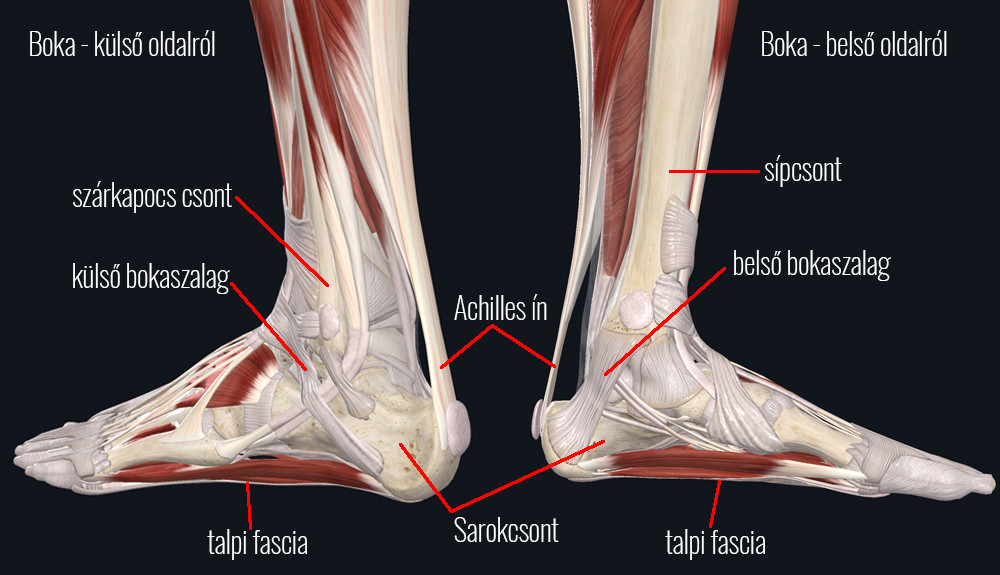
Possible causes of ankle pain
Ankle pain can be caused by the bones, ligaments and tendons that form the ankle, or by various types of inflammation.
Causes of ankle pain may include:
- Achilles tendon inflammation (tendinitis)
- Achilles tendon rupture
- Avulsion fracture (at the bone attachment site the muscle or tendon pulls off a small piece of the bone)
- Ankle fracture (fracture of the bones forming the ankle)
- Bursitis (inflammation of a bursa)
- Gout (arthritis associated with uric acid buildup)
- Osteoarthritis (arthritis that leads to joint deterioration)
- Osteochondritis dissecans (caused by necrosis of the bone beneath the joint cartilage due to insufficient blood supply)
- Plantar fasciitis (inflammation of the plantar fascia) (the plantar fascia is a thick sheet of connective tissue that originates on the plantar surface of the heel bone and runs forward to the toes. Its role is to absorb shock when the foot strikes the ground during walking, running and jumping, and to protect the muscles, vessels and nerves on the sole.)
- Pseudogout
- Psoriatic arthritis (arthritis associated with psoriasis)
- Reactive arthritis
- Rheumatoid arthritis (inflammatory polyarthritis)
- Septic (infection-related) arthritis
- Ankle sprain
- Stress fractures
- Tarsal tunnel syndrome, etc.

