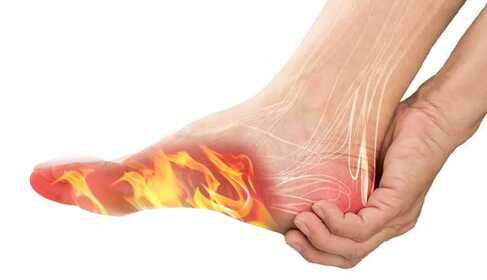
Causes of Burning Foot Syndrome
Burning foot syndrome typically causes symptoms that worsen at night. Affected people usually describe a burning, pins-and-needles type pain, most commonly located on the sole, around the ankle and sometimes on the lower leg. Although there may be no visible signs on the feet, the agonizing pain can make it impossible to sleep. Sleepless nights and days filled with suffering significantly reduce your quality of life. […]

Burning foot syndrome typically causes symptoms that worsen at night. Affected people usually describe a burning, pins-and-needles type pain, most commonly located on the sole, around the ankle and sometimes on the lower leg. Although there may be no visible signs on the feet, the agonizing pain can still torment you to the point that you cannot sleep. Sleepless nights and days full of suffering significantly reduce your quality of life. The condition is also referred to as "tingling feet" or paresthesia. It is a condition that is often difficult to eliminate.
Everyone reports a different type of pain, and clinical examinations often reveal little or no detectable structural abnormality. Pain perception is subjective and individual, and there is no objective method to measure it, so each person experiences it differently.
Possible causes of burning foot syndrome
In most cases no single trigger can be identified. It is most often described as a consequence of some form of nerve damage (peripheral neuropathy). Nerve damage can be caused by many factors, for example diabetes, chronic alcoholism, certain medications, poisons, severe B-vitamin deficiency or HIV infection. But fatigue or a fungal infection of the skin can also cause it.
Alcoholism
Alcohol is a powerful "nerve toxin." When consumed excessively and over a long period, it directly damages nerve cells (among other cell types). Alcoholics often neglect proper nutrition, so deficiency diseases such as vitamin deficiencies are common and can worsen the damaging effects.
Charcot-Marie-Tooth disease
A group of inherited disorders that cause nerve damage. This damage mainly affects the arms and legs (peripheral nerves). It is also called hereditary motor and sensory neuropathy.
It results in smaller and weaker muscles, sensory and muscle contraction disturbances, and walking difficulties. Foot deformities such as claw toes and high arches are also common. Symptoms usually begin in the feet and lower legs but can progress to affect the hands and arms over time.
Symptoms usually appear in adolescence or early adulthood, but they can also develop in middle-aged adults.
Diabetic neuropathy
Nerve damage that develops as a result of long-standing diabetes. High blood sugar (glucose) can damage nerves throughout the body, but most commonly it destroys the nerves in the legs and feet.
Depending on which nerves are affected, symptoms can range from pain and numbness in the legs and feet to problems with the digestive system, urinary tract, blood vessels and heart. In some people the symptoms are mild, while in others they can be extremely painful and disabling.
Diabetic neuropathy is a serious complication of diabetes and may affect up to 50% of people with diabetes. The problem can be prevented or at least slowed. This requires keeping blood glucose within the normal range, which depends on consistent and healthy lifestyle choices.
Medication-induced neuropathy
Certain medications can also cause nerve damage as a side effect.
- Heart or blood pressure medications, e.g. Amiodarone, Hydralazine
- Anticancer (chemotherapy) agents, e.g. Cisplatin, Suramin, Vincristine
- Drugs used to treat infections, e.g. Chloroquine, Isoniazid (INH), Metronidazole (Flagyl), Nitrofurantoin, fluoroquinolone or quinolone antibiotics (e.g., Savulin)
- Medications used to treat autoimmune diseases, e.g. Etanercept (Enbrel), Leflunomide (Arava)
- Drugs used to treat epileptic seizures, e.g. Carbamazepine, Phenobarbital
- Medications to deter alcohol intake, e.g. Disulfiram
- HIV/AIDS medications, e.g. Didanosine (Videx), Emtricitabine (Emtriva), Stavudine (Zerit), Tenofovir and emtricitabine (Truvada)
- Other drugs and substances, e.g. Colchicine (used for gout), Arsenic, Gold
HIV/AIDS
Acquired immunodeficiency syndrome (AIDS) is a chronic, potentially life-threatening condition caused by the human immunodeficiency virus (HIV). By damaging the immune system, HIV impairs the body's ability to fight infections and diseases. HIV is a sexually transmitted infection (STI). It can also be transmitted by contact with infected blood or from mother to child during pregnancy, childbirth or breastfeeding. Without treatment, it can take years for HIV to weaken the immune system sufficiently to progress to AIDS.
There is no cure, but medications can dramatically slow disease progression. These drugs have reduced AIDS-related mortality in many developed countries.
Hypothyroidism (underactive thyroid)
The thyroid gland does not produce enough of certain vital hormones.
In its early stages it may not cause noticeable symptoms. Over time, untreated hypothyroidism can lead to many health problems, such as weight gain, joint pain, infertility and heart disease.
Accurate thyroid function tests are available for diagnosis. Treatment with synthetic thyroid hormone is usually simple, safe and effective once you and your doctor find the correct dosage.
Chemotherapy
A drug treatment that uses potent chemicals to kill rapidly dividing cells in the body. It is used to treat malignant tumors because cancer cells grow and multiply much faster than most normal cells.
There are currently many different chemotherapy drugs available, which can be used alone or in combination to treat a wide range of cancers.
Although chemotherapy is effective against many types of cancer, the therapy can also have side effects. Some side effects are mild and manageable, while others can cause serious complications.
Complex regional pain syndrome
A chronic pain condition resulting from dysfunction of the nervous system. It usually affects a part of an arm or leg. It generally develops after an injury, surgery, stroke or heart attack. The pain is disproportionate to the severity of the original injury.
It is not common, and its exact cause is not clearly understood. Treatment is most effective when started early. In such cases improvement or even remission is possible.
Chronic kidney disease
A progressive decline in kidney function; severe cases lead to kidney failure.
The kidneys filter waste products and excess fluid from the blood, which are then excreted in the urine. They help produce hormones to stimulate red blood cell production and convert vitamin D into its active form so it can be used by the body. Advanced chronic kidney disease can cause dangerous accumulations of fluid, electrolytes and waste products.
In the early stages there may be few signs or symptoms. You may only become aware of kidney disease once it is advanced.
Treatment focuses on slowing the progression of kidney damage, generally by addressing the underlying causes. However, even this may not always prevent further kidney damage. Chronic kidney disease can progress to end-stage renal failure, which is fatal without artificial filtration (dialysis) or a kidney transplant.
Chronic kidney disease is very common. In Hungary, about one million people have this problem, and 600,000 adults have kidney function below 60 percent. The magnitude of reduced kidney function is roughly comparable to that of diabetes: this problem is therefore also considered a public health issue. The prevalence of kidney disease causing reduced kidney function is increasing worldwide, mainly because its main causes — obesity and diabetes — are becoming more common, especially among older people.
Athlete's foot (tinea pedis)
A fungal skin infection that usually begins between the toes, causing cracked, dry, scaly skin. It can spread to the sole and sides of the foot. It typically occurs in people whose feet sweat a lot and who are forced to wear closed shoes for long periods.
Signs and symptoms include itchy, scaly rashes that may sting or burn. The condition is contagious and can spread via infected floors, towels or clothing (for example, gym locker-room showers are common places where it can be transmitted).
Athlete's foot is closely related to other fungal infections, such as infections of the groin and genital area, and superficial fungal infections of the neck, limbs and trunk that occur on so-called sebaceous skin areas. It is treatable with antifungal medications, but infections often recur.
Tarsal tunnel syndrome
Tarsal tunnel syndrome is numbness and pain caused by compression of the tibial nerve in the region of the lower leg, ankle and sole of the foot. The problem arises from a "tunnel" or canal through which the tibial nerve passes at the ankle. Here the nerve can be compressed by other structures (tendons, bones).
Vitamin deficiency
Deficiency of vitamin B12 and folate causes a reduction in healthy red blood cells (anemia). It can occur if you do not eat enough foods containing B12 and folate or if absorption or processing of these vitamins is impaired for some reason. In such cases overly large red blood cells are produced that do not function properly, reducing their oxygen-carrying capacity.
Symptoms may include fatigue, shortness of breath, dizziness and sensory disturbances. Vitamin supplementation can correct the deficiency.
The diseases and conditions listed above are often associated with the burning foot phenomenon.
When should you see a doctor?
Because pain perception is subjective and individual, diagnostic tests in the clinic often show little or nothing. Some methods (e.g., EMG) can examine the function of large nerve fibers. Your muscles and reflexes may function normally because these depend on the function of large fibers.
However, seek urgent medical attention if:
- the burning sensation in your foot started suddenly, especially if you were exposed to some toxin (poison) or it began after taking a new medication for the first time.
- an open wound on your foot appears to be infected, especially if you have diabetes.
Finding the cause is important because knowing it allows for effective treatment. Make an appointment for evaluation if
- your feet have been "burning" for several weeks,
- you notice the symptoms are becoming more intense and painful,
- you feel the burning sensation starting to spread up your leg,
- your toes or feet are becoming numb.