
Neurological causes
The most common cause of spasticity is damage to the central nervous system. This can be a consequence of a stroke (brain hemorrhage or cerebral infarction), spinal cord injury, or damage caused by multiple sclerosis. Traumatic brain injury, brain tumors, or perinatal oxygen deprivation (cerebral palsy) can also lead to spasticity.
As a result of nervous system injuries, normal communication between the brain and muscles is disrupted. The brain can no longer properly regulate muscle tension, which leads to persistent overactivity.
Conditions most commonly causing spasticity
In clinical practice, the following conditions most often cause spasticity:
Stroke (brain hemorrhage/cerebral infarction): Post-stroke spasticity is the most common form and affects 20–40% of patients. It usually develops 1–6 weeks after the stroke and mainly affects the muscles on the affected side.
Cerebral palsy: The result of brain damage at birth or in early childhood, causing lifelong spasticity. About 80% of children with cerebral palsy exhibit spasticity to varying degrees.
Multiple sclerosis (MS): In this autoimmune disease the myelin sheath is damaged, leading to gradually developing spasticity. Spasticity occurs in 60–84% of people with MS.
Spinal cord injury: Spasticity develops as a consequence of traumatic or disease-related spinal cord damage. It affects muscles below the level of injury and often causes severe spasticity.
Traumatic brain injury: Spasticity often develops after brain damage from accidents, especially when the motor cortex is affected.
Myotonic dystrophy: An inherited muscle disease that causes progressive muscle weakness and spasticity.
Hereditary spastic paraplegia: A genetic disorder that primarily affects the leg muscles, causing progressively worsening spasticity.
Effect of lifestyle factors in different conditions
Although the underlying cause of spasticity is neurological, your lifestyle can significantly influence the severity of symptoms in all the mentioned conditions. Lack of regular movement further increases muscle stiffness, while poor posture and stress raise muscle tension. Sleep deprivation and inadequate nutrition can also worsen the condition.
For post-stroke patients, early mobilization and physical therapy can significantly reduce the risk of developing spasticity. In children with cerebral palsy, regular physiotherapy and activity can maintain range of motion. In multiple sclerosis, temperature control is particularly important because heat often worsens symptoms.
Daily activity level plays an especially important role. If you remain immobile for long periods, the muscles stiffen even more and spasticity can worsen. Therefore, regular, targeted movement and therapy are of great importance in every condition that causes spasticity.
How to recognize the symptoms of spasticity?
The symptoms of spasticity develop gradually and can appear in varied forms. The most characteristic sign is continuous muscle tightness, particularly noticeable in the arms and legs. This tightness does not go away with rest and may even worsen with stress or fatigue.
During movement you may notice that your muscles resist your intentional movements. Walking becomes strange, steps uneven, often with a "scissoring" character. For the arms, fine motor tasks like writing or using cutlery become difficult.
Muscle cramps are also common, appearing suddenly and painfully. These cramps can be particularly disturbing at night or during rest. Spastic muscles are sensitive to temperature — cold generally increases symptoms while heat can relieve them.
Important to know: Spasticity is not the same in every patient. For some it affects only certain muscles, while for others it causes generalized stiffness. Symptom severity can also vary from day to day.
Overview of medical treatment options
Medical treatment combines several methods to effectively reduce spasticity. Pharmacotherapy primarily uses muscle relaxants that decrease excessive muscle tension. Commonly used medications include baclofen, tizanidine and diazepam.
In more severe cases, botulinum toxin injections can be used to provide localized muscle relaxation. This can be particularly effective when only specific muscles are affected. The effect typically lasts 3–6 months, so regular repetition is required.
Physiotherapy and therapeutic exercise are a fundamental part of every spasticity treatment plan. Professionals teach specific stretching and strengthening exercises that help maintain range of motion and reduce muscle stiffness.
Lifestyle changes to ease spasticity
Daily movement and activity
Regular exercise is perhaps the most important tool in the fight against spasticity. You don't need to overdo it, but even short daily activities can help a lot. The key is consistency: it's better to do 15–20 minutes of targeted exercises daily than one hour once a week.
Stretching exercises are especially useful. Perform them slowly and in a controlled manner, holding each stretch for 20–30 seconds. Applying warm water or warm packs before stretching can make the exercises more effective.
Stress management and relaxation
Stress can significantly increase spasticity, so it's important to learn appropriate relaxation techniques. Progressive muscle relaxation, where you consciously tense and then relax your muscles, can be particularly helpful. Breathing exercises and meditation can also help reduce overall tension.
Establishing a calm daily routine is important. Regular sleep times, balanced nutrition and adequate fluid intake all contribute to symptom relief.
Optimizing environmental factors
Your environment also affects spasticity. Keep your home warmer, especially in winter, because cold increases muscle tension. Wear comfortable, non-restrictive clothing that does not impede circulation.
Ergonomics at work and home are also important. If you sit a lot, ensure proper back support and a footrest. Avoid staying in the same position for long periods.
NMES therapy - The home treatment revolution
What is NMES and how does it work?
Neuromuscular Electrical Stimulation (NMES) is a therapeutic method that uses electrical impulses to stimulate muscles. This technology allows muscles to be activated externally, bypassing damaged nerve pathways.
An NMES device sends controlled electrical signals to muscles through electrodes. These signals mimic the nervous system's natural impulses, causing muscle contractions. By adjusting different frequencies and intensities, various therapeutic effects can be achieved. A comprehensive meta-analysis found that NMES significantly improves daily living functions after stroke, especially when used in the subacute phase.
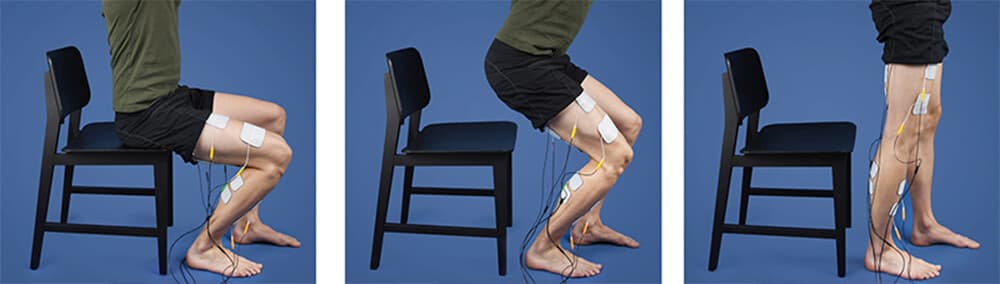
Placement of NMES electrodes for treating spastic muscles - correct positioning is crucial for effective therapy
NMES frequencies and their effects on spasticity
The effectiveness of NMES therapy largely depends on the frequency used. Low frequencies (1–10 Hz) primarily have a relaxing effect, helping to reduce muscle tension and improving blood circulation in the affected area. A systematic review found that the combination of NMES and rehabilitation training is significantly more effective than conventional treatment in reducing spasticity.
Medium frequencies (20–50 Hz) provide an excellent balance between relaxation and mild muscle strengthening. These frequencies are particularly useful in spasticity because they help "reprogram" the muscles, reducing excessive tension. Meta-analyses demonstrate that electrical stimulation significantly reduces spasticity in post-stroke patients.
Higher frequencies (50–100 Hz) are more aimed at muscle strengthening, but they should be used cautiously in spasticity as they may increase muscle tension. A randomized clinical trial showed that 35 Hz stimulation was more effective at improving functional independence in post-stroke patients than 50 Hz.
Scientific background: Research indicates that the 35–40 Hz frequency range is most effective for reducing spasticity after stroke. Lower frequencies (below 40 Hz) primarily target slow-type (type I) muscle fibers, which are a preferable choice in spasticity. This range optimally stimulates motor neurons without causing excessive tension.
Types of home NMES devices and how to choose
Today there are many NMES devices suitable for home use. The simplest models offer basic pulse patterns, while advanced devices have programmable protocols and multi-channel stimulation.
When choosing, consider the size and number of areas to be treated. If you want to treat only small muscles, a 2 channels device may be sufficient. For larger areas or simultaneous treatment of multiple muscle groups, 4- or 8-channel devices are recommended.
An important feature is wide frequency adjustability and precise intensity control. For spasticity it is particularly useful if the device has pre-programmed spasticity-reducing protocols. According to Canadian physiotherapist expert recommendations, the 20–50 Hz frequency range is most effective in NMES therapy.
Devices recommended for treating spasticity
Among the devices particularly recommended for spasticity treatment is the Myolito multifunctional electrotherapy device, which includes TENS, EMS and FES programs and is specifically suitable for treating muscle spasticity. The two-channel system allows the simultaneous treatment of several muscle groups.
For beginners the Rehalito muscle stimulation device is excellent; it has a simple user interface and was developed specifically to treat muscle pain and stiffness. It is particularly effective for neck muscle tension caused by stress and for heavy leg symptoms.
For more advanced users the Premium 400 multifunctional electrotherapy device offers a comprehensive solution. Its four-channel system, programmable protocols and wide frequency range allow precise and effective treatment of spasticity. The device includes TENS, EMS, FES and iontophoresis programs.
For professional and experienced users the Genesy 1500 multifunctional electrotherapy device represents the most advanced solution. This device also has special programs for denervated muscle treatment, which is particularly useful in severe peripheral neurological damage.
Practical application guide
Using NMES therapy at home is relatively simple, but it is important to follow some basic principles. Always start at a low intensity and gradually increase until you feel a pleasant but noticeable muscle contraction. The devices sold by MediMarket all include detailed Hungarian language manuals to help with correct use.
Treatment sessions typically last between 15 and 30 minutes. As a beginner, use it once a day; later — if you tolerate it well — you can treat up to twice daily. It is important to allow at least 4–6 hours between two sessions. Stimulator devices have automatic timers to help ensure the correct treatment duration.
Electrode placement is crucial for effectiveness. Place the electrodes at the two ends of the treated muscle, preferably following the muscle orientation. Ensure the electrodes do not touch each other and that the skin is clean and dry before application. The self-adhesive electrodes available for the devices are reusable and with proper storage can be used 20–30 times.
Safety warning: Never apply NMES over the heart area, during pregnancy, or if you have a cardiac pacemaker. Avoid application on damaged skin and sensitive areas (neck, head). A systematic review on hospital patients indicates that NMES is generally safe but certain precautions are necessary.
Combined treatment approach
You will achieve the best results when NMES therapy is combined with other treatment methods. Supplementing conventional physiotherapy exercises with NMES can significantly improve treatment effectiveness. Recent studies show that combining NMES and botulinum toxin is even more effective for functional improvement in children with cerebral palsy.
A useful combination is NMES applied after a warm-water bath, followed by gentle stretching exercises. Heat helps relax the muscles, NMES further reduces tension, and stretching helps maintain the increased range of motion.
Combining massage and NMES can also be effective. First perform a gentle massage on the treated area, then apply NMES, and finish with a short massage after the session.
Summary and future outlook
What to expect from medical treatment?
In medical treatment you can primarily expect symptom relief and improved functionality. Drug therapy usually takes effect within 2–4 weeks, while botulinum toxin injections can work faster (but their effect lasts only a few weeks to months). Results vary by individual, but most patients experience significant improvement.
With the help of a physiotherapist you can learn techniques and exercises to use at home. This is key for long-term maintenance of improvements and preventing further deterioration.
Your role in the recovery process
Your active participation is indispensable for successful spasticity treatment. In addition to medical therapy, regular home therapy, lifestyle modification and a positive attitude all contribute to better outcomes.
Home use of NMES therapy can be a particularly valuable complement to treatment. With regular use — usually after 4–6 weeks — you may notice reduced muscle tension and easier movement. Choosing the right NMES device and using it properly can significantly speed up the rehabilitation process.
It is important to form realistic expectations. Treating spasticity is a long-term process that requires patience and persistence. Small steps and gradual improvements are typical rather than sudden, dramatic changes. The MediMarket experts provide ongoing advice on optimal device use.
When to see a doctor and what to watch for
Contact your doctor immediately if spasticity suddenly and significantly worsens, or if new symptoms appear such as severe pain, redness or swelling. Specialist consultation is also important if you do not see improvement after 6–8 weeks despite home treatments.
During NMES treatment pay attention to skin reactions. If persistent redness, itching or pain occurs, reduce the intensity or pause the treatment. Always listen to your body and do not overexert the treatment.
Contraindications and risks: NMES therapy is generally safe, but caution is needed in certain cases. Consult a doctor before starting treatment in the presence of platelet disorders, severe cardiovascular disease, or acute inflammatory conditions. During pregnancy and in children under 18, use only under medical supervision.
Treating spasticity is a complex process that includes medical treatment, lifestyle changes and home therapy. NMES technology offers significant opportunities for symptom relief at home, but it should always be combined with other treatments for the best results. Patience, persistence and professional support together can lead to regaining quality of life.
Professional sources and further reading
The information in this article is based on the latest scientific research. For more detailed information we recommend studying the following professional sources:
- NMES effectiveness on daily functions after stroke - systematic review
- Effects of electrical stimulation on spastic muscles after stroke - PubMed
- 35 Hz vs 50 Hz frequency comparison in hand motor rehabilitation
- NMES clinical practice recommendations - Canadian expert consensus
- NMES professional guide - Physiopedia
- Professional NMES devices for spasticity treatment - MediMarket
The MediMarket expert team provides continuous support in selecting and using NMES devices. Detailed advice and educational materials are available to every purchaser.

