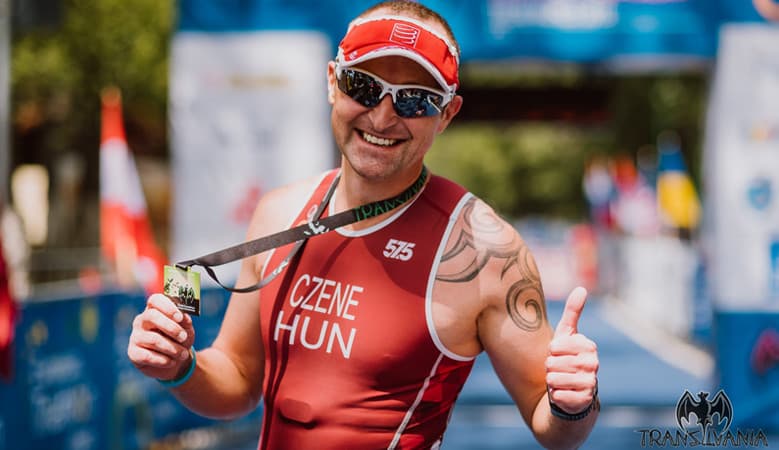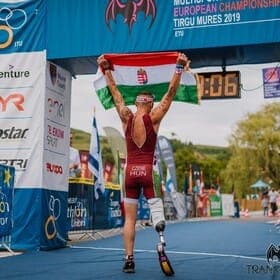
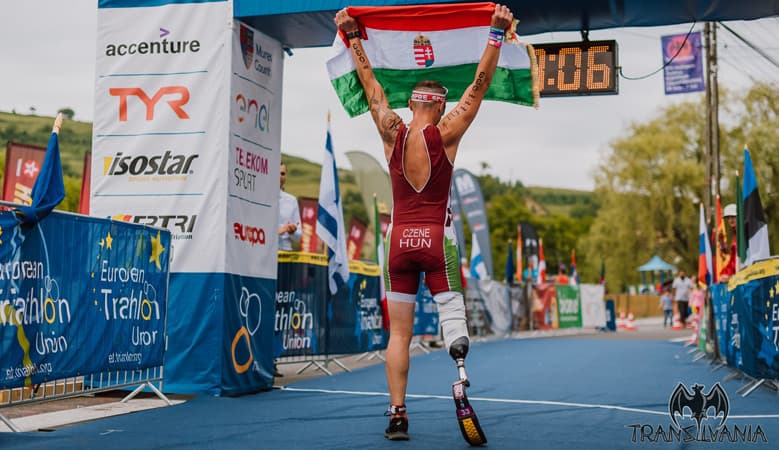
Championship title 4 months after vertebral fracture – Gábor Czene, paratriathlete
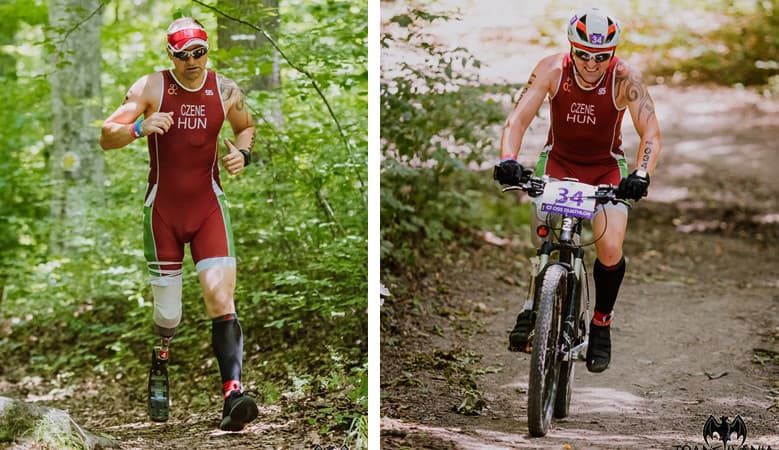
Gábor Czene lost his right leg in a road motorcycle accident at the age of 25. For years he believed that was the limit of his mobility and sport. But things turned out differently....
After learning to use a standard prosthetic leg successfully, he received a special running prosthesis. The device proved so effective that he started running, cycling and eventually triathlon. After achieving smaller goals he tackled the ExtremeMan triathlon (this race begins with a 3,800-meter swim, followed by 180 km of cycling and finishes with a marathon distance run of 42 km).
The respect that poured in after his successful completion made him realize his true mission: “I want to help people who lost a limb, amputees, to give them inspiration, an example — someone from among them who can tell them what to expect. My mission is to support my fellow sufferers,” he said.
But the trials did not end there… In September he crashed while cycling and suffered a cervical vertebra fracture. He lay immobilized for months in a collar, watching in fear as his unused muscles atrophied and as his goals drifted away in every area of life. He contacted me in February this year, and barely 4 months later he won a championship title! Can you believe it?
Dr. Zátrok Zsolt (ZZs): What made you reach out to me?
Gábor Czene (GC): After the accident I had already exhausted the rehabilitation treatments covered by the state health insurance. "That's the maximum amount you can be prescribed" they said, even though my condition still didn't allow me to move.
I couldn't even move my neck; my neck muscles were tense, painful and stiff. I just watched idly as my thigh muscles slowly "disappeared."
I have a training partner who was already using the Triathlon Pro device at the time and drew my attention to it. I looked it up online and found your blog and your articles about muscle stimulation. I thought it might speed up my rehabilitation. That's when I wrote to you.
ZZs: When we first met you did not seem very cheerful and your self-confidence was not fully intact.
GC: That's true. I thought a lot about things. I was afraid to take off the cervical collar because I feared further injury. Meanwhile the Paralympic Association informed me that I had been selected for the national team preparing for the Paralympics.
Imagine the situation... you're lying in bed, unable to move, and they're dangling opportunities in front of you. A string of once-in-a-lifetime possibilities… national selection… training camps… trips to distant places… World Cup races and more challenges. I could barely turn for my phone.
On top of that I wanted to return to my workplace as soon as possible, where tasks and the trust of my leaders were also waiting for me.
The treating doctors only gave me empty promises, but nothing changed on its own.
ZZs: We agreed to proceed step by step. We started with the biggest problem: relaxing and strengthening your neck muscles. You used a Triathlon Pro sports electrostimulation device regularly. What did you experience?
GC: I followed your advice. In the first treatments I wasn't very professional, but I took pictures and sent them to you. Based on those you told me what to correct. After initial uncertainty I slowly got the hang of it. The stiffness in my neck eased very quickly, and as my postural strength began to return, I could very soon start training. That's when the second phase came…
ZZs: You mean strengthening the thigh muscles?
GC: Yes. As I began to feel the effect on my neck, it also motivated me to "bring back" my thigh muscles.
ZZs: How successful has that been?
GC: Well, I don't think that in February, when we started working together, I would have put money on the idea that four months later I would stand on top of the national podium in both triathlon and duathlon, take part in a World Cup race and even win an international competition in my category.
But that's what happened. I can hardly believe it became reality. Muscle stimulation played a big role in this; perhaps most importantly it helped me regain my self-confidence. Day by day I felt myself regaining strength with its help. I was able to prepare more intensely and more effectively. It was clearly a help.
ZZs: You still use the device regularly. What are your favorite programs and what do you mainly use it for?
GC: Post-workout recovery. That's very effective. I recover from load significantly faster if I use a recovery program after training. Even on the day right after heavy load I can train much more intensely than before.
Also, for me it is particularly important to increase the strength of the thigh muscles of my amputated leg. Without lower-leg and calf muscles I can only use my thigh muscles for running and cycling. Healthy athletes can increase thigh strength with weighted squats. I cannot do that with my injured leg. Therefore it is especially important for me to use strength-building stimulation for the quadriceps and hamstrings. Beyond recovery, this is what I regularly use it for.
ZZs: Which race are you preparing for now?
GC: I'd like to complete the ExtremeMan again, but this time in a two-person relay. The start is only a few weeks away. Besides that, the upcoming World Cup races are on the schedule.
Zátrok Zsolt: Good luck in your races! Thank you for sharing your story!
Gábor Czene: Thank you for your help!
Gábor Czene uses a Triathlon Pro device in his preparation