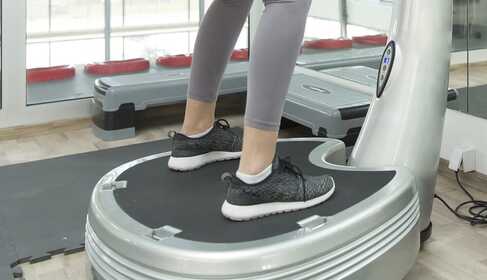
Contraindications for the Use of Vibration Trainers
Vibration trainers are very popular because they can work the muscles thoroughly in a short time with almost no sweating. They are excellent at any age, and regular vibration training is especially beneficial for older adults. But when should they not be used? In recent times several research groups have examined the effects and contraindications of whole-body vibration therapy. I wrote about the favorable effects on health in a previous article, and now I have summarized the contraindications.

Vibration trainers are very popular because they can work the muscles thoroughly in a short time with almost no sweating. They are good at any age, and regular vibration training is particularly beneficial in older age. But when should they not be used? Recently several research groups have investigated the effects and contraindications of whole-body vibration therapy. I wrote about the favorable effects on health in a previous article, and now I have compiled the contraindications.
Briefly about the effects of vibration
Like physical activity, whole-body vibration activates the bone receptors and stimulates bone formation. The movement of the vibrating plate triggers a "tonic vibration reflex." During vibration this reflex is continuously active and alternately causes contraction and relaxation of muscles on one side and then the other. Consequently, the effect on muscles is direct, while bones respond indirectly to the forces produced by muscle contractions. Whole-body vibration has been shown to modify testosterone and growth hormone levels (3, 4). By increasing hormonal activity it stimulates muscle and bone building.
Combining exercise with vibration may produce greater improvements in muscle strength and bone structure than exercise alone.
Main parameters of vibration
- Direction of the vibration
- Vibration frequency (Hz)
- Amplitude, i.e. platform displacement. It indicates how much movement occurs in each direction (in millimeters). The magnitude of the vibratory stimulus is a combination of amplitude and acceleration.
- Acceleration. It indicates how fast the displacement and reflex movement occur. Higher acceleration elicits stronger reflex contractions.
- Duration of vibration (training time)
- Body position / posture on the platform. Standing with straight, stiff knees places greater load on the knee, hip and spinal joints. Standing with bent knees reduces the load on the joints.
Only those vibration devices on which you can stand have physiological effects. Devices intended for seated use without a handhold may feel pleasant, but they have no physiological effect.
Direction of the vibration
There are many vibration devices on the market that provide two types of vibratory stimulus.
- Unidirectional (vertical) displacement. Such platforms tilt side to side. The movement is uniform.
- Variable-direction (oscillating) displacement. The vibrating plate vibrates in changing directions around its center. This movement is non-uniform and better simulates the loads that affect the body during walking.
There is currently insufficient data to decide whether a tilting or oscillating platform is preferable. (1)
Vibration frequency and amplitude
- The frequency of the vibration platform is adjustable on most devices.
- Low frequencies below 20 Hz can disrupt the function of internal organs. (1) Do not use low vibration frequencies!
- Frequencies above 70 Hz have been shown to cause muscle damage. (1)
- Improvements in muscle strength and muscle mass have been observed with frequencies of 25–45 Hz. (1, 3, 11–19).
- The frequency range between 20 and 70 Hz is the medically recommended, safe zone.
Contraindications for whole-body vibration
Manufacturers of the equipment have identified many contraindications to vibration therapy. Their general recommendation is that whole-body vibration is not advisable in the following conditions.
These are recommendations and relative contraindications. Determining whether it is safe in your case is the physician's responsibility. One must weigh the expected benefits against the possible risks. If the balance favors benefits, the treatment may be performed cautiously. In other cases it is better to avoid it because of potential adverse effects.
- Kidney stones or gallstones. Vibration can dislodge stones, causing colic and possibly requiring surgery.
- Pregnancy. Vibration can trigger uterine contractions, which may cause miscarriage or premature labor.
- Epilepsy. Vibration may trigger seizures in susceptible individuals.
- Active malignancy
- Presence of a pacemaker
- Untreated orthostatic hypotension. (If your blood pressure drops when standing and you are prone to fainting, you could lose consciousness on the platform and injure yourself.)
- Recent implants (joint/cornea/cochlear, etc.). An implant that has not yet fully ossified may become displaced. If the implantation is more than 100–120 days old, it should no longer be able to shift.
- Recent surgery. Exercising too early can cause wound dehiscence. If the surgery was more than 100–120 days ago, the wounds have reached their final state and vibration should pose no risk.
- Recently placed intrauterine devices or clips.
- Acute thrombosis, recent hernia, acute joint inflammation (e.g., rheumatoid arthritis).
- Severe cardiovascular disease (heart failure, cardiomyopathy, etc.)
- Certain forms of arrhythmia
- Severe diabetes with peripheral neuropathy. Because sensory nerves are damaged, the reflex response to vibration does not work, increasing the risk of falling and accidents from the platform's motion.
- Migraine (6–8).
- Inner ear disorders. Vibration can increase dizziness and headache.
- In severe osteoporosis, strong muscle contractions may cause spontaneous bone fractures or loosening of metal implants or screws. (20)
Medical studies related to vibration training
- Totosy de Zepetnek JO et al. Whole-body vibration as potential intervention for people with low bone mineral density and osteoporosis: A review JRRD Vol 46, No. 4 2009 pg 529-542
- De Gail P, Lance JW, Neilson PD. Differential effects on tonic and phasic reflex mechanisms produced by vibration of muscles in man. J Neurol Neurosurg Psychiatry. 1966; 29(1): 1–11
- Bosco C, Iacovelli M, Tsarpela O, Cardinale M, Bonifazi M, Tihanyi J, Viru M, De Lorenzo A, Viru A. Hormonal responses to whole-body vibration in men. Eur J Appl Physiol. 2000; 81(6):449–54.
- Kvorning T, Bagger M, Caserotti P, Madsen K. Effects of vibration and resistance training on neuromuscular and hormonal measures. Eur J Appl Physiol. 2006;96(5):615–25.
- Rubin C, Pope M, Fritton JC, Magnusson M, Hansson T, McLeod K. Transmissibility of 15-hertz to 35-hertz vibrations to the human hip and lumbar spine: Determining the physiologic feasibility of delivering low-level anabolic mechanical stimuli to skeletal regions at greatest risk of fracture because of osteoporosis. Spine. 2003; 28(23): 2621–27.
- Whole Body Advanced Vibration Exercise [Internet]. Windsor (Canada): WAVE Manufacturing Inc; c2009 [updated 2009; cited 2008 Apr 1]. Available from: http://www.wavexercise.com/.
- VibraFlex [Internet]. Naples (FL): Orthometrix, Inc; c2006–9 [updated 2009 Jun 1; cited 2009 Jan 15]. Available from: http://www.vibraflex.com/.
- TurboSonic [Internet]. Hood River (OR): TurboSonic USA; c2007–8 [updated 2008; cited 2009 Jan 15]. Available from: http://www.turbosonicusa.com/.
- Galileo: Whole Body Vibration [Internet]. Hornsby Heights (Australia): Novotec Medical; c2008 [updated 2008 Mar 11; cited 2009 Jan 17]. Available from: http://www.galileowholebodyvibration.com.au/.
- Juvent [Internet]. Somerset (NJ): Juvent Medical, Inc; c2007 [updated 2007; cited 2009 Jan 17]. Available from: http://www.juvent.com/.
- Delecluse C, Roelants M, Verschueren S. Strength increase after whole-body vibration compared with resistance training. Med Sci Sports Exerc. 2003;35(6):1033–41.
- Bosco C, Cardinale M, Tsarpela O. Influence of vibration on mechanical power and electromyogram activity in human arm flexor muscles and whole body vibration therapy contraindications. Eur J Appl Physiol Occup Physiol. 1999;79(4):306–11.
- Bosco C, Colli R, Introini E, Cardinale M, Tsarpela O, Madella A, Tihanyi J, Viru A. Adaptive responses of human skeletal muscle to vibration exposure and whole body vibration therapy contraindications. Clin Physiol. 1999;19(2):183–87.
- Kerschan-Schindl K, Grampp S, Henk C, Resch H, Preisinger E, Fialka-Moser V, Imhof H. Whole-body vibration exercise leads to alterations in muscle blood volume. Clin Physiol. 2001;21(3):377–82.
- Abercromby AF, Amonette WE, Layne CS, McFarlin BK, Hinman MR, Paloski WH. Variation in neuromuscular responses during acute whole-body vibration exercise. Med Sci Sports Exerc. 2007;39(9):1642–50.
- Torvinen S, Kannus P, Sievänen H, Järvinen TA, Pasanen M, Kontulainen S, Järvinen TL, Järvinen M, Oja P, Vuori I. Effect of four-month vertical whole body vibration on performance and balance. Med Sci Sports Exerc. 2002; 34(9):1523–28.
- Torvinen S, Kannus P, Sievänen H, Järvinen TA, Pasanen M, Kontulainen S, Nenonen A, Järvinen TL, Paakkala T, Järvinen M, Vuori I. Effect of 8-month vertical whole body vibration on bone, muscle performance, and body balance: A randomized controlled study. J Bone Miner Res. 2003;18(5):876–84.
- Roelants M, Delecluse C, Goris M, Verschueren S. Effects of 24 weeks of whole body vibration training on body composition and muscle strength in untrained females. Int J Sports Med. 2004;25(1):1–5.
- Torvinen S, Kannu P, Sievänen H, Järvinen TA, Pasanen M, Kontulainen S, Järvinen TL, Järvinen M, Oja P, Vuori I. Effect of a vibration exposure on muscular performance and body balance and whole body vibration therapy contraindications. Randomized cross-over study. Clin Physiol Funct Imaging. 2002;22(2):145–52.
- Craven BC. Effectiveness of vibration and standing versus standing alone for the treatment of osteoporosis for people with spinal cord injury. http://clinicaltrials.gov/, NCT00150683; 2001.
- Slatkovska L, Alibhai SMH, Beyene J, Cheung AM, editors. The efficacy of whole-body vibration in reducing bone loss in postmenopausal women: A meta-analysis. Proceedings of the ASBMR 30th Annual Meeting; 2008 Sep 12–16; Montreal, Canada. Washington (DC): ASBMR.