
Rehabilitation after Covid-19 infection
Coronavirus (COVID-19) infection can cause serious respiratory, physical and psychological dysfunction in affected patients. It is increasingly clear that recovery can be prolonged and difficult even after moderately severe illness. For this reason, returning people who have had the disease to a normal life rhythm — that is, COVID rehabilitation — is receiving growing attention. Rehabilitation often begins in hospital, but most of it takes place after discharge at home. Since you or your relatives may be affected, it is worth knowing the available options.
The primary symptoms of COVID-19 infection are fever, cough, shortness of breath and muscle pain (myalgia). In mild cases the illness "gets by" with these symptoms. After a few days the symptoms lessen and resolve.
In severe cases the symptoms can deteriorate rapidly. Due to bilateral lung involvement, breathing may "collapse" and acute respiratory distress syndrome (ARDS) can develop. Fibrinous secretions form in the lung air sacs, and fibrin accumulation can be observed between lung cells (pulmonary interstitial fibrosis).
The virus can also cause varying degrees of dysfunction in other organs — for example the heart, liver and kidneys. These changes contribute to oxygen deficiency (hypoxemia) and to impairment of cardiopulmonary and organ functions.
What does this mean in daily life?
You will hear many different stories from people who have had the infection, although the course of illness usually follows one of the patterns below.
Some people go through the illness with only mild symptoms. It is only slightly worse than a common cold and leaves no lasting consequences.
Others have stronger symptoms. Fever knocks them down for days, they cough, but pneumonia does not develop. However, the end of symptoms does not mean the end of problems — far from it. Their former strength may not return for weeks, and a variety of complaints appear here and there. Minimal exertion is exhausting and they cannot do meaningful work. Normal activity may only resume several months after the infection.
Those who fare worst are patients hospitalized with pneumonia and who require ventilatory support. Spending weeks in intensive care, bedridden, causes muscle wasting and loss of strength. Many other functions may also be impaired. So much so that after being taken off the ventilator, even eating without assistance can be a huge challenge. It is a major success when a patient can walk from one side of the bed to the other. A friend of mine, after several weeks in intensive care, was so weakened that he literally had to relearn to walk. Months after returning home he still spends about 80% of his day in bed.
COVID is not a joke. While many survive it easily, those with more severe symptoms often regain their pre-illness state only slowly, and in some cases full recovery may not be achievable.
COVID rehabilitation
Experts agree that patients who have had COVID require rehabilitation to recover their pre-illness condition.
Rehabilitative treatments for mild and moderate infections should be started as soon as symptoms allow. In severe and critical cases, life-saving measures are of course the priority. Rehabilitation can begin once the condition has stabilized.
One important prerequisite is that peripheral oxygen saturation (SpO2) should be above 88% (measurable at home with a pulse oximeter device).
If palpitations, sweating, chest tightness or shortness of breath are present at rest, a rehabilitation program must not be started. It is the treating physician's responsibility to decide when gradual rehabilitation can begin.
- The rehabilitation program should be determined taking into account clinical symptoms, physiological parameters and imaging data, comorbidities, contraindications, etc.
- The patient needs an individualized, gradually progressive rehabilitation plan that matches their aerobic capacity, muscle strength and balance.
- Short-term goals of pulmonary rehabilitation are to relieve breathlessness, anxiety and depression; long-term goals are maximal recovery of the patient’s activity level.
- The aim is to improve performance and quality of life and to facilitate return to society (for example to regain work capacity).
- Planning and organizing rehabilitation is the responsibility of physicians and healthcare professionals. A rehabilitation specialist helps already during the hospital phase. Their role is to teach rehabilitation exercises.
- After discharge, treatments must be continued. This, however, becomes the responsibility of the patient and family members.
Main directions of rehabilitation
- Restoring endurance: These are mainly aerobic exercises such as walking, brisk walking, jogging, cycling, swimming, etc. Physical rehabilitation should start at very low intensity. Aim for 3–5 sessions per week, 20–30 minutes each. As performance improves, gradually increase both intensity and duration.
- Regaining strength: Strengthen the larger muscle groups — thighs, upper arms and shoulders, and core muscles. Use weights when training specific muscle groups. Perform 8–12 repetitions of a movement for 1–3 sets. Start with light weight and increase by about 5–10% per week. Regaining muscle strength can be accelerated with a muscle stimulation device; see my previous article.
- Balance training: If balance problems develop, perform targeted exercises to restore balance. These exercises are taught by a physiotherapist. They can be done without equipment, but some aids may be needed.
- Breathing training: If you experience shortness of breath, wheezing or labored breathing, a physiotherapist will help with body positions that aid breathing and with establishing a correct breathing rhythm, as well as with exercises to strengthen the respiratory muscles.
- Airway clearance: After COVID-19 infection (especially in patients with COPD) a significant amount of cough-inducing secretions can accumulate in the airways. It is recommended to learn and use oscillating positive end-expiratory pressure techniques. The AerobiKa OPEP device is, for example, excellent for this purpose.
AerobiKa OPEP
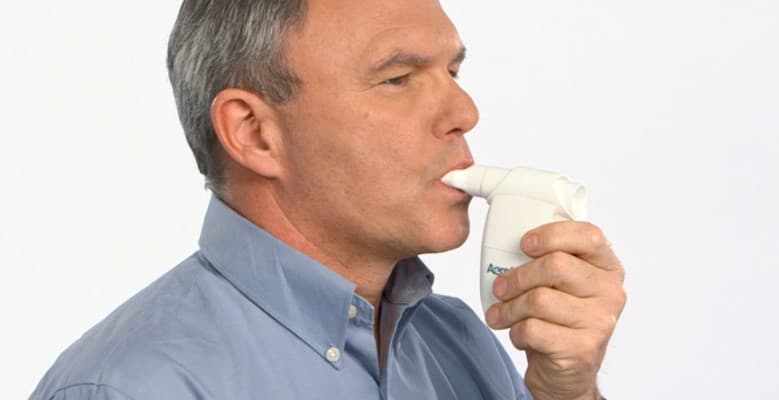
- vibration and positive end-expiratory pressure
- helps clear airway secretions
- twice daily for 5–10 minutes is sufficient
- adjunctive treatment for COPD, cystic fibrosis and prolonged pneumonia
During recovery, avoid personal contact to prevent reinfection (e.g. with other pathogens). Rehabilitation should be guided primarily via videos, printed exercise instructions or online consultation and education rather than in-person meetings.
Rehabilitation is an essential part of COVID infection management. If you were sent home from the hospital, it means the immediate life-threatening condition has been resolved, but you are not yet recovered. Much remains to be done to regain your pre-illness strength. With the help and guidance of doctors and rehabilitation professionals you must perform the exercises and training yourself. Nobody will do it for you!
Sources
- Pulmonary rehabilitation for patients with coronavirus disease 2019 (COVID-19) Lu-Lu Yang, Ting Yang
- Physiotherapy management for COVID-19 in the acute hospital setting: clinical practice recommendations. Peter Thomas, Claire Baldwin, Bernie Bissett, Ianthe Boden, Rik Gosselink, Catherine L Granger, Carol Hodgson, Alice YM Jones, Michelle E Kho, Rachael Moses, George Ntoumenopoulos, Selina M Parry, Shane Patman, Lisa van der Lee

