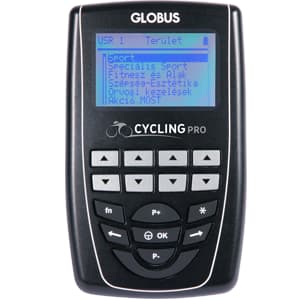
Cycling Pro sport muscle stimulator
For years the number of cyclists in our country has been steadily increasing, and with it the number of competitors. It is true for every sport that the more and harder you train, the more fatigued the muscles become and the more frequent various complaints and injuries are. Less time is left for recovery. The Globus Cycling Pro sport muscle stimulation device was made for cycling enthusiasts. Regardless of discipline, I consider it at least as important an accessory for every cyclist as a good protective helmet or shoes. Why do I think that? I'll write about it now.
Who is the Cycling Pro for?
This device was not invented for the casual cyclists who dust off the shopping bike at the weekend and pedal to the market in jeans and flip-flops to show how eco-conscious they are.
The Cycling Pro is for those who ride at least 4–5 times a week with training value (i.e., at least 60 minutes). Nowadays cycling has many branches, such as track, road, cyclo-cross, XCO, XCM, downhill, 4X, enduro, dirt, freeride, BMX, trial, indoor. The goals may differ: speed, endurance, skill, aesthetics, spectacle — but everyone has to turn the pedals. The body is stressed in similar places, primarily the leg muscles and joints, as well as the glutes, hips and lower back, and the arms and shoulder muscles can get fatigued.
The Cycling Pro is a 4-channel electrotherapy device specifically assembled for cyclists. It can be used to avoid or treat problems that make preparation harder or spoil it. These include recurring injuries, severe muscle and joint pains, slowed muscle recovery, increased muscle stiffness, rapid loss of strength after injury, etc.
The special programs form four main groups.
Goals of the muscle efficiency improvement programs
- increase strength focusing on the muscle fibres relevant to the discipline and race distance. Improving endurance, speed or sustained power requires different treatment
- reduce and delay muscle fatigue
- improve oxygen delivery capacity
- improve resistance to metabolites
- prevent joint trauma and muscle injuries and reduce risk
- improve specific strength and thereby sprint and spurt ability, as well as endurance strength needed, for example, to overcome climbs
- specific training for "supporting muscles", e.g. upper limbs or trunk muscles in mountain bikers
The injury treatment programs aim to address traumas and recurring issues such as
- relieving muscle tension in the neck area and shoulders
- promoting recovery after injuries
- alleviating muscle, joint and back pain
- treating knee inflammation
The goals of the recovery programs
- relieve post-training and post-race muscle fatigue
- accelerate the removal of lactic acid from the muscles
- reduce muscle stiffness
- prevent muscle cramps
- take the load off the neck and shoulders after long hours in the saddle
Prevention programs aim to avoid and manage cycling injuries
- stabilize the knee joint to prevent overload inflammations
- strengthen the abdominal and trunk muscles to prevent low back pain (lumbago)
Complete “toolbox”
The Cycling Pro is a powerful device that provides several types of electrotherapy treatments. These are applied to different tasks, and within each type there are many treatment programs, which makes several hundred (!) possible uses.
- TENS: pain relief treatment. Quickly relieves pain caused by muscle, tendon and ligament injuries, bruises, strains, impacts, or haematomas. Drug-free, so it is especially important because it avoids doping issues.
- EMS: muscle stimulation, intended for muscle treatment. Depending on the pulse settings it can increase muscle blood flow, promote capillarization, warm up, reduce muscle stiffness, help recover muscle strength, increase muscle mass, etc.
- Iontophoresis: using electric current to deliver a drug deep into the muscle or joint. This provides a stronger local effect since most orally taken medication is broken down and little reaches the injury site.
- Microcurrent (MENS): pain-relieving, but its main strength is in healing inflammatory processes. Excellent for quickly resolving consequences of injuries.
Think of the Cycling Pro as a healing "toolbox", full of programs that help "repair" a malfunctioning, poorly performing body. That it offers 23 different microcurrent programs is like having 23 sizes of wrench in a set. That's a large enough "selection" to address many problems.
You cannot treat the entire musculature at once with it. The device does not replace training — it is absolutely not for that! It is suitable for treating 1–2 larger joints or muscle groups at a time, meaning you can concentrate on solving a clearly defined problem.
As important as a good helmet or cycling shoes!
Consider the Cycling Pro as a technical tool that helps the effectiveness of your training, just as important as a good saddle or good shoes. Imagine how you'd fare barefoot!?
Although the muscle stimulator — with persistent use — can even improve performance, its primary role is to help maintain and restore the health of your muscles and joints so you can enjoy your favourite sport for life.
Examine what problems you have. If you are affected by any of the following, you'll find it very useful.
Typical injuries
Cyclists — whether professional or amateur — regularly encounter many complaints that can occur during training and races. Because everyone has different musculature, bone structure, etc., the occurrence and intensity of complaints vary individually. I won't list every possible issue, just the most common ones.
- Knee pain usually indicates joint overload. Often it is caused by relative weakness of the thigh muscles (i.e., weakness relative to the high load).
- Inflammation of the Achilles tendon and plantar fascia, heel spurs, piriformis syndrome: these are mostly caused by overload and neglecting recovery exercises and treatments after training.
- Back pain is surprisingly common among cyclists. Many people "just" ride and do little or no strengthening or gym work. Yet during cycling the gluteal and trunk muscles are forced to produce big forces. These must stabilise and properly support the legs for powerful pedalling. If their strength is inadequate, part of the energy of every pedal stroke is transferred to the spine and back muscles. Weak core muscles can cause back, lumbar and neck pain. This interferes with training and prevents high intensity.
- Muscle and ligament injuries mostly occur from lack of warm-up or muscle fatigue. A sudden start or gear change can overstretch a muscle fibre or ligament, causing partial or complete rupture.
- Loss of strength after injury is a natural process. If intensive training is interrupted by an injury, the body quickly breaks down unused muscle mass and strength. After a minor injury it can take months to regain strength and muscle mass. If recovery is neglected, the risk of re-injury increases.
Deployment areas of the Cycling Pro
You can use the device both for prevention and for treating existing complaints. Of course, if you know your knee often bothers you, you won't let inflammation develop from training; instead you stabilise the joint by strengthening your thigh muscles. Strong supporting muscles prevent knee pain.
Let's look at some important treatment options. Again, just a taste of the many possibilities.
Warm-up
It is especially common among amateurs to head out for training straight from work or family dinner. They close the gate, jump in the saddle and ride at race pace without any proper warm-up, making sure the "x" km/h speed is met from the first second.
An un-warmed muscle, however, is stiff. "It doesn't understand how it went suddenly from desk-side rest to the midst of a fierce race." In the first kilometres it literally fights to get the blood circulation up to the required level, to warm up to operating temperature, and to loosen its stiffness.
Tendons have even worse blood circulation than muscles, so they need more time to warm up. Since you didn't do that, tiny microtears appear in the ligaments and especially at the points where they attach to bone. This leads to overload inflammation, which is painful and prevents proper movement execution, thus disrupting the training.
A 10–20 minute muscle stimulation before training increases blood flow to the muscle and its tendons 3–8 times. It warms and makes the muscle and tendon more flexible, preparing them for high force output.
With proper warm-up you can significantly reduce the chance of injuries such as overload injuries to the knee ligaments and tendons that stabilise the kneecap, Achilles tendon and plantar fascia inflammation, piriformis syndrome, heel spurs, etc.
Accelerating muscle regeneration
After age 30 your body does not regenerate like it used to. If you train regularly, you know that after a more intense session you barely can get out of bed the next day. This and that aches, feels tight or strained.
You know that during movement the muscle itself produces the energy needed for work, but metabolites are created in the process. Accumulation of these metabolites over time causes muscle fatigue, stiffening and even pain. The longer they remain in the muscle, the worse it gets.
Most metabolites are broken down in the liver, so the sooner they get there, the sooner muscle stiffness and fatigue resolve.
The problem is that metabolites cause vasodilation, which after exercise slows blood circulation and prevents them from leaving.
Numerous studies show that muscle stimulation can increase blood flow in the treated area by up to 300%. This significantly speeds up pumping and washing out waste products from the muscle.
Therefore it reduces the amount of metabolites and, through that, muscle fatigue and stiffness more effectively than other cooldown methods. It's best to treat within 90 minutes after exercise.
Faster circulation also helps refill the muscle energy stores. A muscle treated this way will be noticeably fresher and more rested for the next session, allowing more effective training.
By improving muscle recovery you reduce stiffness and tension, thereby lowering the risk of strains, sprains and tears during the next activity.
If you haven't used a stimulator yet, try the recovery treatments first! The effect is immediately noticeable.
Developing an underperforming muscle
If your back, knee or hip hurts by the end of training, there's a good chance your trunk, thigh and gluteal muscles are not strong enough.
These muscles stabilise the areas they surround. If they are weak either absolutely or relatively, pain will appear.
You can strengthen them with weight training. But if you expose your sore back or knee to heavier loads, you will worsen the problem.
Here the muscle stimulator comes into play, allowing you to strengthen a muscle or muscle group without putting any load on the joint. With impulses in the proper frequency range you can elicit contractions without heavy weights.
Thus the stimulator can strengthen muscles in a few weeks enough so that conventional strengthening can take over the task.
Avoiding relapse
You've probably been in a situation where you suffered an injury during preparation that made training impossible for weeks.
You may have experienced that strength gains made over months evaporate in 2–3 weeks. Then it takes months again, and often the whole season is not enough to catch up.
In such cases use the Cycling Pro!
Although you cannot load the joint and thus cannot move as usual, stimulation allows you to maintain the condition of your muscles. The stimulator creates muscle contractions without moving or loading the joint. Your muscles won't waste away even if you are not active.
A point of special interest to elite athletes: those who train several hours a day may face problems when travelling to a distant competition. On a 30+ hour flight muscles stiffen, and even a two-day break can be noticeable at that level. For them the muscle stimulator is an invaluable tool. It fits in a pocket, can be used on the plane, and fully maintains the most important muscles. Upon arrival there will be no trace of muscle fatigue or performance drop.
Healing muscle injuries
Muscle stimulation was originally a medical, hospital treatment used to restore muscle diseases. In sports injuries it's important for you to return to training as soon as possible.
Muscle stimulation does not move the joint, so you can begin muscle-preserving treatments a day after any tendon, ligament, capsule or cartilage injury!
After a muscle injury you need to wait a few days for the bleeding to stop. But 2–3 days after the injury you can already apply it.
It enhances blood and lymph circulation, which brings nutrients necessary for healing to the injury site. This speeds up the restoration of muscle fibres.
The Cycling Pro's microcurrent program called "muscle recovery" helps restore the membrane potential of injured cells at the cellular level and directly aids healing.
Cyclist and the Cycling Pro
Whether you ride competitively or just for pleasure, first check whether any of the above cause problems for you.
If so, use the Cycling Pro muscle stimulator — it gives you help you cannot get elsewhere.