
Training Plan Tuned for Muscle Stimulation
Most Hungarian amateur athletes train in the spare time they steal from their job and their family/partner. With such obligations, only a few manage optimal preparation. I’ll show you an opportunity provided by the most modern medical technology that you can use passively — for example while doing office work — and literally "gain" training time. With muscle stimulation you can effectively develop your muscles. Of course, not all muscles at once as with traditional training. But that’s not the goal! Apply muscle stimulation to the muscles that your sport uses most. For example, if you cycle or run, focus on your leg muscles. If you make stimulation part of your training plan, it can provide significant development opportunities. Let’s see what this is about.
How do you tune a car?
Let’s take a simple example. You buy a factory car, but you’re not satisfied with its speed and want to improve it. What do you do? You tune it!
And what are the options?
Although I’m a layperson when it comes to car repair, I’ve heard of a few: you add spoilers and wings, lower the suspension and install stiffer springs, change the carburetor, tweak the chip, bore out the cylinder, fit a stronger turbo, modify the particulate filter and the exhaust system.
So you have many options. If you tweak just one of them the performance improves a little, but if you systematically "touch" everything you get a very good final result.
How can you "tune" your body?
If you understood the car example, you may realize that there isn’t only one method to develop your body and abilities. It’s not enough just to lift weights, you know! — I could say. Just as with a car you can modify many different factors, the same goes for your body and muscles.
Improving sports performance starts with training, which affects your body in a complex way. With regular, goal-oriented training your muscles, circulation, breathing, metabolism and energy production processes work more optimally and efficiently. Training that fits your goal is important: if you prepare for an endurance event but only lift weights in a gym, your running performance won’t improve; conversely, if your aim is large and impressive muscle mass, running all day won’t help. Do the training that matches your goal!
When you train, impulses from your brain produce coordinated muscle contractions. Muscles’ needs for nutrients and oxygen increase, your breathing speeds up and your heart rate and blood pressure rise. With repeated and increasing load your body starts to "build": it develops stronger bones, tendons and muscles, grows new capillaries, and improves the efficiency of your circulation, respiration and metabolic processes.
For this to happen you also need rest and replenishment (providing nutrients and fluids for the building process). The integration of training — i.e., the effects of training becoming part of your body — occurs during rest. Don’t neglect regeneration! If you don’t rest, fatigue will force you to train at reduced intensity next time, slowing progress and increasing injury risk because tired muscles are more prone to damage.
The possibilities mentioned are only the main groups; each is practically a separate science and offers many interventions. Muscle stimulation gives you the opportunity to optimize the muscles you use most, and in this article I discuss only that possibility.
What extra does muscle stimulation give you?
Because you can train only when your job, family duties and the weather allow, sessions are often skipped or get less time than planned. In such cases you can supplement the missed muscle work on your most important muscles with stimulation (even while sitting in front of the TV)!
If you do office work, you can perform stimulation while sitting, which can act as a second workout! This speeds up your development and improves performance.
Why is this effective? Because the impulses from a muscle stimulation device produce exactly the same muscle contractions as the impulses coming from your brain when you contract voluntarily. There is no difference!
Of course, stimulation affects only the fibers, metabolism and circulation of the targeted important muscles and has no "systemic" effect. Therefore it cannot replace traditional training but only supplement it. You must improve the adaptation of your other muscles, circulation and breathing with hard training, but targeted stimulation can give you a very significant boost.
In summary: muscle stimulation is a training-complement method that helps the specific development of muscles. Its effects are medically documented and supported. Its main advantages: it’s doping-free, completely safe for your health, and you can learn to use it in 1–2 hours!
When I use the term "muscle stimulator" in my writings, I mean only quality devices that I consider effective from a medical perspective. Don’t think you can go into Lidl and expect the three-thousand-forint promotional unit they sell there to have the effects I describe! When you talk about driving to the neighboring town, you don’t want to get into a child’s plastic toy car. If you understand that a toy car cannot be used for real transport (even if they call it a "car"), then you also understand that a few-forint stimulator won’t be able to manage your muscles properly.
For illustration I made a video so you can see the difference between devices.
When should you use muscle stimulation?
Use it when:
- you have less time for traditional training than you’d like
- you’ve plateaued and can’t progress
- you recover more slowly from the usual load
- you experience pain under load (e.g., Achilles tendon pain indicating overload, chronic inflammation or muscle weakness that can be treated and corrected with stimulation)
- your goal contradicts the type of your muscle fibers (for example, you have large, strong muscles but want to run a half marathon, or conversely you’re slim but want to do triathlon and don’t have enough thigh power for the bike)
- you cannot get results developing a particular muscle or muscle group despite trying
- you want to consciously improve a muscle capability: e.g., endurance, sustained power, or strength (these cannot be increased simultaneously — if you increase strength it can hurt endurance and vice versa)
- you get injured and don’t want to lose part of your muscle mass during inactivity
- you want to speed up muscle recovery to tolerate higher-intensity training
- you want to improve circulation and aerobic tolerance of your most important muscles
- you want to prevent overload injuries
If you’ve read this far you can see that muscle stimulation can offer a lot. I understand that you may be skeptical. So I want to prove to you how effective it can be.
Follow a 10-week training program with me!
The most useful way is to demonstrate the possibilities of stimulation via a "volunteer experiment." The experiment is as follows: for 10 weeks I’ll "document" my training. I’ll continue my cycling workouts unchanged, but will supplement them with passive muscle stimulation treatments in the office and while working.
We’ll see whether I can improve my performance and verify my claim that muscle stimulation can effectively improve sports performance. Based on more than 20 years of experience as a physician and medical-technology expert I’m fairly confident about this. :)
I will soon turn 52, I’m 188 cm tall and weigh 110 kg. I used to be a throwing athlete — multiple champion, national team member, age-group record holder. Since I stopped competitive sport — nearly 30 years ago — I cycle to maintain my health (mostly mountain bike, less road riding).
In the past 6 months I cycled more than 3,600 km in total and climbed over 45,000 m. This training volume is not small even at an amateur level, although I know people who enter ExtremeMan with less.
Update: I extended the table with January, February and March data. For clarity the blue columns show the period before the project started, while the green ones show the values achieved since the start.
In January I spent a total of 21 hours 29 minutes in the saddle, covered 621 km and climbed 12,731 m (an average gradient of 2% — about 20 meters per kilometer on average, which is nothing special).
In February I rode 462 km and climbed 9,722 m, which is an average gradient of 2.1% — due to a winter "vacation" many workouts were missed.
In March I rode 620 km and climbed 11,000 m, an average gradient of 1.8%.
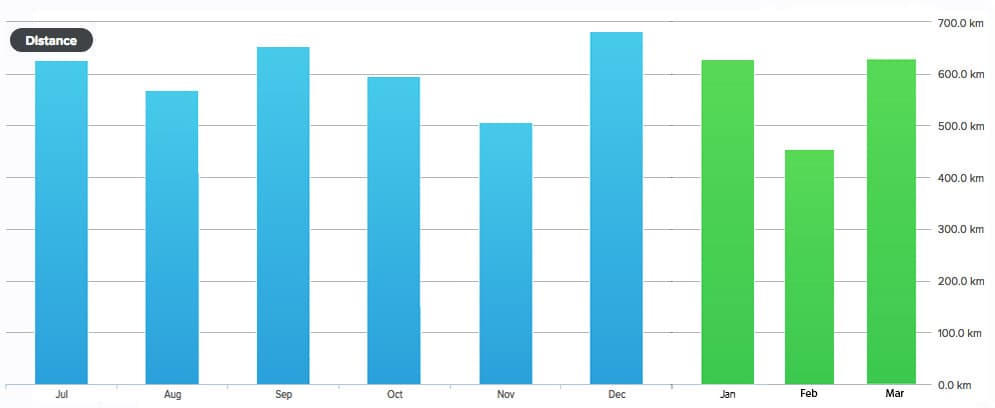
From the graph you can see I average about 600 km per month. That’s been the case for years and I didn’t change my traditional training volume for the test.
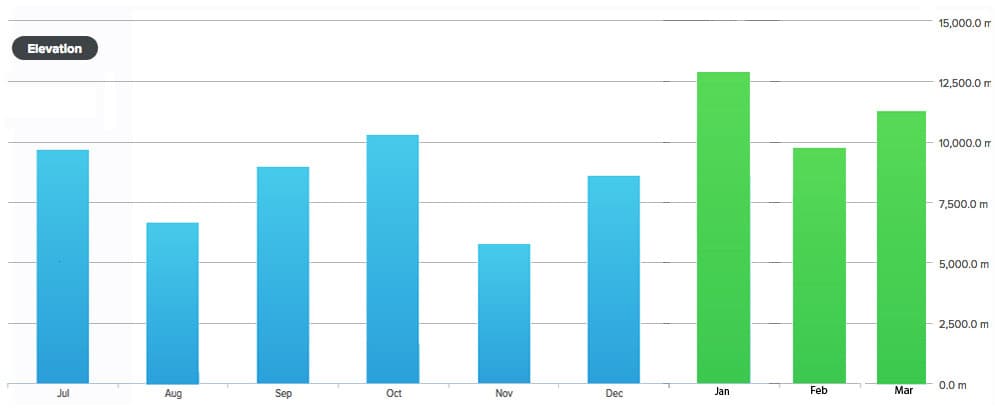
Elevation gain also fits the trend. I generally "do" 8–10 thousand meters of climbing per month, average gradient around 2%.
What’s the deal?
I have a ProForm Tour de France 4.0 bike ergometer that simulates a route drawn on Google Maps, so I virtually ride a real course. The good thing is I can repeat the same course as many times as I want and the machine always creates the same conditions. There is no wind, rain or traffic. The only difference can be in my muscles and body.
On this ergometer I created a course that I will use as a test. It’s 20.16 km long with about 450 m total elevation. The first 8.5 km section is completely flat, running through the Mirna river valley, then it climbs for about 11 km.
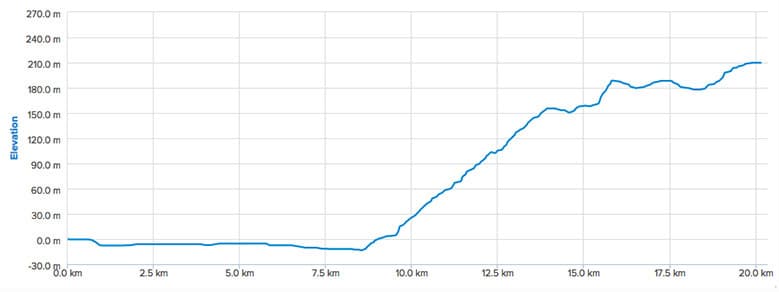
To start I’ll ride once to record my baseline, then we’ll repeat the test regularly to see where I get. I’ll keep working and I’ll train as much as my time allows. I won’t change the usual training dose from the last half-year and I won’t follow a special training plan. I’ll ride as much as I have time for and as I feel like.
I’ll keep training as before, with just one exception!
Since my blog and advisory work keep me at a desk, I’ll use passive time at my desk for muscle stimulation.
Because cycling — especially long distances — requires endurance, I’ll run endurance development programs and treatments that influence blood supply and aerobic capacity on the thigh and calf muscles most important for cycling. I’ll also write about these programs so you get the full picture of what and why I’m doing it.
There’s another aspect I want to highlight that shows how hard it is for me to reach the goal. I mentioned that I used to be a javelin-throwing champion — an event lasting at most about 10 seconds. A short burst with explosive energy transfer into the throw. Such movements are ideal for my type IIb muscle fibers — explosive and very strong. But there’s a serious problem: type IIb fibers are not enduring; they last at most about a minute under load. That’s not what cycling needs! Endurance sports rely on so-called type I slow fibers. I don’t have many of those. Muscle fiber ratios are genetically determined and type IIb fibers never turn into type I slow fibers. However, type IIa fast fibers can modify their properties under appropriate stimulation toward greater endurance. My experiment must also examine and prove whether stimulation can change intermediate fibers — i.e., gain strength, performance and of course endurance.
An extra twist: between February 15 and March 2 I’ll be on a trip where I’ll definitely have no opportunity to cycle. So I must cope with a two-week break. We can also see what happens after such a training gap. Can I maintain their condition and performance with muscle stimulation during that time?
At the end of March we’ll summarize, analyze and evaluate the data. I’m sure we’ll gather interesting insights!
Will you join me?
You can find my YouTube channel's SPORT playlist here.
Reports
| date | time | avg power | avg cadence | avg heart rate - % | change vs start (sec) / % | video URL |
|
"Baseline - 1st test" 2019.01.19 |
50:39 | 324W 2.95W/ttkg |
79 |
149 bpm 89% |
- / - | |
|
"2nd test" 2019.01.30 |
49:40 | 338W 3.07W/ttkg |
82 |
156 bpm 93% |
59 sec -2% |
You can watch the test summary here Second test data on Strava |
|
"3rd test" 2019.02.14 |
43:35 | 422W 3.84W/ttkg |
87 |
155 bpm 92% |
424 sec -14% |
You can watch the test summary here 3rd test data on Strava |
|
"4th test" 2019.03.03 |
44:15 | 408W 3.71W/ttkg |
85 | 158 bpm 94% |
384 sec -12.6% |
4th test data on Strava |
|
"5th test" 2019.03.13 |
42:37 | 434W 4.05W/ttkg |
80 |
152 bpm 90% |
482 sec -15.9% |
No video summary was made. Fifth test data on Strava |
|
"6th test" 2019.03.27 |
41:13 | 443W 4.22W/ttkg |
83 |
158 bpm 94% |
566 sec -18.6% |
Final test data on Strava |
Details
2019 January 19 - 1st test
On the first 8 km flat section I averaged over 32.5 km/h, which may have been a bit fast; my heart rate was over 150 then, almost at my aerobic limit. Later on the climb I couldn’t keep cadence and had to drop 15–20 W from my power. With a better pacing and a slightly slower start I could have had a more even ride.
My average heart rate was 149 bpm, which is 89% of maximum. Average power was 324 W, equivalent to 2.95 W/ttkg.
2019 January 20
Today I lazed around and only did stimulator treatments on both quadriceps. On my The Champion device’s Sport program group I ran warm-up, capillarization and endurance strength programs while writing the article.
2019 January 21
This was an unlucky day. I planned a nice ride but by the afternoon I had such a headache I couldn’t stay up (luckily I only get a headache like that every 2–3 years, but then it knocks me out). Fortunately I had done a thorough stimulator session in the office in the morning :). Maybe I overshot a bit, because by evening I had severe muscle soreness in my thighs.
2019 January 22
I definitely overdid it because the muscle soreness in my thighs is intense. Why do I have muscle soreness when I didn’t train? Because muscle stimulation creates the same contractions in the treated muscles as active training. Same mechanism, same metabolic processes. In my opinion stimulation can produce even more effective contractions on the treated muscle than voluntary contractions: more muscle fiber mass is recruited and contracted, and more strongly. It’s no surprise you can overdose — even if I’ve ridden several hundred kilometers this month and nearly 8,000 m of climbing. Luckily I slept off the headache.
Today in the office I ran Warm-up, Capillarization and Endurance Strength stimulation programs totalling 65 minutes at low intensity. Due to soreness my muscles reacted more sensitively to intensity, especially the left vastus lateralis had to be reduced more in intensity.
In the afternoon I rode a good session: over 41 km, average above 30 km/h, over 600 m total climbing. After training I ran an Active Recovery stimulation program aimed at quickly flushing metabolites and improving muscle recovery.
2019 January 23
Active recovery definitely improved the muscle soreness. The difference is significant (situation improved). One sign is that today I tolerated higher intensity stimulation in the office than yesterday. Over the past day my muscles were very sensitive. After the usual 65 minutes of morning stimulation I rode the same amount — 600 m of climbing, average heart rate 145. So today my quadriceps received twice the usual load. Do you think this will have an effect?
2019 January 24
Good news: the muscle soreness is gone! :) Today I rode a Tour course, climbed a small hill (630 m gain) and then blasted down a long descent. The result was a very good average over 33 km/h. For variety today I did capillarization and maximal muscle strength stimulation. This is a completely different high-frequency impulse that improves the power of intermediate fibers rather than slow ones. This is needed on a climb or in a sprint finish when your thighs need 800 W or more for a short time.
2019 January 25
I diligently continued stim sessions in the office. A routine has developed: about 60–80 minutes of stimulation fits into a day. That’s a huge extra!
2019 January 26
The first week is over. In it I rode 4 times, totalling 4 hours 15 minutes in the saddle, total distance 122 km, elevation gain 1,150 m. That’s slightly less than usual. To this I added 6 hours 40 minutes of office stimulation! Whoa! So I didn’t just double the stimulation — I added even more. I’ll continue as I started.
One regret: I didn’t measure my quadriceps circumference at the start. I think the difference in muscle shape is visible.
2019 January 27
Today I managed 60 minutes of endurance strength stimulation.
2019 January 28
Today in the office I ran 80 minutes of aerobic endurance program. Intensity ranged between 18–26 mA (intensity often needs to be adjusted within a given session — usually increased).
In the afternoon I rode one of my favorite mountain routes, nearly 1,600 m of climbing with a 5 km and a 12 km ascent... Delicious... My thighs were totally exhausted — they haven’t had that much load for a long time. Tomorrow they’ll get some rest because I don’t want to overdo it.
2019 January 29
Today I skipped stimulation because my thighs needed a day to breathe and regenerate. However I rode 1:16:43, 39.5 km, 460 m gain.
My thighs are quite tired. On the bike I’m not riding more than before — weekly distance remains 130–160 km. However I very much feel the effect of the stimulation supplement. My thighs feel like they do in a hard training camp when they’re heavily loaded.
Tomorrow comes the second test... after 10 days I don’t expect miracles, especially since my thighs are still sore from the extra load. We’ll see tomorrow!
2019 January 30 - 2nd test
I tackled the test in the early afternoon. Already in the first 1–2 kilometers I felt my heart rate climb uncontrollably, it just kept rising... I don’t remember having such a high average in years. Definitely not for many years. Max was 167 bpm and the average was 156, which is 93% of max... I don’t think you can push much more than that. The reason may have been the higher cadence: average 82 rpm, three rpm higher than last time. In that light it may not be surprising that I rode 59 seconds faster than the first test. 2% faster, which is such a small difference that no firm conclusions can be drawn.
I’ll continue training and stimulation as planned. The next test is due in two weeks.
2019 January 31
The flu tried to knock me down... we were at the theater a few days ago where many in the audience were coughing and spreading their viruses... I felt it yesterday... today I feel very weak. So I chose rest and didn’t ride today. I did complete the stimulation in the office, though.
2019 February 01
Luckily the flu didn’t hit me full-on. I have a little cough and runny nose, but it’s not serious. Yesterday’s malaise is gone. So today I rode again and of course didn’t skip stimulation.
2019 February 02
Several people on Facebook commented that I ride "incredible watts." To this I say: look at the TDF 4.0 promo video (link at the start of the "What’s the deal?" section). It states that my ergometer has an integrated advanced power meter. I don’t claim 100% accuracy, but it always measures the same way. For my experiment the "always the same" is important! I don’t want to break a world watt record; I want to measure how much I can improve relative to my baseline with the extra provided by muscle stimulation. From that perspective the ergometer and consistent power measurement matter. I mentioned that I worked for years as a physician in a cardiology department where we used the most precise medical stress testing system, so I know what this is about. I’ve tested my performance many times and over the past 30 years I repeatedly produced 350–375 W in tests.
That was the second week. I rode 5 times, total distance 230.2 km, elevation 3,680 m. Total training time 6 hours 56 minutes. This is my usual amount.
To this I added 8 hours 55 minutes of passive muscle stimulation. WOW!
2019 February 03
In the morning I worked, wrote an article and uploaded a video while a 90-minute stimulation ran. My muscles tolerate higher intensity now; I continuously adjust the current to my tolerance. In the afternoon I squeezed in a bit of climbing: 31 km with 840 m climbing. A very pleasant thigh feeling :). On today’s route there were several sections over 10% and nearly a kilometer between 13–16%, but my thighs always had enough power. Things are progressing promisingly.
2019 February 04
Life "swept me away" today... I worked in the office in the morning and did stimulation, but a late-afternoon appointment meant no time for a ride.
2019 February 05
Now I’m in the less exciting period... I train when I can and of course keep up the stimulation. This isn’t spectacular or exciting; not much to report. I’m increasing stimulation intensity; I can handle around 40 mA now, meaning stronger contractions in my thigh. On the bike I feel the fatigue but my muscle feeling is improving... for example, I can push one gear harder than usual at the same cadence. That clearly indicates my thigh is stronger, although still fatigued from so much stimulation — not yet "flying." But that will come.
2019 February 06
We’re going to the theater in the evening, so I managed a ride in the early afternoon but didn’t have time for stimulation today.
2019 February 07
After a solid morning stimulation session I rode one of my favorite routes in the afternoon. Although the distance was under 35 km, elevation exceeded 1,600 m — two serious climbs. The first ascent: 5.5 km and 475 m gain (avg 8.6%); the second 12.6 km and 1,150 m gain (avg 9.0%). I didn’t refuel adequately and somewhere around 30 km I ran out of energy... I ate half a PowerBar and after a few kilometers of suffering I managed to finish the route, nearly 10 minutes slower than usual. Lesson? Pay attention to refueling during training, otherwise efficacy suffers!
2019 February 08
In today’s stimulation I tried a new program. From the special cycling programs I ran Aerobic workout 1. Its target frequencies aim to improve the muscles’ aerobic capacity — i.e., tolerance of metabolites. If muscles better tolerate an acidic environment, you can perform more intensely.
In the afternoon I rode a mostly flat route with some small "waves." The pedaling felt good after yesterday’s strong climb. My thighs are still fatigued because they receive two workouts per day (one stimulation + one traditional session).
2019 February 09
A total rest day. I was lazy and neither trained nor stimulated.
2019 February 10
A stimulation-free day with a solid ride over 50 km (mostly flat).
2019 February 11
After 110 minutes of morning stimulation I rode a route with lots of climbing. My thighs are increasingly stronger thanks to the "double" workouts. The past 3 weeks were enough for muscles to adapt to the extra load and the initial constant soreness-like fatigue disappeared.
Just to remind you — I do exactly the same amount of "traditional" training as in previous years (about 550–650 km per month), but for 3 weeks now I’ve added muscle stimulation treatments to my quadriceps. The goal is to prove that stimulation — strictly as a supplement — provides a serious extra benefit and can significantly improve sports performance.
2019 February 12
I had 120 minutes of morning stimulation. In the afternoon I did a special combined session: I combined stimulation and traditional training, i.e., I received muscle stimulation on my quadriceps while riding the ergometer. This together has a more powerful effect on muscles, which the muscle soreness shortly after training clearly indicated. You should try the method.
2019 February 13
Yesterday’s "double" session (stimulation while sitting on the bike) was again novel for my muscles. I have heavy muscle soreness... Although in the morning I considered skipping the ride and just running recovery programs on my thighs to remove metabolites, I ended up getting on the saddle and I don’t regret it.
2019 February 14 - 3rd test
Since I began my "self-experiment" 26 days have passed. Let’s review!
Since the start I rode 676 km, collecting 13,940 m of climbing (avg 2% gradient), spending 24 hours 40 minutes training. That’s my usual amount. But that was the point: to show how much passive muscle stimulation helps while keeping the traditional training dose unchanged.
Because I sit a lot at the computer I have lots of inactive/passive time. I used this period to strengthen my cycling-relevant quadriceps with muscle stimulation. Total stimulation treatment time: 30 hours 58 minutes — more than the time spent on traditional riding.
3rd measurement: 43:39! That is an improvement of 7 minutes 04 seconds, meaning that with one month of added muscle stimulation training I beat my performance from a month earlier by about 3.5 km on the 20.2 km course.
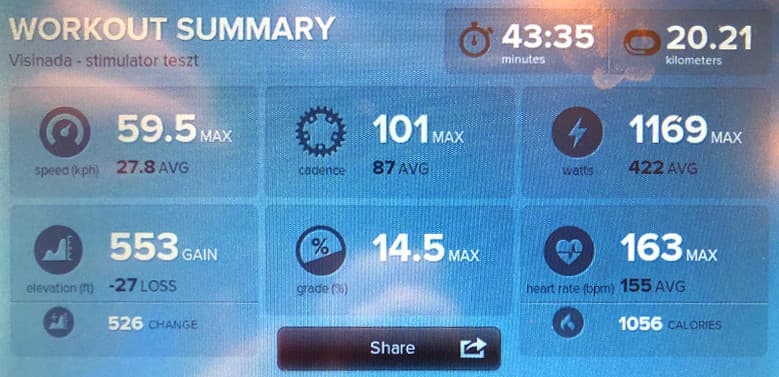
The 3rd test result — the ergometer screen with summary data
Let’s look at the facts!
During today’s effort my average heart rate was 155 bpm, 6 bpm higher than the first test. Cadence improved from 79 to 87 rpm. Average power rose from 324 W to 422 W (I’ve already written about this: my ergometer contains an integrated power meter and always measures the same way — watch the improvement trend and magnitude, not the absolute number! My test’s aim is not achieving high absolute watts but demonstrating the possibility of improvement.)
My body weight didn’t change in the period: I was 110 kg before the test and still am.
I had the same amount of training as in any month of the past half year — this month 670 km were logged. So the total over the past 7 months rose to 4,270 km. This is important because the 14% time improvement wasn’t achieved from an untrained state and not by increasing traditional training volume. Those didn’t change!
What did change and what I attribute the improvement to: one month of about 30 hours of muscle stimulation on the quadriceps most important for cycling — more than the time spent on traditional riding.
I concentrated stimulation on three main targets:
- improving muscle blood flow (oxygenation) with stimuli that encourage capillary proliferation
- maximizing the strength of slow muscle fibers and steering intermediate fibers toward endurance
- improving slow-fiber metabolism by raising the aerobic threshold so muscle cells can produce energy aerobically at higher heart rates
The result is clearly visible: even at higher heart rates my muscles didn’t acidify (only in the last kilometer did my heart rate rise above 160 and I crossed the aerobic threshold). Compared to the first test my muscles were able to deliver nearly 100 W more on average (30% more), which allowed higher cadence and driving a stronger gear.
2019 February 15
From today the test enters a new phase. From now until early March I’ll spend my holiday in Sri Lanka. I’m taking the muscle stimulator with me and will continue treatments, while expecting that traditional training will be minimal or nonexistent.
So the next two weeks of the experiment are like having to skip training due to injury. The aim is to prove that such forced rest can be handled with minimal performance loss if muscle stimulation is maintained.
Flight from noon today...
2019 February 16
We arrived in Colombo in the morning and immediately boarded a bus to reach Nilaveli 250 km away. The road and traffic meant it took until 17:30 to arrive — a solid 8-hour bus ride after two 6-hour flights... Still, I had time on the bus to take out the stimulator and run a treatment.
2019 February 17–March 02
Internet coverage was so poor even in five-star hotels that I couldn’t open the blog to update. Of course nothing much happened — two weeks of complete training break! Neither infrastructure, program nor weather allowed riding. But except for 3 days I always had 60–90 minutes for quadriceps stimulation.
It felt like a two-week training gap due to injury or surgery! Such a break — as you may have experienced — can cause significant performance loss. Tomorrow is the assessment and we’ll see. I’m going to sleep now because I’ve been awake for nearly 36 hours.
2019 March 03 - 4th test
I’m not very fit! I have some jetlag (4.5 hours time difference), and the 12-hour nearly sleepless flight didn’t help...
However my time result was surprisingly good! 44:15 is only 40 seconds slower than two weeks ago. You could say that despite two weeks off I didn’t lose muscle condition — thanks to muscle stimulation. I can attribute the slightly higher heart rate and longer time to fatigue and the time difference!
For me it’s clear that in case of illness, injury or holiday-related missed training, a muscle stimulator provides significant help in maintaining muscle strength.
2019 March 4–12
This was a less eventful period and I won’t detail it. With five rides per week I performed the same amount of stimulation, but I dropped capillarization and focused on maximizing endurance fibers. During rides I noticed I could now pedal two gears harder (at the same cadence) than at the start of February. That significantly increases speed. On training rides I keep hitting my best route times, beating results from years ago — and I’m not getting younger.
2019 March 13 - 5th test
Almost two months have passed since I started my self-experiment. Let’s review!
February was mixed in terms of training. While in the first 14 days I trained with previous intensity, after the 15th I did almost nothing because I traveled to Sri Lanka. There we constantly moved from place to place and even the very best five-star hotels lacked a gym. The infrastructure didn’t allow jogging either. And in 35°C with 98% humidity I didn’t feel like it. So I relied on muscle stimulation to maintain my quadriceps.
How much did that help? Quite significantly!
5th measurement: 42:37! I improved further. My time is now 8 minutes 02 seconds better than at the start. That means with about one and a half months of extra muscle stimulation I beat my baseline by roughly 4–4.5 km on the 20.2 km course — over a 15% improvement. And I don’t feel like I’ve hit a limit. Two weeks until the final test. We’ll see if the result can be even better.
2019 March 14–26
Back to busy weekdays. Not much detail to add. Beyond 3–5 rides per week I also did an additional 5–6 hours of muscle stimulation, focusing on maximizing quadriceps endurance.
During rides I always found my quadriceps strong enough, meaning there’s no climb where my legs "run out" — circulation and breathing have become the limiting factors. However, whereas in January I couldn’t raise my heart rate above 150–155 no matter how hard I pushed, now I can push it toward 175 (note: theoretical max with my age, 52, is 220–52 = 168 bpm).
Cadence is consistently higher than a month and a half ago and combined with a stronger gear this means meaningful speed gains. I think I’m near what can be achieved with this amount of training and stimulation. Tomorrow the test will show how much that’s worth.
2019 March 27 - 6th test
I think I’ve convincingly proven that a muscle stimulator can effectively "push" performance — provided you use it! In my case stimulation time exceeded traditional training time.
6th measurement: 41:13! I improved by another minute. Now I’m 566 seconds — 9 minutes 16 seconds — faster than at the start. That means with a 10-week muscle stimulation training supplement I achieved over 18% performance improvement. In other words I’d beat my starting self by about 5 km on the same 20.2 km course.
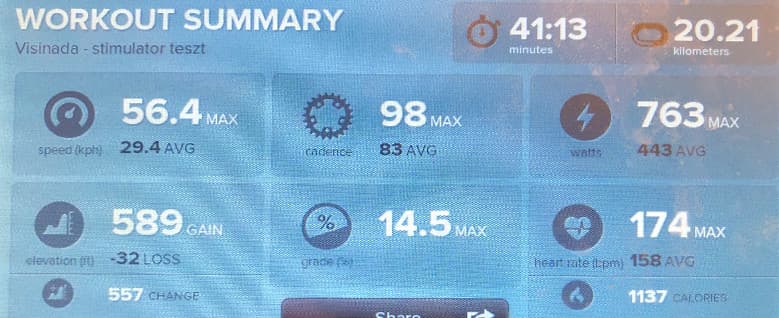
If I didn’t convince you, the fault isn’t mine! :) I uploaded the test data to my Strava profile so you can check there too.
| date | training time | distance | elevation | muscle group - stimulation program (duration minutes - intensity mA) | device |
| January 19 | 50:29 - test | 20.2 km | 467 m | Quadriceps - Active recovery (30 min - 18 mA) | The Champion |
| January 20 | Quadriceps - Warm-up (15 min - 18 mA), Capillarization (20 min - 22 mA), Endurance strength (30 min - 28 mA) | The Champion | |||
| January 21 | Quadriceps - Warm-up (15 min - 18 mA), Capillarization (20 min - 22 mA), Endurance strength (30 min - 28 mA) | The Champion | |||
| January 22 | 1:24:35 | 41.44 km | 650 m | In office: Quadriceps - Warm-up (15 min - 15 mA), Capillarization (20 min - 15 mA), Endurance strength (30 min - 18 mA) Post-ride: Active recovery (15 min - 15 mA) |
The Champion |
| January 23 | 1:06:21 | 31.43 km | 595 m | Quadriceps - Warm-up (15 min - 18 mA), Capillarization (20 min - 18 mA), Aerobic endurance (30 min - 23 mA) Post-ride: Active recovery (15 min - 18 mA) |
The Champion |
| January 24 | 54:36 | 30.34 km | 631 m | Quadriceps - Capillarization (20 min - 21 mA), Maximal strength (30 min - 21 mA) Post-ride: Active recovery (15 min - 21 mA) |
The Champion |
| January 25 | In office: Quadriceps - Endurance strength (60 min - 23 mA) | Cycling Pro | |||
| January 26 | 1:40:02 | 52.30 km | 380 m | Post-ride: Active recovery (15 min - 20 mA) | |
| January 27 | Quadriceps - Endurance strength (60 min - 19 mA) | Cycling Pro | |||
| January 28 | 1:35:51 | 34.70 km | 1594 m | Quadriceps - Endurance strength (80 min - 23 mA) Post-ride: Active recovery (15 min - 18 mA) |
Cycling Pro |
| January 29 | 1:16:43 | 39.5 km | 460 m | Quadriceps - Endurance strength (80 min - 23 mA) Post-ride: Active recovery (15 min - 18 mA) |
The Champion |
| January 30 | 49:40 | 20.20 km | 467 m | Quadriceps - Endurance strength (80 min - 23 mA) Post-ride: Active recovery (15 min - 18 mA) |
The Champion |
| January 31 | Quadriceps - Aerobic endurance (80 min - 28 mA) | The Champion | |||
| February 01 | 1:49:08 | 54.3 km | 1,099 m | Quadriceps - Endurance strength (80 min - 23 mA) Post-ride: Active recovery (15 min - 18 mA) |
The Champion |
| February 02 | 1:23:39 | 46.8 km | 60 m | Post-ride: Active recovery (15 min - 18 mA) | The Champion |
| February 03 | 1:05:36 | 31.4 km | 844 m | Quadriceps - Capillarization (20 min - 30 mA), Aerobic endurance (30 min - 35 mA), Endurance strength (40 min - 43 mA) | The Champion |
| February 04 | Quadriceps - Aerobic endurance (80 min - 41 mA) | The Champion | |||
| February 05 | 1:22:41 | 41.4 km | 937 m | Quadriceps - Capillarization (20 min - 38 mA), Aerobic endurance (40 min - 43 mA), Endurance strength (40 min - 43 mA) | The Champion |
| February 06 | 1:20:08 | 39.59 km | 823 m | ||
| February 07 | 1:31:40 | 34.71 km | 1,661 m | Quadriceps - Capillarization (30 min - 40 mA), Endurance strength (80 min - 48 mA) | The Champion |
| February 08 | 1:26:19 | 46.62 km | 453 m | Quadriceps - Warm-up (20 min - 38 mA), Special prog. Aerobic endurance 1 (80 min - 48 mA) | The Champion |
| February 09 | - | - | - | - | - |
| February 10 | 1:38:55 | 52.3 km | 360 m | - | - |
| February 11 | 1:16:54 | 37.5 km | 890 m | Quadriceps - Capillarization (30 min - 40 mA), Endurance strength (80 min - 48 mA) | The Champion |
| February 12 | 1:03:40 | 31.8 km | 780 m | Office - quadriceps - Capillarization (40 min - 40 mA), Aerobic endurance (80 min - 44 mA) Combined training: on ergometer during ride Aerobic endurance program (30 min - 36 mA) |
The Champion |
| February 13 | 1:02:53 | 31.44 km | 790 m | Quadriceps - Warm-up (20 min - 35 mA), Capillarization (30 min - 40 mA), Active recovery (60 min - 38 mA) | The Champion |
| February 14 | 43:39 | 20.2 km | 467 m | ||
| February 15 - March 02 | - | - | - | I performed stimulation every day. Usually 60–90 minutes focused on capillarization and endurance strength. | The Champion |
| March 03 | 44:15 | 20.2 km | 467 m | ||
| March 04 | 1:22:03 | 39.6 km | 962 m | Quadriceps - Warm-up (20 min - 28 mA), Special prog. Aerobic endurance 1 (50 min - 35 mA) | The Champion |
| March 05 | 26:13 | 11.4 km | 401 m | - | - |
| March 06 | - | - | - | - | - |
| March 07 | 44:00 | 20.5 km | 719 m | - | - |
| March 08 | - | - | - | Quadriceps - Warm-up (20 min - 28 mA), Special prog. Aerobic endurance 1 (50 min - 35 mA) | The Champion |
| March 09 | 1:21:50 | 46.8 km | 246 m | Quadriceps - Warm-up (20 min - 28 mA), Special prog. Aerobic endurance 1 (50 min - 35 mA) | The Champion |
| March 10 | - | - | - | - | - |
| March 11 | 1:25:33 | 34.7 km | 1,440 m | Quadriceps - Warm-up (20 min - 30 mA), Special prog. Aerobic endurance 1 (50 min - 36 mA) | The Champion |
| March 12 | 1:10:59 | 40.1 km | 611 m | Quadriceps - Warm-up (20 min - 28 mA), Special prog. Aerobic endurance 1 (50 min - 38 mA) | The Champion |
| March 13 | 42:37 | 20.2 km | 467 m | Quadriceps - Warm-up (20 min - 25 mA), Special prog. Aerobic endurance 1 (50 min - 39 mA) | The Champion |
| March 14 | 1:19:31 | 43.1 km | 800 m | Quadriceps - Warm-up (20 min - 28 mA), Special prog. Aerobic endurance 1 (50 min - 38 mA) | The Champion |
| March 15 | Quadriceps - Warm-up (20 min - 25 mA), Special prog. Aerobic endurance 1 (50 min - 38 mA) | The Champion | |||
| March 16 | 2:11:22 | 70.9 km | 600 m | Quadriceps - Warm-up (20 min - 24 mA), Special prog. Aerobic endurance 1 (50 min - 28 mA) | Cycling Pro |
| March 17 | - | - | - | Quadriceps - Warm-up (20 min - 25 mA), Special prog. Aerobic endurance 1 (50 min - 30 mA) | Cycling Pro |
| March 18 | 1:19:52 | 41.4 km | 1,062 m | Quadriceps - Warm-up (20 min - 26 mA), Special prog. Aerobic endurance 1 (50 min - 38 mA) | The Champion |
| March 19 | 44:01 | 22.1 km | 650 m | Quadriceps - Warm-up (20 min - 26 mA), Special prog. Aerobic endurance 1 (50 min - 41 mA) | The Champion |
| March 20 | - | - | - | - | - |
| March 21 | 51:05 | 36.0 km | 116 m | - | - |
| March 22 | Quadriceps - Warm-up (20 min - 38 mA), Special prog. Aerobic endurance 1 (50 min - 40 mA) | The Champion | |||
| March 23 | - | - | |||
| March 24 | 1:23:36 | 34.31 km | 210 m | Quadriceps - Warm-up (20 min - 25 mA), Special prog. Aerobic endurance 1 (50 min - 32 mA) | The Champion |
| March 25 | 1:18:30 | 30.24 km | 940 m | - | - |
| March 26 | 1:09:47 | 38.2 km | 262 m | - | - |
| March 27 | 41:13 | 20.2 km | 587 m | - | - |

