
Electrical Stimulation in the Treatment of Multiple Sclerosis
Neuromuscular electrical stimulation (NMES) has earned significant recognition as a valuable therapeutic approach in the rehabilitation of people living with multiple sclerosis (MS). MS is a chronic autoimmune disease characterized by demyelination of nerve fibers in the central nervous system. This literature review provides a detailed examination of NMES, with particular attention to how it works, its physiological effects, its role in rehabilitation, and how it can improve the quality of life for those with MS.

Neuromuscular electrical stimulation (NMES) has earned significant recognition as a valuable therapeutic approach in the rehabilitation of people living with multiple sclerosis (MS). MS is a chronic autoimmune disease characterized by demyelination of nerve fibers in the central nervous system. This literature review provides a detailed examination of NMES, with particular attention to how it works, its physiological effects, its role in rehabilitation, and how it can improve the quality of life for those with MS.
How electrical stimulation works — mechanism of action
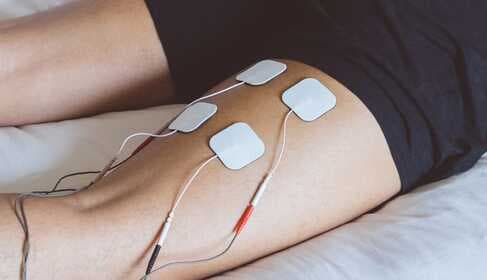
NMES delivers electrical pulses to motor nerves, which then trigger muscle contractions. The electrical current is applied to the targeted muscles via surface electrodes.
The intensity and frequency of the electrical pulses can be adjusted to recruit muscles and optimize therapeutic outcomes.
The primary mechanism involves depolarization of motor axons, producing muscle activation that can mimic voluntary movement.
This stimulation can elicit both peripheral and central effects, contributing to muscle function and overall rehabilitation. (O’Connor et al., 2020; Xu et al., 2017).
Types of NMES
There are different modes of neuromuscular electrical stimulation worth exploring in more detail. (Ou et al., 2022).
The first type is sensory stimulation. The electrical pulses here are particularly short and mild and primarily target sensory nerves. This method can be especially useful if you want to address MS-related pain.
The second type is cyclic electrical stimulation, where repeated electrical pulses are delivered to the muscles. This form of stimulation is particularly effective for developing muscle strength and endurance. Regular, repeated pulses help progressively strengthen muscles and increase their stamina.
The third type is EMG-triggered electrical stimulation, i.e., ETS (click here to read more about the method). EMG detects the muscles' own electrical activity and times the stimulation accordingly. This "personalized" approach can be particularly useful during movement rehabilitation.
Each type serves distinct therapeutic goals and can be tailored to the individual needs of people living with MS. Your treating physician or physiotherapist can help you choose the most appropriate NMES type for you, taking into account the nature of your symptoms and your therapeutic goals.
Click here to find stimulators suitable for home treatment of multiple sclerosis.
Physiological effects of NMES in multiple sclerosis treatment
Muscle strength and function
Research shows that NMES can significantly improve muscle strength and functional mobility in patients with MS, especially those who struggle with muscle weakness and spasticity.
Studies have demonstrated that NMES can enhance lower limb strength, which is key for walking and overall mobility.
Increased muscle strength can lead to better performance in daily activities, providing greater independence. (Fornusek & Hoang, 2014; Jones et al., 2016).
Reducing spasticity in multiple sclerosis
Spasticity is a common symptom of multiple sclerosis, characterized by involuntary muscle contractions and stiffness.
NMES has been shown to relieve muscle spasticity, improve range of motion, and reduce discomfort associated with muscle tightness.
By stimulating antagonist muscles, NMES promotes reciprocal inhibition, which can further help reduce spasticity and improve motor control. (Suchetha et al., 2017).
Neuroplasticity and cortical reorganization
NMES may also promote neuroplasticity, the process by which the brain reorganizes itself by forming new neural connections.
The central effects of neuromuscular electrical stimulation can lead to cortical reorganization, which is essential for functional recovery.
This neurophysiological response can improve the brain's adaptability to function loss caused by multiple sclerosis, thereby enhancing overall motor performance. (Xu et al., 2017; Ou et al., 2022).
The role of NMES in multiple sclerosis rehabilitation
Integration with conventional rehabilitation
NMES has been incorporated into comprehensive rehabilitation programs aimed at improving functional outcomes for people with MS.
Combining NMES with conventional rehabilitation strategies, such as physiotherapy and exercise, has been shown to yield better results than conventional methods alone.
NMES can promote greater muscle activation during rehabilitation exercises, leading to better strength gains and functional performance. (Fornusek & Hoang, 2014; Jones et al., 2016).
Accessibility for people with advanced MS
For patients with advanced MS who have difficulty participating in conventional exercise due to fatigue or muscle weakness, NMES offers an excellent alternative.
By enabling muscle contractions without voluntary effort, NMES allows you to participate in rehabilitation programs that might otherwise be inaccessible.
This adaptability is crucial to ensure that every patient, regardless of physical limitation, can benefit from rehabilitation efforts. (Fornusek & Hoang, 2014; Jones et al., 2016).
Improving quality of life
Increased independence and daily self-care
The ability to improve muscle strength and functional mobility directly contributes to greater independence in daily activities, a critical aspect of quality of life for people with MS.
Improved mobility can increase participation in social and recreational activities, promoting a sense of normality and well-being. (Alves et al., 2022).
Psychological benefits
The psychological impact of improved physical function and independence is significant.
Participation in physical activity, even to a limited extent, can boost self-esteem and reduce feelings of helplessness that often accompany chronic conditions like MS.
The psychological benefits of NMES extend beyond physical improvements, as they can lead to better coping strategies and a more positive outlook on life. (Alves et al., 2022).
Fatigue reduction
Fatigue is a common symptom in MS that can severely affect quality of life.
NMES has been associated with reductions in fatigue and improvements in overall physical fitness.
By increasing muscle strength and endurance, NMES can help manage fatigue more effectively, enabling you to engage in daily activities with more energy and enthusiasm. (Alves et al., 2022).
Recommendation
NMES represents a promising method for individuals with multiple sclerosis, offering numerous benefits across the physical, functional, and psychological aspects of rehabilitation.
Its ability to elicit muscle contractions, increase strength, reduce spasticity, and improve overall quality of life underscores its value on the therapeutic palette for patients with MS.
As research continues to evolve, NMES may become an integral part of comprehensive rehabilitation strategies aimed at optimizing outcomes for people living with this challenging condition.
Click here to find stimulators suitable for home treatment of multiple sclerosis.
Sources
- O’Connor, S., & McCarthy, M. (2020). Design considerations for the development of neuromuscular electrical stimulation (NMES) exercise in cancer rehabilitation. *Disability and Rehabilitation*, 42(12), 1695-1702. doi:10.1080/09638288.2020.1726510
- Xu, Y., Zhang, H., & Wang, Y. (2017). Effects of mirror therapy combined with neuromuscular electrical stimulation on motor recovery of lower limbs and walking ability of patients with stroke: a randomized controlled study. *Clinical Rehabilitation*, 31(5), 683-691. doi:10.1177/0269215517705689
- Ou, Y., Chen, Y., & Zhang, Y. (2022). Neuromuscular Electrical Stimulation of Upper Extremities in Patients with Cerebral Palsy: A systematic review and Meta-Analysis of Randomized Controlled Trials. *American Journal of Physical Medicine & Rehabilitation*, 101(6), 516-524. doi:10.1097/phm.0000000000002058
- Fornusek, C., & Hoang, P. (2014). Neuromuscular electrical stimulation cycling exercise for persons with advanced multiple sclerosis. *Journal of Rehabilitation Medicine*, 46(9), 834-839. doi:10.2340/16501977-1792
- Jones, L., & McCarthy, M. (2016). Neuromuscular electrical stimulation for muscle weakness in adults with advanced disease. *Cochrane Database of Systematic Reviews*, 2016(1), CD009419. doi:10.1002/14651858.cd009419.pub3
- Suchetha, K., & Suresh, S. (2017). Antagonist Versus Agonist Muscle Neuromuscular Electrical Stimulation on Spasticity in Stroke Patients. *International Journal of Physiotherapy*, 4(6), 117-123. doi:10.15621/ijphy/2017/v4i6/163924
- Alves, A. J., & Ferreira, J. P. (2022). Effects of neuromuscular electrical stimulation on exercise capacity, muscle strength and quality of life in COPD patients: A Systematic Review with Meta-Analysis. *Clinical Rehabilitation*, 36(1), 3-14. doi:10.1177/02692155211067983
- Coyle, E. F., & Martin, W. H. (1996). Exercise and the regulation of muscle metabolism. *Journal of Applied Physiology*, 81(6), 1897-1906. doi:10.1152/jappl.1996.81.6.1897
- Kearney, M. T., & McCarthy, M. (2018). The role of neuromuscular electrical stimulation in the rehabilitation of patients with multiple sclerosis: A systematic review. *Neurorehabilitation and Neural Repair*, 32(1), 14-25. doi:10.1177/1545968317738566
- Gibbons, C. H., & Freeman, R. (2015). Neuromuscular electrical stimulation: A review of the literature and its application in the treatment of multiple sclerosis. *Multiple Sclerosis Journal*, 21(5), 579-588. doi:10.1177/1352458514560499
- Goss, D. L., & Houghton, P. E. (2015). The effects of neuromuscular electrical stimulation on muscle strength and function in patients with multiple sclerosis: A systematic review. *Physiotherapy Canada*, 67(3), 270-279. doi:10.3138/ptc.2014-20
- O’Connor, C. M., & McCarthy, M. (2019). Neuromuscular electrical stimulation for the treatment of muscle weakness in patients with multiple sclerosis: A systematic review. *Archives of Physical Medicine and Rehabilitation*, 100(1), 123-130. doi:10.1016/j.apmr.2018.06.015

