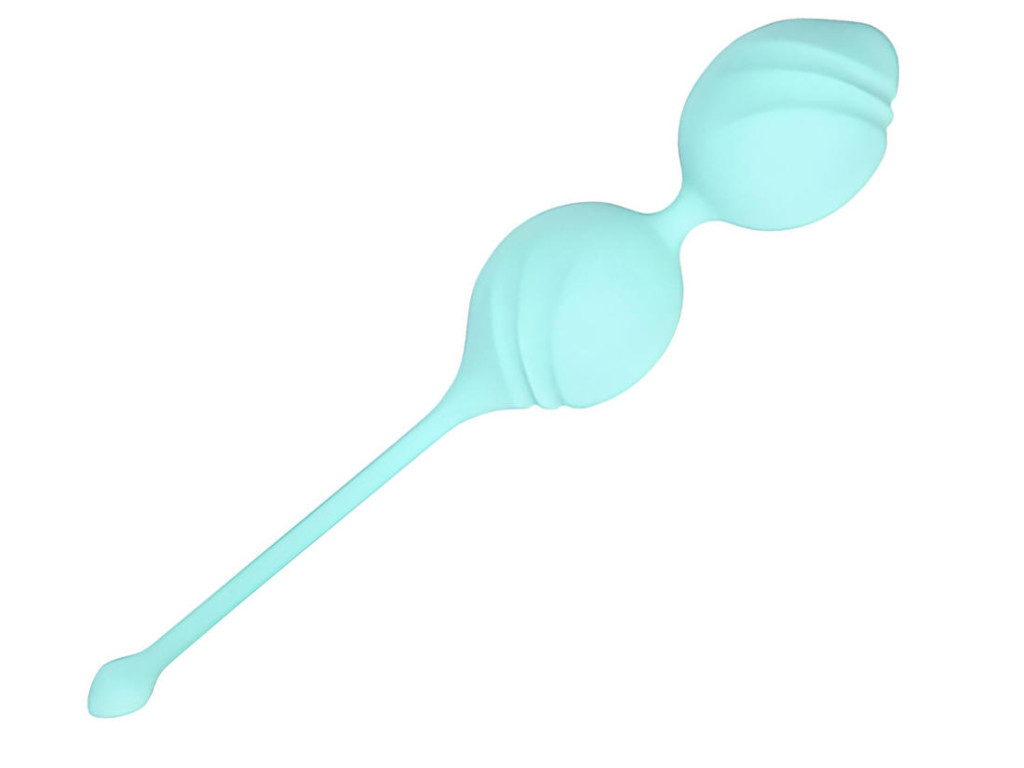
Who do I recommend it for?
If your pelvic floor muscles are still fine, but you want to prevent weakness – for example before menopause, alongside regular exercise, or to compensate for sedentary work – the Fleur vaginal ball offers a simple daily maintenance option.
It can be used as a supplement to postnatal pelvic floor recovery – after the 6-week medical check-up (8 weeks in the case of episiotomy). It cannot replace electrostimulation treatment on its own, but as a supplement it may help maintain muscle strength between sessions. If uterine or bladder prolapse is also present, you will find detailed guidance in my article on treatment of uterine prolapse.
If you already use an electrostimulator (Kegel Toner, Perfect PFE, Biolito or evoStim), the Fleur vaginal ball can be used as additional training on the days between treatments. Active Kegel exercises and passive wearing together may support the effectiveness of muscle training.
If you are put off by electrostimulation, the Fleur vaginal ball offers a non-electric alternative. It is important to know: the effectiveness of the vaginal ball is limited compared with electrostimulation – if symptoms do not improve, it is worth reconsidering stimulation treatment.
How does the vaginal ball work?
The Fleur vaginal ball trains the pelvic floor muscles in two ways:
Passive training (wearing): The weight of the balls (75 g) pulls downwards – your pelvic floor muscles contract reflexively to keep the balls in place. This is continuous, low-intensity muscle work that may help maintain muscle tone.
Active training (Kegel exercises): Using the balls as resistance makes conscious muscle contractions more intense. This method can be a more effective version of traditional Kegel exercises.
Important difference compared with electrostimulation: The vaginal ball relies solely on voluntary muscle activity – it trains the muscles you can consciously contract. Electrostimulation devices (such as the Kegel Toner or the Perfect PFE) also reach muscle fibres that you cannot consciously activate. That is why, in more severe incontinence, electrostimulation is the more effective approach.
Frequently asked questions
It may be useful for prevention and as a supplement in the case of mild symptoms. If symptoms of incontinence are already present (regular leakage), the vaginal ball alone is typically not enough – an electrostimulation device (e.g. Kegel Toner, Perfect PFE) is a more effective approach.
Do not use it during pregnancy, within 6 weeks after childbirth (within 8 weeks in the case of episiotomy), with uterine or bladder prolapse, active vaginal infection, or if you are under 18. If in doubt, consult your doctor.
Yes, this is the recommended use: the electrostimulator (e.g. Kegel Toner, Perfect PFE, Biolito) provides the main therapy, while the Fleur vaginal ball can be used as additional training on the days between sessions. The two do not replace each other, but complement each other.
A maximum of 1 hour a day is recommended. Wearing it for too long can cause muscle fatigue, which is counterproductive. Start with 15–20 minutes, then gradually increase to 1 hour.
The Fleur weighs 75 g, which means medium resistance. If you are looking for a heavier variant, or want a progressive system, consult your doctor about the right load level.
Before and after each use, wash it with warm water and mild soap. Dry it thoroughly and store it in a dry, clean place. Do not use alcohol-based cleaner.
How do you use the Fleur vaginal ball?
1
Insert the balls
Moisten the balls with water or a water-based lubricant, and insert them comfortably into the vagina. The retrieval cord must remain outside.
2
Passive training – wearing
Carry on with your daily activities while wearing the balls – for up to 1 hour a day. Your pelvic floor muscles work involuntarily to keep the balls in place. This is continuous, low-intensity training.
3
Active training – Kegel exercises
You can also use the balls as resistance: tighten your pelvic floor muscles for 5 seconds, then relax for 5 seconds. Repeat 10–15 times, in 2–3 sets a day. The balls add extra resistance to the exercise.
4
Remove and clean the balls
Pull them out gently by the retrieval cord. After use, wash them with warm water and mild soap, then dry them.
5
Regular use
30–60 minutes of passive wearing a day and/or 2–3 sets of active Kegel exercises a day. Improvement can be felt with regular use over several weeks.
What’s in the box
The Fleur vaginal ball comes with the following accessories:
- 1 set Fleur vaginal ball (2 balls, linked by a cord, 75 g)
- 1 pc user instructions
Technical data
| Type | Vaginal ball (passive, non-electronic) |
| Quantity | 2 balls, linked by a cord |
| Total weight | 75 g |
| Use | Passive wearing (max. 1 hour/day) + active Kegel exercises |
| Power supply | Not required (non-powered device) |
| Manufacturer | TensCare Ltd |
| Classification | CE class II medical device (MDR, ISO 13485) |
 When should you NOT use it?
- Pregnancy
- Within 6 weeks after childbirth (8 weeks in the case of episiotomy)
- Uterine or bladder prolapse (prolapsus)
- Active vaginal infection or inflammation
- Under 18 years of age
Not sure? Consult your doctor before use!
 Important information
The Fleur vaginal ball is a CE-marked, class II medical device (manufactured according to MDR, ISO 13485). It is a supplementary tool for pelvic floor muscle training – it does not replace medical treatment or electrostimulation therapy.
The effectiveness of pelvic floor muscle training (PFMT) in the treatment of urinary incontinence is also supported by systematic reviews from the Cochrane Institute.1
The information on this page is for informational purposes only. Home therapy devices are intended to complement medical treatment, not replace it. If you have any symptoms, consult your doctor.
Scientific background
The effectiveness of pelvic floor muscle training is supported by clinical evidence:
- Dumoulin C, Cacciari LP, Hay-Smith EJC. (2018). Pelvic floor muscle training versus no treatment, or inactive control treatments, for urinary incontinence in women. Cochrane Database Syst Rev. 10(10):CD005654. PubMed
- Todhunter-Brown A, Hazelton C, Campbell P, et al. (2022). Conservative interventions for treating urinary incontinence in women: an Overview of Cochrane systematic reviews. Cochrane Database Syst Rev. 9(9):CD012337. PubMed
 Incontinence treatment – full guide →
 Treatment in practice – step by step →
 Urinary incontinence and its treatment →
 Guide to pelvic floor exercises →
 Kegel Toner – entry-level electrostimulation →
 All incontinence devices →