
medimarket.com logo

Support tel: +36-53/200108

Categories
medimarket.com logo

Support tel: +36-53/200108

  • Categories
    • Deals
    • Home therapy
    • Disease Treatment
    • Fitness
    • Beauty Care
    • Veterinary Medicine
    • Clinic Equipment
    • Accessories and Add-Ons
    • Clearance Sale
  • Blog
  • Info
  • About us
  1. Blog
  1. Blog
Back

Managing Incontinence at Home - Guide

Incontinence – the inability to control urine or stool – means the affected person cannot hold back urine or cannot control bowel movements. This is not a natural part of aging, and you should not have to “get used to it”. It is estimated that about 500,000 people in Hungary struggle with some degree of incontinence, but many remain silent because of shame.

In my experience, most patients believe the only solution is the “adult” diaper. However, targeted pelvic floor muscle training – sometimes supported by electrical stimulation – can produce meaningful improvement in a large proportion of cases.1

Urological problems
Dr. Zátrok Zsolt
Dr. Zátrok Zsolt

Definition What is incontinence?

Incontinence is not a disease, but a symptom. It is usually caused by weakness of the pelvic floor muscles or disturbances in neurological control. If you treat the underlying cause, the symptom can improve.

Which type applies to you?

For effective treatment of incontinence, it is important to know which type affects you. The three main types require different treatment approaches:

Leakage occurs when coughing, sneezing, laughing, lifting, or running. The cause is weakness of the pelvic floor muscles and the urethral sphincter. This is the most common form in women – especially after childbirth, menopause, or gynecological surgery. In men it can occur after prostate surgery.

Stress incontinence is a form that can be effectively treated with electrostimulation therapy. The Cochrane Institute's comprehensive review found high-level evidence that pelvic floor muscle training (PFMT) effectively improves symptoms.1

Detailed guide to urinary incontinence →

A sudden, intense urge to urinate occurs and you cannot reach the toilet in time. The cause is overactivity of the bladder muscle (overactive bladder). The bladder contracts involuntarily before it is full.

Electrostimulation can also be effective for urge incontinence. The Cochrane review found moderate-to-high level evidence of a beneficial effect of electrostimulation for this type.1

Detailed guide to urinary incontinence →

Stress and urge incontinence occur together. This is most common in older adults. Treatment requires a complex approach: a combination of pelvic floor muscle training and bladder training can produce results.

When combined with biofeedback, electrostimulation can significantly improve quality of life.2

Urinary incontinence in detail →

Involuntary passage of stool due to weakness or damage of the anal sphincter. The most common causes are childbirth injury, prostate or rectal surgery, and neurological diseases. Randomized trials show that home electrostimulation can significantly improve symptoms – and is more cost-effective than clinic-based treatment.3

Detailed guide to fecal incontinence →

The uterus, bladder or rectum descends toward the vagina due to damage or stretching of the supporting ligaments and partly due to weakness of the pelvic floor muscles. Incontinence in this case is caused by pressure exerted on the bladder by the prolapsing organs. Pelvic floor muscle training can help improve symptoms in mild to moderate prolapse, but because it does not affect the supporting ligaments, only partial improvement can be expected.

Detailed guide to uterine prolapse →

Important to know

Establishing an accurate diagnosis is a medical task. If you have symptoms of incontinence, first consult your treating physician or a urologist. Home electrostimulation devices can be used as a complement to medical treatment.

How it works How can electrostimulation help?

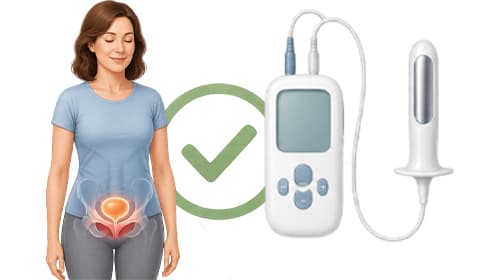
Electrostimulation (also called functional electrical stimulation – FES) works with low-intensity electrical impulses. The impulses stimulate the pelvic floor muscles and their supplying nerves, retraining and "re-educating" them.

The electrical impulses trigger contractions of the pelvic floor muscles – similar to Kegel exercises but more targeted and more intense. This is particularly useful if you cannot voluntarily contract these muscles (which applies to about 30% of affected individuals).

Regular stimulation gradually increases muscle strength and mass, which can improve sphincter function.

Low-frequency (10–20 Hz) stimulation can calm bladder overactivity – this is key for treating urge incontinence. Tibial nerve stimulation (TTNS) affects neural control of the bladder and can help reduce sudden urges to urinate.5

Premium devices provide real-time feedback on muscle activity (EMG or pressure biofeedback). This lets you see whether you are performing exercises correctly and measure your progress. A 279-participant, 3-year follow-up study demonstrated that electrostimulation combined with biofeedback can produce lasting improvement.2

Target groups Who is home electrostimulation therapy recommended for?

Home pelvic floor muscle stimulation can be widely used, especially if you belong to any of the following groups:

  • Postpartum Postpartum incontinence – urinary incontinence guide →
  • Post-menopause Pelvic floor weakness after menopause →
  • Male Urinary leakage after prostate surgery →
  • Sphincter Sphincter weakness – fecal incontinence guide →
  • Prolapse Uterine prolapse and its treatment →
  • Prevention Prevention – intimate exercise guide →

Which device might be suitable?

When choosing, the type and severity of incontinence and individual needs are decisive. The comparison below helps you navigate:

Segment Device Who is it for? Main benefit
Entry TensCare Kegel Toner Mild to moderate stress incontinence, prevention Easy to use, affordable
Fleur vaginal balls Passive muscle training, prevention No power needed, usable anywhere
Fleuron set Gradual muscle building, mild symptoms 4 levels, progressive training
Mid Biolito Moderate stress, urge or mixed incontinence 2 channels, good value for money
PFE for Women Female stress/urge incontinence Programs optimized for women
PFE for Men Post-prostatectomy incontinence, men Protocols designed for men
Myolito All forms of incontinence + pain TENS/EMS/FES in one device
TensCare Sure Pro All three incontinence types + tibial stimulation Versatile device
Premium evoStim UG Complex urge incontinence Clinical-level programs
evoStim E Severe incontinence, EMG-biofeedback needed EMG-biofeedback, clinical-grade measurement
evoStim P Complex cases, mixed incontinence, vaginismus Pressure-biofeedback, most comprehensive
Accessory Prosecca strap Male stress incontinence, direct protection Mechanical drip prevention with Velcro strap

My advice for choosing

If you are just starting home treatment, the Biolito or the PFE for Women / PFE for Men offer excellent value. If biofeedback — i.e. measurable progress — matters to you, consider the evoStim E or evoStim P devices.

Practical tips for home treatment

The effectiveness of home electrostimulation therapy depends heavily on regular use. Here are some tips from my clinical practice:

What to expect?

Initial results typically appear after 2–4 weeks of regular use. For lasting improvement, a minimum 8–12 week treatment cycle with daily 20–30 minute sessions is recommended. It is worthwhile to perform Kegel exercises in parallel with electrostimulation.

I have summarized detailed treatment protocols – frequency, intensity, duration – in this article:

  • Manual Practical management of incontinence stimulation treatment →
  • Kegels Intimate exercise – how to strengthen your pelvic floor muscles →

Why not settle for diapers?

An adult diaper is symptom management – it hides the problem but does not solve it. A simple calculation: HUF 5,000–10,000 per month on diapers can amount to up to HUF 100,000 per year. Every year!

An electrostimulation device is a one-time — several ten-thousands HUF — investment that aims to treat the cause.

But it is not just about money. Incontinence can significantly worsen quality of life, social relationships, and self-confidence. If there is a chance of improvement, it is worth trying.

  • Diaper trap The adult-diaper trap – Is it worth it? →

Research Scientific background

The effectiveness of electrostimulation and pelvic floor muscle training is supported by numerous clinical trials and systematic reviews. Below I summarize the most important findings:

2022 Cochrane review – 29 reviews, 8,975 women

The Cochrane Institute's comprehensive analysis found high-level evidence that pelvic floor muscle training (PFMT) – alone or combined with electrostimulation and biofeedback – effectively improves incontinence symptoms and quality of life. More intensive, individually supervised training can yield even better results.1

2023 systematic review and meta-analysis – 29 RCTs, 2,601 participants

The latest meta-analysis supports physiotherapy (PFMT + electrostimulation + biofeedback) as a first-line therapy for stress incontinence. Urine leakage was significantly reduced in treated groups.6

2022 systematic review – PFMT ± biofeedback ± electrostimulation, 2,441 women

Analysis of 15 randomized trials: pelvic floor muscle training alone or combined resulted in significant improvement or full continence in 62% of patients.7

2015 RCT – Home electrical stimulation in fecal incontinence

A randomized trial showed that home electrostimulation significantly improved incontinence scores and anxiety. Home treatment cost about half that of clinical biofeedback with similar effectiveness.3

Warning Before you start treatment

Electrostimulation therapy is generally safe, but in certain conditions it should not be used or only under medical supervision:

When NOT to use it?

  • Pacemaker – electrical impulses can interfere with pacemaker function
  • Pregnancy – pelvic stimulation should not be applied during pregnancy
  • Active malignancy in the treatment area – stimulation is prohibited over a tumor
  • Untreated epilepsy – electrical impulses may provoke seizures
  • Acute inflammation or infection in the pelvic area – stimulation can worsen inflammation
  • Metal implant in the treatment area – for hip or pelvic prostheses consult your physician

Attention Important

Home electrostimulation devices are intended to complement medical treatment. Before starting therapy, consult your treating physician or a urologist – especially if any of the above conditions apply to you.

FAQ Frequently asked questions

Initial improvement is generally experienced after 2–4 weeks of regular daily use. For lasting results, an 8–12 week treatment cycle is recommended. Devices with biofeedback allow measurable progress, which can be motivating.

No. You can set electrostimulation to your own comfort level. Most people feel a mild tingling or a pleasantly strong muscle contraction. If you experience pain, reduce the intensity.

Yes. The PFE for Men is specifically designed for men. Pelvic floor muscle training has proven helpful for post-prostatectomy incontinence.4 The Prosecca strap offers a mechanical solution for direct protection.

A simple stimulator works the muscles with electrical impulses – a “passive exercise.” A device with biofeedback additionally measures your muscle activity (EMG or pressure measurement) and provides real-time feedback. This way you know whether you are performing exercises correctly and can objectively measure progress. Research suggests that therapy complemented by biofeedback can produce more lasting results.2

No. CE-marked electrostimulation devices designed for home use can be purchased without a prescription. However, a medical consultation before treatment is recommended so that device selection and the treatment protocol match your condition.

No. Home electrostimulation devices serve as adjuncts to medical treatment. Incontinence requires medical evaluation because a more serious underlying condition may be present. Devices can support treatment of the identified condition.

Related Read more

  • Urinary Urinary incontinence and its treatment →
  • Fecal Fecal incontinence and its treatment →
  • Practical Practical management of incontinence stimulation treatment →
  • Kegels Intimate exercise – how to strengthen your pelvic floor muscles →
  • Prolapse Uterine prolapse and its treatment →
  • Diaper trap The adult-diaper trap – Is it worth it? →

Summary Summary – Quick overview

What is this article about? A complete guide to at-home electrostimulation treatment for incontinence – types, therapeutic options, device selection, and scientific evidence.
Who is it for? Anyone struggling with urinary or fecal continence issues who wants to take active steps to address them.
Main message: Incontinence is treatable. Pelvic floor muscle training – including when combined with electrostimulation – is the first-line, non-surgical therapy recommended by international guidelines.
Next step: Read the detailed guide to urinary incontinence →

References

  1. Todhunter-Brown A, Hazelton C, Campbell P, et al. (2022). Conservative interventions for treating urinary incontinence in women: an Overview of Cochrane systematic reviews. Cochrane Database Syst Rev. 9(9):CD012337. DOI: 10.1002/14651858.CD012337.pub2
  2. Zhang L, et al. (2023). Long-term efficacy of pelvic floor biofeedback combined with electrical stimulation for stress urinary incontinence. J Cent South Univ (Med Sci). DOI: 10.11817/j.issn.1672-7347.2023.220401
  3. Cohen-Zubary N, et al. (2015). Home electrical stimulation for women with fecal incontinence: a preliminary randomized controlled trial. Int J Colorectal Dis. 30(4):521-528. DOI: 10.1007/s00384-015-2128-7
  4. Laurienzo CE, et al. (2018). Pelvic floor muscle training and electrical stimulation as rehabilitation after radical prostatectomy. J Phys Ther Sci. 30(6):825-831. DOI: 10.1589/jpts.30.825
  5. Mazur-Bialy AI, et al. (2020). Physiotherapy for prevention and treatment of fecal incontinence in women. J Clin Med. 9(10):3255. DOI: 10.3390/jcm9103255
  6. Ghaderi F, Kharaji G, Hajebrahimi S, et al. (2023). Physiotherapy in patients with stress urinary incontinence: a systematic review and meta-analysis. Urol Res Pract. 49(5):293-306. DOI: 10.5152/tud.2023.23018
  7. Alouini S, Memic S, Couillandre A. (2022). Pelvic floor muscle training for urinary incontinence with or without biofeedback or electrostimulation in women: a systematic review. Int J Environ Res Public Health. 19(5):2789. DOI: 10.3390/ijerph19052789
Dr. Zátrok Zsolt

Dr. Zátrok Zsolt

MD, medical technology specialist, blogger

The information in this article is for informational purposes only. Home therapeutic devices are intended to complement medical treatment and do not replace it. If you have symptoms, consult your treating physician.

Back
Customer account
  • Sign In
  • Sign Up
  • My Profile
  • Cart
  • My Favorites
Information
  • Terms and Conditions
  • Privacy Policy
  • Payment
  • Shipping
  • Contact details
Scart Kft
  • Koltói Anna utca 39., Albertirsa, 2730
  • +36-53/200108
  • [email protected]
  • facebook

SUBSCRIBE
TO OUR NEWSLETTER!

Don't miss out on useful information!

Subscribe
barion_com
paypal
  • Deals
  • Home therapy
  • Disease Treatment
  • Fitness
  • Beauty Care
  • Veterinary Medicine
  • Clinic Equipment
  • Accessories and Add-Ons
  • Clearance Sale
  • Blog
  • Info
  • About us
Change language
  • hu
  • en
  • sk
  • de
  • nl
Change currency
Sign in
Sign Up
Privacy settings
Our website uses cookies necessary for basic functionality. You can allow additional cookies for broader features (marketing, analytics, personalization). For more details, see our Privacy Policy in the Privacy Notice.