
Hyperhidrosis — abnormal sweating
Many people suffer from the symptoms of abnormal sweating (medically known as hyperhidrosis). Without any particular trigger — such as high heat or stress — sweat can seem to "pour off" them. If you are affected, you may struggle a lot with this problem. You can try a range of cosmetics, medications, recently even botox treatments, or you might undergo surgery. However, these methods truly work for only a few. Nowadays tap water iontophoresis is being "rediscovered." It has been used for nearly 50 years, but only in recent years have the devices become truly effective. So much so that in the most recent studies more than 90% of treated patients report beneficial effects. Let's examine the method more closely.
What is sweating?
Sweating is your body's natural tool for regulating temperature; it primarily protects your body from overheating. Sweating itself is a “normal” and necessary function whose role is to regulate body temperature.
There are millions of sweat-producing glands in your body.
Sweating increases in response to heat, physical activity, stress, infectious diseases, and the consumption of strongly spiced, hot foods. These factors activate the sweat glands and increase sweat production.
Spicy foods, such as chili peppers, contain components that send signals to the brain indicating an increased body temperature, which leads to increased sweating.
We call it abnormal sweating when you sweat more than would be expected based on the ambient temperature, your activity level, or stress. This can interfere with daily activities and may cause social anxiety or embarrassment.
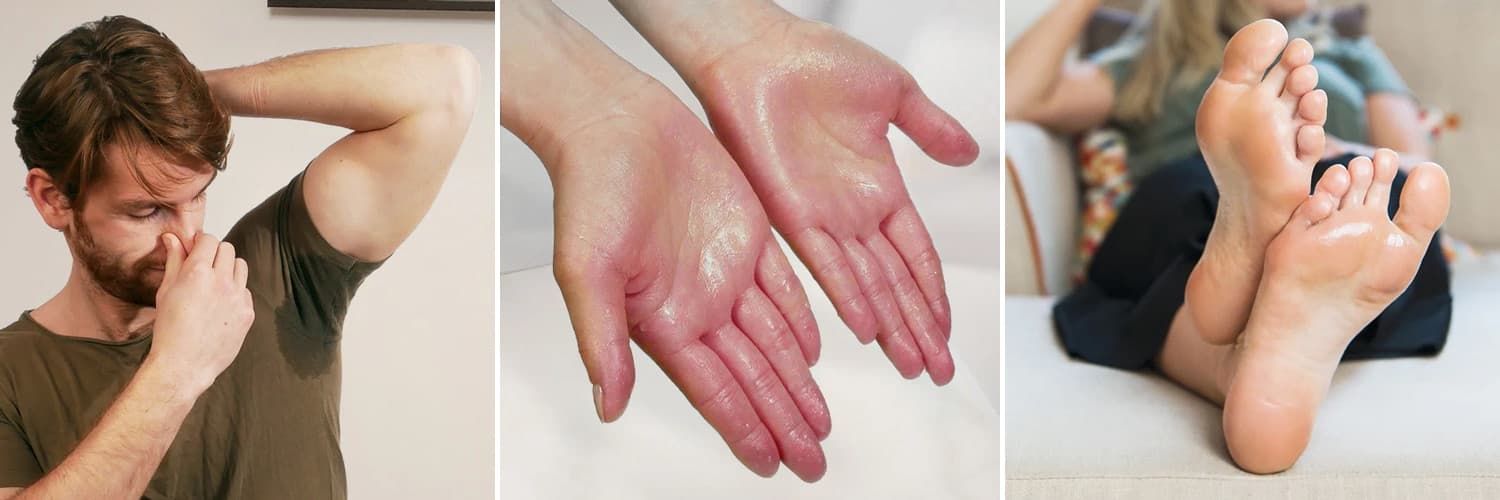
The condition known as hyperhidrosis can affect the whole body (generalized) or only certain areas (localized), most commonly the palms, soles, underarms, or face.
Sweat together with the breakdown products of bacteria and fungi on the skin can produce a characteristic odor.
What is hyperhidrosis?
For unknown reasons some people's sweat glands are excessively active and produce large amounts of sweat continuously and without justification. This phenomenon is called abnormal sweating or hyperhidrosis, and it affects about 5% of the world's population.
Hyperhidrosis is a condition in which the body sweats excessively, regardless of environmental temperature or physical activity.
This condition typically appears in the underarm, palm, sole, and face areas. The neck, back, chest, and thighs can also be commonly affected.
Types of hyperhidrosis
There are two main types: primary and secondary hyperhidrosis.
The primary hyperhidrosis is usually hereditary and results from overactivity of the sweat glands.
This condition generally begins in childhood or adolescence and is due to hyperactivity of the sympathetic nervous system, which is involved in temperature regulation.
The nerves that run to the sweat glands function abnormally, causing the sweat glands to produce a strong output of sweat even when there is no reason to do so.
The sweat glands are essentially "switched on" all the time, and their activation does not require a triggering factor such as increased body temperature from exercise.
Secondary hyperhidrosis usually appears as a consequence of an existing disease or condition, such as an overactive thyroid, diabetes, or as a side effect of certain medications.
It typically occurs in adulthood and may be accompanied by other symptoms besides excessive sweating, such as palpitations, tremors, or insomnia.
People with hyperhidrosis sweat 4-5 times more than average. The amount of sweat significantly exceeds what the body needs to maintain and regulate temperature.
Which diseases can cause abnormal sweating?
Secondary hyperhidrosis can be a symptom of certain diseases. It can be associated with some conditions and often occurs with obesity, heavy alcohol consumption, heavy smoking, or regular aspirin use.
Psychological problems, workplace or school stress, and anxiety are often accompanied by increased sweating.
In women, hormonal changes can lead to increased sweating during menstruation or menopause.
A common phenomenon is pubertal sweating, especially in the underarm area, caused by the development and increased activity of the so-called apocrine glands.
In the above cases the increased sweating is the body's natural reaction, but less commonly it can be a symptom of an underlying disease.
Health conditions that can cause increased sweating include:
Acromegaly
A hormonal disorder that develops when the pituitary gland produces too much growth hormone in adulthood.
If there is too much growth hormone, bones enlarge. In childhood this leads to increased height and is called gigantism. In adulthood there is no change in height; instead the increase in bone size is limited to the bones of the hands, feet, and face — this is called acromegaly. Symptoms include an enlarged face and hands. Changes in the face cause the brow bone and the lower jaw to protrude, and the nose and lips to thicken.
Because it is not common and the physical changes develop slowly over many years, diagnosis can sometimes take a long time. If untreated, high levels of growth hormone can affect other parts of the body beyond the bones.
This can lead to serious — sometimes life-threatening — health problems. However, therapy can reduce the risk of complications and significantly improve symptoms, including facial asymmetry.
Diabetic hypoglycemia
This occurs when a person with diabetes does not have enough sugar (glucose) in their blood. Glucose is the main fuel for the body and brain, so they cannot function well without enough of it.
Low blood sugar (hypoglycemia) is defined as a blood glucose level below 70 milligrams per deciliter (mg/dl) or 3.9 millimoles per liter (mmol/l).
Pay attention to early warning signs and begin treating low blood sugar immediately — once hypoglycemia has developed you can raise it quickly with a simple sugar source such as glucose tablets or fruit juice. Tell your family and friends what symptoms to watch for and what to do if you cannot manage your condition yourself.
Infection
Medication side effect
For example, some beta-blockers (used to lower blood pressure) and some antidepressants can sometimes cause increased sweating.
Leukemia
A cancer of the body's blood-forming tissues, including the bone marrow and the lymphatic system.
There are many types. Some forms of leukemia are more common in children, while others mainly affect adults.
It usually affects white blood cells, which are effective infection fighters — normally they grow and divide in an orderly way as the body needs them. In people with leukemia the bone marrow produces too many abnormal white blood cells that do not function properly.
Treatment can be complex — depending on the type of leukemia and other factors. However, there are methods and tools that can help make therapy successful.
Lymphoma
A cancer of the lymphatic system, which is part of the body's defense network against pathogens.
The lymphatic system includes lymph nodes (glands), the spleen, the thymus, and the bone marrow. Lymphoma can affect all these areas and other organs. Lymph nodes are pea-sized collection points for lymphocytes. There are about 600 such nodes in the lymphatic system, for example near the knees, groin, neck, and underarms. Nodes are connected by a network of lymphatic vessels.
There are many types. The main subtypes include:
- Hodgkin lymphoma (formerly called Hodgkin's disease).
- Non-Hodgkin lymphoma
Which treatment is best for you depends on the type and severity of the lymphoma. Treatment may include chemotherapy, immunotherapy drugs, radiation therapy, bone marrow transplantation, or some combination of these.
Malaria
A disease caused by a parasite. The parasite is transmitted to humans through the bites of infected mosquitoes. People with malaria usually feel very ill, with high fever and chills.
While infection is uncommon in temperate climates, malaria is still widespread in tropical and subtropical countries. Nearly 290 million people are infected with malaria annually, and more than 400,000 people die from the disease.
To reduce malaria infections, global health programs distribute preventive drugs and insecticide-treated bed nets to protect people from mosquito bites. The World Health Organization has recommended a vaccine for children living in areas with intense malaria transmission.
Protective clothing, bed nets, and insecticides can protect you while traveling. You can also take preventive medication before, during, and after traveling to high-risk areas. However, it is important to know that many malaria parasites have developed resistance to commonly used treatments.
Fever of unknown origin
Fever is a temporary rise in body temperature that often occurs because of some illness. It is a sign that something unusual is happening in the body.
For an adult, fever can be uncomfortable but is usually not cause for concern unless it reaches 39.4°C (103°F) or higher. For infants and small children, even a slightly elevated temperature can indicate a serious infection.
Fever usually subsides within a few days. Many over-the-counter medicines reduce fever, but sometimes it is better not to treat it. Fever appears to play a key role in the body's fight against many infections.
Menopause
Marks the end of menstrual cycles. It is diagnosed after 12 months without a menstrual period. It can occur in your 40s or 50s, though the average age is around 50.5 years in Hungary according to a 2018 survey.
It is still a natural biological process. Physical symptoms such as hot flashes, together with emotional symptoms, can disrupt sleep, reduce energy levels, or affect mental health. Many effective treatments are now available, ranging from lifestyle changes to hormone therapy.
Adrenal tumor
A rare, usually noncancerous (benign) tumor that develops in the adrenal gland.
You have two adrenal glands located on the top of your kidneys. A tumor may affect one or both adrenal glands.
Such a tumor can release hormones that cause high blood pressure, headaches, sweating, and panic attack-like symptoms. It can produce sudden large blood pressure swings, but because blood pressure may be normal between spikes, detecting the condition can be difficult. Usually a nine-day monitoring period is used if the disease is suspected. If untreated, the condition can cause severe or life-threatening damage to other systems of the body.
It is usually discovered in people aged 20 to 50, although the tumor can develop at any age. Surgical removal usually normalizes blood pressure.
Neurological disease
Thyroid overactivity
Occurs when the thyroid gland produces too much thyroxine hormone. This can speed up the body's metabolism, causing unintentional weight loss and a fast or irregular heartbeat.
Several treatments are available. Doctors use antithyroid drugs and radioactive iodine to slow the production of thyroid hormones. Sometimes surgery to remove all or part of the thyroid is part of the treatment.
Although it can be serious, especially if left untreated, most people respond well to timely diagnosis and treatment.
Tuberculosis (TB)
A potentially serious infectious disease that primarily affects the lungs. The bacteria that cause it spread from person to person in tiny droplets released into the air by coughing and sneezing.
In developed countries, tuberculosis infections began to re-emerge in 1985, partly because of the appearance of the HIV virus that causes AIDS. HIV weakens the immune system, making it less able to fight TB bacteria.
In Hungary it is well known how serious the social consequences of the regime change were for some groups of society. With increasing poverty, TB cases began to rise. Since 1996 the numbers have again started to fall, but in 1998 they were still higher than in 1990.
What remains worrying is the following: one of the most important and general lessons in fighting tuberculosis is that social factors have not been sufficiently considered in prevention and treatment, even though their importance is well known. A better-functioning social system would likely be able to combat TB spread effectively even amid persistent poverty.
Many strains of tuberculosis are resistant to the drugs most commonly used to treat the disease. People with active TB must take multiple medications for months to clear the infection and prevent antibiotic resistance.
The diseases presented here can often be associated with abnormal sweating. For a precise diagnosis always cooperate with your physician or other healthcare professional.
Medical treatment of hyperhidrosis
Treatment for hyperhidrosis depends on the type of hyperhidrosis.
For primary hyperhidrosis treatment typically begins with antiperspirant cosmetics such as powders and deodorants. If these fail (they help only a few people), botox injections follow. Botox is a nerve toxin injected into the affected area to "paralyze" the nerve supplying the sweat glands. Sweating stops for a few months, then the botox treatment must be repeated. This is quite an expensive "entertainment," as botox for a single hand or foot costs about HUF 60,000–80,000 per session.
An even more drastic and permanent option is surgical interruption of the sympathetic nerve…
In secondary hyperhidrosis the underlying disease (thyroid, diabetes, hormonal disorder, etc.) must be treated. If the underlying disease is resolved, the excessive sweating usually disappears as well.
Hyperhidrosis also has psychological effects, such as anxiety, depression, or social isolation. Therefore it is important that people with hyperhidrosis seek medical help and receive psychological support alongside treatment.
Home treatment of hyperhidrosis
There is currently no method to permanently eliminate primary (idiopathic) abnormal sweating.
Symptomatic treatments can stop or at least reduce symptoms for a period of time (depending on the individual, a few weeks or months).
One effective method is iontophoresis. The clinical use of classic iontophoresis began in the mid-20th century, but it was already known in the 18th century (work of Luigi Galvani, 1786 and Alessandro Volta, 1790).
A breakthrough has been achieved only in the last 10–15 years. Modern therapeutic devices (e.g., the Dermadry device) have been developed that now achieve over 95% effectiveness — that is, 95% of treated patients report reduction or elimination of symptoms.
Today tap water iontophoresis is considered one of the safest, easiest to perform, and most effective treatments for hyperhidrosis.
The International Hyperhidrosis Society, the professional organization of physicians treating abnormal sweating, has long recommended this treatment as a primary choice.
It is effective even if all other usual treatment attempts (cosmetics, medications, botox, acupuncture, etc.) have failed.
The treatment is safe, needle-free, and medication-free. A mild, pulsing electrical current is passed across the skin of the problem area.
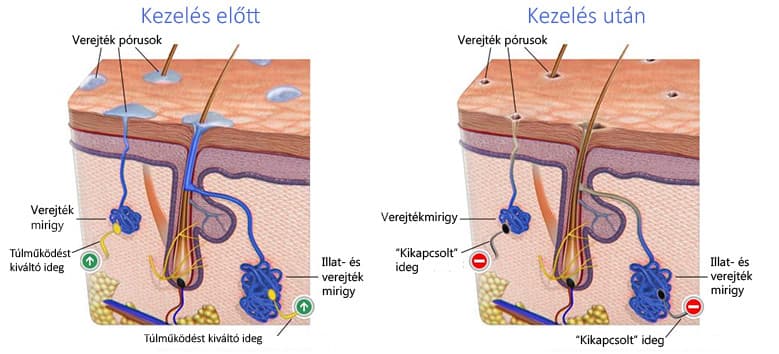
Treatment with the appropriate frequency and intensity of current "separates" the connection between the sweat glands and the autonomic nerves that give them faulty instructions. Thus the sweating generated by the faulty nerve function ceases.
A two-week course can stop sweating for weeks or at least significantly reduce it. Importantly: it succeeds in almost all cases!
What is tap water iontophoresis?
To better understand iontophoresis, let's define the word itself.
- Ion = an electrically charged molecule
- Phoresis = a process in which, under the effect of an electrical direct current, charged particles migrate in electrically conductive electrolyte fluids. Positive ions (cations) migrate toward the negatively charged cathode, while negative ions (anions) migrate toward the positive side, the anode.
- Iontophoresis = moving ionized (electrically charged) particles with the help of an electric current
Iontophoresis is a form of electrotherapy in which a mild electric current is passed through the affected body area (hand, foot, or underarm). The current "carries" electrically charged particles present in the water and delivers them into the body.
The most accepted theory is that this inhibits sympathetic nerve transmission, effectively "switching off" the sweat glands. It neutralizes the signal between the nerves and glands, thereby reducing or completely blocking sweat formation in the treated area. Other theories suggest that iontophoresis causes occlusion of the sweat gland — deposition of ions during treatment creates a temporary "plug" in the sweat glands.
In the end, regardless of the exact mechanism, the treatment can produce excellent results.
Important information before treating sweating
- Only perform iontophoresis if there are no contraindications. These are the same reasons to consider as for other electrotherapy treatments. Follow the device manufacturer's instructions and recommendations.
- It is important to know that you may feel a mild tingling sensation during iontophoresis.
- You should also know that the electric current used in iontophoresis is not strong enough to cause any harm.
- Do not use iontophoresis during pregnancy, if you have a pacemaker, heart disease, or epilepsy. If you are unsure, ask your treating physician.
- Remove jewelry such as rings and bracelets before iontophoresis treatment.
- If you have a wound or scratch on your skin, apply petroleum jelly before treatment to protect the wound from maceration. Petroleum jelly interferes with iontophoresis, so use it only where and as much as necessary.
- The treatment may cause mild redness of the skin. This disappears within a few minutes. If it does not, ask your treating physician for advice.
- If it excessively dries your skin, use a moisturizing lotion after the treatment.
What determines effectiveness?
Primarily the waveform of the current applied by the device.
The best results are expected from devices specifically designed to treat abnormal sweating (e.g., the Dermadry device), which use so-called pulsed current (continuous alternation of current/on and off periods).
There are home electrotherapy units that, in addition to pain relief TENS and muscle stimulation (EMS) programs, also provide iontophoresis using a constant (non-pulsed) current. Such devices are intended for joint complaints. This older type of iontophoresis method is 40–50% less effective in treating sweating than devices providing pulsed current.
What water should you use?
Use plain tap water for the treatment! Water quality may vary by location. If the water is too soft, iontophoresis may be ineffective. Soft water does not contain enough minerals or electrolytes (tiny electrically charged particles). DO NOT use softened water!
If the effect of tap water treatment is mild, try the following:
- Add one teaspoon of baking soda to the water for each treatment.
- According to some clinicians' experience, salty water can have a stronger effect — add a quarter of a teaspoon (about 1 gram) of table salt to the water and perform the treatment that way.
Although purchasing a a device specialized for abnormal sweating treatment may seem expensive, you can quickly see that since the device lasts for many years (even decades), you can treat sweating without further costs. Excessive sweating often runs in families, meaning almost every family member may be affected. The iontophoresis device can even be used by all family members.
Treating hand and foot sweating with iontophoresis
The treatment procedure is essentially the same with both pulsed-current and traditional iontophoresis devices. Here are the steps.
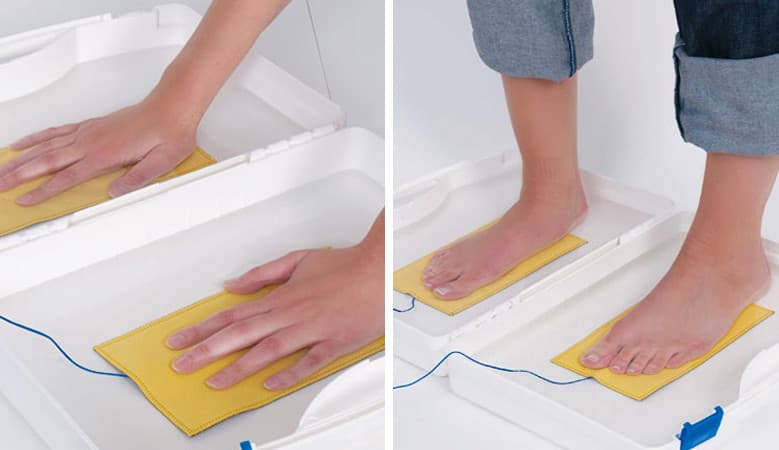
- Take out the device, the iontophoresis kit, and two plastic basins (large enough to fit your hand or foot).
- Fill the basin with a half-centimeter layer of water. The hand or foot should just touch the water!
- Connect the electrode-cable-device.
- Place one sponge-electrode in one basin and the other in the other basin.
- Place both hands or both feet on the sponges/electrodes.
- Start the device. Run the iontophoresis program at a current intensity you can tolerate without pain.
Treating underarm sweating with iontophoresis

- Connect the electrode-cable-device.
- Moisten the sponges and place one in your right and the other in your left underarm. Keep your arms close to your torso for the duration of the treatment.
- Start the device. Run the iontophoresis program at a current intensity you can tolerate without pain.
How often should you perform tap water iontophoresis?
The treatment has two phases: the intensive (symptomatic) and the maintenance phase. In the symptomatic phase you suppress symptoms with intensive (daily) treatment, then after symptoms subside you maintain the achieved state with less frequent but regular treatments. Over time sweating may return and you can switch back to more intensive treatment.
The required frequency in the symptomatic phase depends on the severity of hyperhidrosis.
- Mild: 3–5 times per week for 1–2 weeks.
- Moderate: 3–5 times per week for 2–3 weeks.
- Severe: 3–5 times per week for 4–6 weeks.
With the Dermadry device the treatment takes only 15 minutes (underarm) and 20 minutes (hands and feet).
Once you reach the desired level of dryness, the frequency of treatments can be reduced, but ongoing treatments are still necessary to maintain results.
- Mild: once a week for another 2–3 weeks
- Moderate: once a week continuously
- Severe: 1–3 times per week continuously
Is tap water iontophoresis effective?
An increasing number of clinical trials demonstrate the effectiveness and safety of tap water iontophoresis in treating hyperhidrosis. In most studies, a two-week application yields a success rate around 90%, meaning almost every treated patient reports a beneficial effect.
Studies consistently show that tap water iontophoresis is a simple, safe, economical, and effective treatment option for hyperhidrosis. It is worth trying when simpler and cheaper antiperspirant agents and cosmetics do not yield satisfactory results.
Tap water iontophoresis should definitely be considered before botox injections, surgical interventions, or long-term prescription medications.
It is a natural, drug-free, needle-free, and non-invasive treatment option that provides long-term results. It effectively treats various degrees of hyperhidrosis, from mild to severe cases.

