
Home treatment of the post-thrombosis condition
After an episode of thrombosis you are never quite “the same” again! The disease always ends in a “residual condition” that you must live with for the rest of your life. This is the post-thrombosis condition, medically called post-thrombotic syndrome. Keeping symptoms under control and, above all, preventing recurrence of thrombosis is in your hands. You must care for it every day, continuously. Let’s review your options.
What is the residual condition?
Thrombosis is an occlusion of a vessel. For some reason blood clots in the vessel (most often in a vein) and blocks it.
When this happens it causes severe pain, and you are usually admitted to hospital quickly where "blood thinners" (anticoagulants) and other treatments are started.
If you are fortunate and the blood clot does not dislodge, you will not suffer an embolism, but that does not spare you the consequences.
The clot constantly changes: part of it is gradually absorbed, and part of it is replaced by connective tissue. By about day 90–120 after the thrombosis the process becomes permanent.
How many symptoms remain depends on many factors: the size of the thrombus (blood clot), how quickly treatment began, and how your coagulation and regeneration systems work.
One thing is certain: blood circulation in the affected leg will never be the same as before the thrombosis. Therefore you must live with various symptoms for the rest of your life!
How much suffering it causes depends on what you do to treat the post-thrombosis condition (post-thrombotic syndrome).
What symptoms can occur?
You can see almost everything on this picture:
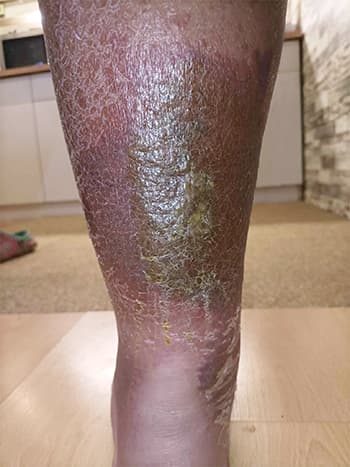
- the affected limb is swollen
- you experience a tight, aching pain and a “heavy leg” sensation
- the skin becomes brownish-purple-reddened
- the skin dries, cracks and a yellowish discharge (lymph) may leak from it
- in more severe cases a non-healing wound (ulcer) may develop
Goals of home treatment for the post-thrombosis condition
- prevent recurrence and repetition of thrombosis
- reduce the symptoms of the residual condition
Products for home treatment of the post-thrombosis condition
Treatment of deep vein thrombosis in the acute phase is a hospital task. At home, the task is to prevent
recurrence and reduce chronic complaints (e.g. edema).
Ways to prevent thrombosis recurrence
If you have already had a thrombosis, the risk of recurrence is significant. You must pay attention to yourself for the rest of your life. It is much easier to prevent thrombosis than to treat it!
- Take the medications prescribed when you left the hospital regularly.
- Some anticoagulant drugs must be dosed so that your blood’s "coagulability" is kept at a certain level. The required dose depends on the current blood test results. Your body’s need for medication can change from time to time, so regular monitoring is necessary. With newer and of course more expensive drugs, frequent monitoring may not be required.
- Never change the dosage of your medication on your own, do not take more or less than prescribed unless you have discussed it with your doctor!
- Attend regular laboratory check-ups. It is usually worth checking the effect of the medications monthly or every two months. Discuss the results with your treating physician.
- Generally you will be taking "blood thinners" (anticoagulants), and overdosing can cause bleeding tendency. You may notice spontaneous gum bleeding, prolonged bleeding after even a small needle prick, or bruising after bumping into furniture.
- Exercise daily. This is the best medicine. Walking 60–70 minutes a day, jogging, or cycling (even in several sessions) can work wonders! Do not underestimate the importance of movement!
- If you take a long car, bus or plane trip, stop or stand up and walk a little every half hour. This helps move blood in your legs.
- If you have not done so yet, finally stop smoking!
- If applicable, stop taking oral contraceptives and switch to another method of contraception.
- If you are overweight, change your diet and lose a few kilograms. Note that regular exercise is the best and most effective weight-loss method.
- Anticoagulant therapy after thrombosis is usually needed for at least 3–6 months. It is the treating physician’s task to decide whether it is needed beyond that. If you make no changes (e.g. do not lose weight, do not quit smoking, do not exercise), the drugs may “stick to you”, meaning you may never be able to stop taking them. If you reduce the number of your risk factors, you have a chance to discontinue them.
Regular physical activity is the main treatment after thrombosis!
Veins lace your entire body. They collect the used blood from your body and return it to the heart, from where it goes to the lungs to pick up fresh oxygen. The arteries then bring that oxygenated blood back to your organs.
Superficial veins collect and transport blood from the skin, mucous membranes and areas close to the body surface. They do not run directly back to the heart on the surface, but join the thick deep veins that run between the tissues. These large "channels" head toward the heart.
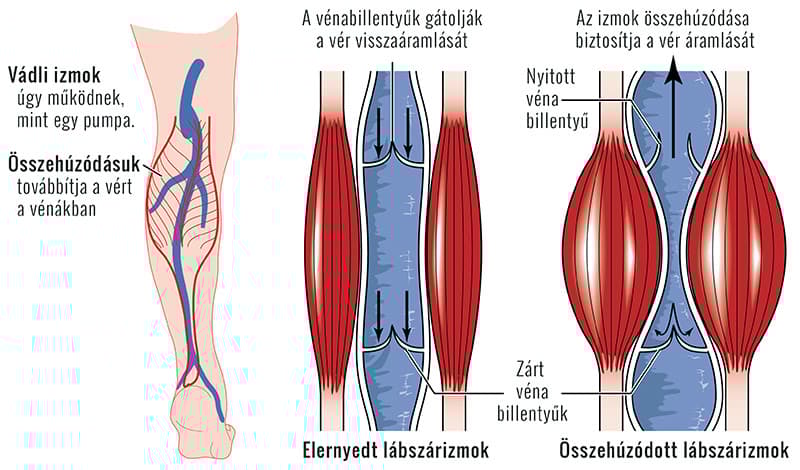
Blood in the veins moves when the muscles around them contract and squeeze the blood out. The muscle pump always pushes the blood toward the heart because the valves in the veins allow flow only in that direction.
For all these reasons regular physical activity is the "engine" of venous circulation; without movement blood does not flow and is prone to clotting and thrombosis formation.
I'm not saying you should take up competitive sports! Regular walking is sufficient. If your condition only allows you to walk a few times around the room, do that, but do it several times daily!
If, however, you are able, jog or cycle. Regularly, i.e. at least 3–4 times a week, and for at least an hour each time (more is better!).
What can you do at home?
If you have had a thrombosis and are physically able to exercise, movement is your main medicine! Never stop it.
However, if you cannot exercise enough, use a home medical device to reduce your symptoms.
Be sure to use a home medical device to improve the post-thrombosis condition if
- you are unable to move because of paralysis or muscle weakness
- you cannot perform active movement due to another condition or illness
- you cannot move enough because of significant overweight
- you cannot move temporarily after surgery
- you cannot move because of joint pain or injury
- you are taking a long trip
In the post-thrombosis condition, treatments aim to stimulate venous blood flow in your leg.

