
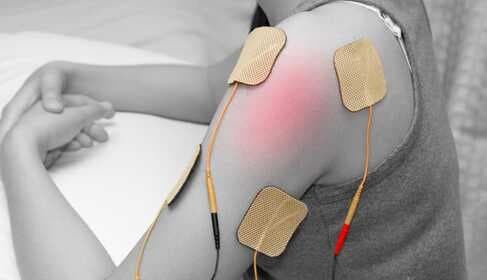

 Mi az interferenciális kezelés, és miben különbözik a TENS-től?
The principle of the method is that two currents with slightly different frequencies "meet" in the tissue and interfere, producing a lower modulation frequency (AMF, beat frequency) — typically in the 1–150 Hz range. This low-frequency component is responsible for the analgesic and muscle-stimulating effects, while at the surface only the higher (less perceptible) carrier frequency is present.
I briefly introduced interferential current in the article on electrotherapy methods; a detailed comparison with TENS is discussed in the TENS article. This article focuses specifically on the mechanism, indications and practical application of interferential current.
 Key point
According to recent clinical evidence, interferential therapy is a complementary modality: a 2023 meta-analysis of 13 RCTs (n=1367) [2] found moderate-quality evidence that IF reduced pain (NPRS −1.57 points) and functional limitation (−1.51 points) compared to placebo in chronic, non-specific low back pain. A 2025 network meta-analysis [6] evaluating six modalities ranked IF among the top 3 physiotherapy modalities for neck pain rehabilitation (after HILT and ESWT). Alone it is rarely the most effective choice — it is typically part of a comprehensive physiotherapy package (exercise, manual therapy, training).
 How does interferential current work?
The 2022 narrative review by Rampazo & Liebano [1] describes three main mechanisms that explain IFC's analgesic and therapeutic effects:
An IF device delivers currents on two channels with slightly different frequencies, e.g. 4000 Hz and 4100 Hz. In the tissue these currents cross and interfere, producing a 100 Hz modulation (AMF – amplitude modulation frequency, or "beat frequency"). This low-frequency component exerts the actual analgesic and muscle-stimulating effect. The user perceives only the high (4 kHz) carrier at the surface, which is more comfortable and causes less skin irritation than the classic TENS tingling.
Skin resistance is frequency-dependent: low-frequency current (TENS, 2–150 Hz) encounters higher skin resistance than medium-frequency current (IF, 4 kHz). The 2022 review [1] states that the 4 kHz carrier reduces skin resistance, allowing the current to reach deeper tissue layers — muscles, joints, fasciae. Therefore IFC is especially suitable for treating deep structures (e.g. hip joint, lumbar paraspinal muscles, knee joint). Important: "deeper penetration" does not automatically mean "greater effectiveness" — the 2022 systematic review by Hussein [3] found that IF alone was favorable, but not significantly better than TENS or laser.
The modulation frequency in the 100 Hz range stimulates peripheral nerve fibres and reduces transmission of pain signals to the central nervous system at the level of the gate control theory. At lower beat frequencies (1–10 Hz) the endogenous opioid (endorphin) system is likely activated, similar to endorphin-type TENS. The precise molecular mechanisms require further research [1], and in clinical practice precise beat-frequency adjustment does not always affect outcomes — therefore most factory IF programs use an automatic "sweep" within a given AMF range.
 For which complaints is interferential therapy effective?
Clinical evidence from 2020 onwards has demonstrated measurable contributions to standard care in the areas below. In all cases IF is used in a supporting role — alongside medical diagnosis and treatment planning:
A 2023 meta-analysis [2] (13 RCTs, total 1367 participants) reported that IF therapy, based on moderate-quality evidence, was superior to placebo for immediate post-treatment improvement in pain intensity (mean NPRS reduction −1.57 points) and functional limitation (Roland-Morris −1.51 points). Important: the effect was not significant at mid- and long-term follow-up (3–6 months). A 2024 RCT [4] in fighter pilots found that a core-exercise + IF combination produced significantly greater improvement after 12 weeks than either method alone. A 2022 study [5] comparing TENS and IF in 33 participants found both methods reduced pain with no clear superiority of either.
A 2025 network meta-analysis [6] (34 RCTs, 2141 patients with neck pain) ranked six different physiotherapy modalities. IF was among the TOP 3 most effective methods (behind HILT and ESWT), outperforming TENS, laser and therapeutic ultrasound. Important: ranking does not mean IF is always the first choice — individual patient characteristics, costs, availability and personal preference also matter.
The 2022 narrative review by Rampazo [1] reported that most studies on knee osteoarthritis showed a significant analgesic effect for IF. Important context: osteoarthritis is multifactorial, with exercise programs, weight control, NSAIDs and, in severe cases, joint replacement as main pillars. IF can contribute to pain relief but does not regenerate cartilage and does not replace basic care.
A 2022 systematic review and meta-analysis [3] (35 trials, 19 included in meta-analysis) found that IF alone was better than placebo for reducing chronic musculoskeletal pain. However: when IF was added to standard physiotherapy it was not significantly better than standard physiotherapy + placebo. Similarly, comparisons with other individual modalities (laser, TENS, cryotherapy) showed no significant differences. This suggests IF is one of several effective options but does not necessarily outperform others.
The 2022 review [1] found significant analgesic effects for IFC in postoperative knee pain (e.g. after TKA). The 2020 multidisciplinary clinical practice guideline [7] lists IF among recommended non-pharmacological modalities for chronic musculoskeletal pain. Important: for postoperative use always consult the treating physician about the appropriate start time and electrode positions — fresh wounds, sutures and surgical materials require special considerations.
Typical IF protocol parameters
Protocol parameters used in recent clinical trials [1][2][4] are listed below. Home devices come with built-in programs — factory settings are usually a good starting point:
| Parameter | Range | Note |
|---|---|---|
| Carrier frequency | 4 kHz (2 or 2.5 kHz also used) | standard 4 kHz; subjectively less perceptible |
| AMF (beat frequency) | 1–150 Hz | 80–150 Hz for analgesia; 20–50 Hz for muscle stimulation |
| Sweep mode | usually active | AMF automatically varies within a range to reduce habituation |
| Current intensity | raised to pleasant tingling | typically 10–60 mA; reduce if painful |
| Treatment time | 15–30 minutes | 15 min/session was most common in clinical trials [4] |
| Frequency | 2–5 times/week | Pilot fighter study [4]: 5x/week for 12 weeks |
| Program period | 4–12 weeks | meaningful improvement appears after 3–4 weeks |
| Electrode arrangement | 4 electrodes, cross pattern | quadripolar; the two channels cross over the center of the painful area |
| Electrode distance | 5–15 cm | depends on the size of the painful area |
Key point – electrode arrangement
IF typically uses 4 electrodes (two channels × 2 electrodes) in a cross formation: the two channels intersect at 90° above the center of the painful area. The currents interfere at this center so that maximum modulation occurs precisely in the deeper tissue layer to be treated. Dual-channel devices (e.g. home units) are adequate for basic tasks, while 4-channel professional devices allow more precise current direction control.
Home devices with an interferential (IF) program
The IF function is not available in all TENS/EMS devices — a special quadripolar output and AMF control are required. In the Medimarket portfolio the following devices include a factory IF program:
- Globus Genesy 3000 – 4-channel multifunction device with factory TENS, EMS and IF programs.
- Globus Genesy 1500 – 4-channel multifunction device with factory TENS, EMS and IF programs.
- TensCare UniPro – compact 2-channel device with simplified IF protocols.
For electrodes we recommend adhesive square electrodes (50×50 mm); a 4-channel IF setup requires 4 electrodes.
Interferential vs. TENS – when to choose which?
Recent evidence indicates both methods can be effective, but with different strengths:
| Feature | TENS | IF |
|---|---|---|
| Carrier frequency | 2–150 Hz (low) | 4 kHz (medium) |
| Skin sensation | perceptible tingling | finer, less tingling |
| Penetration depth | superficial–medium | deeper tissues |
| Number of electrodes | 2 pcs | 4 pcs (quadripolar) |
| Best indication | superficial neuralgia, localized pain | deep muscle pain, joint complaints |
| Evidence in low back pain | moderate | moderate [2] |
| Home simplicity | simple (2 electrodes) | a bit more complex (4 electrodes) |
Detailed methodological comparison: TENS main article. For complex disc-rehabilitation: muscle stimulation and physiotherapy in disc herniation rehabilitation.
 When is interferential therapy NOT recommended?
General electrotherapy contraindications also apply here. Details can be read in the electrical treatment contraindications and electrical treatment and implants articles.
- PACEMAKER, ICD, implanted neurostimulator – only with cardiologist/arrhythmologist approval.
- PREGNANCY throughout the entire period, especially over the abdomen and lumbar region — due to blood and fetal safety concerns.
- Active malignant tumor at the treatment site or undergoing active tumor therapy.
- Acute inflammation with fever or inflammation of unknown origin — medical evaluation first (exclude septic arthritis).
- Active venous thrombosis (DVT) at the treatment site — risk of embolization.
- Fresh skin wound, extensive eczema, skin infection on the electrode area.
- Carotid sinus / anterior neck region — do not place electrodes near the carotid artery.
- Chest / over the heart — risk of rhythm disturbances.
- Cranial vault, temporal, periorbital area, throat — not to be applied to these regions.
- Epilepsy with poorly controlled medication — individual assessment required.
- Severe sensory disturbance at the treatment site — makes safe intensity regulation difficult.
- Metal implant directly under the electrode — risk of electrical heating.
For new, worsening or unexplained symptoms, always seek medical consultation before starting IF treatment on your own.
Frequently asked questions about interferential therapy
TENS uses low-frequency current (2–150 Hz) that stimulates superficial sensory nerves; the user feels distinct tingling. IF uses a higher (4 kHz) carrier frequency, which encounters less resistance through the skin and can penetrate deeper, and in a quadripolar (4-electrode) arrangement the two channel currents interfere in the deep tissue, producing the low modulation frequency there. At the surface IF sensation is finer, less tingling, and can cause less skin irritation during longer treatments.
A single treatment can produce mild pain reduction (short-term analgesia). Sustained effect typically requires 3–4 weeks of regular treatment — the 2023 meta-analysis [2] found clinically meaningful improvement immediately after treatment, but the effect diminished at mid- and long-term follow-up (3–6 months). The 2024 fighter-pilot trial [4] achieved significant functional improvement with a 12-week program (5x/week).
No — it complements them. Recent reviews [1][2][3] position IF as a complementary modality. Decisions about tapering, reducing or changing analgesic medication are exclusively the responsibility of the treating physician. The 2020 clinical guideline [7] also mentions IF as part of a comprehensive physiotherapy package.
Alone it has limited effectiveness. The 2022 Hussein meta-analysis [3] found that IF combined with standard physiotherapy was not significantly better than standard physiotherapy + placebo. However, the 2024 fighter-pilot study [4] showed that IF + core muscle training reduced pain more than either method alone. The most effective approach is a comprehensive package: physiotherapy, exercise, manual therapy + IF/TENS.
IF uses 4 electrodes in a cross pattern: the two channels intersect at 90° above the center of the painful area. A 5–15 cm distance between electrodes is recommended. The two channel currents interfere precisely in the depth of the treatment area, producing maximum effect there. With 2-channel (home) devices you can also use simpler bipolar setups, but the classic quadripolar arrangement offers more precise deep tissue targeting.
Generally no — only with cardiologist/arrhythmologist approval. Any electrical treatment near active implants (pacemaker, ICD, neurostimulator) can cause interference. Metal implants (screws, plates, joint prostheses) directly under an electrode should also be avoided (risk of electrical heating). Detailed considerations are in the electrical treatment and implants article.
 Summary – interferential therapy in brief
What every IF-interested person should know
- Interferential current (IF) works with a 4 kHz carrier + 1–150 Hz beat frequency — sensation at the surface is finer and it penetrates deeper than TENS.
- Moderate-quality evidence [2]: in chronic low back pain IF produced significant immediate pain and functional improvement versus placebo (but long-term effect decreases).
- The 2025 neck pain network meta-analysis [6] ranked IF among the TOP 3 effective modalities.
- It has limited effectiveness when used alone — part of a comprehensive physiotherapy package (physiotherapy, exercise, manual therapy).
- Typical protocol: 4 kHz carrier + 80–150 Hz AMF, 15–30 min, 3–5x/week, 4–12 weeks.
- 4 electrodes in a cross (quadripolar) arrangement over the center of the painful area.
- IF devices: Globus Genesy 600 (4-channel), Genesy 1500 (2-channel), TensCare UniPro (compact).
- Contraindications (pacemaker, pregnancy, tumor, acute fever, DVT, metal implant) must be strictly observed.
Scientific sources (2020+)
Reference numbers [1]–[7] in the article correspond to the following studies (order = ol-list order):
- Rampazo ÉP, Liebano RE. Analgesic Effects of Interferential Current Therapy: A Narrative Review. Medicina (Kaunas). 2022;58(1):141. PMID: 35056448.
- Rampazo ÉP, Júnior MAL, Corrêa JB, de Oliveira NTB, Santos ID, Liebano RE, Costa LOP. Effectiveness of interferential current in patients with chronic non-specific low back pain: a systematic review with meta-analysis. Brazilian Journal of Physical Therapy. 2023;27(5):100549. PMID: 37801776.
- Hussein HM, Alshammari RS, Al-Barak SS, Alshammari ND, Alajlan SN, Althomali OW. A Systematic Review and Meta-analysis Investigating the Pain-Relieving Effect of Interferential Current on Musculoskeletal Pain. American Journal of Physical Medicine & Rehabilitation. 2022;101(7):624-633. PMID: 34469914.
- Zuo C, Zheng Z, Ma X, Wei F, Wang Y, Yin Y, Liu S, Cui X, Ye C. Efficacy of Core Muscle Exercise Combined with Interferential Therapy in Alleviating Chronic Low Back Pain in High-Performance Fighter Pilots: A Randomized Controlled Trial. BMC Public Health. 2024;24(1):700. PMID: 38443845.
- Tella BA, Oghumu SN, Gbiri CAO. Efficacy of Transcutaneous Electrical Nerve Stimulation and Interferential Current on Tactile Acuity of Individuals With Nonspecific Chronic Low Back Pain. Neuromodulation. 2022;25(8):1403-1409. PMID: 34405486.
- Hao J, He Z, Huang B, Li Y, Remis A, Yao Z, Tang Y, Sun Y, Wu K. Comparative effectiveness of six biophysical agents on neck pain rehabilitation: a systematic review and network meta-analysis. European Spine Journal. 2025;34(6):2183-2200. PMID: 40244434.
- Hawk C, Whalen W, Farabaugh RJ, Daniels CJ, Minkalis AL, Taylor DN, et al. Best Practices for Chiropractic Management of Patients with Chronic Musculoskeletal Pain: A Clinical Practice Guideline. Journal of Alternative and Complementary Medicine. 2020;26(10):884-901. PMID: 32749874.

This article is for general information and does not replace personal medical consultation. Interferential therapy is a complementary modality; it does not replace a comprehensive physiotherapy package (physiotherapy, exercise, manual therapy), baseline pharmacotherapy or surgery when indicated. Contraindications (pacemaker, pregnancy, tumor, acute fever, DVT, metal implant) must be strictly observed. The devices presented are CE-certified medical devices; the referenced clinical trials used different devices and protocols. Individual results may vary. For new, worsening or unexplained symptoms consult your treating physician or physiotherapist.

