Rehabilitation after cruciate ligament rupture
An anterior cruciate ligament (ACL) rupture is one of the most common injuries among athletes. For them, proper rehabilitation is particularly important so they can return to competition as soon as possible (without an increased risk of re-injury). For non-athletes, rehabilitation is important to preserve muscle strength and to rebuild muscles so the knee can be fully functional as quickly as possible.
Consequences of cruciate ligament rupture
Of course, the cruciate ligament does not only tear in professional athletes! In fact, recreational sports (e.g., skiing, casual football and basketball, trail running, tennis) or a car accident can also cause a cruciate ligament injury.
In such cases you have two paths ahead of you: surgery, or strengthening the thigh muscles to such an extent that they take over the role (or part of the role) of the anterior cruciate ligament.
Whichever route you take, your rehabilitation will take several months. Muscle wasting begins during the immobilization following the injury, since you can only partially or not at all load the limb. Within 2–3 weeks you may notice a decrease in muscle mass and strength (compared to the uninjured side).
Physiotherapy and its importance
Physiotherapy’s role is to improve range of motion and movement coordination, and to regain muscle strength and mass.
Find a physiotherapist before the surgery who will help you prepare for the operation and, even more importantly, direct your postoperative rehabilitation. Physiotherapy is not the few minutes a day you might get on the hospital ward! The physiotherapist will show you a few exercises that you must perform multiple times a day on your own. Not just for 5 minutes—although that may be all you can manage at first—but for gradually increasing durations and intensity.
You can improve the effectiveness of physiotherapy with simple tools. One such device is the Knee Pulley, which helps increase the knee’s range of motion.
It is a very effective product for preventing knee injuries and aiding recovery. It plays an important role in postoperative rehabilitation, but is also useful for mobilizing a knee that has been immobilized for a long time. The device can be mounted on any door frame; a special anchor secures it to the door without damaging it.
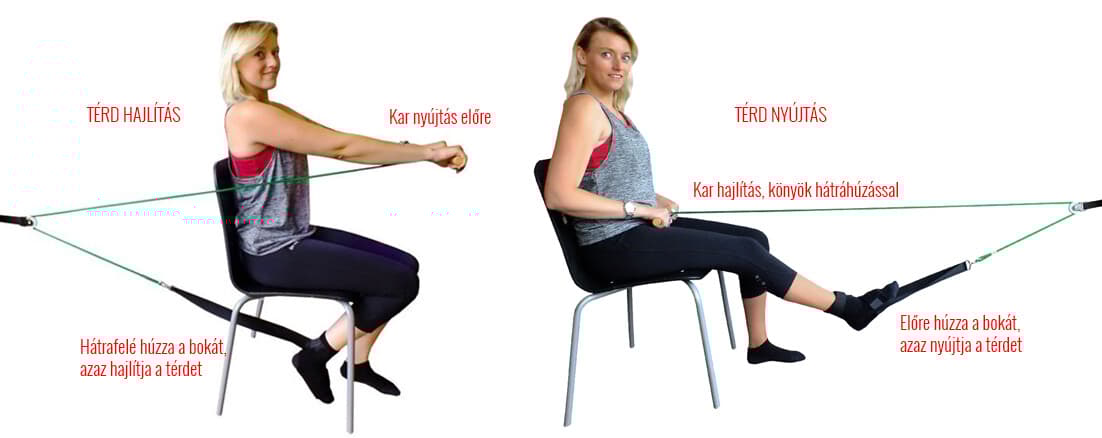
Use it while sitting on a chair. Place your foot in the ankle strap. Pull the handle, which produces a rotating movement at the knee, improving the range of motion. The ankle strap helps keep your foot in the correct position. The rope length can be adjusted at the handle.
Elastic bands and loop bands are also useful aids. Perform your exercises with their help. Moving against the resistance of the band accelerates strength recovery. Click here to find resistance strengthening devices.
Supporting rehabilitation
The success of rehabilitation is determined by when and to what extent you regain the muscle mass and strength of the operated limb. Only then can you perform physiotherapy—that is, the functional exercises—effectively!
An electrical muscle stimulator plays a key role in this. Unfortunately, you receive very little information about it. ACL operations today usually require only a 1–2 day hospital stay. You get home quickly. But this is not the end! This is actually when your months-long rehabilitation should begin. This, of course, is not the hospital’s task but partly the rehabilitation clinic’s and above all yours. If you do not do the exercises and do not undergo muscle stimulation treatments, your recovery will be only partial. You will notice that your knee is unstable, that returning to your previous physical activity seems “hopeless,” and you stop exercising, which further worsens the situation.
The role of muscle stimulation
Numerous scientific studies have examined the role of muscle stimulation in rehabilitation and the results are convincing. Those who used muscle stimulation in their rehabilitation achieved significantly greater muscle strength and smaller differences in strength between the two legs than those who did not use stimulation.
In elite athletes treatments usually begin 2–3 days after surgery; for average people it is common a few days later (5–7 days). One condition must be met before starting stimulation: the knee joint must reach full extension.
To protect the replaced ligament from injury, use the muscle stimulation “passively” in the first days—so that no movement occurs at the joint. Later (depending on condition, from about day 10–14) stimulation can be combined with active movements (e.g., straight leg raises, later knee bends and extensions, and then cautiously standing knee bends).
Recovery is more effective if you use muscle stimulation in the period from the injury to the surgery as well. It matters how much muscle mass you have to lose during the postoperative inactivity. If your thighs are strong before surgery, rehab starts from a better position despite the loss.
You may be wondering how to use muscle stimulation?
Which muscles receive the stimulation depends on the correct placement of the electrodes. In the case of an anterior cruciate ligament rupture you should focus on the quadriceps and the hamstrings.
You must first improve the endurance that provides stability, then gradually incorporate strength-building and some hypertrophy programs into the treatments. It is a mistake to perform only hypertrophy programs, because these strengthen different muscle fibers than those important for joint stability!
I have prepared a recommendation for strengthening the quadriceps. You can perform the daily program at least once, but even 2–3 times a day (as your time allows). If possible, treat yourself daily, but at least 4–5 days each week. Try to increase the current intensity within each session and also from session to session. The course duration is 8–12 weeks!
Research shows that muscle stimulation is more effective if you perform exercises during the treatment. Initially, exercises performed lying down with straight legs are permitted; later these can be replaced by standing up from a chair and squats. Introduce those at the earliest from the third week of your program.
For functional exercises, wireless muscle stimulators are more convenient to use than cabled devices.
Electrical muscle stimulation and post-ACL surgery rehabilitation
Electrical muscle stimulation is a fundamentally important tool in cruciate ligament rehabilitation, as it has been shown to restore muscle strength quickly and effectively. Muscle stimulators are now affordable and can be obtained for home use.
It is worth seeing a physiotherapy professional who will show you how to use the device, how to place the electrodes, and will help ensure you perform the correct tasks at the right frequency and intensity.
You can find the quadriceps strengthening “training plan” here. Follow its instructions.